Service Support — AI Visibility
The AI Visibility Audit We Run Before Anything Else
An AI visibility audit tests real prompts across ChatGPT, Perplexity, Gemini and AI Overviews to find exactly why your business isn't being cited yet.
An AI visibility audit is a structured check of whether ChatGPT, Perplexity, Gemini and Google’s AI Overviews mention or cite your business when someone asks the questions your buyers actually ask — and if they don’t, exactly why. It’s the first thing we run on every new account, before a single sentence of content gets written, because fixing pages without knowing where they stand is guesswork with a client’s budget attached.
Key takeaway
- The audit runs real buyer prompts across ChatGPT, Perplexity, Gemini and AI Overviews — not one generic question typed once into one tool.
- Every result is logged per engine and per prompt, because a site can be well cited in one engine and completely absent in another.
- The output is a ranked, page-level action list — not a visibility “score” that sounds precise but doesn’t tell anyone what to fix.
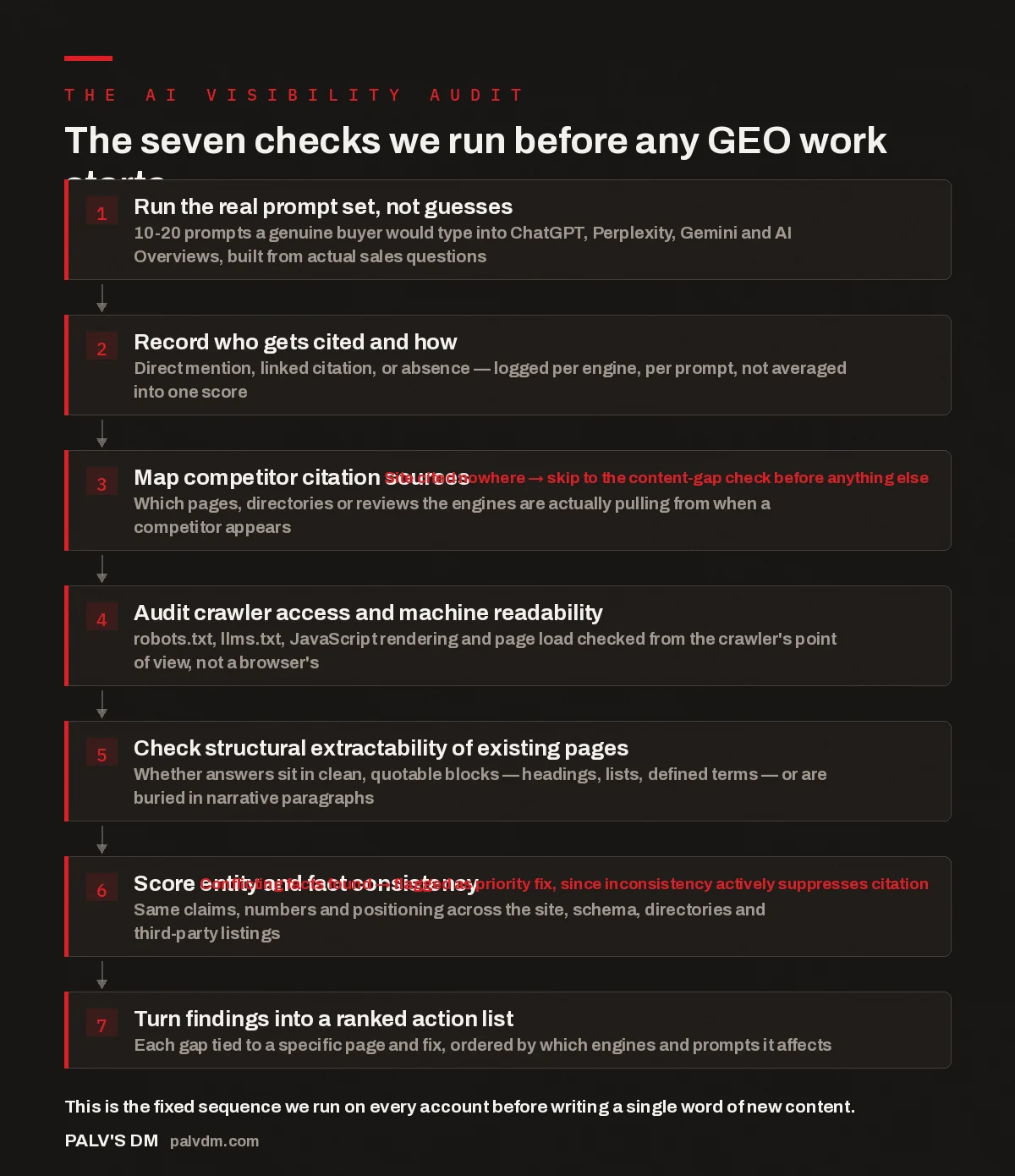
The seven checks we run before any GEO work starts
- Run the real prompt set, not guesses. 10-20 prompts a genuine buyer would type into ChatGPT, Perplexity, Gemini and AI Overviews, built from actual sales questions.
- Record who gets cited and how. Direct mention, linked citation, or absence — logged per engine, per prompt, not averaged into one score.
- Map competitor citation sources. Which pages, directories or reviews the engines are actually pulling from when a competitor appears. Site cited nowhere → skip to the content-gap check before anything else
- Audit crawler access and machine readability. robots.txt, llms.txt, JavaScript rendering and page load checked from the crawler’s point of view, not a browser’s.
- Check structural extractability of existing pages. Whether answers sit in clean, quotable blocks — headings, lists, defined terms — or are buried in narrative paragraphs.
- Score entity and fact consistency. Same claims, numbers and positioning across the site, schema, directories and third-party listings. Conflicting facts found → flagged as priority fix, since inconsistency actively suppresses citation
- Turn findings into a ranked action list. Each gap tied to a specific page and fix, ordered by which engines and prompts it affects.
Why does an AI visibility audit come before any GEO work?
Because “improve AI visibility” isn’t one task — it’s a bundle of different fixes, and the wrong one wastes months. A site invisible because crawlers can’t render its JavaScript needs an engineering fix. A site that renders fine but never gets cited because its content is buried in unstructured paragraphs needs a content rewrite. A site cited correctly in Perplexity but never in ChatGPT needs a different diagnosis again, since each engine sources content differently. Without an audit, all three look identical from the outside: “we don’t show up in AI search.” The audit is what separates them.
The pattern that shows up repeatedly is that clients arrive convinced they know the cause — usually “we need more content” — when the actual blocker is structural: a stale robots.txt rule, a JavaScript-rendered pricing page a crawler never sees, or facts that contradict each other across the site and third-party listings.
How do you actually test AI visibility?
You test it the same way a buyer would use it — by asking real questions and reading the real answers, engine by engine.
- Build the prompt set from sales reality, not keyword tools. We pull from questions a sales or support team actually hears — “is [category] worth it for a business my size,” “who does [service] in [city],” “[competitor] vs [alternative]” — closer to how people query AI assistants than short keyword phrases are.
- Run every prompt in every major engine. ChatGPT, Perplexity, Gemini, and AI Overviews pull from different sources and weight them differently, so a prompt that surfaces you in one can return nothing in another. Testing one engine and generalising from it is the most common DIY-audit mistake.
- Log the exact form of every mention. Not “visible: yes/no” but the specific behaviour — named and linked, named without a link, described without being named, or absent while a competitor appears. Each needs a different fix.
- Repeat prompts to check consistency. AI answers aren’t static; the same prompt can return different results on different runs. One pass tells you what happened once. Several passes over the audit window tell you what’s stable enough to act on.
This step alone usually takes longer than clients expect — it’s the one most templated “AI SEO audit” tools skip, which is why their output tends to be a generic score rather than a defensible diagnosis.
What does the technical side of the audit check?
Prompt testing tells you what’s happening; the technical check tells you why. Three things matter most.
Crawler access. We check robots.txt and, where relevant, llms.txt for rules that block or throttle known AI crawler user-agents — often left over from a blanket “block all bots” rule written before AI crawlers existed as a category. We also check whether crawlers that can access the site can actually render it, since a page depending on client-side JavaScript for its core content can be functionally invisible to a crawler that only reads the initial HTML response.
Structural extractability. AI engines favour content they can lift cleanly — a defined term, a numbered list, a direct answer in the first sentence. A page answering the same question but wrapped in three paragraphs of scene-setting before the point is harder to cite, even if accurate. We go page by page on the site’s most commercially important content and note where the actual answer is buried.
Entity and fact consistency. AI engines cross-reference multiple sources before treating a claim as reliable enough to repeat. If your website says one thing, your Google Business Profile says something slightly different, and a directory listing says a third thing — different founding year, service area, or pricing model — that inconsistency is itself a reason engines hedge or skip you.
Most sites that think they have a content problem actually have a consistency problem. An AI engine won’t confidently cite a business whose website, listings, and schema can’t agree on the same facts.
Palash, Founder, PalV’s DM
How do competitors factor into the audit?
Every prompt that returns a competitor instead of you is a source, not just a disappointment. When an AI engine cites a competitor, we trace where that citation likely comes from — their own site, a comparison article, a review platform, an industry directory — because that source is doing work your content isn’t doing yet. When a client shows up nowhere across the full prompt set, this becomes the priority: understanding what the cited competitor pages have in common, so the content-gap work that follows targets the actual reason they’re winning the citation.
This is also where we check for a more urgent problem: engines actively steering a prompt toward a competitor by name in response to a query about your category. That’s a different, higher-priority fix from simple absence, and it needs its own follow-up.
What comes out of the audit at the end?
Not a percentage score. A ranked, page-level list: which pages need structural rewrites, which are missing entirely and need to be built, which technical blockers need an engineering fix before content work can register, and which consistency issues need resolving across the site and its listings. Each item ties to the specific prompts and engines it affects, so priority reflects where the business is actually losing visibility.
That ranked list becomes the first month’s work plan. Nothing gets built or rewritten on assumption; it gets built because the audit showed a specific gap at a specific prompt in a specific engine — the same discipline behind the ongoing prompt research that tracks results after the audit.
How is this different from a standard SEO audit?
A standard SEO audit is built around ranking signals — crawlability, indexation, backlinks, keyword coverage — with the presumed output being a position on a results page. An AI visibility audit shares some of that groundwork (crawler access and technical health matter to both) but the output differs: whether an AI engine can find, trust, and repeat your content as an answer, which leans much more heavily on structure and fact consistency. Whether to treat the two as separate engagements or one combined process depends on the account — how we decide between standalone AI visibility work and bundling it with SEO covers that tradeoff.
It’s also worth being clear about what the audit and the work after it can’t do. It won’t manufacture citations for a business with no genuine expertise behind its claims, and it’s not a guarantee against an engine’s own volatility — this is a fair look at what GEO cannot do for you before you commit budget.
How long does an AI visibility audit take?
For most sites, the full process — prompt testing across engines with repeat passes, the technical check, the competitor citation trace, and the consistency review — runs one to two weeks before the ranked action list is ready. Sites with a large content archive or a fragmented presence across multiple listings and locations tend to sit at the longer end. Results from the work that follows don’t appear on the same timeline as the audit itself; this covers what determines how soon citations typically show up once fixes are live.
Want this run on your site?
If you’re not sure whether your gap is technical, structural, or a consistency problem, an audit is the fastest way to find out before spending on content.
Frequently asked questions
Do I need an AI visibility audit if I already do SEO?
Ranking well in Google doesn’t automatically translate into being cited by AI engines, since they weigh structure and fact consistency differently than traditional ranking signals do. A site with solid SEO can still be entirely absent from ChatGPT or Perplexity answers, so the audit is worth running even on a site that already performs well in classic search.
Can I run an AI visibility audit myself?
You can test individual prompts yourself and get a rough read on whether you’re mentioned. Harder to do without a repeatable process: the technical crawler check, the structural extractability review across key pages, and the fact-consistency trace across listings — each needs specific tooling and a fixed methodology to do reliably rather than anecdotally.
What if the audit finds we’re already visible?
That happens, and it’s a useful outcome — it tells you where to defend and expand rather than start from zero. The action list then shifts toward locking in consistency so the visibility holds, and finding adjacent prompts where you’re not yet appearing but plausibly could be.
How often should the audit be repeated?
The full audit is typically a one-time baseline at the start of an engagement, with lighter prompt-tracking done monthly afterward to catch drift. A full re-audit makes sense again after a major site change — a redesign, a migration, or a shift in service lines — since any of those can quietly break crawler access or introduce new fact inconsistencies.
Does the audit cover every AI engine that exists?
It covers the engines that matter most for buyer research today — ChatGPT, Perplexity, Gemini, and Google’s AI Overviews — rather than every AI product on the market. New engines get added to the prompt set once they become genuinely relevant to how people search, not tracked speculatively before they have meaningful usage.
Short version: an AI visibility audit tests real buyer prompts across ChatGPT, Perplexity, Gemini and AI Overviews, checks crawler access and page structure from the machine’s point of view, traces where competitors get cited from, and scores fact consistency across your site and listings — then turns it into a ranked, page-level action list. It tells you whether your visibility gap is technical, structural, or content-based, so the work that follows fixes the actual problem instead of a guess at it.