Service Support — Web Development
What a Website Actually Costs to Run Each Year
A clear breakdown of website maintenance cost in India — domain, hosting, security, licences, and maintenance — so year-two costs never surprise you.

A website’s biggest cost is rarely the build itself — it’s what happens every year after launch. Domain renewal, hosting, security, plugin licences, and ongoing maintenance are recurring line items that don’t stop once the site goes live, and website maintenance cost in India is the number most business owners underestimate because nobody quotes it clearly at the sales stage. A realistic budget treats a website the way you’d treat a vehicle: there’s a purchase price, and then there’s what it costs to keep running, insured, and serviced every year after that.
Key takeaway
- A website’s yearly running cost is made up of several separate line items — domain, hosting, security, licences, and maintenance — not one bundled “website fee.”
- Some of these costs are fixed and predictable (domain, SSL), while others scale with the site’s size, traffic, and how often it changes (hosting, maintenance, content updates).
- The businesses that get surprised by website maintenance cost in India are usually the ones who only budgeted for the build and never asked what happens in year two.
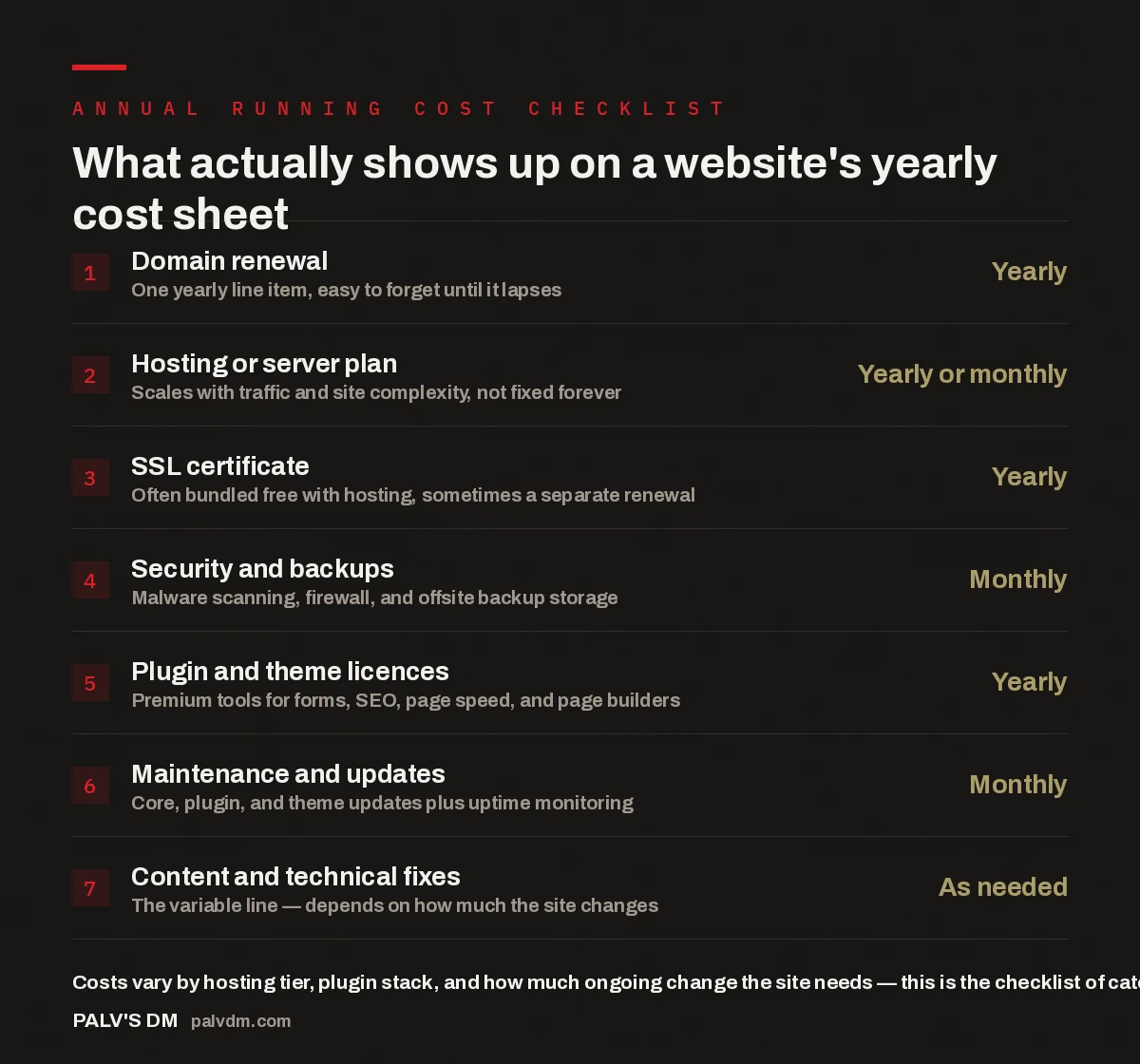
What actually shows up on a website’s yearly cost sheet
- Domain renewal — Yearly. One yearly line item, easy to forget until it lapses.
- Hosting or server plan — Yearly or monthly. Scales with traffic and site complexity, not fixed forever.
- SSL certificate — Yearly. Often bundled free with hosting, sometimes a separate renewal.
- Security and backups — Monthly. Malware scanning, firewall, and offsite backup storage.
- Plugin and theme licences — Yearly. Premium tools for forms, SEO, page speed, and page builders.
- Maintenance and updates — Monthly. Core, plugin, and theme updates plus uptime monitoring.
- Content and technical fixes — As needed. The variable line — depends on how much the site changes.
What recurring costs does a website actually have?
Every live website carries the same core set of recurring costs, even if the amounts differ wildly by site. Domain renewal is the smallest and most predictable — a yearly fee to keep the address registered, and the one item most likely to be forgotten because it renews quietly in the background until it doesn’t. Hosting is the bigger and more variable line: a small brochure site on shared or managed hosting needs far less server capacity than an e-commerce catalogue or a site pulling meaningful traffic, so hosting cost tracks the site’s size and load rather than staying fixed.
SSL certificates are frequently bundled free into hosting plans now, though some hosts still charge separately or upsell a premium certificate. Security and backups are a distinct cost from hosting itself — malware scanning, a web application firewall, and offsite backup storage that survives even if the server doesn’t. Plugin and theme licences cover the tools that make a WordPress site actually function day to day: form builders, SEO plugins, caching and speed tools, and any premium theme or page-builder licence that needs annual renewal. Maintenance and updates — core software, plugin, and theme updates plus uptime monitoring — is the ongoing labour cost of keeping the site secure and working, separate from any one-off content or design change.
How much of this is fixed versus variable?
Domain renewal and SSL are close to fixed — the same predictable amount each year regardless of what happens on the site. Hosting sits in the middle: it’s a known recurring fee, but the tier you need can change as traffic grows, as you add e-commerce functionality, or as the site accumulates more pages and media. Security and maintenance are usually billed as a flat monthly or yearly retainer, but the actual work behind them varies — a quiet month with routine updates costs the provider (and eventually you) less effort than a month where a plugin conflict breaks the checkout page at 11pm.
Content and technical fixes are the genuinely variable line, and the one most businesses forget to budget for at all. A site that never changes after launch still needs updates and security patches, but a site that’s actively used for marketing — new pages, seasonal offers, a redesigned landing page, a fix after a failed plugin update — has ongoing work that isn’t covered by a basic maintenance retainer. Ignoring this category is the single most common reason a “we’ll handle it in-house” plan quietly turns into an emergency call to an agency months later, after something has already broken.
Why does website maintenance cost in India vary so much between providers?
Because “maintenance” means different things depending on who’s quoting it. A budget hosting-plus-updates package might cover core and plugin updates and basic uptime monitoring and nothing else — no security hardening, no backup verification, no response time commitment if something breaks. A more thorough maintenance plan includes proactive monitoring, tested backups (not just backups that exist but have never actually been restored to check they work), malware removal if it happens, and a defined response window. The lower and higher quotes aren’t the same service at different prices; they’re different scopes of work, and the difference usually only becomes visible the day something goes wrong.
Hosting quality is the other lever. Cheap shared hosting keeps the monthly number low but tends to show up later as slow load times, more frequent downtime, and support that’s slow to respond when the server is the actual problem. In the accounts we take over from a previous setup, the pattern that shows up repeatedly is a business that chose the cheapest hosting and maintenance retainer available, then spent more on emergency fixes than a properly scoped plan would have cost from the start. “Cheapest available” and “adequate for a business that depends on this site” are frequently not the same plan.
Nobody asks “what does this cost to run in year two” during the sales call for a new website. They ask it eighteen months later, usually right after something has broken, and usually more annoyed than they need to be — because the answer was knowable on day one, it just wasn’t asked.
Palash, Founder, PalV’s DM
What do businesses commonly get wrong about website running costs?
The most common mistake is treating the build price as the whole budget. A one-time build cost and a recurring running cost are two separate numbers, and a proposal that only quotes the first one isn’t being dishonest so much as leaving out half the picture — deliberately or not. The second mistake is assuming “maintenance” is a single line item rather than a bundle of distinct services (hosting, security, updates, content changes) that can each be sourced separately or together, at very different total costs depending on the combination.
The third mistake is choosing a site architecture that quietly increases running costs later — heavy page builders and a large stack of premium plugins each add their own licence renewal and compatibility risk when core software updates. A site built lean, on self-hosted WordPress without unnecessary plugin bloat, tends to have lower and more predictable running costs than one built quickly with every available page-builder add-on switched on. If you’re comparing quotes at the build stage, it’s worth reading how a cheap website build differs from one that’s actually built to last — the running-cost gap between the two often starts with decisions made before launch.
How do you budget for a website’s running costs each year?
- List every recurring line item separately — domain, hosting, SSL, security, plugin licences, and maintenance — instead of accepting one bundled “website cost” figure that hides what’s actually included.
- Ask what happens when something breaks — what’s the response time, is it included in the retainer or billed separately, and has a backup actually been test-restored recently.
- Set aside a separate content and change budget — new pages, seasonal updates, and design refreshes are ongoing marketing costs, not one-off maintenance tasks, and they need their own line.
- Review the hosting tier annually — a plan sized correctly at launch may not fit the site a year later if traffic, page count, or e-commerce activity has grown.
- Audit the plugin and licence list once a year — tools that were essential at launch sometimes go unused, and each active licence is a renewal cost and a compatibility risk worth re-justifying annually.
This kind of budgeting is easier when the site was scoped properly at the outset. Knowing what’s actually included in a complete website build versus what gets treated as a separate post-launch cost makes the year-two number far less of a surprise. And if the site you’re running costs is already underperforming — slow, hard to update, or quietly losing you leads — it’s worth checking whether the better move is a redesign or a full rebuild before committing to another year of maintenance on a foundation that’s already working against you.
Before you sign a new build or maintenance contract
- Ask for the recurring cost breakdown in writing, not just the one-time build price.
- Confirm exactly what “maintenance” includes — updates only, or updates plus security, monitoring, and support response time.
- Check who owns the hosting, domain, and licence accounts — you, or the agency.
Get a clear, itemised website cost and running-cost breakdown
What is the typical website maintenance cost in India based on?
It’s based on the combination of hosting tier, the scope of the maintenance retainer (updates only versus updates plus security, monitoring, and support), the number of premium plugin or theme licences in use, and how much content or technical change the site needs month to month. Two sites of similar size can have very different running costs depending on these choices, which is why a single flat industry number isn’t a reliable way to budget.
Is hosting the same thing as maintenance?
No. Hosting is the server space and infrastructure that keeps the site online; maintenance is the ongoing work of updating software, monitoring security, and fixing issues on that hosting. A site can have excellent hosting and still break because nobody’s updating plugins or checking backups, and it can have thorough maintenance running on hosting that’s too slow or unreliable for the traffic it receives.
Do all websites need a paid maintenance plan?
Every live website needs someone applying security updates and checking backups, whether that’s a paid retainer, an internal team member, or the business owner doing it themselves. What varies is whether that work is bundled into a formal plan with a response-time commitment, or handled informally and therefore more likely to get missed when other priorities take over — which is usually when a small issue turns into a bigger one.
Why did my hosting or maintenance cost go up after the first year?
Usually because the site grew — more traffic, more pages, more media, or added functionality like e-commerce — and the original hosting tier no longer comfortably fits it. It can also happen if a first-year introductory rate expired and reverted to standard pricing, which is worth checking for specifically when a renewal invoice looks higher than expected.
Can I reduce a website’s running costs without hurting performance?
Often, yes. Auditing the active plugin list for tools that are no longer used, consolidating overlapping premium licences, and matching the hosting tier to actual traffic rather than an inflated worst-case estimate can all lower recurring costs. What doesn’t reduce cost safely is skipping security updates or backups to save money — that trade tends to show up later as a much larger emergency repair bill.
Short version: a website’s yearly running cost is domain renewal, hosting, SSL, security and backups, plugin and theme licences, and ongoing maintenance — plus a genuinely variable line for content and technical changes that most budgets leave out entirely. Website maintenance cost in India differs so widely between providers because “maintenance” isn’t a standard service; it’s whatever’s included in that specific quote. Ask for the recurring breakdown in writing before you sign anything, and budget for year two on day one.