Service Support — Consulting & Audit
Vetting an Agency Proposal With an Independent Consultant
How to review an SEO proposal with an independent consultant: check the scope against the price, claims against your real data, and the contract terms.
To review an SEO proposal with an independent consultant, send them the full document (not a summary) along with your Search Console and analytics access, and have them check three things: whether the scope actually matches the price, whether the claims hold up against your real data, and whether the contract terms protect you. A proper review takes a single session and ends with a plain verdict — fair, overpriced, underscoped, or fine as written — plus the specific questions to take back to the agency before you sign.
Key takeaway
- A proposal review checks the scope against the price, the claims against your own data, and the contract terms against your interests — in that order.
- Bring the consultant the raw proposal and your GSC/GA4 access, not a paraphrased version of what the agency told you.
- The output is a short written verdict and a list of questions to take back to the agency — not a rewrite of the proposal or a pitch to take the work instead.
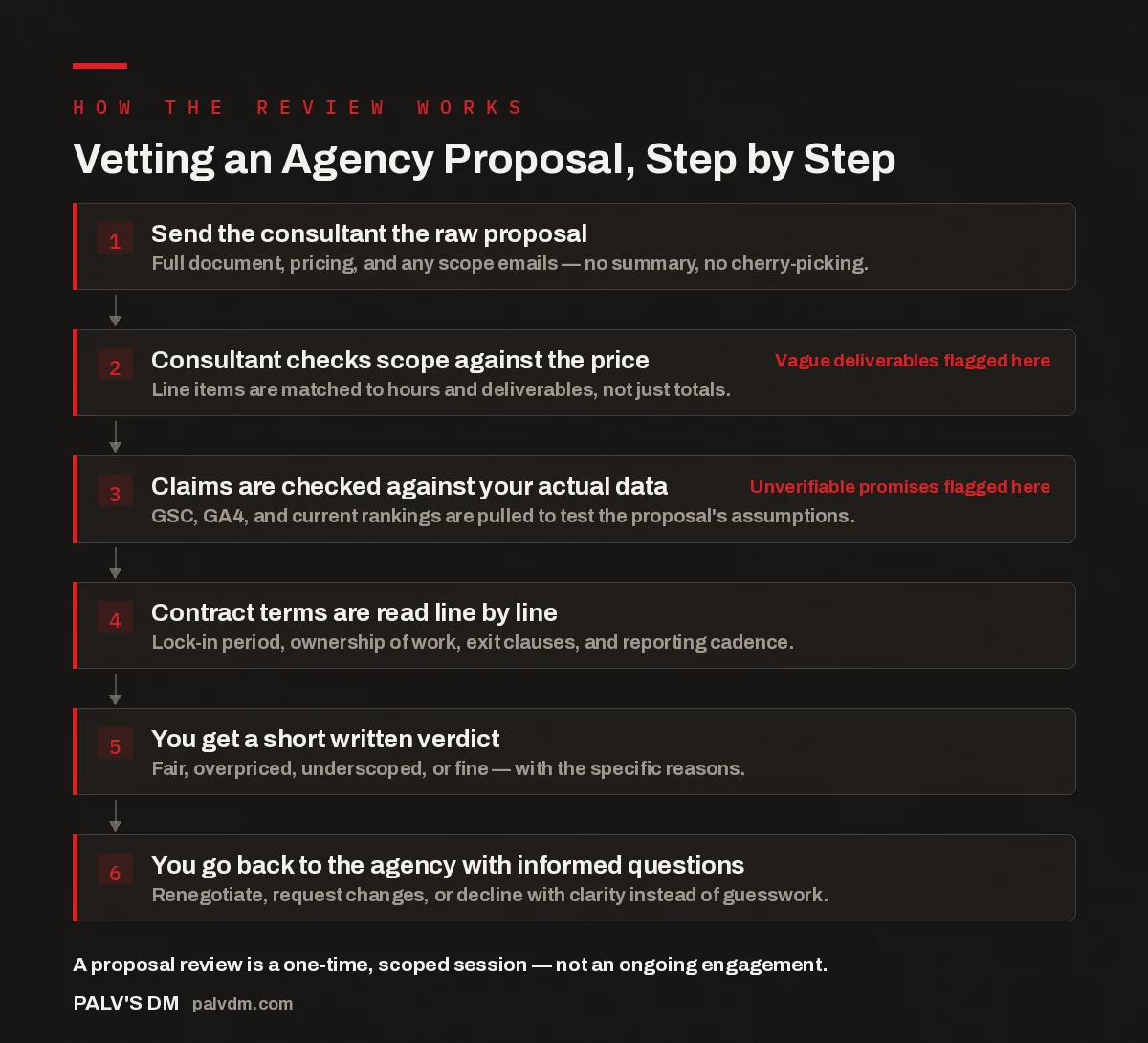
Vetting an Agency Proposal, Step by Step
- Send the consultant the raw proposal. Full document, pricing, and any scope emails — no summary, no cherry-picking.
- Consultant checks scope against the price. Line items are matched to hours and deliverables, not just totals. Vague deliverables flagged here
- Claims are checked against your actual data. GSC, GA4, and current rankings are pulled to test the proposal’s assumptions. Unverifiable promises flagged here
- Contract terms are read line by line. Lock-in period, ownership of work, exit clauses, and reporting cadence.
- You get a short written verdict. Fair, overpriced, underscoped, or fine — with the specific reasons.
- You go back to the agency with informed questions. Renegotiate, request changes, or decline with clarity instead of guesswork.
Why review an SEO proposal before you sign anything?
Most SEO proposals are written to be persuasive, not to be checked. They lead with the outcome you want — more traffic, more leads, higher rankings — and work backward into a scope and price that sound proportionate to it. Nothing in the document forces the numbers to actually add up, and unless you do SEO for a living, you have no easy way to tell a realistic 90-day plan from an inflated one. An independent consultant reads proposals for a living and has no stake in whether you sign this one, so their read isn’t shaped by wanting the account.
This matters most at two points: when you’re comparing multiple agency proposals and can’t tell which is better priced for the work involved, and when a single proposal feels suspiciously cheap or steep and you want a second read before committing budget for six or twelve months. In both cases, the review is cheap relative to what a bad contract costs — a year of retainer fees for work that was never going to move the needle is a far larger loss than an hour or two with a consultant first.
What does the consultant actually check in the proposal?
The review works through the document in a fixed order, because each check depends on the one before it. Skipping straight to “is this expensive?” without first confirming the scope is real just produces an opinion, not a verdict.
- Scope-to-price match. Every line item on the proposal should map to a deliverable you can point to — a number of articles, a technical audit, a set number of link placements, a defined reporting cadence. Where the proposal says “ongoing optimization” or “continuous improvement” with no attached quantity, that’s a gap the consultant will flag, because it’s the part agencies use to absorb hours without accounting for them.
- Claims against your real data. If the proposal promises a specific ranking position, a traffic multiplier, or a timeline to page one, the consultant checks that against your current Search Console history, your niche’s competitiveness, and what similar sites have realistically achieved in that timeframe. A promise that isn’t grounded in your actual starting point is a promise made to close the deal, not to describe the work.
- Strategy coherence. Does the plan described actually address what’s holding your site back, or is it a generic package sold to everyone regardless of their situation? A site with a technical crawl problem doesn’t need six months of content before anyone looks at indexing — a proposal that skips straight to content for every client is a template, not a strategy.
- Contract terms. Lock-in period, notice period to exit, who owns the content and any tools set up during the engagement, and what happens to reporting access if you leave. These are the terms that matter most if the relationship doesn’t work out, and they’re also the ones most people skip reading closely because they’re focused on the pricing table.
Most proposals aren’t dishonest — they’re just optimistic in the agency’s favour. A review isn’t about catching a scam; it’s about finding the gap between what’s promised and what’s actually scoped before you’re the one paying for that gap.
Palash, Founder, PalV’s DM
What should you bring to the review session?
The quality of the review depends directly on what you hand over. A proposal reviewed in isolation, without your actual site data, is still just a document being read for internal consistency — useful, but limited. Bring the following and the review becomes a check against reality instead of a check against itself.
- The full proposal document, including the pricing table and any scope emails that preceded it — not a summary of what the salesperson told you verbally.
- Read or view-only access to Google Search Console and GA4, so the consultant can see your actual traffic, rankings, and technical state rather than taking the agency’s framing of it at face value.
- Any prior SEO history — a previous agency’s reports, a past audit, or notes on what’s already been tried — so the consultant can tell whether the new proposal repeats work that’s already been done.
- Your actual budget ceiling and timeline expectations, stated plainly, so the review can address whether this specific proposal fits your situation rather than SEO proposals in general.
How is this different from getting a second opinion on an agency you already have?
Vetting a proposal happens before you sign anything — there’s no existing relationship or track record to evaluate yet, only a document and a set of promises. A second opinion, by contrast, looks at an agency you’re already paying, using months of reporting and results as evidence. The two situations call for different questions: a proposal review asks “does this plan make sense and is it priced fairly,” while a second opinion asks “is this agency actually delivering what they said they would.” If you’re currently mid-contract and trying to decide whether to renew, that’s a distinct exercise — see our piece on getting a second opinion on agency work for how that review differs.
It’s also worth being clear about what a proposal review isn’t. It’s not an audit of your website — the consultant isn’t crawling your site and generating findings, because there’s no work to check yet, only a plan. And it’s not the start of a sales process for the consultant’s own services, though a good one will tell you honestly if what you need is ongoing hands-on help rather than a single review. If that’s the case, it’s worth understanding when a consultant makes more sense than an agency before you sign anything.
What do you actually walk away with?
A proposal review that’s done properly ends in something concrete, not a verbal “sounds okay to me.” The consultant should give you a short written verdict — typically a page or less — that states plainly whether the scope matches the price, flags any specific claims that don’t hold up against your data, and lists the contract terms worth pushing back on before you sign. This is deliberately narrow. It’s not a rewrite of the agency’s strategy, and it’s not a competing plan for the consultant to run instead. It’s an honest read of the document in front of you, with the reasoning shown so you can act on it yourself. For a broader look at what a written outcome from consulting work should look like, see what you walk away with in writing — the same standard applies whether the session is a proposal review or a full audit.
What you do with that verdict is up to you. Some clients take the flagged issues straight back to the agency and get the scope clarified or the price adjusted before signing — often the best outcome, since it fixes the proposal rather than discarding it. Others use the review to choose between two or three competing proposals on an apples-to-apples basis instead of guessing from pricing alone. Occasionally it surfaces something serious enough — a year-long lock-in with no exit, or claims that plainly don’t match your site’s situation — that walking away is the right call. Preparing well for the session itself also helps; the same groundwork described in what to bring to a consulting call to make it worth it applies directly here.
Before you sign
- Get the raw proposal and your site data in front of someone with no stake in whether you sign it.
- Ask for a written verdict, not a verbal opinion — you need something specific to take back to the agency.
- Treat the review as a one-time check, not the start of a new retainer relationship.
Frequently asked questions
How long does an SEO proposal review actually take?
Most reviews fit into a single session, usually somewhere between 45 minutes and two hours depending on how detailed the proposal is and how much site data there is to cross-check against. It’s a scoped, one-time exercise, not an ongoing engagement.
Will the consultant just tell me to hire them instead?
A consultant doing an honest proposal review is being paid to assess the document in front of you, not to compete for the work. If the review is structured as a pitch for a replacement contract, that’s a sign to find a different reviewer — the value here is independence, and independence means having no stake in the outcome.
Can I get a proposal reviewed if I’m comparing multiple agencies at once?
Yes, and it’s one of the most useful times to do it. Reviewing two or three proposals side by side against the same criteria — scope-to-price match, claim accuracy, contract terms — makes the comparison far more concrete than reading each one separately and going on gut feel.
What if the review finds the proposal is actually fine?
That happens regularly, and it’s a legitimate outcome — not every proposal is inflated or vague. A review that confirms the scope is reasonable and the price is fair still has value: you sign with confidence instead of a nagging doubt, and you have specific questions already answered rather than surfacing them after the contract starts.
Does a proposal review cover technical SEO details I wouldn’t understand anyway?
It should translate them, not skip them. Part of the point of an independent review is turning technical line items — crawl budget work, schema markup, Core Web Vitals fixes — into plain statements about whether they’re needed for your site and whether the time allocated to them is realistic, so you’re not signing off on jargon you can’t evaluate.
Short version: don’t sign an SEO proposal on the strength of how it reads alone. Hand the raw document and your actual site data to someone with no stake in the sale, have them check the scope against the price, the claims against your data, and the contract terms against your interests, and get the result in writing. It’s a small cost against what a year of the wrong retainer would have cost you instead.