Service Support — Consulting & Audit
What You Walk Away With in Writing
A clear breakdown of SEO consulting deliverables you should get in writing: audit findings, a prioritized roadmap, technical specs, and success criteria.

An SEO consulting engagement that ends with nothing but a call and a memory isn’t consulting — it’s a conversation you paid for. What you should walk away with in writing, at minimum, is an audit findings document with evidence for each issue, a roadmap that ranks the work by impact and effort, technical specs precise enough for a developer to action without a follow-up call, and a clear definition of what success looks like and by when. If any of that lives only in the consultant’s head, or only in notes scribbled during a fast-moving call, the engagement did not produce a deliverable. It produced a conversation.
Key takeaway
- A real SEO consulting engagement ends in a written audit, a prioritized roadmap, and specs a developer or writer can act on without booking another call.
- If findings, priorities, or success metrics only exist in your notes from the call, you don’t have a deliverable — you have a memory of a conversation.
- Good deliverables can be handed to anyone on your team, in-house or agency, and they’ll know exactly what to do next without you translating.
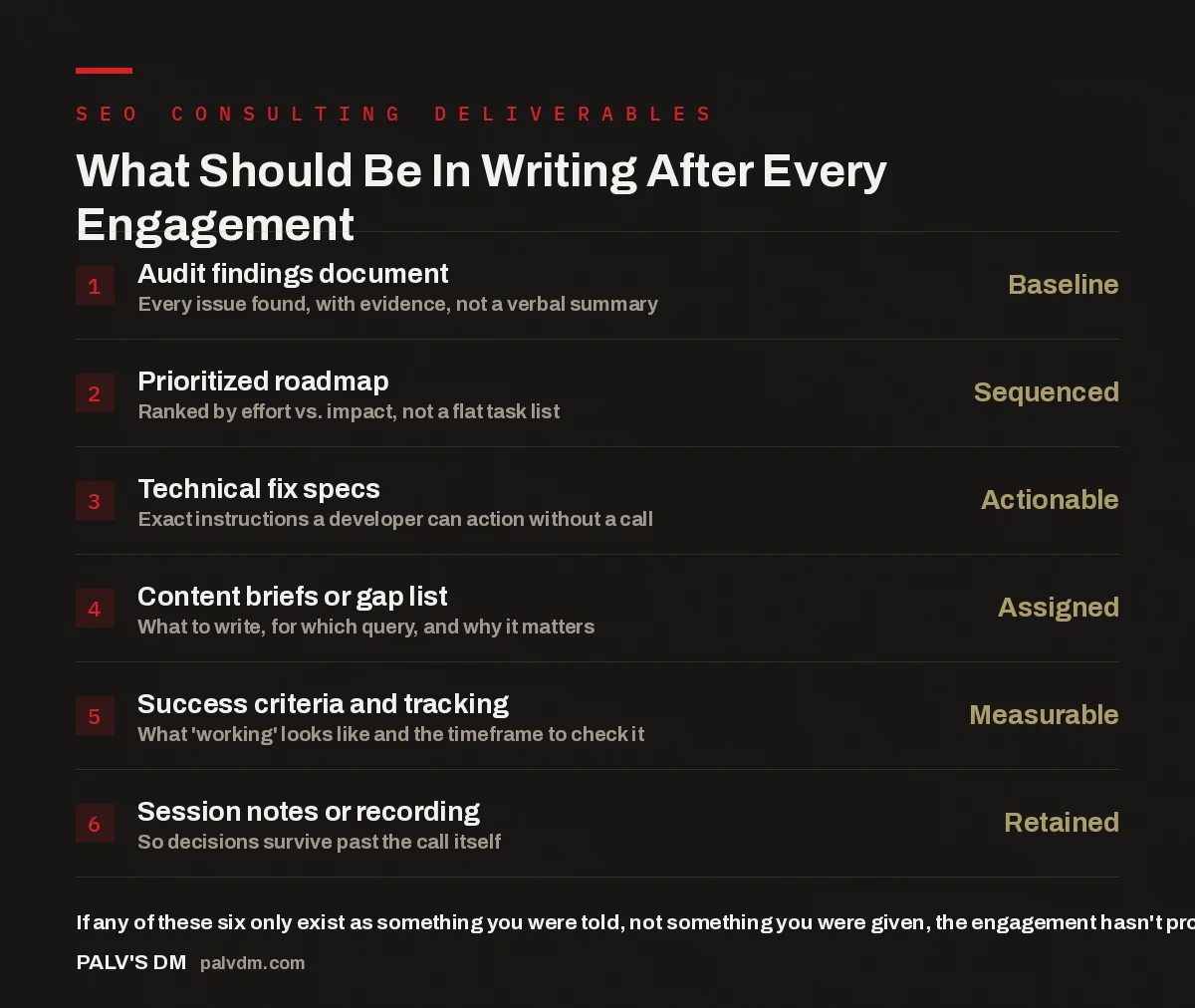
What Should Be In Writing After Every Engagement
- Audit findings document — Baseline. Every issue found, with evidence, not a verbal summary.
- Prioritized roadmap — Sequenced. Ranked by effort vs. impact, not a flat task list.
- Technical fix specs — Actionable. Exact instructions a developer can action without a call.
- Content briefs or gap list — Assigned. What to write, for which query, and why it matters.
- Success criteria and tracking — Measurable. What ‘working’ looks like and the timeframe to check it.
- Session notes or recording — Retained. So decisions survive past the call itself.
What Should Be in Writing After an SEO Consulting Engagement?
SEO consulting deliverables should cover the same ground regardless of whether the engagement was a single audit call or a multi-month advisory retainer: what’s broken, what to do about it, in what order, and how you’ll know it worked. That’s the baseline. An audit findings document lists every issue with evidence — a screenshot, a crawl result, a specific URL — not a summary sentence like “technical issues found.” A prioritized roadmap turns that list into a sequence, because a list of forty problems with no order is a source of anxiety, not a plan. Technical specs translate findings into instructions a developer can implement without scheduling time with you to explain what the consultant meant. Content briefs, where content work is part of the scope, name the target query and the intent behind it, not just a topic. A definition of success — what to measure, and roughly when to expect movement — closes the loop so you’re not guessing whether any of it worked six months later.
None of this needs to be elaborate. A five-page PDF with clear findings and a ranked list beats a forty-slide deck nobody opens again. The test isn’t polish, it’s whether someone who wasn’t on the call can pick up the document and know what to do next.
What Goes Into the Audit Findings Document?
A usable audit findings document groups issues by category rather than dumping them in the order they were noticed. Technical issues — crawlability, indexation, page speed, structured data — sit in one section. Content issues — thin pages, missing intent match, cannibalization — sit in another. Off-page or authority issues, where relevant, sit in a third. Within each category, every finding needs three things: what the issue is, where it shows up (specific URLs or a representative sample, not “several pages”), and why it matters for that particular site rather than in the abstract.
In the accounts we work on, the same handful of findings show up again and again — orphaned pages, duplicate title tags, thin category pages, a redirect chain nobody has checked since a migration two years ago. That pattern is common enough to be worth reading alongside the three findings that show up in almost every audit before your own call, so you can spot the difference between a generic finding and one specific to your site. A findings document that could have been written before the consultant looked at your site isn’t a findings document — it’s a template with your domain name pasted in.
How Should the Roadmap Be Prioritized?
A roadmap earns the name only if it’s ranked, and ranked on two axes: how much effort the fix takes and how much it’s likely to move the needle. A broken canonical tag on your top ten landing pages is low effort and potentially high impact — that goes first. A full information architecture rebuild is high effort and high impact, but it belongs later, sequenced after the quick technical fixes that could otherwise get lost in a bigger project. Anything low effort and low impact goes on a “do eventually” list, not the roadmap itself, so it doesn’t dilute the priority items.
This is also where dependencies matter, and where a lot of roadmaps quietly fall apart. If a content fix depends on a taxonomy change, or a technical fix depends on a developer sprint three weeks out, the roadmap should say so explicitly rather than list both items as if they can happen in parallel. The reasoning behind the sequencing usually gets talked through live — that’s part of what a strategy session is for — but the order itself needs to survive in writing after the call ends, not live only in memory of an hour-long discussion.
What Do Usable Technical and Content Specs Look Like?
The gap between a vague recommendation and a usable spec is the gap between “your pages are slow” and “compress and lazy-load the hero images on the top twenty landing pages; largest contentful paint is driven by unoptimized JPEGs served at full resolution.” One requires a developer to do their own diagnosis before starting. The other lets them open a ticket and get to work. The same applies to content: “you need more blog content” is not a brief. “Write a comparison piece targeting [query], structured around a decision table, aimed at someone who has already narrowed down to two options” is a brief.
| Deliverable type | Vague version | Usable version |
|---|---|---|
| Technical fix | “Improve page speed” | “Compress hero images on the top 20 landing pages; move render-blocking scripts below the fold” |
| Content brief | “Write more blog content” | “Comparison piece for [query], decision-table format, aimed at bottom-funnel readers” |
| Priority note | “Fix these when you can” | “Do these three first — low effort, affects your top revenue pages” |
| Success metric | “See how it goes” | “Re-check indexation and rankings for these URLs at the 60-day mark” |
If you can read a deliverable and immediately know who does the work, in what order, and how to check it’s done — that’s usable. If you finish reading and still have a follow-up question about what exactly to do, the deliverable isn’t finished yet, even if the call is technically over.
What Happens If a Consultant Doesn’t Put Anything in Writing?
Without written deliverables, the value of the engagement degrades the moment the call ends. Whoever was on the call becomes the sole source of what was decided, which is fine until they change roles or simply misremember a detail three weeks later when a developer asks a clarifying question. Priorities blur into a general sense of “there was a lot to fix” rather than a ranked list. And there’s no artifact to hand to whoever implements the work — which matters if you’re choosing between an independent consultant and a full-service agency, since a consultant’s output is often exactly this written plan, handed to your team or another vendor to execute rather than execution itself.
There’s also an accountability problem. A verbal recommendation is easy to reinterpret in either direction — the client can misremember what was suggested, and the consultant can quietly redefine what they meant if the advice turns out wrong. A written, dated deliverable removes that ambiguity for both sides.
If you can’t hand our findings to your developer without getting on another call to explain them, we haven’t finished the job.
Palash, Founder, PalV’s DM
How Do You Know the Deliverables Are Actually Usable?
Run a simple test before the engagement ends: hand the document to someone who wasn’t on the call — a developer, a new hire, another vendor — and see if they can start work from it without pinging you for clarification. If they can, the deliverable is doing its job. If every item needs a follow-up explanation, the document is a summary of a conversation, not a working plan.
It also helps to know what to bring into the engagement in the first place, since the quality of what you get out is partly a function of what the consultant has to work with going in — analytics access, prior audits, a clear sense of your goals. What to bring to a consulting call to make it worth it covers that side of the equation. If the findings reveal issues that need a longer engagement rather than a one-off fix list, that’s a separate decision — but it should be made from a document you can reread, not a fading memory of a call two weeks ago.
Want deliverables you can actually act on?
Every consulting engagement with us ends in a written audit, a prioritized roadmap, and specs your team or agency can implement without another call.
Frequently Asked Questions
What are typical SEO consulting deliverables?
Typical deliverables are an audit findings document with evidence for each issue, a prioritized roadmap sequenced by effort and impact, technical fix specs a developer can implement, content briefs where relevant, and a defined way to measure whether the work is succeeding. What varies is depth and format, not whether these exist at all.
Is a call summary email enough of a deliverable?
Usually not on its own. A summary email is useful as a record of what was discussed, but it rarely has the specificity — exact URLs, ranked priorities, implementation-ready instructions — needed for someone who wasn’t on the call to act without asking follow-up questions. Treat it as a companion to a proper document, not a replacement for one.
Should deliverables differ between a one-off audit and an ongoing retainer?
The format shifts but the standard shouldn’t. A one-off audit produces one comprehensive findings-and-roadmap document. A retainer produces the same category of artifacts on a rolling basis — updated findings, a revised roadmap, new specs — rather than one document at the very end. Either way, decisions made in a session should end up in writing, not just in memory.
Who should be able to use the deliverables — just me, or my whole team?
Anyone who needs to act on the findings should be able to use them without you as a translator — your in-house team, a developer, or a different agency entirely. If the deliverable only makes sense with you explaining it in the room, it hasn’t actually transferred the knowledge from the consultant’s head onto paper.
What should I ask for if a consultant’s proposal doesn’t mention deliverables?
Ask directly what document or artifact you’ll have in hand at the end of the engagement, and ask to see an anonymized sample if one exists. A consultant confident in their process should be able to show you what a findings document or roadmap actually looks like before you commit, not just describe it in the abstract.
The short version: a consulting engagement should leave you holding something you can reread, hand off, and act on — an audit with evidence, a roadmap with a real order, specs a developer or writer can use without another call, and a way to check later whether it worked. If what you have is just a good conversation, ask for the document that goes with it.