Service Support — Consulting & Audit
What to Bring to a Consulting Call to Make It Worth It
What to bring to prepare for an SEO consultation: account access, real goals, and sharp questions that turn a 60-minute call into an actionable SEO plan.

Prepare for an SEO consultation the way you’d prepare for a doctor’s appointment: bring your history, your access, your goal, and your specific questions. Six things matter most — analytics and Search Console access, a real business goal (not “more traffic”), a short list of what’s already been tried, three to five named competitors, your real constraints on budget and dev time, and two or three concrete questions. Show up with those and a 60-minute call produces recommendations you can act on the same week. Show up without them and the call turns into an intake interview, with the useful part pushed to a follow-up email.
Key takeaway
- Bring account access, a stated business goal, and a short history of what’s already been tried — those three alone determine whether the call is diagnostic or just a conversation.
- Name real competitors and real constraints (budget, dev resourcing, approval chain) so the advice you get back is something you can actually execute.
- Walk in with 2-3 specific questions rather than “how’s our SEO doing” — specific questions get specific answers, vague ones get a generic audit summary.
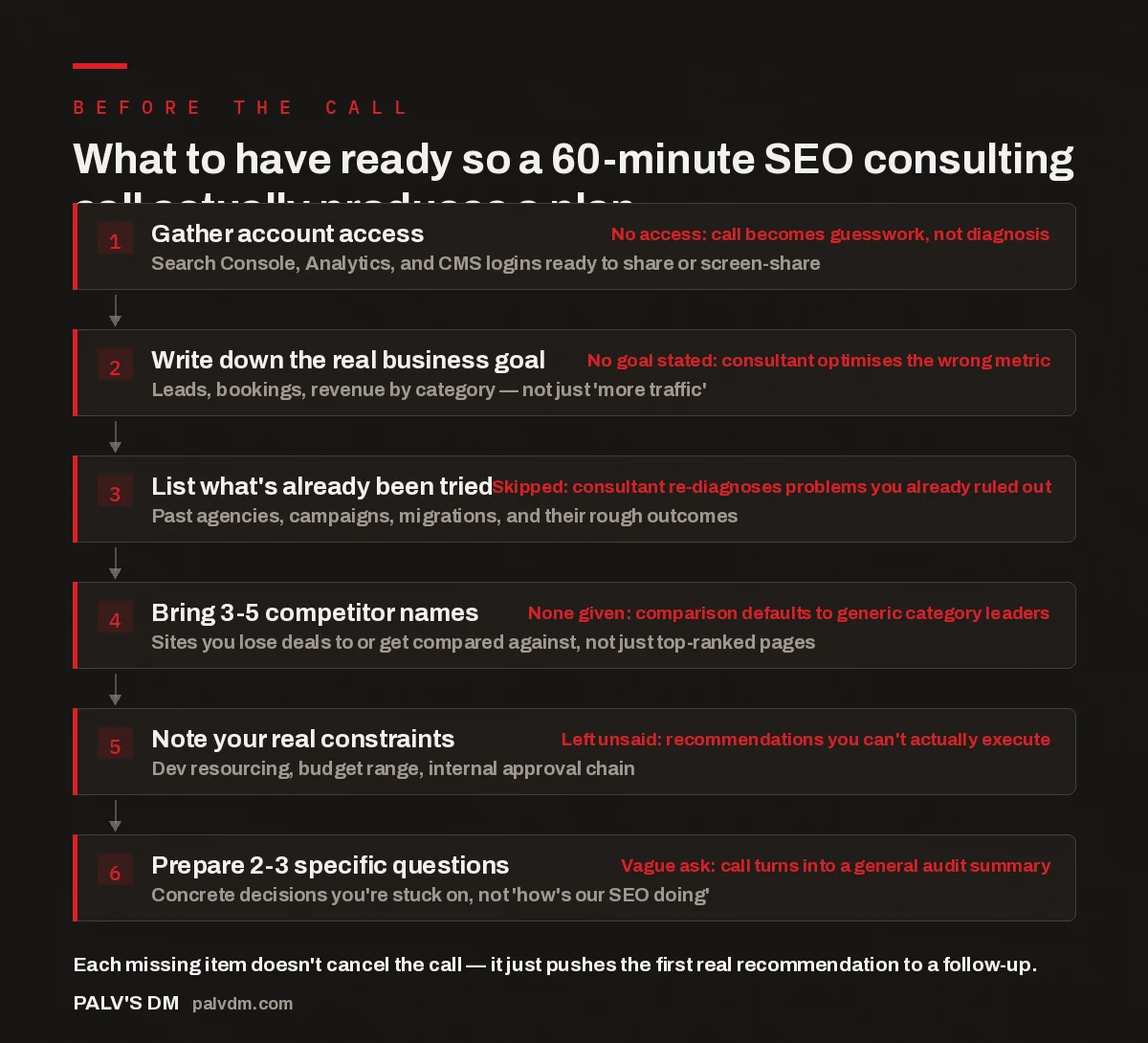
What to have ready so a 60-minute SEO consulting call actually produces a plan
- Gather account access. Search Console, Analytics, and CMS logins ready to share or screen-share. No access: call becomes guesswork, not diagnosis
- Write down the real business goal. Leads, bookings, revenue by category — not just ‘more traffic’. No goal stated: consultant optimises the wrong metric
- List what’s already been tried. Past agencies, campaigns, migrations, and their rough outcomes. Skipped: consultant re-diagnoses problems you already ruled out
- Bring 3-5 competitor names. Sites you lose deals to or get compared against, not just top-ranked pages. None given: comparison defaults to generic category leaders
- Note your real constraints. Dev resourcing, budget range, internal approval chain. Left unsaid: recommendations you can’t actually execute
- Prepare 2-3 specific questions. Concrete decisions you’re stuck on, not ‘how’s our SEO doing’. Vague ask: call turns into a general audit summary
Why does account access matter more than anything else you bring?
Because without it, every statement a consultant makes on the call is a hypothesis instead of a finding. Search Console shows what’s actually ranking and getting clicked, Analytics shows what’s converting, and a look at the CMS shows what’s realistically editable without a developer. Skip this and the consultant reasons from your homepage and whatever you say out loud — fine for a sales pitch, not for a plan. In the accounts we work on, the calls that end in a specific next step are almost always the ones where the person shared a Search Console screen five minutes in.
You don’t need to hand over admin credentials before you’ve decided to work with someone. Read-only access, a temporary user, or simply screen-sharing your own dashboard all work. What doesn’t work is describing your traffic from memory — “it’s been kind of flat” isn’t the same information as a graph with a visible drop in March.
What business goal should you actually state, and why is “more traffic” not one?
State the outcome that changes your revenue, not the metric that sits upstream of it: more qualified leads from a specific service page, more bookings in a slower season, more revenue from a particular product category, or fewer support tickets caused by people not finding information before they buy. “More traffic” isn’t a goal a consultant can build a plan around, because traffic to the wrong pages, from the wrong intent, can go up while the business goes nowhere. “We want the /services/consulting page to generate five qualified enquiries a month instead of one” gives a consultant something to reverse-engineer; “more traffic” gives them nothing to disagree with, which sounds friendly but produces generic advice.
How do you summarise what’s already been tried without writing a full history?
Keep it to a short list: which agencies or freelancers worked on the site and roughly when, any major migrations or redesigns, any campaigns that clearly worked or didn’t, and any penalties or manual actions you’re aware of. This doesn’t need dates and screenshots — a few sentences prevents the consultant from re-diagnosing something you already know.
- Previous agencies or freelancers and the rough period they worked with you
- Any site migration, redesign, or platform change and roughly when it happened
- Campaigns or big content pushes that you believe worked, and ones you believe didn’t
- Any known penalty, manual action, or sudden traffic drop, even without a confirmed cause
If the history is genuinely complicated — several agencies, an unresolved traffic collapse, a migration nobody fully documented — say so plainly rather than smoothing it over. A consultant who hears “we’re not sure what happened after the redesign, traffic just dropped” can look at the timeline directly instead of working from a version simplified for the sales call.
Which competitors should you actually name?
Name the businesses you lose deals to, not the sites that happen to rank first for your main keyword — those are frequently different lists. A directory site or a large aggregator might dominate the search results without ever being a real alternative a prospective customer weighs against you. The competitors worth discussing are the three to five businesses a buyer actually compares you with before choosing, because that’s who your content and service pages need to out-argue, not just outrank. If you’re not sure who those are, ask your sales team or check your last few lost deals for a pattern.
The single biggest difference between a consulting call that produces a plan and one that produces a summary isn’t expertise on either side — it’s whether the person on the client side did fifteen minutes of prep. Access, a real goal, and a short history turn generic advice into a specific one.
Palash, Founder, PalV’s DM
What constraints should you say out loud before the consultant recommends anything?
Say what your actual budget range is, how much developer time you can realistically get in a given month, and who needs to approve changes before they go live. A consultant who doesn’t know you have zero developer access will recommend structural fixes that sit in a backlog for a year; one who doesn’t know your budget range will size a plan that gets rejected the moment it reaches a decision-maker. You don’t need an exact number if that feels premature — a range is enough, as long as the constraint is on the table before the recommendation is made, not after.
What questions are worth asking instead of “how’s our SEO doing”?
Bring questions tied to a decision you’re actually stuck on: whether to redesign or rebuild, whether to bring content in-house or keep outsourcing it, or whether a particular page is worth the investment it would take to fix. “How’s our SEO doing” invites a general status update, which is fine for a check-in but wastes a slot that could have resolved something specific.
- “Is our traffic drop tied to the redesign in March, or something else?” instead of “why did our traffic drop?”
- “Should we rebuild this page or is a content refresh enough?” instead of “is our content good?”
- “Is it worth hiring in-house for this or keeping it outsourced another year?” instead of “should we do SEO ourselves?”
Two or three questions like this, written down before the call, keep the conversation anchored to decisions you can actually make afterward — a specific question gets a specific answer, an open-ended one gets a broad overview you likely already had.
What happens if you show up without any of this?
The call still happens, but the first half becomes an intake interview instead of a diagnosis. The consultant asks the questions this article just walked through, you answer them live, and by the time there’s enough context to say anything specific, the call is close to over. That’s not a wasted call, but it is a slower one — the useful recommendation arrives in a follow-up email days later instead of in the room.
If you genuinely don’t have time to prepare all six items, prioritise access and the goal statement — those two alone let a consultant look at real data and reason toward a real outcome. The rest is what turns a good call into an efficient one, but fifteen to twenty minutes of prep, mostly writing down things you already know, is proportionate for a call that might shape decisions worth months of work.
How does this connect to related decisions around consulting?
Preparing well for one call also clarifies whether a single session is even enough, or something more structured. It helps to know what actually happens in a strategy session versus a shorter advisory call, and to think about what you should walk away with in writing afterward — a call without a written summary is easy to half-remember a month later. If the call is really the first step in evaluating a proposal you’ve already received, read about vetting an agency proposal with an independent consultant beforehand. And if this call doubles as a free audit intake, what we look at in the first 30 minutes of any audit explains what to expect from that first pass.
Key takeaway
- Fifteen to twenty minutes of prep — access, a stated goal, a short history — is what separates a diagnostic call from an intake interview.
- Named competitors and stated constraints keep the advice you get grounded in what you can actually execute.
- If you’d rather skip straight to a structured, no-cost version of this conversation, book one directly.
FAQ
How long should I spend preparing for an SEO consulting call?
Fifteen to twenty minutes is usually enough. Most of the prep is writing down information you already have — your goal, a short history, a few competitor names, and your real constraints — rather than researching anything new. The exception is account access, which can take longer if someone else needs to grant it, so request that a day or two ahead of the call.
What if I don’t have Search Console or Analytics access to share?
Say so upfront rather than hoping it doesn’t come up. A consultant can still have a useful conversation about your goals, history, and constraints, but any diagnostic claims about current rankings or traffic will have to wait until access is sorted out, usually as a follow-up step after the call.
Do I need to prepare differently for a free audit call versus a paid consulting session?
The core prep is the same — access, goal, history, competitors, constraints, questions — because both calls run on the same information. The difference is usually depth: a free audit call focuses more narrowly on a first-pass diagnosis, while a paid session can go further into strategy once the basics are established.
Should I prepare a written brief, or is talking through it on the call enough?
A short written note — even five bullet points sent an hour before the call — is more useful than talking through it live, because it lets the consultant absorb your goal and history before the call starts. It doesn’t need to be formal; an email with your goal, a one-line history, and two or three competitor names covers most of it.
What’s the single most common thing people forget to bring?
A stated business goal. Most people bring access and a rough sense of history, but default to “more traffic” or “better rankings” when asked what they actually want, which isn’t specific enough to build a plan around. Naming the real outcome — more leads from a page, more bookings in a season — is the one piece of prep that changes the advice the most.