E-E-A-T Explained Without the Jargon
E-E-A-T is not a ranking factor and there is no score. What it actually is, where it comes from, and what it genuinely means for your pages.
E-E-A-T stands for Experience, Expertise, Authoritativeness and Trustworthiness. It is not a ranking factor, there is no E-E-A-T score, and Google does not measure it directly. It is a concept from Google’s Search Quality Rater Guidelines — the manual used by human contractors who assess sample search results to help Google evaluate whether its ranking systems are working. Those ratings do not affect the sites rated. What E-E-A-T actually gives you is a description of what Google is trying to reward, which makes it a useful checklist even though it is not a lever.
The distinction matters because “improve your E-E-A-T” is sold as a service, and it cannot be done directly any more than you can improve your temperature by adjusting a thermometer.
Where it comes from
Google employs thousands of external quality raters who follow a public document — the Search Quality Rater Guidelines — to assess the quality of search results. E-E-A-T is one of the frameworks in that document.
Three things follow that people routinely get wrong. Raters assess whether Google’s systems are producing good results; they do not assign scores to individual websites. A rating has no effect on the rated site’s rankings. And the guidelines are aspirational — they describe what good looks like so that engineers can build systems that approximate it.
The framework began as E-A-T. Google added the first E, for Experience, at the end of 2022, and that addition is the most practically useful part of the whole thing.
What each letter asks
Experience — have you actually done this?
The newest and, for most businesses, the most actionable. It asks whether the creator has first-hand, lived experience of the subject.
A review written by someone who used the product for three months beats one assembled from spec sheets. A migration guide written by someone who has run migrations — including one that went wrong — beats a summary of other guides. Experience shows through specifics: what surprised you, what failed, the detail nobody who had not done it would think to mention.
This is the component a small agency can most readily demonstrate, because it requires having done the work rather than having a brand.
Expertise — do you know the subject?
Knowledge and skill. Formal for some topics — medical, legal, financial content is expected to come from qualified people. Informal for others: someone who has managed a condition for a decade has genuine expertise about living with it, credentials or not. Google’s guidelines explicitly recognise this everyday form.
Authoritativeness — are you a recognised source?
Reputation, as judged by others rather than asserted by you. Citations from credible sites, mentions in industry coverage, being the source others point to. This is the slowest to build and the least directly controllable.
Trustworthiness — the one that actually matters
Google states plainly that Trust is the most important member of the family, and that the other three exist to support it. Accuracy, honesty, transparency, safety.
Practically: is the information correct and current? Is it clear who is behind the site and how to contact them? Are commercial relationships disclosed? Are claims sourced? For anything transactional, is the process secure and are terms clear?
A page can be written by a genuine expert and still fail on Trust — undisclosed affiliate relationships, outdated pricing, no way to contact anyone.
YMYL: where the bar rises
Google applies far higher scrutiny to “Your Money or Your Life” topics — content that could materially affect health, financial stability, safety or wellbeing.
Medical, legal and financial advice sit here obviously. Less obviously, so do pages about major purchases, employment, housing, and information affecting groups of people. If your topic is YMYL, unqualified authorship and unsourced claims are a far bigger liability than in a low-stakes category. If it is not, the bar is meaningfully lower and treating a recipe blog like a medical journal is wasted effort.
How to actually improve it
Since there is no score, everything here is about making genuine quality legible to systems trying to approximate it.
- Put real names on content, with real credentials. Google’s own self-assessment questions start with “who created this content.” Anonymous pages cannot answer it. Building an author page that signals expertise covers the construction, and why anonymous content is losing ground covers the stakes.
- Show experience through specifics. Screenshots of your own screen. Numbers from your own work. What went wrong. Generic advice signals the absence of experience regardless of what the byline claims.
- Cite sources for factual claims. This is also [[information-gain-ranking-signal|how information gain compounds]. Link to primary sources — the documentation, the study, the dashboard — not to another blog post summarising them.
- Make the organisation identifiable. A real About page, a physical location, a working contact route, named people.
- Keep pages current, honestly. Update the content and then the date. Changing the date without changing the content is a trust problem, and Google is explicit that faking freshness does not work.
- Disclose commercial relationships. Affiliate links, sponsorships, client relationships in a case study.
- Publish your methodology. How you research, test and verify. This answers Google’s “how was it produced” question directly, and almost nobody does it.
What E-E-A-T is not
- Not a score. Nothing in Google assigns your site an E-E-A-T number, and any tool claiming to measure yours has invented a metric.
- Not a ranking factor. It is a description of intent, not a system.
- Not fixable by adding an author box. A byline with no substance behind it is decoration.
- Not equally weighted everywhere. YMYL content is held to a far higher standard than low-stakes topics.
- Not achievable through schema alone. Markup describes what is on the page; it cannot manufacture credibility that is not there.
Why it matters more in 2026
Two shifts made this framework more consequential than it was.
Content generation became nearly free, so effort stopped functioning as a proxy for care, which is why the confirmed ranking factors matter less than the evidence behind them. What remains as a differentiator is exactly what E-E-A-T describes: verifiable identity, demonstrable first-hand experience, real sourcing.
And the AI-answer surface rewards the same things. Generative engines need attributable sources, and research published at KDD 2024 found that adding statistics, quotations from named sources, and citations to authoritative sources raised a page’s visibility in generative answers by up to around 40%. That is E-E-A-T restated as retrieval mechanics.
Across the 2026 updates, the direction was consistent — evidence over volume. E-E-A-T is the vocabulary Google already had for describing it.
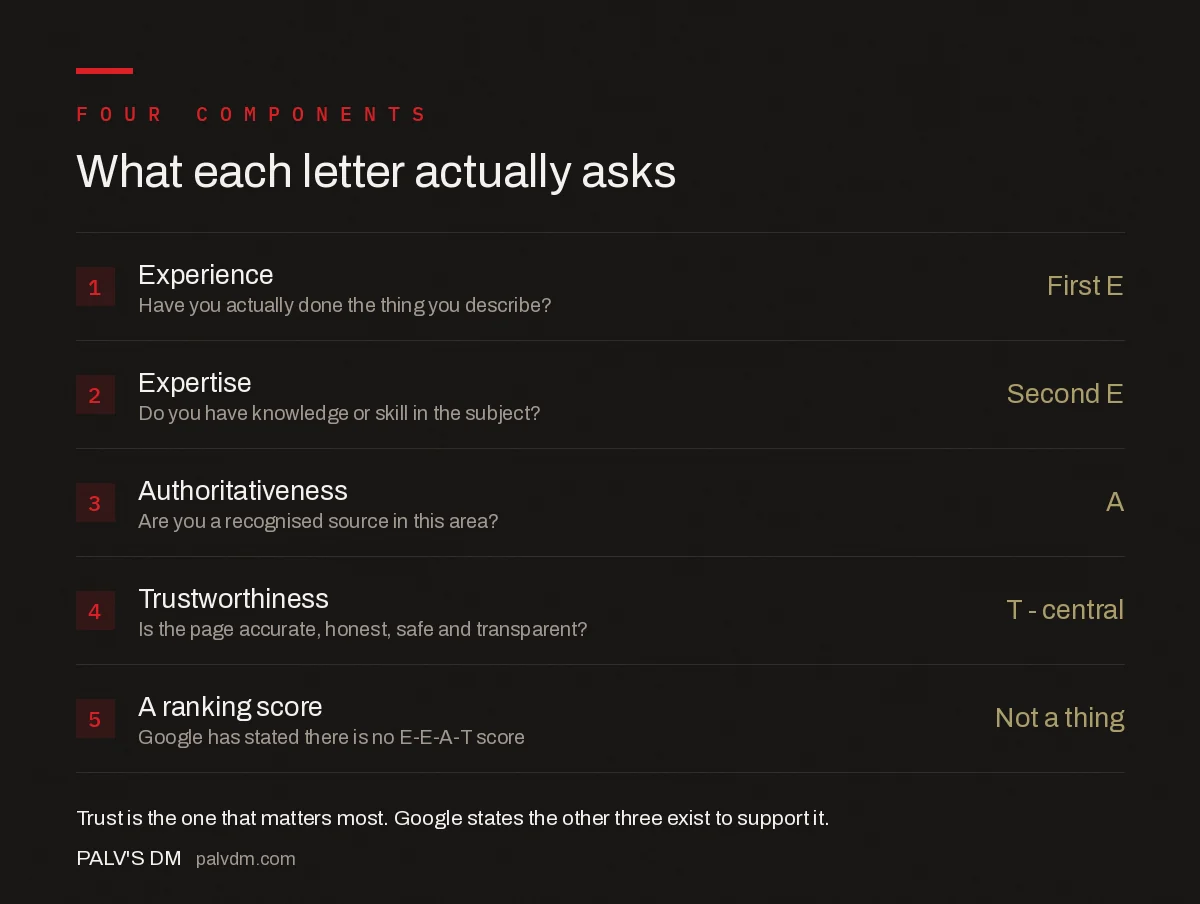
What each letter actually asks
- Experience — First E. Have you actually done the thing you describe?.
- Expertise — Second E. Do you have knowledge or skill in the subject?.
- Authoritativeness — A. Are you a recognised source in this area?.
- Trustworthiness — T – central. Is the page accurate, honest, safe and transparent?.
- A ranking score — Not a thing. Google has stated there is no E-E-A-T score.
Frequently asked questions
What does E-E-A-T stand for?
Experience, Expertise, Authoritativeness and Trustworthiness. It is a framework from Google’s Search Quality Rater Guidelines, the manual used by human contractors who assess sample search results. The first E, for Experience, was added at the end of 2022 to the earlier E-A-T framework, and asks whether the creator has genuine first-hand experience of the subject.
Is E-E-A-T a Google ranking factor?
No. There is no E-E-A-T score and Google does not measure it directly. It is a description of what Google’s ranking systems are trying to reward, used by quality raters to assess whether those systems are working. Rater assessments do not affect the sites being rated. It remains a useful checklist precisely because it describes the target.
Which part of E-E-A-T matters most?
Trust. Google states plainly that Trustworthiness is the most important member of the family and that Experience, Expertise and Authoritativeness all exist to support it. A page written by a genuine expert can still fail on Trust through undisclosed commercial relationships, outdated information, unsourced claims, or no clear way to identify and contact who is behind the site.
What is YMYL content?
“Your Money or Your Life” content — pages that could materially affect a person’s health, financial stability, safety or wellbeing. Medical, legal and financial advice are the clearest cases, along with major purchases, employment and housing. Google applies substantially higher scrutiny to YMYL topics, so unqualified authorship and unsourced claims carry far more risk there.
How do I improve my site's E-E-A-T?
Put real names and verifiable credentials on content, show first-hand experience through specifics like your own screenshots and results, cite primary sources rather than other blog posts, make the organisation identifiable with a real About page and contact route, keep pages genuinely current, disclose commercial relationships, and publish your methodology. None of this moves a score, because there is no score — it makes real quality legible.
Sources
- Google Search Quality Rater Guidelines
- Creating helpful, reliable, people-first content — Google Search Central
- GEO: Generative Engine Optimization (Aggarwal et al., KDD 2024)
Want this done on your site?
Every PalV’s DM engagement starts with a free audit of your actual website — a 12-point
crawl covering what is blocking indexation, on-page gaps against your primary keywords, speed
findings, and the three to five fixes worth making first. Delivered in two working days. No
payment details, and the findings are yours whether you hire us or not.