Does Page Speed Affect Rankings? Separating Signal From Noise
Page speed is a real Google ranking signal through Core Web Vitals, but it acts as a tiebreaker, not a boost. What the data shows, and which speed claims are myths.

Yes, page speed affects rankings, but as a tiebreaker and a baseline filter rather than a direct boost: Google confirms Core Web Vitals influence ranking, but relevance and content quality outweigh it, and a fast page with weak content will not outrank a slower page that better answers the query. The myth isn’t that speed matters — it’s the size of the effect people assume it has.
This gets misread in both directions. Some sites ignore speed entirely because “content is what matters,” and lose winnable rankings to a faster competitor with equivalent content. Others chase a perfect 100 Lighthouse score assuming it’ll move rankings on its own, and it doesn’t, because that score isn’t even the metric Google uses for ranking.
Does page speed directly affect Google rankings?
Yes, through the Core Web Vitals component of the page experience system Google rolled out in 2021. Google’s own documentation on Core Web Vitals and search results states plainly that these signals influence ranking, while also stating that good Core Web Vitals scores don’t guarantee a top ranking — there’s more to page experience, and far more to ranking overall, than speed alone.
The honest framing: speed is necessary but not sufficient. A page failing Core Web Vitals badly is at a real disadvantage against equally relevant competitors passing them. A page passing Core Web Vitals perfectly gets no special boost if its content doesn’t serve the query as well as a competing result.
Myth: a perfect PageSpeed Insights score guarantees better rankings
Claim: Hitting 90+ or 100 in the Lighthouse performance score section of PageSpeed Insights is what Google uses to rank pages on speed.
Reality: That 0-100 score is a lab metric, generated in a simulated, controlled environment for developer debugging. Google’s ranking-relevant Core Web Vitals data comes from the Chrome UX Report (CrUX) — real visits from real Chrome users over a rolling 28-day window. A page can score 95 in the lab and still fail LCP in the field if real users on slower connections or older devices experience it differently than the lab simulation does.
Why the confusion exists: PageSpeed Insights shows both numbers on the same page, and the prominent 0-100 score is far more visually dominant than the field data table beneath it, so it gets treated as “the SEO score” when it isn’t the one tied to ranking.
Myth: speed improvements produce an immediate ranking jump
Claim: Shaving a second off load time should move rankings within days.
Reality: Field data is a rolling 28-day average, so a speed fix takes weeks to fully reflect in Google’s Core Web Vitals assessment, not days. And because speed is one signal among many rather than a heavily weighted one, the ranking movement from a speed fix alone is usually modest unless the page was failing badly enough to sit in the “Poor” bucket before the fix.
Why the confusion exists: Case studies showing dramatic ranking jumps after a speed overhaul often bundle in other changes made at the same time — content updates, new internal links, fixed indexing issues — and attribute the whole gain to speed alone.
Myth: mobile speed and desktop speed matter equally for ranking
Claim: Since Google looks at speed, optimising for whichever device shows the better score is enough.
Reality: Google has used mobile-first indexing since 2018, meaning the mobile version of a page is the primary basis for indexing and ranking for virtually all sites now. Mobile Core Web Vitals data carries far more practical weight than desktop data, even for sites with a desktop-heavy audience, because Google’s crawling and evaluation defaults to the mobile experience.
Which Core Web Vitals thresholds does Google use to judge “good”?
| Metric | Good | Needs improvement | Poor |
|---|---|---|---|
| Largest Contentful Paint (LCP) | ≤ 2.5s | 2.5s – 4.0s | > 4.0s |
| Interaction to Next Paint (INP) | ≤ 200ms | 200ms – 500ms | > 500ms |
| Cumulative Layout Shift (CLS) | ≤ 0.1 | 0.1 – 0.25 | > 0.25 |
A page needs all three metrics in the “Good” range, measured at the 75th percentile of real visits, to get a “Good” overall page experience rating. Passing two out of three still leaves the page in the “Needs improvement” bucket for the page experience report.
What speed thresholds actually correlate with ranking outcomes?
Aggregate studies comparing Core Web Vitals pass rates between page-one and page-two results consistently find page-one results pass at a higher rate, and the gap widens further among competitive, high-traffic queries where content quality between competitors is closely matched. That pattern is consistent with speed acting as a tiebreaker: it barely shows up when one page is a clearly better answer, and shows up more clearly when several pages are near-equally relevant.
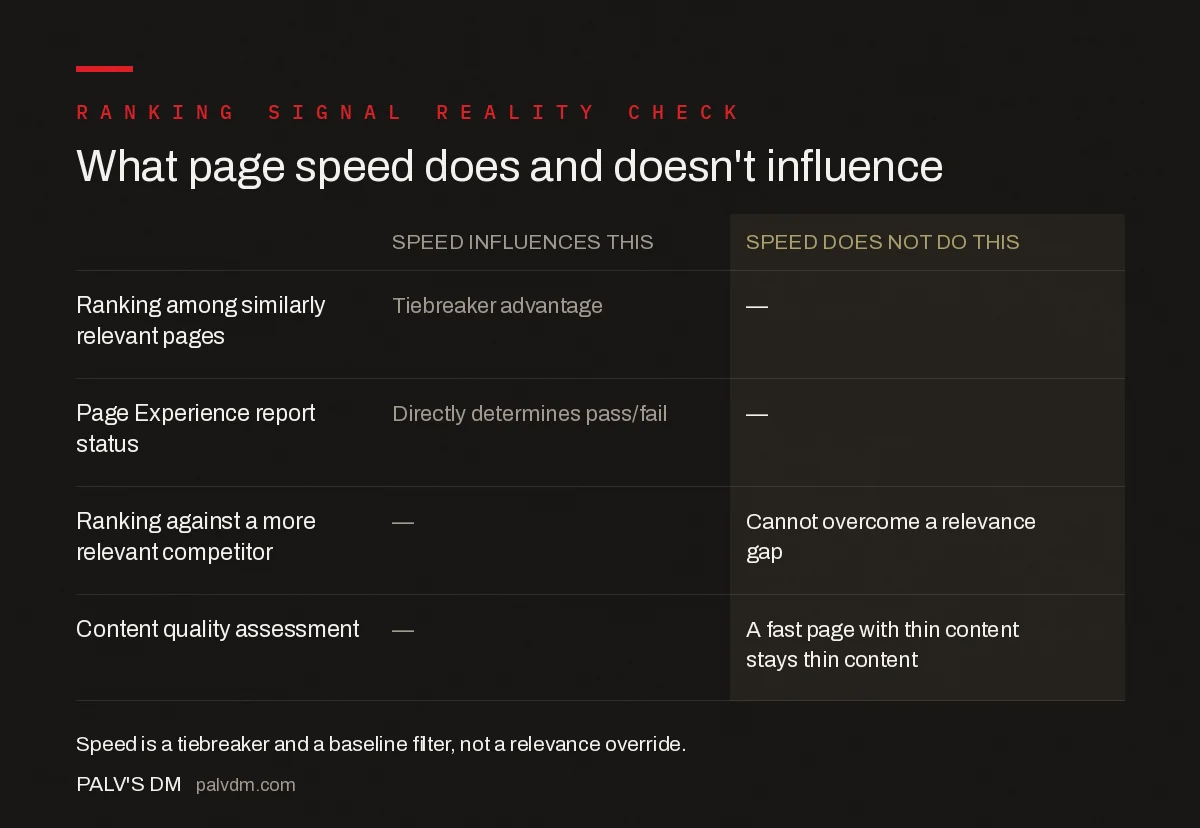
What page speed does and doesn’t influence
| Factor | Speed influences this | Speed does not do this |
|---|---|---|
| Ranking among similarly relevant pages | Tiebreaker advantage | — |
| Page Experience report status | Directly determines pass/fail | — |
| Ranking against a more relevant competitor | — | Cannot overcome a relevance gap |
| Content quality assessment | — | A fast page with thin content stays thin content |
What should a site actually prioritise: speed or content?
Both, sequenced correctly. If a page is failing Core Web Vitals badly — LCP over 4 seconds, CLS over 0.25 — that’s worth fixing first, because it’s an active handicap against every competitor passing the same checks. Once a page is solidly in “Good” territory, further speed optimisation has diminishing returns for ranking specifically, even though it still helps conversion rate and user experience. At that point, content depth, relevance, and internal linking are the higher-leverage lever.
Frequently asked questions
Is page speed a ranking factor?
Yes. Google has used page speed as a ranking signal since 2010 on desktop and 2018 on mobile, and folded it into the broader Core Web Vitals framework in 2021. It functions as one of many signals, not a dominant one, and mainly matters as a tiebreaker between otherwise similar pages.
Can a fast page outrank a slower page with better content?
Rarely. Google prioritises relevance and content quality far above page experience signals. A fast page that answers the query poorly will not outrank a slower page that answers it well; speed only tips the outcome when the pages are otherwise closely matched on relevance.
Does PageSpeed Insights score directly determine rankings?
No. The 0-100 Lighthouse performance score shown in PageSpeed Insights is a lab metric for developers and isn’t used directly in ranking. Google’s ranking-relevant Core Web Vitals data comes from real-user field data collected through the Chrome UX Report instead.
Do all three Core Web Vitals matter equally?
They’re assessed together, but a page needs to pass all three — LCP, INP, and CLS — to get a “Good” page experience rating. Failing even one metric, most often LCP on image-heavy pages or INP on JavaScript-heavy interactions, keeps the page out of the “Good” bucket entirely.
Sources
- Understanding Core Web Vitals and Google Search Results — Google Search Central
- Core Web Vitals: The Complete Guide
- Technical SEO: The Complete Working Guide
- Field Data vs Lab Data: Why PageSpeed Shows Two Scores
Want this done on your site?
Every PalV’s DM engagement starts with a free audit of your actual website — a 12-point
crawl covering what is blocking indexation, on-page gaps against your primary keywords, speed
findings, and the three to five fixes worth making first. Delivered in two working days. No
payment details, and the findings are yours whether you hire us or not.