Does Schema Improve Rankings Directly? The Honest Answer
Google has said repeatedly that schema markup is not a ranking factor. Here is what it actually does, and why marked-up sites often still rank well.

No, schema markup does not directly improve your Google rankings, and Google has said this plainly, more than once. What it does is make your page eligible for rich results, star ratings, FAQ accordions, breadcrumbs, and give search engines and AI systems a cleaner, structured read of your content. That’s a real benefit. It’s just not the one most SEO advice implies.
This myth persists because the correlation is real even though the causation isn’t. Sites with well-implemented schema often do rank well. But that’s usually because the same team that bothers to implement schema correctly also tends to write clearer content, structure pages better, and handle technical SEO competently across the board. Schema is a symptom of a well-run site, not the cause of one ranking.
What has Google actually said about this?
Google’s own structured data documentation states it directly: a structured data manual action “means that a page loses eligibility for appearance as a rich result; it doesn’t affect how the page ranks in Google web search.” That’s about as unambiguous as Google gets on any SEO question.
John Mueller has repeated the same point across multiple public Q&As over the years: there’s no generic ranking boost from structured data, and having it on a page doesn’t substitute for the actual ranking factors like content quality, relevance and links. Danny Sullivan, Google’s Public Liaison for Search, has said the same thing even more bluntly in public replies: schema doesn’t affect ranking. Gary Illyes has made comparable comments at industry conferences, and the position has been consistent from Google since roughly 2018, not something that shifted with a recent update.
What Mueller has been more open about is a narrower, related point: structured data can help Google understand a page’s content better, which in turn can support relevance matching for a given query. That’s a real mechanism, but it’s meaningfully different from “adding schema increases your rank.” Understanding a page correctly is table stakes, not a bonus multiplier.
Claim vs reality: sorting out what schema does and doesn’t do
Most of the confusion collapses once you separate the specific claims people repeat from what’s actually documented.
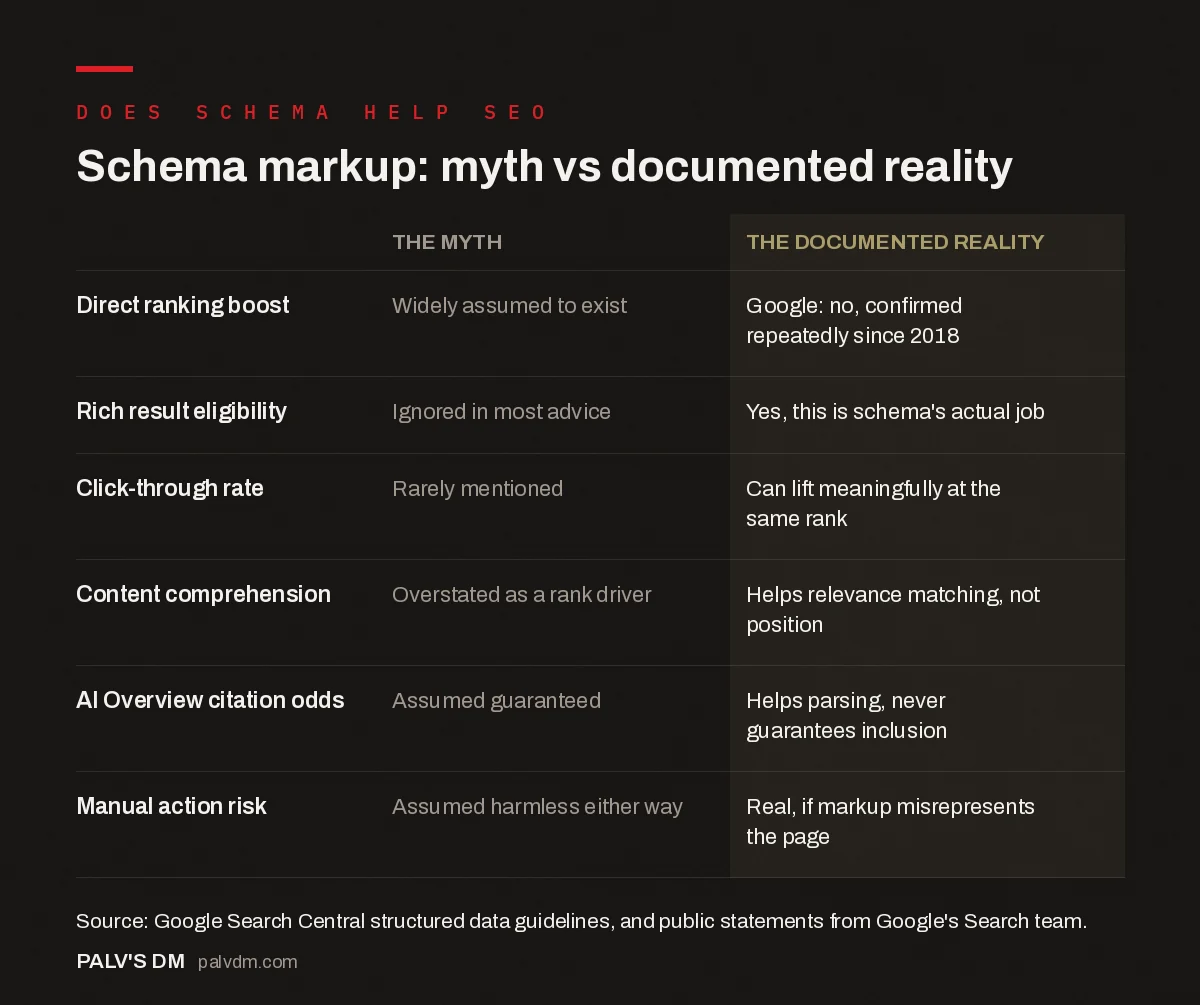
Schema markup: myth vs documented reality
| The myth | The documented reality | |
|---|---|---|
| Direct ranking boost | Widely assumed to exist | Google: no, confirmed repeatedly since 2018 |
| Rich result eligibility | Ignored in most advice | Yes, this is schema’s actual job |
| Click-through rate | Rarely mentioned | Can lift meaningfully at the same rank |
| Content comprehension | Overstated as a rank driver | Helps relevance matching, not position |
| AI Overview citation odds | Assumed guaranteed | Helps parsing, never guarantees inclusion |
| Manual action risk | Assumed harmless either way | Real, if markup misrepresents the page |
Look at that list and a pattern emerges. Almost everything schema genuinely does is downstream of comprehension and presentation, not ranking. That’s not a small thing. Click-through rate differences from rich results are one of the more reliable levers available in on-page SEO, and CTR itself can indirectly correlate with ranking signals over time even though schema isn’t the direct cause.
So why do people keep insisting schema boosts rankings?
A few reasons, and none of them involve Google being secretly dishonest about it. First, correlation is genuinely easy to mistake for causation here. Sites that implement schema correctly are disproportionately run by people who also do everything else right: fast hosting, clean internal linking, well-structured content. Strip out schema from those sites and they’d probably still outrank thinner competitors.
Second, the SEO industry has a long history of overselling small technical wins as ranking silver bullets, because “add this markup and rank higher” is a much easier pitch than “here’s why your content underperforms.” I’ve had more than one client ask specifically for schema because a previous agency framed it as a ranking hack. It’s an easier sell than telling someone their service pages need a rewrite.
Third, rich results genuinely do move the needle on traffic, just not through the mechanism people assume. A page that jumps from a plain blue link to one with a star rating and FAQ dropdown can see a meaningfully higher click-through rate at the same ranking position. That traffic increase feels like a ranking win even when the position in the results never moved.
What should you actually prioritise schema for?
- Rich result eligibility on high-intent pages. FAQ, HowTo, Review and Product schema on pages where a visible enhancement genuinely helps the click decision.
- Entity clarity for AI systems. Organization, Person and Article schema help AI Overviews and other answer engines parse who you are and what the page is about, which supports citation odds even without a guarantee.
- Consistency with visible content. Every property you mark up should describe something a human reader can actually see on the page. Marking up content that isn’t visible is a direct violation of Google’s guidelines and risks the manual action mentioned above.
- Not chasing every schema type available. There’s no benefit to marking up types that don’t apply to your content. It adds maintenance overhead for zero return.
What about the studies that claim a ranking correlation?
You’ll come across blog posts citing correlation studies that show pages with schema markup ranking, on average, in higher positions than pages without it. Treat these carefully. A correlation study measuring thousands of ranking pages cannot isolate schema as the cause, because it can’t control for everything else those same sites are doing right: page speed, backlink profile, content depth, internal linking. Schema tends to travel with technically competent site management. That’s the confound, and it’s a big one.
If you want a cleaner signal than a correlation study, look at what happens on a single site before and after adding schema with nothing else changed. In my own client work, that’s where the pattern actually shows up: rankings hold steady, and what moves is click-through rate on the specific queries where a rich result now appears. That’s a small but real distinction worth keeping straight before you present schema to a client or a boss as a ranking fix.
None of this means correlation studies are worthless. They’re useful for spotting which schema types are becoming more common among competitive pages, which is a reasonable signal for prioritisation. They’re just not evidence that adding the markup itself moves your position.
Does this mean schema isn’t worth the effort?
No, and that’s worth being direct about. Skipping schema because “it doesn’t affect rankings” throws away a real, measurable lever: click-through rate. If two results sit at position four and one shows star ratings while the other doesn’t, the one with stars wins more clicks at the identical rank. Over months, that’s a meaningful amount of traffic left on the table for a markup task that usually takes under an hour per template.
The honest framing is this: implement schema because it improves how your page is displayed and understood, not because you expect it to move you up the results page. Get that expectation right and schema stops being a disappointment and starts being what it actually is, a solid, low-effort visibility tool.
Set expectations with clients the same way. Promising a ranking lift from schema sets up a conversation you’ll lose in three months when nothing moves. Promising better click-through rate on pages that earn a rich result is a claim you can actually stand behind, and it’s usually the more valuable outcome anyway.
Frequently asked questions
Does adding schema markup make my page rank higher?
No, not directly. Google has stated repeatedly, including in its own documentation, that structured data is used for eligibility to rich results, not as a ranking signal on its own. A page with perfect schema and weak content will not outrank a page with strong content and no schema.
What does schema markup actually do then?
It makes your page eligible for rich results like star ratings, FAQ dropdowns, breadcrumbs and recipe cards, and it gives search engines and AI systems a clearer, machine-readable description of your content. Both of those can lift click-through rate and citation odds without changing your position in the results.
Can schema markup hurt my rankings?
Schema that misrepresents the page, marks up content that isn’t visible to users, or is used deceptively can trigger a manual action, which removes rich result eligibility and in serious cases can affect the site more broadly under Google’s spam policies. Accurate schema carries no such risk.
Does schema help with AI Overviews and AI search?
It helps indirectly, the same way it helps traditional search: by making the page’s structure and facts easier for a system to parse and extract accurately, which supports being selected as a source. It’s not a guaranteed inclusion mechanism for AI Overviews or any AI answer engine.
Is JSON-LD better than microdata for SEO?
Google recommends JSON-LD as its preferred format because it sits separately from the visible HTML, which makes it easier to implement and maintain without touching page templates. Microdata and RDFa are still supported and equally valid technically, just more work to maintain.
How do I know if my schema is working?
Check the Rich Results Test for validity, then check Search Console’s relevant enhancement reports over the following weeks to see if impressions with that rich result type start appearing. Working means eligible and displaying, not a ranking change.
Sources
- General Structured Data Guidelines — Google Search Central
- Google Confirms That Structured Data Won’t Make a Site Rank Better — Search Engine Journal
- Schema Markup: A Practical Guide With Copy-Paste JSON-LD
- Rich Snippets vs Rich Results vs SERP Features
- Marking Up Content That Isn’t Visible: Why It Backfires
- Rich Results Test vs Schema Validator: Different Jobs
Want this done on your site?
Every PalV’s DM engagement starts with a free audit of your actual website — a 12-point
crawl covering what is blocking indexation, on-page gaps against your primary keywords, speed
findings, and the three to five fixes worth making first. Delivered in two working days. No
payment details, and the findings are yours whether you hire us or not.