Rich Snippets vs Rich Results vs SERP Features: What’s Actually Different
Rich snippets and rich results are the same thing under different names. SERP features is the broader category both sit inside. Here's the actual hierarchy.

Rich snippets and rich results are the same thing, just two names for one concept: enhanced search listings generated from schema markup. SERP features is the broader category both sit inside, alongside things you can’t earn through markup at all, like the local pack or a knowledge panel. Most confusion in this space comes from treating three nested terms as three separate categories.
Google’s own glossary settled this years ago: rich snippets are now officially called rich results. Yet “rich snippet” never left common usage, so SEOs, clients and a lot of published content still use both terms as if they mean different things. They don’t. The real distinction worth understanding is the one between rich results and the wider universe of SERP features.
What is a SERP feature, exactly?
A SERP feature is anything on a search results page that isn’t a standard organic blue link. That’s a wide net: the local pack, the knowledge panel, image and video carousels, People Also Ask boxes, AI Overviews, and rich results all qualify. Some SERP features come from structured data you add. Others, like the knowledge panel, get generated algorithmically from Google’s own knowledge graph and can’t be triggered by markup at all, no matter how correctly you implement it.
This is the piece that trips people up in client conversations. Someone asks “how do I get a knowledge panel,” and the honest answer is you can’t request one directly the way you can request rich result eligibility with schema. A knowledge panel is Google deciding your entity is significant enough to warrant one, informed by signals across the web, not a checkbox you tick in your markup.
How do the three terms actually relate to each other?
Think of it as three rings, not three separate boxes.
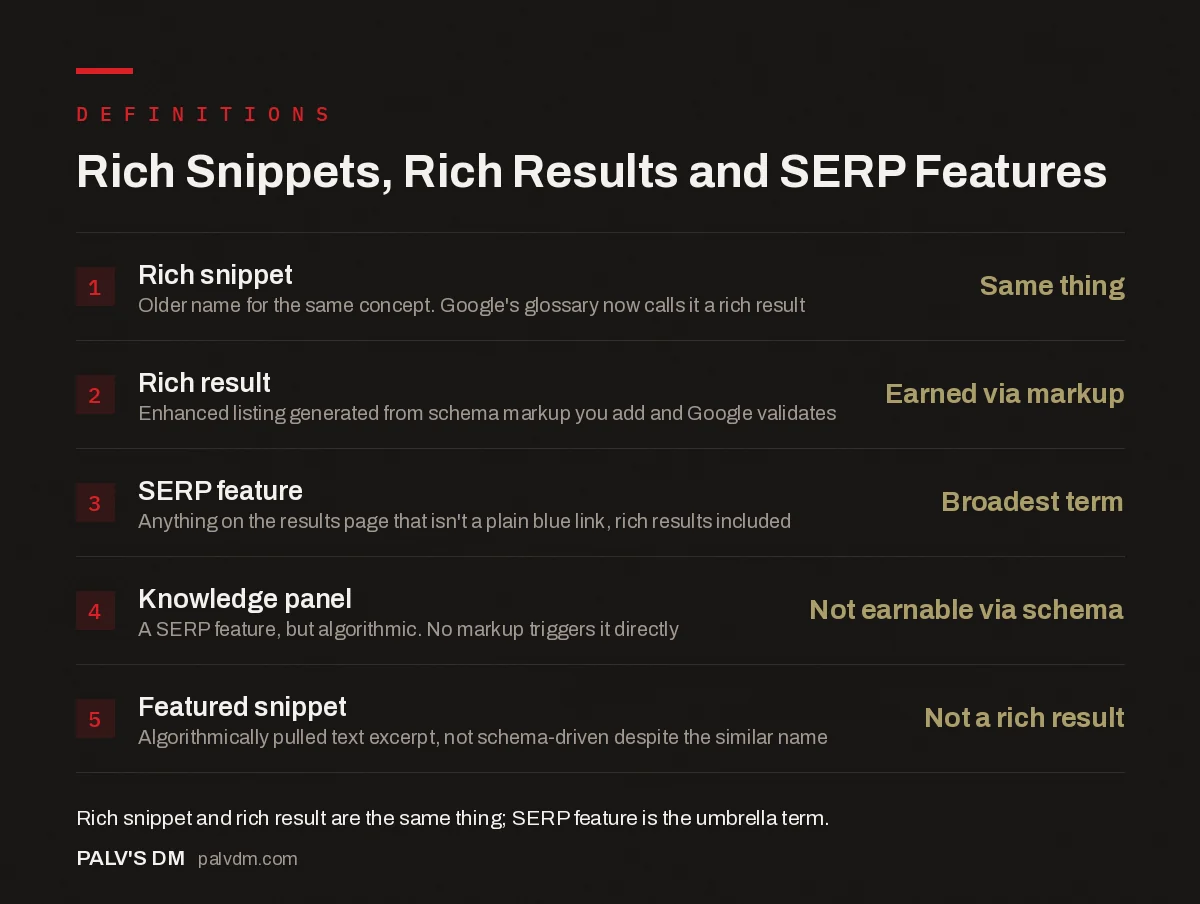
Rich Snippets, Rich Results and SERP Features
- Rich snippet: same as rich result. Older name for the same concept. Google’s glossary now calls it a rich result.
- Rich result: earned via markup. Enhanced listing generated from schema markup you add and Google validates.
- SERP feature: the broadest term. Anything on the results page that isn’t a plain blue link, rich results included.
- Knowledge panel: not earnable via schema. A SERP feature, but algorithmic. No markup triggers it directly.
- Featured snippet: not a rich result. Algorithmically pulled text excerpt, not schema-driven despite the similar name.
Everything in the “rich results” ring also counts as a SERP feature, since by definition it’s not a plain blue link. But plenty of SERP features sit outside that ring entirely, because they don’t come from schema markup on your page at all.
What types of rich results actually exist right now?
Google publishes an official gallery of supported types, and it’s worth checking directly rather than trusting a list from 2022 that’s gone stale. The types most businesses realistically use include Review (the yellow star rating), Product (price, availability, shipping info), Recipe, Event, and Software App. Each has its own required and recommended fields documented in Google’s structured data guidelines, and eligibility depends on meeting those exactly, not just having valid JSON-LD somewhere on the page.
Two types deserve a specific callout because so much older content still recommends them at face value: FAQ and HowTo. Google announced in August 2023 that it was reducing how often these two display in search results, aiming for what it called a cleaner, more consistent search experience. The schema still validates and Google still reads it. It just shows up as a rich result far less often than it did before that change.
Does adding a rich result improve rankings?
No, and Google has said so directly: structured data is not a ranking factor. What it changes is presentation, not position. A product listing with a star rating and price sitting at position six can out-click a plain blue link sitting at position four, because the enhanced listing gives someone a reason to pick it over a competitor before they’ve even clicked through. That’s a real, measurable click-through improvement. It’s just not the same thing as ranking higher, and treating rich results as a ranking tactic sets the wrong expectation with a client who’s watching position, not clicks.
Where do AI Overviews fit into all this?
AI Overviews are a SERP feature, not a rich result. They’re generated by Google’s models synthesising an answer from multiple sources, not by structured data you add to a single page requesting eligibility. A page can have flawless schema markup and never appear in an AI Overview, and a page with no schema at all can get cited in one if the underlying content answers the query clearly.
What schema does contribute here is indirect but real: clean, well-marked-up content is easier for any system, Google’s classic index or an AI model summarising sources, to parse and attribute correctly. We treat schema as part of machine readability generally, not as a lever aimed specifically at any one SERP feature. Chasing “schema that gets me into AI Overviews” is the wrong framing. Chasing “content and markup clear enough that any system parsing it gets the facts right” is the one that actually holds up across whichever feature Google (or another engine) decides to show.
Why does this distinction actually matter for a business owner?
Because it changes what you can reasonably promise a client or expect from a project. If someone asks for “a knowledge panel,” the honest scope of work is entity-building work across multiple signals over months, not a schema sprint. If someone asks for “rich snippets on our product pages,” that’s a concrete, achievable task with a clear validation step. Conflating the two, treating every SERP feature as equally winnable through markup, sets expectations no amount of correct JSON-LD will meet.
The practitioner habit worth building here: before quoting or scoping any structured-data work, name specifically which rich result type you’re targeting and check Google’s current documentation for its eligibility requirements. Requirements change (the FAQ and HowTo reduction is proof of that), and a scope built on last year’s rules wastes a client’s budget on markup that technically validates but rarely displays.
How do you check whether your page actually qualifies?
- Run the page through Google’s Rich Results Test first, before assuming your CMS or plugin added markup correctly. A green tick under “Detected items” confirms it’s valid and eligible, not just present.
- Check Search Console’s Enhancements reports for each schema type you’re using. It separates errors (the item is ineligible) from warnings (eligible but missing a recommended field), and that distinction changes what you fix first.
- Confirm the markup describes visible content. Google’s structured data policies require what’s marked up to actually appear on the page a visitor sees. Markup for content that isn’t there is a policy violation, not a shortcut.
- Re-test after any template change. Schema commonly breaks silently when a theme update or a plugin change alters the page’s HTML structure around it.
If you’re setting up schema for the first time or auditing what’s already live, our practical schema markup guide walks through implementation with copy-paste JSON-LD for the common types.
Frequently asked questions
Are rich snippets and rich results actually the same thing?
Yes. Google’s own glossary states rich snippets are now called rich results. The term “rich snippet” is the older name that stuck around in common SEO usage after Google formally renamed the concept, but there’s no functional difference between them today.
Is a featured snippet the same as a rich snippet?
No, and this is the mix-up that causes the most confusion. A featured snippet is an algorithmically generated text excerpt Google pulls from a page’s content. A rich snippet requires structured data markup you add deliberately. Google decides what goes in a featured snippet; you control whether a rich result is eligible.
Do rich results directly improve rankings?
No. Google has said structured data isn’t a ranking factor. What rich results change is how a listing looks at whatever position it already ranks, which can lift click-through rate even without moving the ranking itself.
Why did my FAQ rich results disappear?
Google reduced how often FAQ and HowTo rich results display in search, a change it announced in August 2023 to keep results cleaner. The schema still validates and can still trigger the rich result; Google just shows it less often than it used to for these two types specifically.
What’s the difference between a rich result and a SERP feature?
Every rich result is a SERP feature, but not every SERP feature is a rich result. SERP features include things like the local pack and knowledge panels, which Google generates algorithmically and that you can’t add structured data to trigger directly.
Sources
- Search Gallery: supported structured data types, Google Search Central
- Changes to HowTo and FAQ rich results, Google Search Central Blog
- Schema Markup: A Practical Guide With Copy-Paste JSON-LD
- Does Schema Improve Rankings Directly?
- FAQPage Schema After Google Reduced Its Display
- HowTo Schema: Where It Still Earns Results
Want this done on your site?
Every PalV’s DM engagement starts with a free audit of your actual website — a 12-point
crawl covering what is blocking indexation, on-page gaps against your primary keywords, speed
findings, and the three to five fixes worth making first. Delivered in two working days. No
payment details, and the findings are yours whether you hire us or not.