Faceted Navigation: Controlling the Crawl Explosion
Faceted navigation causes more crawl-budget waste than any other single site pattern. Here is how to decide which filter combinations to block, canonicalize, or let index.
Faceted navigation is the single most common source of crawl-budget waste Google encounters, because every filter and sort combination on a category page can generate its own crawlable URL, and an unmanaged filter set multiplies a few hundred real products into tens of thousands of near-duplicate ones. Controlling it means deciding, facet by facet, which combinations deserve a URL, which deserve a canonical tag, and which should never be requested by a crawler at all.
The fix isn’t “block everything” or “index everything” — both extremes cause damage. Block too aggressively and you lose long-tail category rankings worth real traffic. Index too liberally and Googlebot spends its budget re-crawling filter permutations instead of finding new or updated products, which is the more common failure mode on large ecommerce sites.
What is faceted navigation and why does it explode crawl demand?
Faceted navigation is the sidebar or top-bar filter system on a listing page — brand, size, color, price range, rating, availability — that lets a shopper narrow a category. Each filter applied typically appends a query parameter or path segment to the URL. The explosion happens combinatorially: a category with six filter types, each offering four to eight options, produces thousands of mathematically possible URL combinations even if only a few hundred SKUs exist underneath them. Sort order and pagination multiply that further, since ?sort=price-asc and ?sort=price-desc of the same filtered set are each a distinct crawlable URL by default.
How do you decide which facets deserve an indexable URL?
Score each facet type against two questions: does it have standalone search demand, and does the resulting page have enough unique inventory to justify existing as a page. A single-attribute facet like “brand” or “category-plus-material” often clears both bars — “leather office chairs” is a real query with real search volume. A three-way combination like brand-plus-color-plus-price almost never does; nobody searches “Herman Miller black chairs under $500,” and the page underneath it usually shows the same five products as several sibling combinations.
| Facet pattern | Search demand | Recommended treatment |
|---|---|---|
| Single high-value attribute (e.g. /shoes/waterproof/) | Often real, measurable | Indexable, self-canonical, in sitemap |
| Two-attribute combination with volume (e.g. /shoes/waterproof/mens/) | Sometimes real | Indexable only if inventory is unique; otherwise canonical to parent |
| Price range, size, color filters | Rarely searched directly | Canonical to unfiltered category, crawlable |
| Sort order (price, rating, newest) | None | Blocked in robots.txt, never crawled |
| Session, tracking, or pagination-plus-filter combos | None | Blocked in robots.txt; use rel=next-style link hints for pagination itself |
How do you technically control the combinations Google crawls?
Three tools do different jobs, and using the wrong one for a given facet is the most common implementation error. Google’s own large-site guidance is direct on this point: block low-value parameter combinations in robots.txt rather than relying only on noindex, because a robots.txt Disallow prevents the crawl request from happening at all, while a noindex tag still costs a full crawl — Googlebot has to fetch the page to read the tag before it can discard the result.
- Robots.txt Disallow — for facet combinations with zero search value: sort parameters, session IDs, three-plus filter stacks. Stops the request before it costs anything.
- Canonical tag — for facets that should stay crawlable (for freshness or internal linking) but shouldn’t compete with the parent category in the index. Costs a crawl but consolidates ranking signals.
- Parameter handling and internal link discipline — the underlying fix. If low-value facet URLs are never linked from crawlable pages in the first place, Googlebot has far less to discover regardless of what robots.txt says.
How much crawl budget does faceted navigation actually consume?
On unmanaged ecommerce sites, faceted URLs commonly account for a large share of total crawl activity — in some site audits, over a third of all crawl requests hit parameter-based URLs that deliver no unique ranking value, and on larger catalogs that share can run well past half. That’s crawl budget not spent discovering new products, updated pricing, or restocked inventory, which is the actual cost, not the faceted pages themselves.
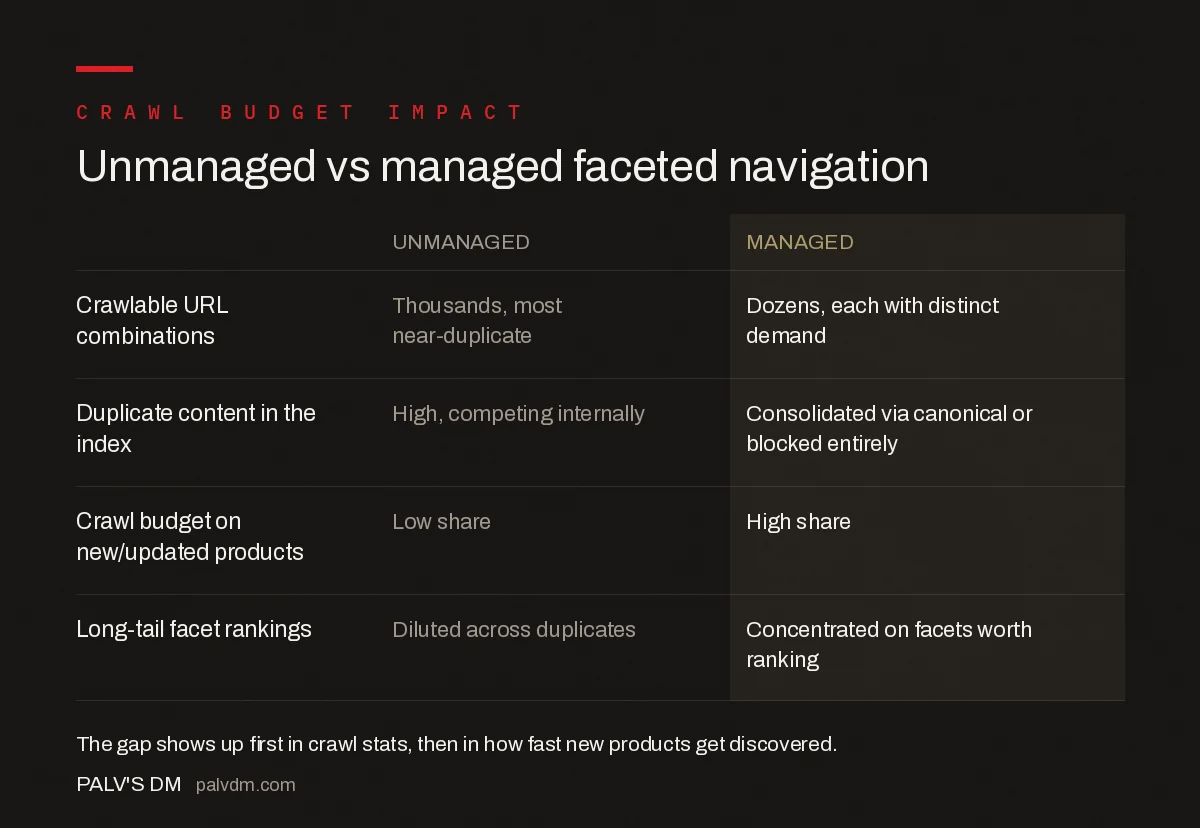
Unmanaged vs managed faceted navigation
| Metric | Unmanaged | Managed |
|---|---|---|
| Crawlable URL combinations | Thousands, most near-duplicate | Dozens, each with distinct demand |
| Duplicate content in the index | High, competing internally | Consolidated via canonical or blocked entirely |
| Crawl budget on new/updated products | Low share | High share |
| Long-tail facet rankings | Diluted across duplicates | Concentrated on the facets worth ranking |
What does a working faceted navigation implementation look like?
Start with an audit: crawl the site with a tool like Screaming Frog configured to follow faceted links, and group the resulting URLs by parameter pattern rather than reading them one at a time. That grouping is what reveals which patterns are actually generating volume versus which exist in theory only. From there, apply the table above facet type by facet type, not page by page — a single robots.txt rule or canonical pattern typically covers an entire class of URLs at once.
Static, clean URLs for the facets worth indexing — /shoes/waterproof/ rather than /shoes/?attr=waterproof — also help, because they’re easier to include deliberately in an XML sitemap and easier for users to link to externally, which is a ranking signal parameter-based URLs rarely accumulate.
What mistakes make faceted navigation worse instead of better?
- Noindexing everything instead of blocking the zero-value combinations. This still burns crawl budget on every noindexed URL, solving the duplicate-content problem while leaving the crawl-waste problem untouched.
- Canonicalizing every facet to the root category. This kills legitimate long-tail rankings for facets that do have search demand, treating a real opportunity the same as junk.
- Blocking facets in robots.txt after they’re already indexed. Google can’t recrawl a blocked URL to see a noindex tag or discover it should drop out, so already-indexed junk pages can linger. Noindex first, block after they’ve dropped from the index.
- Ignoring internal link discipline. Robots.txt rules only stop new crawl requests; they don’t stop internal navigation from generating fresh combinations for users and bots to click into.
Frequently asked questions
What is faceted navigation in SEO terms?
Faceted navigation is the filter and sort system on category or listing pages — size, color, price range, brand — where each combination can generate its own URL. Left unmanaged, those combinations multiply into thousands of near-duplicate pages that compete for the same crawl budget and rankings as the main category page.
Should faceted URLs be blocked with robots.txt or noindex?
Robots.txt for the combinations with no search demand and no unique content, because a Disallow stops the crawl request before it happens. Noindex still costs a crawl, since Googlebot has to fetch the page to read the tag, so reserve it for facets you want crawled for freshness but never shown in results.
Which facet combinations are worth letting Google index?
Ones with real, standalone search demand and enough unique product inventory to justify a page — a single high-volume attribute like “waterproof hiking boots,” not a three-way combination like size-color-price that no one searches for. If a facet page wouldn’t rank for anything on its own, it shouldn’t be indexable.
Does canonicalizing faceted URLs to the main category page fix crawl budget?
It fixes duplicate-content indexing but not crawl budget, because Googlebot still has to request the faceted URL to discover the canonical tag inside it. For genuine crawl-budget savings, the URL needs to be blocked from being requested at all, typically in robots.txt or by removing the crawlable link path.
Sources
- Large Site Owner’s Guide to Managing Crawl Budget — Google Search Central
- Technical SEO: The Complete Working Guide
- Mobile-First Indexing: What Still Trips Sites Up
- hreflang Implementation Without the Common Errors
- Mixed Content and HTTPS Issues That Break Rankings
Want this done on your site?
Every PalV’s DM engagement starts with a free audit of your actual website — a 12-point
crawl covering what is blocking indexation, on-page gaps against your primary keywords, speed
findings, and the three to five fixes worth making first. Delivered in two working days. No
payment details, and the findings are yours whether you hire us or not.