Service Support — AI Visibility
GEO for a B2B SaaS: What the Work Looks Like
GEO for SaaS starts with an audit, not new content — fixing comparison pages, docs, and crawler access before writing anything new from the ground up.
GEO for a B2B SaaS company means treating the docs, comparison pages, and blog archive you already have as raw material AI engines pull answers from — not writing a stack of new content first. The work starts with an audit of what ChatGPT, Perplexity, and Gemini already say about your product category, then fixes the specific page types — comparison, integration, pricing, and “alternatives to X” — that those engines cite most when a buyer asks about software like yours. For most SaaS accounts, that means restructuring pages that already exist before anything gets written from scratch.
Key takeaway
- GEO for SaaS starts with an audit of existing docs, comparison pages, and blog posts — not a new content plan.
- Comparison and “alternatives to” pages get cited more than any other page type in software categories, so they’re fixed first.
- Citation results show up on a different timeline than rankings — usually visible within four to eight weeks, tracked across five engines monthly.
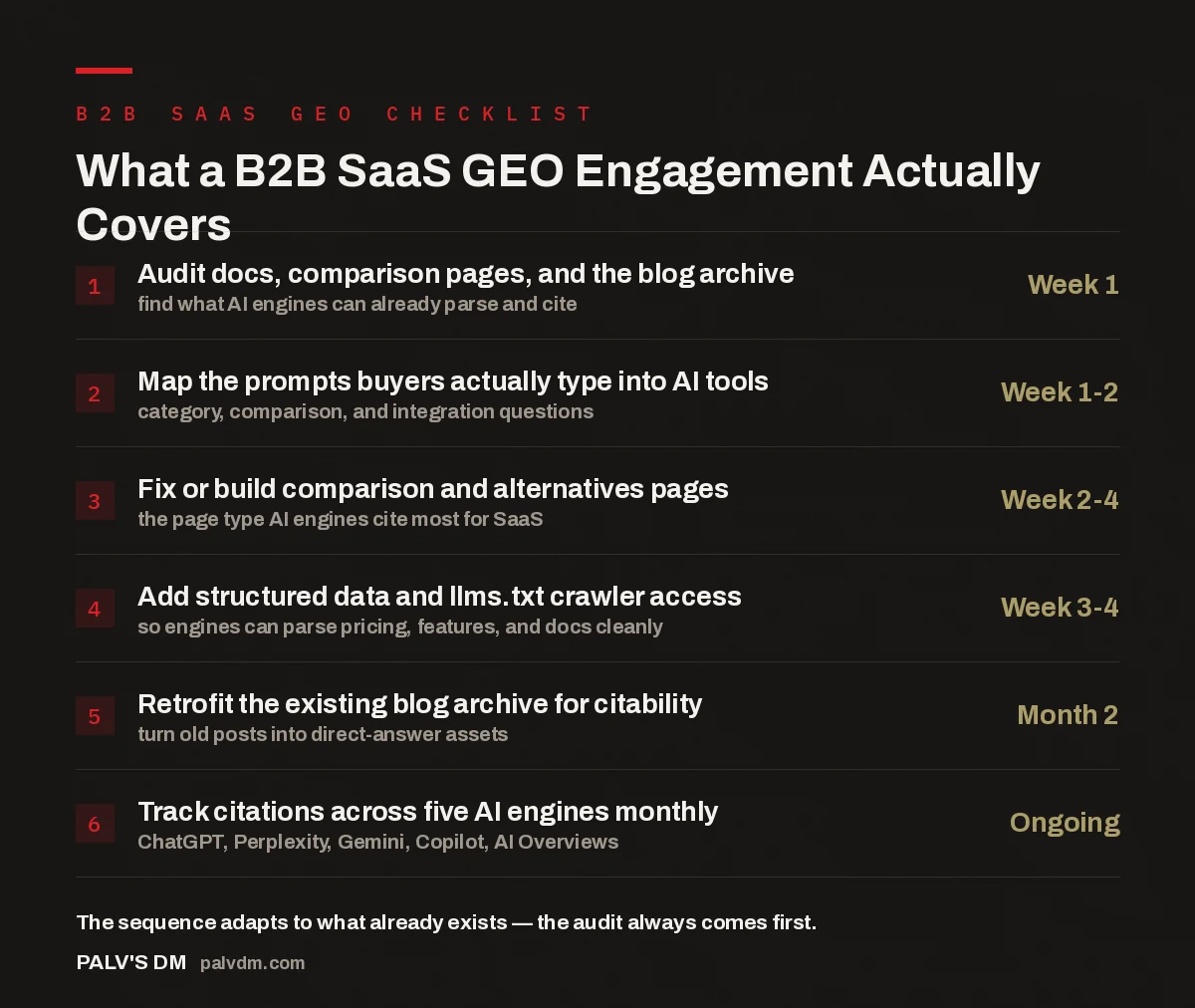
What a B2B SaaS GEO Engagement Actually Covers
- Audit docs, comparison pages, and the blog archive — Week 1. find what AI engines can already parse and cite.
- Map the prompts buyers actually type into AI tools — Week 1-2. category, comparison, and integration questions.
- Fix or build comparison and alternatives pages — Week 2-4. the page type AI engines cite most for SaaS.
- Add structured data and llms.txt crawler access — Week 3-4. so engines can parse pricing, features, and docs cleanly.
- Retrofit the existing blog archive for citability — Month 2. turn old posts into direct-answer assets.
- Track citations across five AI engines monthly — Ongoing. ChatGPT, Perplexity, Gemini, Copilot, AI Overviews.
What does GEO actually change for a SaaS product?
GEO changes whether your product shows up when someone asks an AI engine a buying question instead of typing a Google search. A prospect evaluating project management tools used to type “best project management software for agencies” into Google and click through ten blue links. Increasingly, the same person asks ChatGPT or Perplexity and gets a synthesized answer naming three or four tools — with no guarantee your product is one of them, even if you’d rank on page one of Google for that exact phrase. GEO makes sure your product is one of the names in that answer, and that the reasoning behind why is accurate.
For a B2B SaaS company specifically, this matters more than in most categories because software buying already runs through heavy research before a demo call happens. Category comparisons, “vs” pages, integration docs, and pricing pages get consulted repeatedly across a buying committee — and those are exactly the page types AI engines lean on to answer product questions, because they’re structured, factual, and easy to extract a clean comparison from. That’s why fixing them is where GEO work for SaaS actually starts.
Where does the work start for a B2B SaaS account?
The first step is the same AI visibility audit we run before any GEO engagement, not content production. Before writing anything, we check what AI engines currently say about your product category — running the prompts a real buyer would use (“best X for Y team size,” “X vs Z,” “does X integrate with Salesforce”) across ChatGPT, Perplexity, Gemini, and Copilot, and recording whether your product appears, what’s said about it, and which pages (yours or a competitor’s) the engine is pulling from.
That audit tells you three things: whether you’re already cited somewhere and just need reinforcement, whether a competitor’s page is winning a citation you should own, or whether your category isn’t being discussed by AI engines yet. Skipping this and jumping straight to writing “AI-optimized” content is the most common way SaaS teams waste a GEO budget — producing pages nobody asked an AI engine about, in a format it was never going to cite anyway.
What content does a SaaS company already have that GEO can use?
Most B2B SaaS companies have more usable raw material than they think: a help center, an API or integration doc set, a handful of “vs competitor” pages someone wrote for SEO years ago, and a blog archive with useful how-to and definitional posts buried under thin, promotional ones. GEO work usually restructures this existing library before it produces new pages:
- Comparison and “alternatives to” pages — rewritten so the verdict and criteria are stated plainly near the top, not buried under a sales pitch
- Integration and API docs — reformatted with direct, self-contained answers to specific setup questions instead of only prose walkthroughs
- Pricing pages — clarified so plan names, limits, and what’s included are stated as discrete facts an engine can extract, not just laid out in a pricing table image
- Older blog posts with genuine expertise — restructured with direct answers and clear headings rather than rewritten from zero
This is also where crawler access gets checked. It’s common for a SaaS site’s docs subdomain to sit behind a separate crawl configuration, a login wall, or a robots rule nobody has reviewed since the site was built — any of which can quietly block pages an AI engine would otherwise cite. Setting up llms.txt and confirming crawlers can reach comparison and docs pages is a small technical step with an outsized effect: good content existing versus that content being reachable at all.
The SaaS accounts that get cited fastest almost never have the most content. They have the clearest comparison pages and the fewest crawler roadblocks in front of them.
Palash, Founder, PalV’s DM
How is GEO for SaaS different from GEO for ecommerce or a local business?
The prompts differ, and so does the buying committee behind them. A local business buyer asks something close to “best [service] near me” — a single-decision-maker query. An ecommerce buyer asks about a specific product against alternatives, often close to a purchase. A B2B SaaS buyer’s questions are layered and repeat across people: a manager asks about category fit, a technical evaluator asks about integrations and security, a finance stakeholder asks about pricing tiers — often in separate conversations with the AI engine, days or weeks apart.
That has a direct implication for prompt research: mapping prompts for a SaaS account means mapping the whole buying committee’s questions, not just the head-term category query. This is what our prompt research process is built to handle — an engagement that only optimizes for “best CRM software” and ignores “does [product] have SOC 2 compliance” is optimizing for one persona out of three or four who actually influence the decision.
What does month one of a SaaS GEO engagement look like?
- Run the AI visibility audit across ChatGPT, Perplexity, Gemini, Copilot, and Google AI Overviews for your category’s core prompts, and document where you’re cited, where a competitor is, and where nobody is.
- Map the prompt set for the full buying committee — category, comparison, integration, security, and pricing questions — not just the category head term.
- Fix or rebuild the two or three comparison and alternatives pages closest to your core category, since these are usually the highest-leverage pages in a SaaS account.
- Confirm llms.txt is set up and that AI crawlers can reach docs, help center, and comparison pages without hitting a login wall or blocked path.
By the end of month one, the goal isn’t a citation spike — it’s a clear map of which prompts matter, which pages are already close to citable, and which technical blockers are sitting in the way.
What happens in months two through six?
Months two and three are usually where turning the existing blog archive into AI-citable assets happens — taking posts with genuine expertise and restructuring them with direct-answer openings, question-style headings, and self-contained sections, rather than writing replacements from scratch. In the accounts we work on, this consistently produces citations faster than net-new content does, because the expertise and the site’s existing authority are already there; the post just wasn’t structured for an engine to extract from.
From month three onward, the work becomes tracking and iteration: monthly citation checks across five AI engines, watching for prompts where a competitor’s page has replaced yours or vice versa, and adjusting specific pages based on what’s actually happening rather than a fixed content calendar. This is the part of GEO that looks the least like traditional SEO — there’s no ranking position to chase, only a recurring, evidence-based question of “did we get cited on this prompt this month, and if not, why.”
How long before a B2B SaaS account sees results?
Citation changes tend to show up faster than organic rankings do, because there’s no equivalent of Google’s slow trust-building period for a single page — an AI engine can start citing a restructured comparison page within weeks of it being crawled, if the underlying signals (clarity, structure, crawler access) are in place. “Faster” is directionally true across the accounts we work on, not a guaranteed date: a site with clean technical access often sees the first citation shifts in four to eight weeks, while a site with crawler blockers or thin comparison pages takes longer, because those have to be fixed first.
Key takeaway
If you want a clear picture of where your SaaS product currently stands across AI engines — and a prioritized plan built from that, not a generic content list — that’s exactly what an AI visibility engagement starts with.
FAQ
Do we need to write new content for GEO, or can existing pages be reused?
Most B2B SaaS accounts can reuse the majority of existing content. Comparison pages, docs, and older posts usually just need restructuring — a direct answer up top, clearer headings — rather than a rewrite. New pages get built only where a genuine gap exists, like a missing alternatives page.
Which AI engines matter most for a B2B SaaS product?
ChatGPT, Perplexity, Gemini, Microsoft Copilot, and Google AI Overviews are the five we track monthly, since together they cover the tools B2B buyers reach for most when researching software. Weighting shifts by category, which is why the audit looks at all five rather than assuming one dominates.
Does GEO replace SEO for a SaaS company, or run alongside it?
Alongside it. Organic search still sends traffic and demo signups GEO doesn’t replace, and technical foundations — clean structure, crawlability, clear content — benefit both. Most SaaS accounts run GEO as an addition to an existing SEO program, prioritized around the pages that matter most for AI citation.
What if a competitor is already being cited for our category’s main comparison prompt?
It’s fixable, but it starts with understanding why their page is being cited — usually clearer structure, a more direct comparison table, or better crawler access, not something unbeatable. The fix is restructuring your comparison page to answer the prompt more clearly, confirming it’s reachable by AI crawlers, then tracking whether the citation shifts over the following months.
How is progress measured if there’s no ranking position to track?
Through a recurring citation log — running the mapped prompts across the five tracked engines each month and recording whether your product is mentioned, in what context, and against which competitors. That log is the equivalent of a rank tracker for AI visibility.
Short version: GEO for a B2B SaaS company is an audit-first process that restructures existing comparison pages, docs, and blog posts before producing new content, because those page types are what AI engines already reach for when answering software buying questions. The buying committee behind a SaaS purchase asks layered questions — category, integration, security, pricing — so prompt mapping has to cover all of them. Fix crawler access, fix the highest-leverage comparison pages first, retrofit the blog archive next, then track citations across five engines every month to see what’s actually moving.