Service Support — AI Visibility
GEO for an Ecommerce Catalogue
A practical guide to AI visibility for ecommerce catalogues: what makes product pages citable to AI engines, how to prioritise fixes, and where to start.

AI visibility for an ecommerce catalogue means restructuring product and category pages so tools like ChatGPT, Perplexity, and Google’s AI Overviews can pull your specs, comparisons, and review evidence directly into an answer — and credit you as the source. It is not a redesign of your storefront. It is a parallel layer: clean structured data, comparison content between your own SKUs, review text that is actually readable by a crawler, and a handful of category pages built to answer a buying question rather than just display a filtered grid. For a catalogue with hundreds or thousands of products, the real challenge in AI visibility for ecommerce is deciding where to start — you cannot rebuild every product page for citation-readiness in one pass, so the work has to be sequenced.
Key takeaway
- AI visibility work on a catalogue starts with structure, not more content — specs, review text, and comparisons need to exist in plain, crawlable HTML.
- Fix your highest-intent categories first and treat GEO as a phased rollout across the catalogue, not a one-time project touching every SKU at once.
- Track citations by category every month so you know which page changes are actually getting referenced, rather than assuming the whole catalogue improved together.
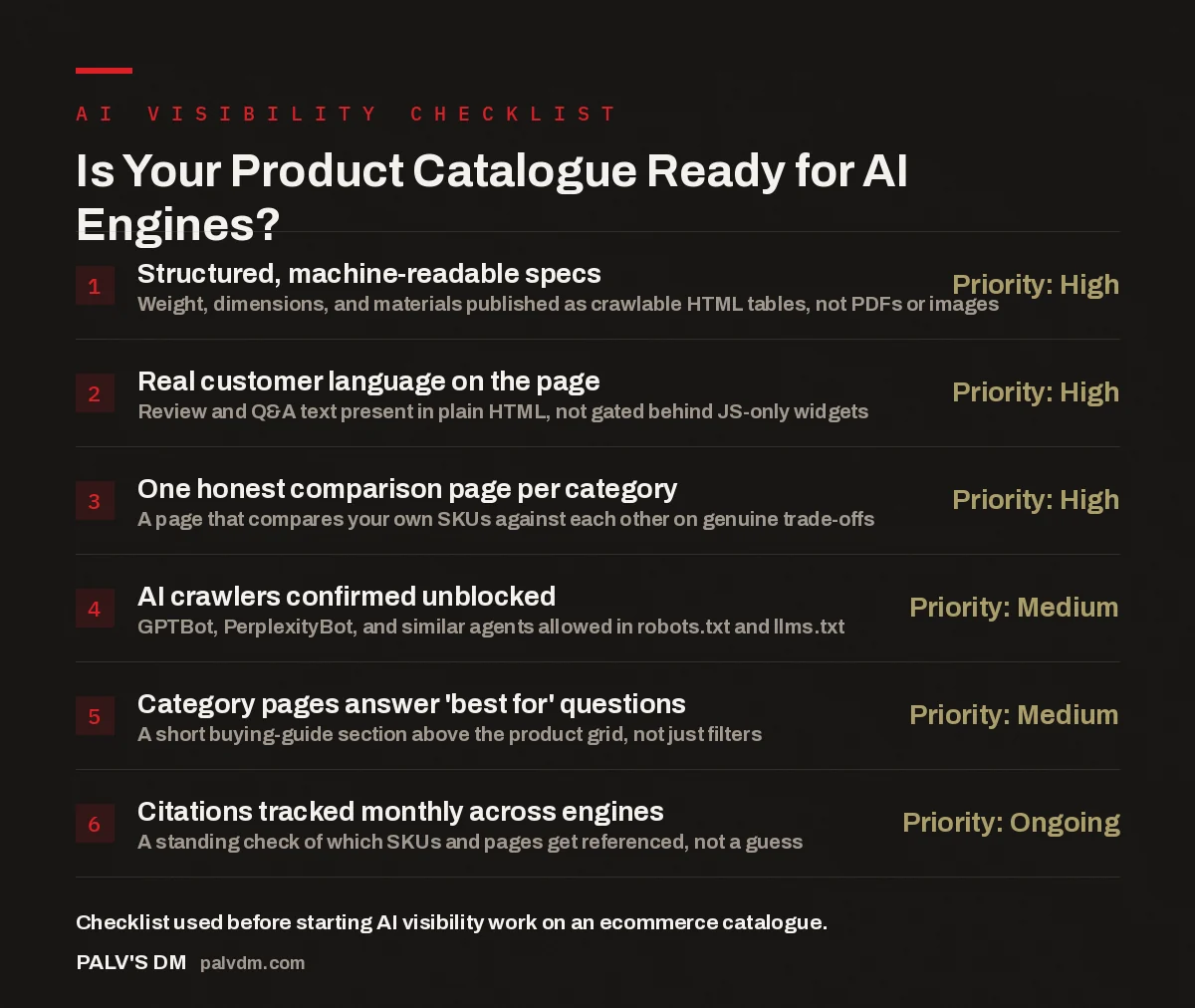
Is Your Product Catalogue Ready for AI Engines?
- Structured, machine-readable specs — Priority: High. Weight, dimensions, and materials published as crawlable HTML tables, not PDFs or images.
- Real customer language on the page — Priority: High. Review and Q&A text present in plain HTML, not gated behind JS-only widgets.
- One honest comparison page per category — Priority: High. A page that compares your own SKUs against each other on genuine trade-offs.
- AI crawlers confirmed unblocked — Priority: Medium. GPTBot, PerplexityBot, and similar agents allowed in robots.txt and llms.txt.
- Category pages answer ‘best for’ questions — Priority: Medium. A short buying-guide section above the product grid, not just filters.
- Citations tracked monthly across engines — Priority: Ongoing. A standing check of which SKUs and pages get referenced, not a guess.
Why does an ecommerce catalogue need a different GEO approach than a blog?
A blog post is written to be read start to finish, which is exactly the shape an AI engine likes to lift from. A product catalogue is not built that way. Most of the page is data — a spec table, a price, a gallery, a filter widget — rendered through a JavaScript storefront framework, with a few lines of unique description wedged in between. On top of that, product descriptions across a catalogue tend to be near-duplicates of each other with the noun swapped out, which gives a crawler very little to distinguish one SKU from the next.
Comparison, which is normally where the buying decision actually happens, usually occurs off-site: in a chat window, in a forum thread, in a “best X for Y” article you did not write. If your catalogue has no page that does that comparison honestly, an AI engine will source the comparison from somewhere else — a competitor’s page, a review site, a forum post — and you lose the citation even for your own products. That is the structural mismatch GEO for ecommerce is built to fix: not adding more content, but exposing the data and comparisons that already exist in your systems in a form a language model can actually parse.
What actually makes a product page citable in AI visibility for ecommerce?
In the accounts we work on, the pattern that shows up repeatedly is that citability has almost nothing to do with word count and almost everything to do with whether the page’s facts are extractable as text. A product page can be citable at 300 words if the specs are in an HTML table and the review evidence is readable, or invisible at 1,200 words if everything meaningful is locked inside a JavaScript accordion that only renders after a click.
- Specs as HTML, not images or PDFs. Weight, dimensions, materials, and compatibility need to sit in a real table an AI crawler can read, not a spec sheet graphic.
- Review text rendered server-side. If your reviews load only after a user scrolls or clicks a tab, most crawlers never see them — the star rating shows up, the substance behind it does not.
- A stated use case per product. “Best for small kitchens” or “not suited to outdoor use” gives an AI engine language it can match against a buyer’s actual question.
- Internal comparison content. A page that compares your own SKUs on genuine trade-offs, written plainly, rather than three near-identical listings.
This is the same discipline behind how we engineer a page for citation without wrecking it for readers — the goal is never to stuff a product page with keyword-y filler; it is to make sure the facts that are already true about the product are sitting in a form a model can lift cleanly.
How do you prioritise GEO work across thousands of SKUs?
You do not. Not all at once, anyway. The catalogues where AI visibility work actually moves the needle are the ones where the first pass is scoped narrowly: the categories that carry the most commercial intent, the SKUs with the highest margin, or the products that keep showing up in your own search and support data as things people are actively comparing before they buy. Everything else waits.
Before touching page templates, it is worth running the same kind of structured check we use in the AI visibility audit we run before anything else: which categories are already being surfaced or misrepresented by AI engines today, which product types have genuine buying-decision complexity (multiple materials, sizes, or use cases), and which pages currently rely entirely on JavaScript to render anything a crawler would need. That audit tells you where a template-level fix — one change applied across a whole category — will do more good than rewriting individual product pages one at a time.
You don’t get AI visibility by making every product page perfect at once. You get it by fixing the template, then building the ten pages that actually answer a shopping decision — and doing that before you touch anything else.
Palash, Founder, PalV’s DM
Which pages should you build or fix first?
Start with the pages that carry the comparison weight for the whole catalogue, not the individual product pages. In practice, that is usually three types of page:
- Category buying guides. A short, honest section above the product grid that answers “which type of [category] should I get for [use case]” — this is the page most likely to get pulled into an AI answer before a shopper ever reaches a product page.
- One comparison page per category. Your own SKUs laid out against each other on real trade-offs — price tier, durability, use case — so an AI engine can cite your comparison instead of a third-party review site’s.
- The 20-50 highest-intent product pages. Not your whole catalogue — the products people are actually researching before buying, fixed for structured specs and readable review text first.
This sequencing is roughly what an AI visibility engagement actually involves once the audit is done — it is closer to a phased content and markup rollout than a single technical project you finish and walk away from.
On the technical side, none of this matters if the crawlers behind these AI engines cannot reach your pages in the first place. Checking that GPTBot, PerplexityBot, and similar agents are not blocked in robots.txt, and putting a basic llms.txt file in place, is a separate but necessary step — covered in detail in how we set up llms.txt and crawler access for clients. Skipping this step means the rest of the work is invisible no matter how well-structured the pages are.
How do you know whether the changes are actually working?
You check, on a fixed schedule, which pages and SKUs are actually being cited — not whether traffic to the category “feels” different. AI citations do not show up in Google Search Console, and they are not consistent across engines: a product can get cited regularly in Perplexity and never appear in ChatGPT’s answers, or the reverse. Tracking this properly means running the same query set across multiple engines every month and logging which URLs get referenced, which is the approach we detail in how we track citations across five engines every month.
For a catalogue, the useful signal is not “are we visible” in the abstract — it is which categories moved after a template fix and which did not, so you know whether to roll the same fix out further or rethink it. A category that shows no citation movement three or four months after a structural fix usually means the underlying page still has a rendering or content problem the audit missed, not that AI visibility “doesn’t work” for that type of product.
Next step
If you’re not sure which categories in your catalogue are worth fixing first, that’s exactly what an audit is for.
FAQ
Does GEO replace SEO for an ecommerce site?
No. Traditional SEO still governs whether your category and product pages rank and get crawled by Google in the first place. GEO sits on top of that: the same well-structured page that ranks well is also the page an AI engine can extract facts from cleanly. Neglecting either one leaves value on the table.
How long does GEO take to show results on a large catalogue?
There’s no fixed timeline we’d put a precise number on, since it depends on how many categories you fix, how often AI engines recrawl your site, and how competitive the category is. Directionally, template-level fixes to a category tend to surface in citation tracking faster than one-off individual product page edits, simply because they touch more pages at once.
Do I need to rewrite every product description on my site?
No, and trying to would stall the project. Prioritise by intent: fix the category buying guides and comparison pages first, then the highest-intent product pages, then work down the list. Most catalogues never need every single SKU rewritten — the long tail rarely carries enough search or comparison volume to justify it.
Can this work if my store runs on a templated platform like Shopify or Magento?
Yes, and templated platforms actually help here — a fix made once to the product or category template applies across every page that uses it. The main thing to check first is whether specs, reviews, and descriptions render as plain HTML on page load, or only after JavaScript runs client-side, since that determines whether crawlers can see them at all.
What’s the difference between AI visibility ecommerce work and a general AI visibility audit?
The audit process is the same starting point regardless of site type. What differs for ecommerce is the scale problem — thousands of near-duplicate pages instead of dozens of articles — and the fact that the buying decision itself, the comparison between products, needs its own dedicated page rather than being assumed to live inside a single product listing.
Short version: GEO for an ecommerce catalogue is not a full rewrite. It’s structuring specs and reviews as crawlable HTML, building comparison and category buying-guide pages you currently don’t have, confirming AI crawlers can actually reach the pages, and tracking citations by category every month so you know which fixes to roll out further.