Service Support — AI Visibility
GEO for a Local Service Business
A practical checklist for ai visibility local business work: fix NAP consistency, complete your GBP, and rewrite service pages so AI engines cite you.
AI visibility for a local business means showing up when someone asks ChatGPT, Gemini, or Google’s AI Overviews a question like “best plumber near me” or “who does AC repair in [area]” — not just ranking in the traditional blue links. It runs on the same underlying facts as local SEO (Google Business Profile, reviews, NAP consistency, service pages) but the engines weigh those facts differently: they favour clear, specific, machine-readable answers over pages built purely to rank. If your listings are thin or your site talks in vague marketing language, an AI engine has nothing concrete to cite, and it recommends a competitor instead.
Key takeaway
- AI visibility for local businesses builds on the same data as local SEO — Google Business Profile, reviews, NAP consistency — but engines reward specificity over marketing copy.
- The fastest wins are usually structural: complete your Business Profile, fix inconsistent NAP data, and rewrite service pages so they answer real questions instead of listing city names.
- Third-party proof — reviews, local press, directory listings — matters more for AI citation than it ever did for classic rankings, because engines treat outside sources as corroboration.
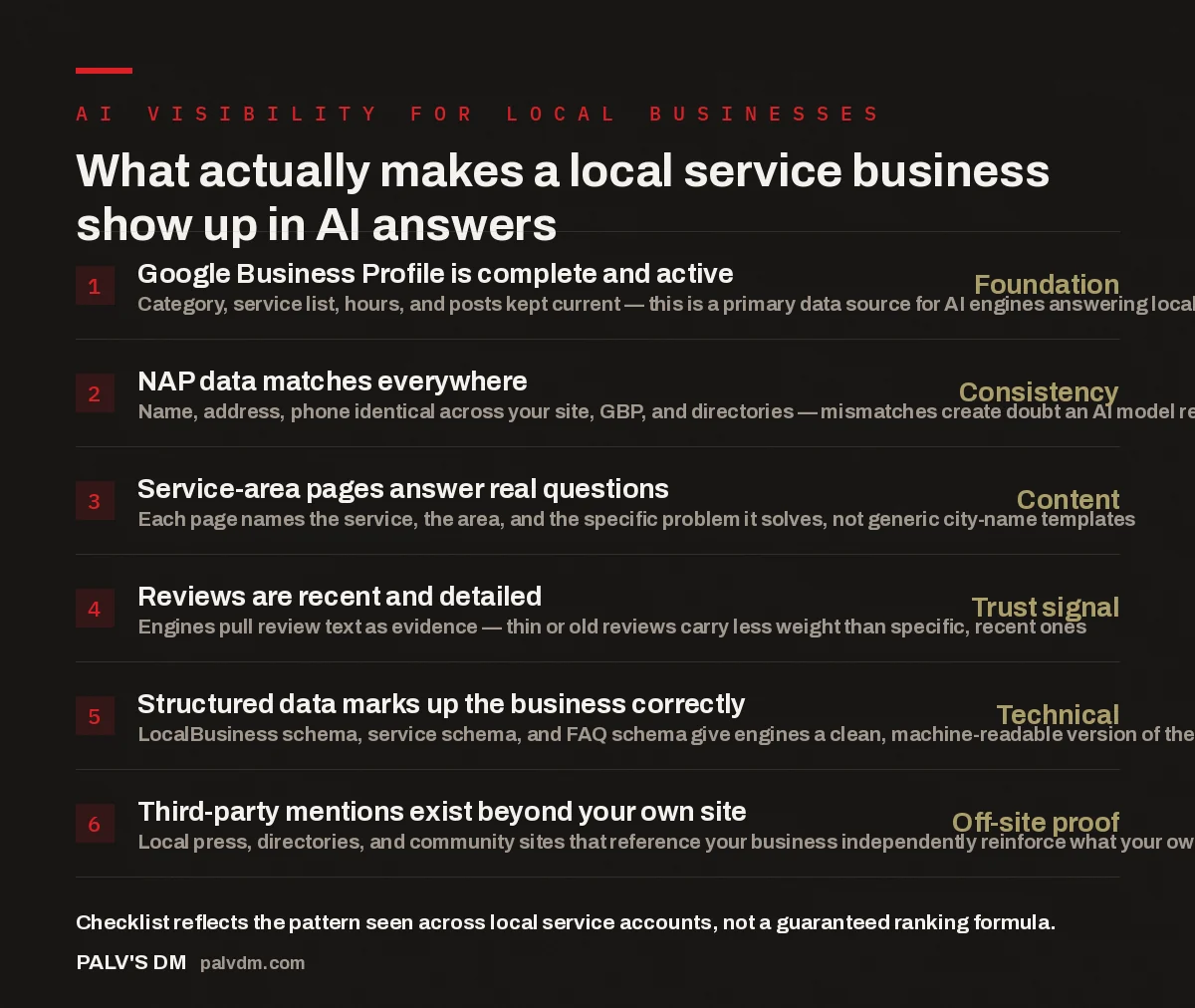
What actually makes a local service business show up in AI answers
- Google Business Profile is complete and active — Foundation. Category, service list, hours, and posts kept current — this is a primary data source for AI engines answering local queries.
- NAP data matches everywhere — Consistency. Name, address, phone identical across your site, GBP, and directories — mismatches create doubt an AI model resolves by dropping you.
- Service-area pages answer real questions — Content. Each page names the service, the area, and the specific problem it solves, not generic city-name templates.
- Reviews are recent and detailed — Trust signal. Engines pull review text as evidence — thin or old reviews carry less weight than specific, recent ones.
- Structured data marks up the business correctly — Technical. LocalBusiness schema, service schema, and FAQ schema give engines a clean, machine-readable version of the same facts.
- Third-party mentions exist beyond your own site — Off-site proof. Local press, directories, and community sites that reference your business independently reinforce what your own pages claim.
What is GEO for a local business, really?
GEO — generative engine optimisation — is the work of making your business easy for an AI system to find, understand, and confidently recommend. For a local service business, that mostly means the same raw material local SEO has always used: your Google Business Profile, your reviews, your service pages, your citations across directories. What changes is the test each piece of content has to pass. A traditional search ranking algorithm can reward a page for keyword density and backlinks even if a human would find it vague. An AI engine, by contrast, is trying to compose an actual answer — “here’s a plumber in this area who does emergency call-outs” — and it needs a source specific enough to lift a sentence from. Vague pages don’t get lifted. They get skipped.
This is why a business that has run competent local SEO for years can still be invisible in AI answers. Ranking well in Google’s classic results and being cited by an AI engine are correlated but not the same test. If you are unsure whether your business needs this work at all yet, this breakdown by business type is a reasonable place to start before spending on anything else.
How is this different from traditional local SEO?
The inputs overlap almost completely. The outputs — what actually earns you a mention — diverge in a few concrete ways.
| Local SEO priority | What matters for classic rankings | What matters for AI visibility |
|---|---|---|
| Google Business Profile | Category, hours, primary listing accuracy | All of that, plus complete service descriptions and Q&A the engine can quote directly |
| Reviews | Volume and star rating | Specific text mentioning the service, the problem solved, and the area — sparse reviews carry little weight |
| Service pages | Keyword targeting per page | A direct, self-contained answer to the question a customer would actually type or ask |
| Citations and directories | Backlink and domain-authority value | Corroboration — a second source confirming the same facts an AI model already has from your site |
Nothing here means you should abandon local SEO practice. It means the bar for “good enough” content has moved. A service page that used to rank fine with a paragraph of city-name-stuffed copy now needs to actually explain what you do, where, and for whom — because an AI engine is reading it the way a person would, not the way a 2015 crawler would.
What do AI engines actually pull from when answering local questions?
In the accounts we work on, a handful of source types come up repeatedly when an AI engine answers a local query: the business’s own Google Business Profile and website, aggregated review platforms, local directories and press mentions, and — increasingly — Reddit or community forum threads where someone asked for a recommendation and got specific answers. None of these are exotic. They’re the same sources a careful human would check before recommending a business to a friend. The difference is that an AI engine checks them systematically and rewards whichever source gives it the clearest, most specific fact to repeat.
This is also why third-party mentions matter more here than they did for classic SEO. A backlink used to matter mostly for the authority it passed. Now it also matters because it’s a second, independent confirmation of a fact — “this plumber does same-day service in this area” — that an AI model can cross-reference against your own site. One source alone is a claim. Two sources saying the same thing is closer to a fact worth citing.
Most local businesses don’t have a visibility problem because they’re bad at what they do. They have one because nothing they’ve published gives an AI engine a specific enough fact to repeat.
Palash, Founder, PalV’s DM
How do you build AI visibility as a local service business?
The order matters less than covering all of it, but this is the sequence that tends to produce results fastest for a local service business specifically.
- Audit what’s already true about your business online. Pull your Google Business Profile, your existing service pages, and your review spread across platforms. You’re checking for gaps and contradictions before adding anything new — this is the same first move we make on every AI visibility engagement.
- Fix NAP consistency everywhere it appears. Name, address, and phone number should be character-for-character identical across your website, Google Business Profile, and every directory listing you can find. A mismatch doesn’t just confuse customers — it gives an AI model a reason to hedge or drop your business from an answer entirely.
- Rewrite service-area pages to answer real questions. Replace “Plumbing Services in [City]” boilerplate with pages that state the specific service, the area covered, typical response time, and the kind of job you handle. Specificity is what gets quoted; generic template copy is what gets skipped.
- Add structured data that matches what’s on the page. LocalBusiness schema, Service schema, and FAQ schema give engines a clean, machine-readable version of the same facts your page states in prose. This doesn’t replace good content — it makes good content easier for a crawler to parse correctly.
- Actively build third-party corroboration. Ask satisfied customers for reviews that mention the specific service and area, get listed accurately in local directories, and pursue local press or community mentions where relevant. This is slower than the on-site work but it’s what turns a claim into something an engine treats as verified.
- Track whether it’s working. Run the same set of realistic customer queries across the major AI engines on a recurring basis and note whether your business gets mentioned, and how. We cover how to do this properly in our monthly citation tracking process.
What mistakes make local businesses invisible to AI engines?
The most common failure isn’t a technical one — it’s a content problem dressed up as a technical problem. A business will have a technically sound website, correct schema, and a decent Google Business Profile, and still get skipped because every page reads like marketing copy rather than an answer. “We pride ourselves on quality service” tells an AI engine nothing it can repeat to a customer asking a specific question. “We handle emergency water heater repairs in [area], typically same-day” does.
The second most common mistake is inconsistency across listings — a different phone number on an old directory, a slightly different business name on a review platform, an address that doesn’t match your Business Profile. Each one individually looks minor. Together, they read to an AI engine as noise it can’t confidently resolve, and the safe move for a model that’s uncertain is to leave you out rather than risk citing wrong information.
The third is treating this as a one-time project. AI engines revisit sources, reviews accumulate or go stale, and competitors are doing this same work. A checklist you complete once and never revisit tends to decay in visibility over six to twelve months as fresher, more specific competitor content takes its place.
Where this fits with your existing SEO
If you’re not sure whether AI visibility work should run alongside your local SEO or as a separate track, this comparison covers both models honestly. For most local service businesses, the two share enough source material that bundling makes more sense than running them apart — but it depends on how much of your current SEO is already solid.
Does AI visibility replace the need for local SEO?
No. AI visibility builds on the same foundation as local SEO — your Google Business Profile, reviews, and service pages — so the two aren’t competing efforts. Most local businesses need both working from the same accurate data rather than treating them as separate projects.
How long does it take for a local business to start showing up in AI answers?
It varies by how much groundwork already exists — a business with clean, consistent listings and real reviews moves faster than one starting from scratch. Rather than guess a timeline, it’s worth reading through what actually affects the speed of a first citation before setting expectations.
Do I need a large content budget to become AI-visible as a local business?
No. Most of the highest-impact work is fixing and clarifying what already exists — your Business Profile, your existing service pages, your review consistency — rather than producing large volumes of new content. Precision matters more than volume for a local service business.
Can a single-location business really compete with larger chains in AI answers?
Yes, more often than in classic rankings. AI engines answering a local query weigh specificity and proximity heavily, and a single-location business with accurate, detailed listings can out-compete a chain’s generic, templated location pages for the same query.
What’s the single fastest fix for a local business with no AI visibility at all?
Start by fixing NAP consistency and completing your Google Business Profile — those two together resolve most of the “engine can’t confidently confirm this business” problem before any new content gets written.
Short version: AI visibility for a local service business runs on the same facts as local SEO, but AI engines reward specific, verifiable claims over generic marketing copy. Fix NAP consistency, complete your Google Business Profile, rewrite service pages to answer real questions, add matching structured data, build genuine third-party corroboration, and track your citations over time. None of it requires a large budget — it requires precision with what you already have.