Are Group-Buy SEO Tools Safe? The Honest Answer
Group-buy SEO tools break the terms of Ahrefs, SEMrush and Moz outright. Here's what that actually risks, for freelancers and the clients you serve.
Group-buy SEO tools are not safe in any strict sense: they violate the terms of service of every major provider (Ahrefs, SEMrush, Moz among them), and you’re trusting your search data and, often, client information to a reseller you have no formal agreement with. They’re also cheap, functional most of the time, and used far more widely than the platforms themselves would like. Both things are true at once.
This question comes up from freelancers and small agencies weighing a $2,000-a-year Ahrefs subscription against a group-buy price that’s a tenth of that. The honest answer isn’t “never, under any circumstances.” It’s “know exactly what you’re trading away before you decide.”
What actually is a group-buy SEO tool subscription?
A single paid account for a tool like Ahrefs, SEMrush or Moz gets split across dozens, sometimes hundreds, of unrelated users through a reseller. The reseller pays for one legitimate top-tier subscription, then sells access slots to individuals at a steep discount, often through a shared login, a proxy-routed browser session, or a semi-custom dashboard that pulls data from the underlying tool. It’s the SEO-industry version of a shared Netflix password, run at commercial scale.
What do the terms of service actually say?
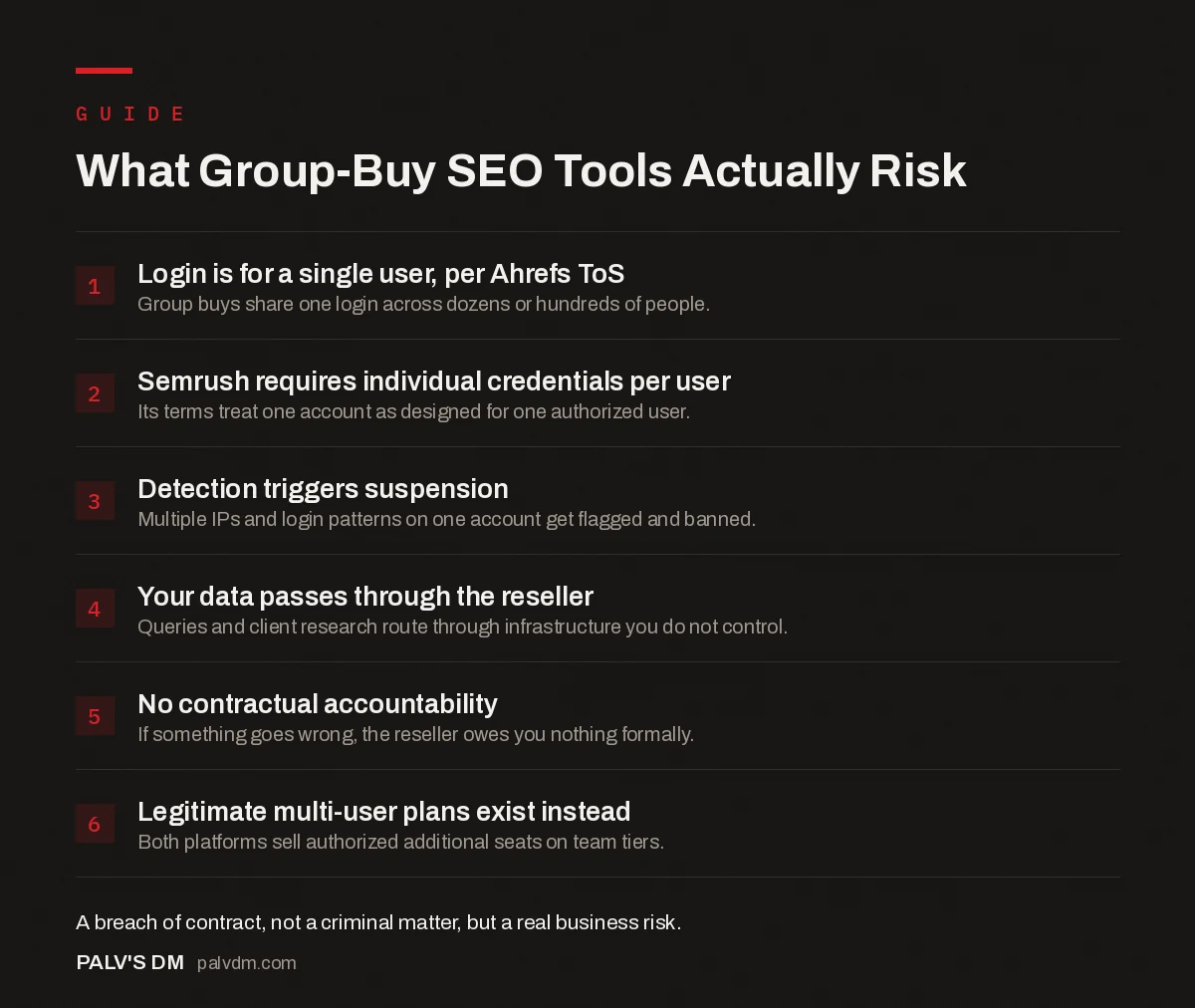
What Group-Buy SEO Tools Actually Risk
- Login is for a single user, per Ahrefs ToS. Group buys share one login across dozens or hundreds of people.
- Semrush requires individual credentials per user. Its terms treat one account as designed for one authorized user.
- Detection triggers suspension. Multiple IPs and login patterns on one account get flagged and banned.
- Your data passes through the reseller. Queries and client research route through infrastructure you do not control.
- No contractual accountability. If something goes wrong, the reseller owes you nothing formally.
- Legitimate multi-user plans exist instead. Both platforms sell authorized additional seats on team tiers.
Why do accounts get banned, and how often does it actually happen?
SEO platforms actively look for the signature of a shared account: dozens of simultaneous sessions from different IP addresses and geographies, login patterns that don’t match a single person’s working hours, or usage volume far beyond what one legitimate user would generate. When that pattern trips a threshold, the account gets suspended, sometimes without warning mid-session. Reputable group-buy providers build a “replacement within 24 hours” promise into their pitch precisely because this happens regularly enough to need a standard response, not as a rare edge case.
That detail alone tells you something: if bans were rare, providers wouldn’t need a rehearsed recovery process. The whole business model assumes accounts will get caught and replaced on a rolling basis.
What’s the actual risk if you’re using one for client work?
This is where it stops being a personal cost decision and becomes a client-facing liability. If you’re pulling competitive backlink data, keyword rankings, or a technical audit for a paying client through a shared account, a few things can go wrong that don’t happen with a legitimately licensed tool. The account can get banned mid-project, stalling deliverables with no explanation you can honestly give the client. The data itself sits on infrastructure you don’t control, run by a reseller with no contractual accountability to you or your client if something leaks or goes wrong. And if a client ever specifically asks what tools generated a report, you’re stuck either lying or admitting the sourcing wasn’t properly licensed, neither of which is a good position for an agency to be in.
We don’t use group-buy tools on any client-facing work here, full stop. The math doesn’t work: the money saved is small relative to what a single lost client relationship, or a single embarrassing “where did this data come from” conversation, would cost.
What are the legitimate ways to cut SEO tooling costs?
- Use the free tiers that already exist. Ahrefs Webmaster Tools gives verified site owners a genuinely useful slice of Ahrefs’ data for free. Google Search Console and Google Keyword Planner cost nothing and cover a surprising amount of core keyword and performance work.
- Consider a genuinely cheaper full platform. Tools like SE Ranking or Mangools price meaningfully below Ahrefs and SEMrush while still offering a real, individually licensed account with proper support and data handling.
- Split cost through the provider’s own multi-user plans. Ahrefs and SEMrush both support paid additional seats on team plans. It costs more per person than a group-buy slot, but it’s the difference between a shared team license and an unauthorized one.
- Pay for short bursts, not year-round access. Some tools offer monthly billing specifically so you can subscribe for an intensive audit month and cancel afterward, rather than paying for idle months the rest of the year.
Is there a version of this that’s actually fine?
Genuinely legitimate multi-user access exists and isn’t the same thing as a group buy. If your agency pays for a proper team or agency-tier plan and adds colleagues as authorized users through the tool’s own dashboard, that’s compliant, licensed, and exactly what those tiers are built for. The distinction that matters is authorization: does the platform know and consent to who’s using the account, or is access happening through a workaround the platform would shut down if it noticed. A five-person agency legitimately splitting the cost of one properly licensed team plan is a completely different situation from a hundred strangers sharing one login through a reseller.
What red flags should make you walk away from a specific provider?
If you’re going to research this route anyway, some warning signs matter more than others. A provider that only accepts cryptocurrency or informal payment apps, with no invoice and no refund policy, has structured the transaction so you have zero recourse if the account dies the next day. A provider promising “lifetime access” for a tool that only sells annual subscriptions is making a claim it can’t actually back, since it doesn’t control the underlying platform’s pricing or policies. And a provider that won’t say plainly, if asked, that this is a shared account arrangement, is being evasive about the one thing you most need to understand before paying.
None of this makes group buying “safe,” it just separates the providers who are at least honest about what you’re buying from the ones setting you up for a worse surprise than a routine ban.
How do you explain this if a client asks directly?
Badly, is the short answer, which is exactly why we avoid the situation instead of preparing a script for it. There’s no version of “the competitive data in your audit came from a shared login on a tool we don’t have a license for” that reads as reassuring to a paying client. If cost is genuinely the constraint, the honest move is scoping the engagement around what a properly licensed free tier or a legitimate lower-cost platform can support, and being upfront that a deeper Ahrefs-level backlink analysis is a specific paid add-on rather than something bundled in for free. Clients generally respect a clear boundary about tooling costs far more than they’d respect finding out the sourcing wasn’t clean.
Frequently asked questions
Is it legal to use group-buy SEO tools?
It’s not typically a criminal matter, but it is a clear breach of contract. Ahrefs and SEMrush both state in their terms of service that a login is for a single authorized user, and account sharing violates that agreement. The provider’s remedy is usually suspension or termination of the account, not legal action against you personally, but it is still, contractually, a violation.
What happens if a group-buy SEO account gets banned?
You lose access immediately, mid-project, with no warning. Most group-buy providers claim they’ll issue a replacement account within about 24 hours, but that’s still downtime you didn’t plan for, and it’s happening on infrastructure you don’t control and can’t monitor.
Are there safer, legitimate alternatives to group-buy SEO tools?
Yes. Every major SEO platform offers a genuine free tier or trial (Ahrefs Webmaster Tools, SEMrush’s limited free searches, Ubersuggest, Google Search Console and Google Keyword Planner), and several credible lower-cost tools like SE Ranking or Mangools cover most day-to-day work at a fraction of Ahrefs or SEMrush’s full price, with a real, ToS-compliant account.
Can group-buy tool providers see my search data?
Yes, structurally they have to. You’re logging into infrastructure the provider controls, often through a proxy or shared browser session they administer, which means your queries, the domains you’re researching, and potentially client information you type into the tool pass through a third party you have no formal agreement with.
Do agencies actually use group-buy SEO tools for client work?
Some do, particularly very small operations trying to keep costs down, but it’s a genuine liability for client-facing work. If a client ever asks how their competitive data was sourced, or an account gets banned mid-audit, there’s no good answer that doesn’t involve admitting the tooling wasn’t properly licensed.
Sources
- Terms of Service, Ahrefs
- Terms of Service, Semrush
- Third-Party SEO Data Got Less Reliable: How to Compensate
- The SEO Tool Stack a Small Agency Actually Needs
- Free SEO Tools That Replace Paid Ones (Mostly)
- How to Verify a Tool’s Data Before You Trust It
Want this done on your site?
Every PalV’s DM engagement starts with a free audit of your actual website — a 12-point
crawl covering what is blocking indexation, on-page gaps against your primary keywords, speed
findings, and the three to five fixes worth making first. Delivered in two working days. No
payment details, and the findings are yours whether you hire us or not.
Get your free SEO audit
See One-Time Service plans and prices