Product Reviews Updates and the Rise of First-Hand Testing
Google's product reviews updates ran from April 2021 to November 2023, then went silent. What the reviews system rewards and how to write reviews that survive.

Google’s product reviews updates were a series of ranking changes that began on 8 April 2021 and were designed to reward reviews containing genuine first-hand testing rather than summaries of manufacturer copy. In April 2023 Google widened the scope beyond products and renamed it the reviews system, and since the November 2023 rollout it has stopped announcing updates to it entirely. Google’s documentation now states that the reviews system “is improved at a regular and ongoing pace”, which means changes land continuously and without notice.
The requirement Google introduced in 2021 has not softened since. It asked reviewers to prove they had handled the thing they were writing about — with measurements, original photography and specifics no press release contains. That requirement is now the single hardest test in affiliate and comparison publishing.
What was the first product reviews update?
Google announced the first product reviews update on Thursday 8 April 2021. The announcement was direct about the problem it was solving: “we know people appreciate product reviews that share in-depth research, rather than thin content that simply summarizes a bunch of products”.
Two constraints in that first announcement are usually forgotten. It went live the day it was announced, with no advance notice, and it “only involves English language reviews for now”. Google also stated that the update was separate from core updates, while noting that the advice it gives for core updates was relevant to reviews as well.
Alongside it Google published a list of questions for reviewers, which remains the clearest specification of what the system rewards. Do your reviews:
- Express expert knowledge about products where appropriate?
- Show what the product is like physically, or how it is used, with unique content beyond what is provided by the manufacturer?
- Provide quantitative measurements about how a product measures up in various categories of performance?
- Explain what sets a product apart from its competitors?
- Cover comparable products to consider, or explain which products might be best for certain uses or circumstances?
- Discuss the benefits and drawbacks of a particular product, based on research into it?
- Describe how a product has evolved from previous models or releases?
- Identify key decision-making factors for the product’s category and how the product performs in those areas?
Every one of those questions is impossible to answer honestly without access to the product. That was the design.
How many product reviews updates were there?
Seven rollouts appear on Google’s Search Status Dashboard, plus the April 2021 launch which predates the dashboard’s ranking history. The durations vary far more than core update rollouts do.
| Update | Started | Duration |
|---|---|---|
| December 2021 product reviews update | 1 Dec 2021 | 20 days |
| March 2022 product reviews update | 23 Mar 2022 | 14 days |
| July 2022 product reviews update | 27 Jul 2022 | 6 days |
| September 2022 product reviews update | 20 Sep 2022 | 6 days |
| February 2023 product reviews update | 21 Feb 2023 | 14 days |
| April 2023 reviews update | 12 Apr 2023 | 13 days, 2 hours |
| November 2023 reviews update | 8 Nov 2023 | 29 days |
The April 2023 entry is the one to notice. Google dropped “product” from the name, and the system’s scope widened from products to reviews of anything. Google’s current documentation confirms that breadth: reviews “can be about any topic”, including “media such as movies or video games, or services and businesses such as restaurants or fashion brands”.
Why did Google stop announcing reviews updates?
The November 2023 reviews update, which ran 29 days from 8 November, is the last one listed on the dashboard. Google’s reviews system documentation explains why nothing followed it: “The reviews system is improved at a regular and ongoing pace.”
That has three practical consequences, and they change how you diagnose a drop in review traffic:
- There is no date to attribute a loss to. If your review pages decline, you cannot check the dashboard and confirm a reviews update ran, because Google no longer posts them. The confirmed versus unconfirmed distinction gets harder here than anywhere else in SEO.
- There is no refresh to wait for. Google states that content affected by the reviews system “may recover over time, if you’ve made improvements to your content”, with no cycle attached.
- Core updates still move review content too. A drop on review pages during a confirmed core update is more likely to be that core update than the reviews system. Checking the 2026 update record first is still the right sequence.
How is the reviews system different from a core update?
Review publishers routinely misattribute losses, because the two mechanisms produce similar-looking charts and only one of them is announced. They are not the same thing and the correct response differs.
| Reviews system | Core update | |
|---|---|---|
| What it assesses | Standalone review content specifically | All content, across the whole index |
| Announced? | Not since November 2023 | Always, on the Search Status Dashboard |
| Scope of a hit | Usually page level; site-wide only for review-heavy sites | Query-level reassessment across the site |
| Recovery | May recover over time once content improves | Largest changes tend to arrive with a subsequent core update |
| What to fix | Evidence of testing: measurements, photography, drawbacks | Whether the page deserves to rank against those that gained |
The practical sequence is to check dates first. If the decline lines up with a confirmed rollout on the dashboard, treat it as a core update and work from there. If it does not line up with anything announced, and it is concentrated on review URLs while your non-review content is stable, the reviews system is the more plausible explanation. And if the drop arrived alongside a spam update, neither answer applies — the three mechanisms have three different fixes.
One thing rules out nothing: a review site can be hit by both in the same quarter. Google runs core updates and improves the reviews system independently, so overlapping losses are common and the only way to separate them is by URL segment and date.
What does the reviews system actually apply to?
Google’s documentation is unusually precise about scope, and most publishers assume it is broader than it is.
- It evaluates first-party standalone review content — articles, blog posts and pages written to provide a recommendation, an opinion or an analysis.
- It does not evaluate third-party reviews, such as customer reviews posted in the reviews section of a product page. Your user-generated star ratings are not what the system is judging.
- It works primarily at page level. Google adds that for sites with “a substantial amount of review content, any content within a site might be evaluated by the system”, and that a site-wide evaluation is unlikely if you do not have many reviews.
- It runs in eleven languages: English, Spanish, German, French, Italian, Vietnamese, Indonesian, Russian, Dutch, Portuguese and Polish.
Structured data helps identification but is not the mechanism. Google says product structured data “might help us better identify if something is a product review, but we don’t solely depend on it”. Getting product schema and review markup right improves how listings appear; it does not substitute for the content quality the system assesses.
One more scope note matters for ecommerce sites. A category page listing twenty products is not a review under this definition, and a product description page is not one either. The system is looking for the article you wrote about the thing, not the page where you sell it.
How do you write a review that survives?
Google’s requirements translate into a production process rather than a writing style. The publishers that lost ground from 2021 onward were mostly those that could not change the process.
- Get the product. There is no way to fake quantitative measurements or physical description at scale. Buy it, borrow it, or narrow your coverage to categories you can actually access.
- Photograph it yourself. Manufacturer imagery proves nothing. Original photography is the cheapest available evidence that you held the thing, and it is visible to a human reader instantly.
- Measure something. Battery life under a stated workload, decibel readings, weight on your own scales, time to complete a task. Numbers you generated are the clearest form of demonstrated first-hand experience.
- State the drawbacks specifically. Google asks for benefits and drawbacks based on research. A review with no meaningful criticism reads as affiliate copy because it usually is.
- Cover the alternatives honestly. Google asks reviewers to cover comparable products and explain which suits which circumstances. A well-built comparison table is the format that answers this directly, and it is also the structure AI engines cite most readily.
- Say who tested it. A named reviewer with relevant background answers the “who” question that sits at the centre of E-E-A-T. An unattributed review cannot.
- Prune what you cannot upgrade. A large archive of untested round-ups is thin content at scale. Consolidating fifty summaries into ten tested reviews is usually the better trade.
For anyone running affiliate content in India, the economics of this are the real constraint. Testing costs money per product, and the volume model that made affiliate publishing profitable in 2018 assumes you never touch anything. Google’s reviews system exists precisely to make that model stop working, and it has been running continuously and silently since November 2023.
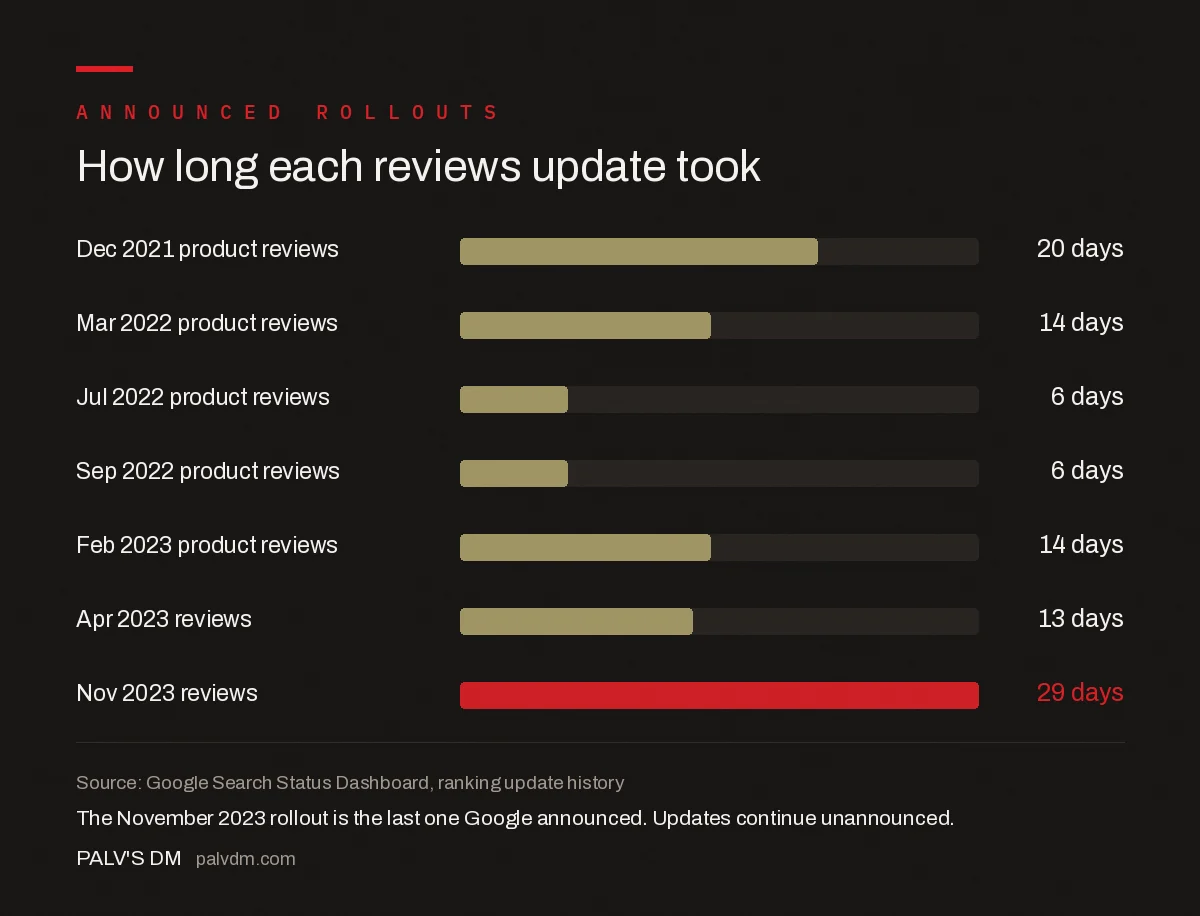
How long each reviews update took
| Metric | Value |
|---|---|
| Dec 2021 product reviews | 20 days |
| Mar 2022 product reviews | 14 days |
| Jul 2022 product reviews | 6 days |
| Sep 2022 product reviews | 6 days |
| Feb 2023 product reviews | 14 days |
| Apr 2023 reviews | 13 days |
| Nov 2023 reviews | 29 days |
Source: Google Search Status Dashboard, ranking update history
Frequently asked questions
What is the Google product reviews update?
The product reviews update was a ranking change first launched on 8 April 2021 that rewarded reviews demonstrating genuine first-hand research over content that simply summarised products. Google widened its scope beyond products in April 2023 and renamed it the reviews system. It now covers reviews of media, services and businesses as well as physical products.
Is the Google reviews system still running?
Yes, continuously. The November 2023 reviews update, which ran 29 days from 8 November 2023, is the last one Google announced on its Search Status Dashboard. Google’s documentation states the reviews system is improved at a regular and ongoing pace, meaning changes now land without announcement and there is no rollout date to attribute a drop to.
Does the reviews system affect customer reviews on product pages?
No. Google’s documentation states that the reviews system evaluates first-party standalone content written to provide a recommendation, opinion or analysis, and does not evaluate third-party reviews such as those posted by users in the reviews section of a product or services page. Customer star ratings on an ecommerce page are outside its scope.
What does Google want in a product review?
Google’s published questions ask whether a review expresses expert knowledge, shows what the product is like physically with content beyond the manufacturer’s, provides quantitative performance measurements, explains what sets it apart from competitors, covers comparable alternatives, discusses benefits and drawbacks based on research, and identifies the key decision-making factors for that category.
Which languages does the reviews system cover?
Google’s documentation lists eleven languages globally: English, Spanish, German, French, Italian, Vietnamese, Indonesian, Russian, Dutch, Portuguese and Polish. The first product reviews update in April 2021 applied to English-language reviews only, and coverage expanded over subsequent rollouts.
How do you recover from a reviews system drop?
Google states that content impacted by the reviews system may recover over time if you have made improvements to your content, and adds that its assessment of review content is only one of many ranking factors. In practice that means adding original testing, original photography and quantitative measurements to the reviews worth keeping, and consolidating or removing untested round-ups.
Sources
- What creators should know about Google's April 2021 product reviews update
- Google Search's reviews system and your website — Scope, languages and ongoing update cadence
- Write high quality reviews — Search Central
- Google Search Status Dashboard — ranking update history
Want this done on your site?
Every PalV’s DM engagement starts with a free audit of your actual website — a 12-point
crawl covering what is blocking indexation, on-page gaps against your primary keywords, speed
findings, and the three to five fixes worth making first. Delivered in two working days. No
payment details, and the findings are yours whether you hire us or not.