SEO for a Local Service Business With One Location
A practical guide to SEO for a single-location business: what to prioritise, which multi-location tactics to skip, and what earns real map pack visibility.
SEO for a local business in India with one location works differently from SEO for a chain or a multi-city service provider. You don’t need city-page templates, a rank tracker watching fifty cities, or most of the “local SEO” checklist written for businesses with ten branches. What you need is one Google Business Profile that’s genuinely complete, one location page that earns its address, a steady trickle of real reviews, and service pages that map to what you actually do. Everything else is optional or actively wasted effort.
Key takeaway
- A single-location business needs one strong location page and a complete Google Business Profile — not a template built for multi-branch chains.
- Reviews collected on a steady cadence do more for local rankings than almost any other single lever available to a small operator.
- Most of the wasted budget in single-location SEO goes toward tactics — city-page farms, generic directory submissions — built for businesses with a very different footprint.
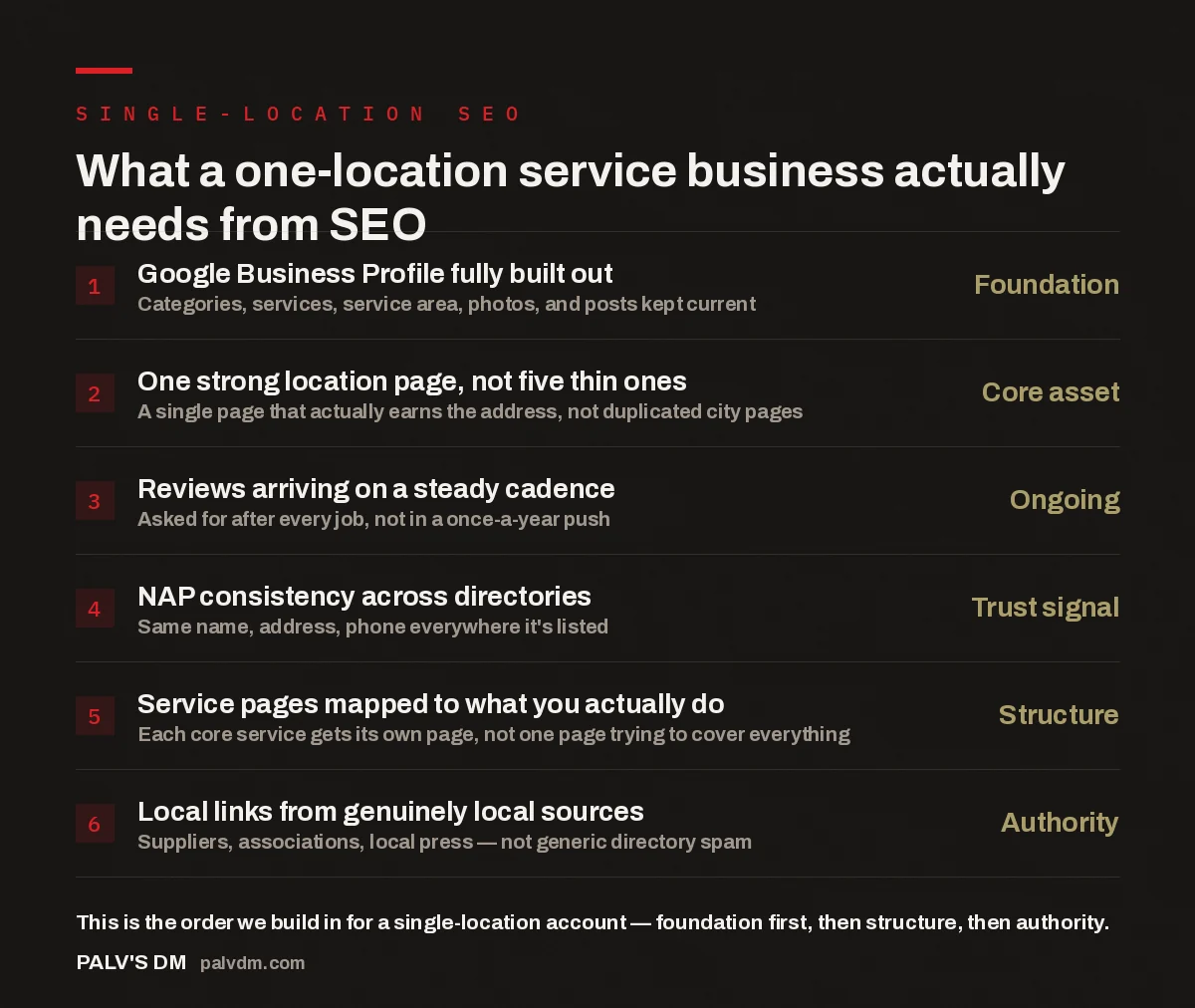
What a one-location service business actually needs from SEO
- Google Business Profile fully built out — Foundation. Categories, services, service area, photos, and posts kept current.
- One strong location page, not five thin ones — Core asset. A single page that actually earns the address, not duplicated city pages.
- Reviews arriving on a steady cadence — Ongoing. Asked for after every job, not in a once-a-year push.
- NAP consistency across directories — Trust signal. Same name, address, phone everywhere it’s listed.
- Service pages mapped to what you actually do — Structure. Each core service gets its own page, not one page trying to cover everything.
- Local links from genuinely local sources — Authority. Suppliers, associations, local press — not generic directory spam.
Why doesn’t multi-location SEO advice work for a single-location business?
Most SEO advice, and most agency proposals, are written for businesses with five, ten, or fifty locations. That advice says to build a page per city, submit to a hundred directories, and target every neighbourhood pincode in your metro. For a chain, that structure makes sense — each branch genuinely needs its own page because each has its own address, hours, and service radius.
A plumber, an interior designer, a chartered accountant, or a clinic operating from one address doesn’t have that problem, and building that structure anyway creates a real one. A dozen thin “service in [neighbourhood]” pages that all say roughly the same thing, pointing at one location, read to Google as duplicate content stretched over a template. It’s the single most common thing we see when auditing a single-location business that’s already spent money on SEO — more location pages than actual locations, and rankings that never moved because those pages were fighting each other instead of building one page’s authority.
The fix is almost always subtractive before it’s additive: consolidate into one genuinely strong page for the actual address, and redirect the effort that went into thin duplicates toward the profile, the reviews, and the service pages that actually matter.
How do you build a Google Business Profile that actually earns local visibility?
For a single-location business, Google Business Profile carries more weight than almost anything else here, because it’s the surface Google shows first for “near me” and local-intent searches — the map pack, not the organic list below it. A profile that’s merely filled in gets you listed. A profile that’s complete and kept current is what gets you into the top three.
- Pick the primary category deliberately. This field influences which searches you show up for more than almost any other setting. “Electrician” and “Electrical repair service” aren’t interchangeable in how Google matches intent.
- List every service you offer, using the names customers search for, not internal jargon.
- Set the service area honestly. If you serve a 15km radius, say that — an inflated area dilutes relevance for searches closest to your actual address.
- Upload real photos on a schedule — completed jobs, the storefront, the team — not stock imagery. Profiles with recent, genuine photos consistently show more engagement in the accounts we manage.
- Post updates monthly at minimum — an offer, a completed project, a seasonal note — anything showing the profile is actively managed, not abandoned after setup.
None of this is exotic. It’s also the part that gets skipped most often, because it feels like admin work rather than “SEO” — and it’s the first thing we check when a single-location client comes to us after a previous agency’s work didn’t move the needle.
What does the one location page need to include?
Since there’s only one address to build for, that page needs to work harder than any single page on a multi-location site would. It should state the exact address and service area in the first screen, list the specific services offered, and include enough real detail — team, equipment, years operating, service process — that it reads as a genuine business page rather than a template with the city name swapped in.
Embed the Google Map, keep the NAP (name, address, phone) formatted exactly as it appears on the Business Profile, and add a testimonials section pulling from actual reviews rather than paraphrased ones. If the business has a physical storefront customers visit, photos of that space do more for trust — and, indirectly, for conversion — than another paragraph of generic service copy.
Why do reviews matter more for a single location than for a chain?
A chain spreads its review volume across many locations, so any one branch’s review count is a smaller signal. A single-location business has exactly one profile carrying all of its review weight, which means the pace and recency of reviews matter more here than almost anywhere else in local SEO.
The pattern that shows up consistently in single-location accounts is simple: businesses that ask for a review after every completed job, using a direct link sent by WhatsApp or SMS right after the work is done, build a steady stream that reads to Google as an actively trusted business. Businesses that only think about reviews in an occasional single push end up with a profile that looks stalled between pushes — and a stalled profile tends to slip in the map pack even if nothing else about the business changed.
Responding to every review, positive or negative, in a specific and non-templated way matters more here too, since it’s the only profile a prospective customer will read before deciding whether to call.
The single-location businesses that win the map pack aren’t the ones with the fanciest website — they’re the ones where the owner treats asking for a review as part of finishing the job, not as a separate marketing task they’ll get to eventually.
Palash, Founder, PalV’s DM
How should service pages be structured for one location?
Each core service should get its own page rather than being folded into one long page that tries to cover everything. A pest control business, for example, benefits from separate pages for termite treatment, general pest control, and rodent control rather than one page mentioning all three in passing — each is searched separately, with different intent, and a dedicated page can answer that specific search directly instead of making the reader scroll past unrelated services.
This is different from the city-page trap described earlier. Service pages aren’t duplicating the same content with a different label — each one covers a genuinely different service, with its own process and its own reasons a customer would choose it. That’s the distinction that separates useful page structure from thin duplication: does each page answer a different question, or the same question with a word swapped in?
What kind of links actually help a single-location business?
Generic directory submissions — the kind sold in bulk packages promising fifty or a hundred listings — do very little beyond the handful of directories that genuinely matter (Google Business Profile, Justdial, IndiaMART if relevant to the trade, and any industry-specific directory customers actually browse). Beyond that short list, returns drop off fast.
What tends to move the needle instead is genuinely local: a mention from a supplier’s website, a local trade association listing, a feature in local press, a sponsorship page for a local event, or a link from a complementary local business that refers customers back and forth. These links are harder to get in bulk, which is exactly why they carry more weight — they’re evidence of a real business embedded in a real local economy, not a purchased listing.
Where to start
If you run a single-location business and want a clear view of what’s actually broken, we run a free audit covering your Business Profile, location page, and current review pace before recommending anything.
How long does it take to see results for a single-location business?
Directionally, the foundation work — Business Profile completion, NAP consistency, the core location page — tends to show early movement in map pack visibility within the first couple of months, since these are largely fixes to existing signals rather than new authority built from scratch. Organic rankings for competitive keywords take longer, which is why what actually goes into a client’s first 90 days looks different for a single-location business than for a larger, multi-service site. With a smaller keyword universe and a tighter service area, a single-location business also tends to see a better return from a smaller, focused plan than from a larger retainer built for hundred-page sites — part of why the right SEO plan differs so much between a 10-page site and a 500-page one.
What should a single-location business skip entirely?
A few things come up repeatedly as wasted spend:
- City-page farms. Pages targeting neighbourhoods with no genuine physical presence compete with your real location page rather than supporting it.
- Bulk directory submission packages. Beyond the handful customers actually use, these add noise without relevance.
- Rank tracking across dozens of keyword variants. A single location has a manageable core keyword set — tracking every long-tail permutation adds overhead without insight.
- A blog with no connection to the services offered. Content that doesn’t map to a service page or a real customer question rarely earns its keep.
Whether SEO is worth running alongside paid channels at all is worth asking honestly before committing budget — see whether you need SEO if you’re already running Google Ads. And if a previous provider ran exactly the bloated, multi-city structure described above, rebuilding SEO after a bad agency experience covers what that cleanup involves.
Frequently asked questions
Is SEO worth it for a small, single-location business in India?
Yes, provided the plan matches the business’s actual footprint. A single-location business doesn’t need a large, multi-city programme — it needs a complete Google Business Profile, one strong location page, a steady review pace, and service pages that map to what’s actually offered. That’s a focused, achievable scope for most local service businesses.
Do I need multiple location pages if I only have one address?
No. Multiple thin pages for neighbourhoods around a single real address tend to create duplicate-feeling content that competes with itself. One well-built page for the actual address, supported by a complete Google Business Profile, generally outperforms a handful of thin duplicates.
How important is Google Business Profile compared to the website?
For map pack visibility specifically, Google Business Profile tends to matter more than the website, since it’s the surface shown first for “near me” and local-intent searches. The website still matters for organic rankings and converting the visitor once they click through, so the two need to work together rather than one substituting for the other.
How many reviews does a single-location business actually need?
There’s no fixed number that guarantees ranking — what tends to matter more is consistency over time. A steady trickle of new reviews after every job builds a stronger, more current-looking profile than a large one-time batch followed by months of silence, even if the total count ends up similar.
Short version: a single-location business doesn’t need multi-city SEO tactics — it needs a complete Google Business Profile, one strong location page, a steady cadence of real reviews, service pages mapped to what’s actually offered, and a small number of genuinely local links. Get those five right and most of what a bigger, multi-location programme would add on top stops being necessary.