Rebuilding SEO After a Bad Agency Experience
Left with damage from a previous agency? Here's exactly how to fix bad SEO work — the right order to audit, clean up, and rebuild without making it worse.
If you’re trying to fix bad SEO work left behind by a previous agency, the order of operations matters more than the speed. Reclaim every account first, read the backlink profile before you touch anything else, check for manual actions, then clean up content and technical debt before you build anything new. Skip that sequence — start publishing fresh content on top of an unaudited link profile, for instance — and you can end up compounding the damage instead of fixing it.
Key takeaway
- Recovery work starts with an audit, not a new content calendar — you need to know exactly what the previous agency did before you can undo the parts that are hurting you.
- The most common damage isn’t dramatic. It’s usually thin content, keyword cannibalisation, and a link profile nobody can explain — not a manual penalty.
- Recovery timelines run longer than a clean build because you’re often undoing signals Google has already indexed and trusted, not just adding new ones.
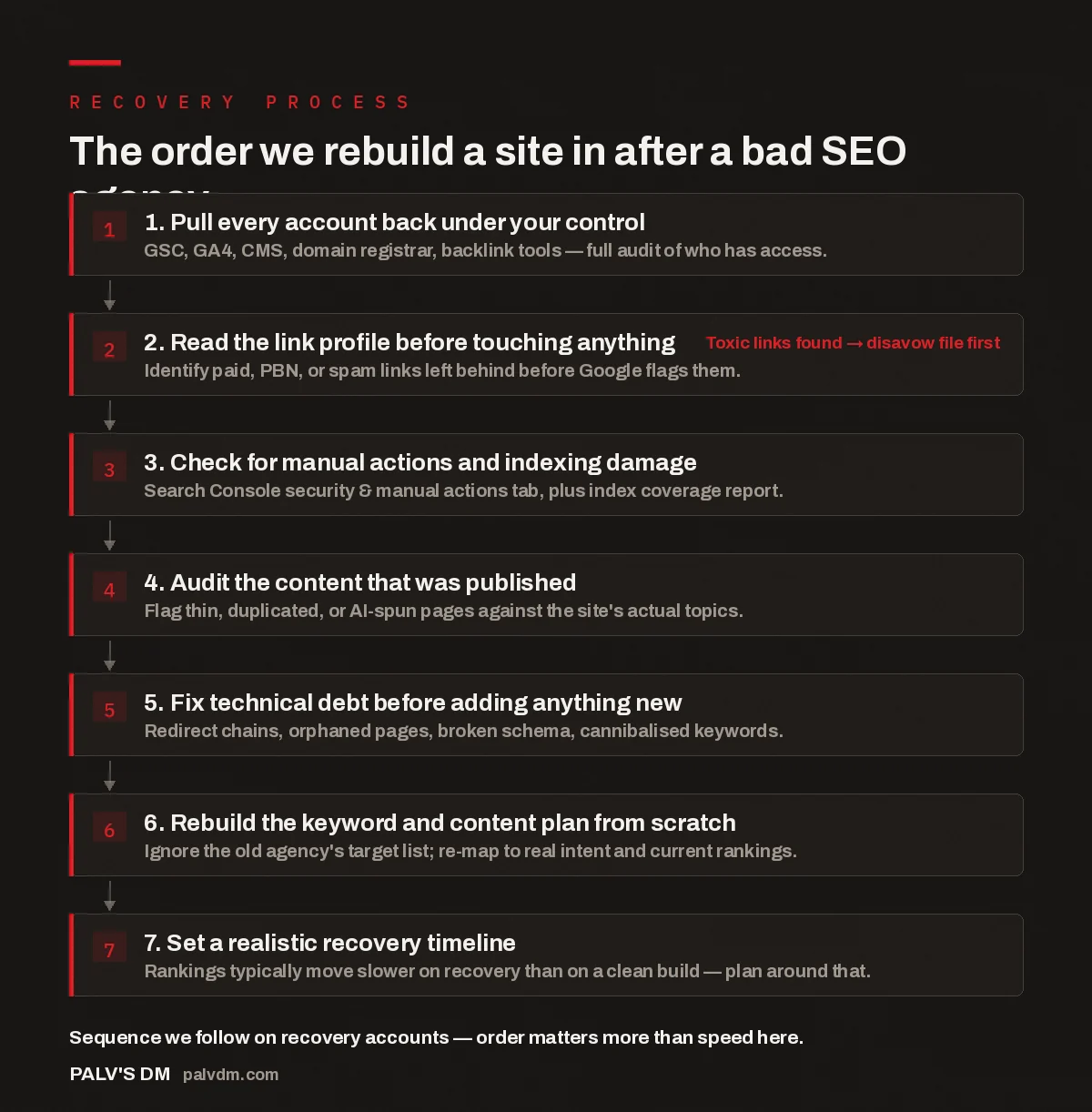
The order we rebuild a site in after a bad SEO agency
- 1. Pull every account back under your control. GSC, GA4, CMS, domain registrar, backlink tools — full audit of who has access.
- 2. Read the link profile before touching anything. Identify paid, PBN, or spam links left behind before Google flags them. Toxic links found → disavow file first
- 3. Check for manual actions and indexing damage. Search Console security & manual actions tab, plus index coverage report.
- 4. Audit the content that was published. Flag thin, duplicated, or AI-spun pages against the site’s actual topics.
- 5. Fix technical debt before adding anything new. Redirect chains, orphaned pages, broken schema, cannibalised keywords.
- 6. Rebuild the keyword and content plan from scratch. Ignore the old agency’s target list; re-map to real intent and current rankings.
- 7. Set a realistic recovery timeline. Rankings typically move slower on recovery than on a clean build — plan around that.
How do you know an agency actually did damage, versus SEO just being slow?
Not every disappointing SEO engagement means damage was done. Sometimes the previous agency just didn’t do much — no content, no links, no technical fixes, months of invoices for very little visible work. That’s a wasted budget, but it’s not the same problem as active harm to your rankings, and it doesn’t need the same recovery process.
The signs of actual damage look different. A sudden, unexplained traffic drop that lines up with a specific date is one — check that date against Search Console’s manual actions tab and against any known algorithm update windows before assuming the worst. A backlink profile full of domains you don’t recognise, often from link networks or paid placements, is another; you can usually spot these by exporting your link list and scanning for repeated low-quality patterns rather than one-off links from real sites. Pages that rank for the wrong queries, or multiple pages on your own site competing against each other for the same keyword, point to cannibalisation from a content plan built without a real keyword strategy behind it. And content that reads like it was written to hit a word count rather than answer a question is the most common pattern we see — pages that technically exist but were never going to convert or rank sustainably.
If none of that shows up and the account simply underperformed, you’re in a different situation — you need a better plan, not a cleanup. If one or more of those signs is present, treat it as recovery work and start with the audit before anything else.
What’s the right order to fix bad SEO work without making it worse?
The sequence above exists because each step depends on information from the one before it. Reclaiming accounts first isn’t just good hygiene — you can’t audit what you can’t see, and it’s common for a departing agency to still hold admin access to Search Console, the CMS, or even the domain registrar long after the contract ends. Get every login, transfer every property, and confirm you’re the verified owner before you do anything else.
Reading the link profile before publishing anything new matters because new content built on top of a toxic link profile inherits that risk. If there’s a manual action coming, or if Google is already discounting the site’s trust because of spammy inbound links, fresh content won’t fix that — it just adds more pages to a site that’s still under a cloud. This is also where you decide whether a disavow file is genuinely warranted; disavowing is a blunt tool and overusing it can remove links that were actually helping, so it’s worth doing carefully rather than reflexively.
The content audit comes before the technical fixes because you need to know what to keep, what to rewrite, and what to remove entirely before you start redirecting URLs or restructuring the site. Pruning thin or duplicate pages first prevents you from building redirect chains that just point one weak page to another weak page. Only once the content and technical layers are stable does it make sense to build a new keyword plan — one based on current search behaviour and your actual competitive position, not the target list the previous agency was working from, which may have been chasing keywords with no real business relevance in the first place.
How long does SEO recovery actually take compared to starting fresh?
This is the part clients are usually least prepared for. A site with no SEO history at all can, in some ways, be easier to grow than a site with a bad SEO history — because a clean site has no negative signals to undo, only positive ones to build. A recovery account often needs to first neutralise what’s there before net-new work starts moving the needle.
In the accounts we’ve taken over from a previous agency, the pattern that shows up repeatedly is a flat or even declining period in the first stretch of the engagement, while indexing, link, and content issues get resolved, followed by movement that tracks more closely with a normal SEO timeline once the underlying account is clean. That flat period isn’t wasted time — it’s the point where Google is re-crawling and re-evaluating pages that changed, and where any residual link or content risk gets resolved. It’s also the period where client patience matters most, because it’s easy to mistake “no visible movement yet” for “this still isn’t working,” when in fact the visible movement was never going to show up before the cleanup was substantially complete.
Set expectations on this before work starts, not after three months of asking why rankings haven’t moved. A realistic recovery conversation includes what’s being cleaned up, roughly how long that phase is expected to take given the scale of the issues found, and what signals indicate the site has moved from “recovery” to “normal growth” mode.
Most of the “bad SEO” we get called in to fix isn’t sabotage — it’s neglect wearing a strategy’s clothes. Nobody set out to hurt the site. They just never audited what they were building on top of.
Palash, Founder, PalV’s DM
What should you check before hiring the next SEO agency?
The best time to prevent a repeat of this is before you sign the next contract, not after. Ask directly who retains ownership of accounts, logins, and assets during and after the engagement — you should keep full ownership throughout, not just be granted access on request. Ask how keyword priorities get chosen and whether that process is explained to you or handed over as a black box. Ask what reporting looks like month to month, and whether it shows actual work completed or just ranking snapshots with no context behind them.
It also helps to ask what the agency won’t do — a clear list of tactics they avoid (link buying, AI-spun content at scale, keyword stuffing) tells you more about their standards than a list of what they will do. Any agency that can’t answer these plainly, or that becomes vague when asked who owns what once the contract ends, is worth a second look before you commit.
Next step
If you’re sitting on a site that came out of a bad SEO engagement, the first useful thing is an honest audit — not a new content calendar. We run that audit before we propose anything.
FAQ
How do I know if my previous SEO agency bought backlinks?
Export your backlink list from a tool like Search Console or a third-party link index and scan for patterns: many links from unrelated, low-authority domains, links from sites with obvious link-farm structures, or a spike of links added in a short window. A single unusual link isn’t proof; a cluster of them from domains with no topical relevance to your business usually is.
Should I disavow all suspicious backlinks immediately?
No. Disavowing is meant for links you believe are actively harming the site, not every link you’re unsure about. Over-disavowing can strip out neutral or even helpful links. Review the list carefully, or have someone experienced review it, before submitting a disavow file — it’s a one-way action that’s easy to get wrong in either direction.
Can I keep the content the old agency wrote, or should I remove it all?
Keep what’s genuinely useful and rewrite or remove what isn’t — this isn’t an all-or-nothing decision. Audit each page against real search intent and current performance. Pages already getting traffic and doing their job usually just need updating. Thin, duplicated, or off-target pages are usually better rewritten or consolidated than left live.
Will rankings drop further before they recover?
It’s possible, especially if changes like removing thin pages, redirecting URLs, or disavowing links cause short-term fluctuation while Google re-crawls and re-evaluates the site. This is a normal part of cleanup, not a sign it’s failing. What matters is whether the trend stabilises and turns upward once the recovery work is substantially complete.
How do I even find out what the previous agency actually did?
Start with what you can access directly: Search Console’s performance and manual actions data, your CMS’s page and revision history, your backlink profile, and any monthly reports you were sent. If reports were vague or missing, that gap itself is useful information — it tells you the audit needs to be more thorough because there’s no paper trail to lean on.
Short version: fixing bad SEO work is a sequencing problem before it’s a tactics problem. Reclaim your accounts, audit the link profile and content before publishing anything new, fix technical debt, then rebuild the keyword plan from a clean base. Expect a flatter recovery period before growth resumes, and use what you learned to ask sharper questions of the next agency you hire. For related reading, see how we handle inheriting a site with years of undocumented SEO history, why you should keep every account, login and asset under your own control, how we choose which keywords to chase first on a rebuild, and what happens if results still don’t come after a clean restart.