Service and Offer Schema for Agencies and Consultants
A practical guide to Service and Offer schema for agencies: what it does, what it does not do, and copy-paste JSON-LD that nests correctly.

Service schema describes what your agency or consultancy actually does, marked up so search engines and AI systems can parse it as a distinct, structured entity rather than a paragraph of marketing copy. It doesn’t earn a rich result of its own the way Product or Review schema does. What it does is give every service page a clean, machine-readable definition that supports your Organization markup, your local presence, and increasingly, how AI answer engines describe your business when someone asks what you offer.
Most guides to this topic blur Service and Product schema together, or imply Service markup earns star ratings and price snippets the way ecommerce schema does. It doesn’t, and setting that expectation correctly upfront saves a frustrating conversation three months later when nothing visibly changes in the SERP.
What does Service schema actually mark up?
The Service type in schema.org’s vocabulary describes something a business provides to a customer: SEO consulting, legal representation, accounting, web development, coaching. It sits alongside properties like serviceType, areaServed, provider, and hasOfferCatalog, which together let you describe not just that you offer SEO services, but that you offer them to businesses in Ahmedabad, through a named organization, across a defined set of pricing tiers.
Here’s the honest technical reality: Google’s own list of structured data markup it supports for rich results doesn’t include a dedicated Service feature the way it includes Product, Review, Event or Job Posting. Marking up Service correctly won’t earn you a star rating or a price badge in the SERP. Its job is quieter: clean entity data that machines, including AI systems building an answer, can extract with confidence.
A working example for an agency service page
Here’s a stripped-down but functional example for a single service, nested with an offer catalog for tiered pricing:
{
  "@context": "https://schema.org",
  "@type": "Service",
  "@id": "https://example.com/services/seo/#service",
  "name": "SEO Services",
  "serviceType": "Search engine optimisation",
  "provider": { "@id": "https://example.com/#org" },
  "areaServed": {
    "@type": "City",
    "name": "Ahmedabad"
  },
  "hasOfferCatalog": {
    "@type": "OfferCatalog",
    "name": "SEO service tiers",
    "itemListElement": [
      {
        "@type": "Offer",
        "itemOffered": { "@type": "Service", "name": "Technical SEO Audit" },
        "priceCurrency": "INR"
      },
      {
        "@type": "Offer",
        "itemOffered": { "@type": "Service", "name": "Ongoing SEO Retainer" },
        "priceCurrency": "INR"
      }
    ]
  }
}
Notice the provider property references an @id rather than repeating the whole Organization block. That’s deliberate. If you’ve already got Organization schema on your homepage, point to it by ID instead of duplicating the address and contact details on every service page. Repetition here isn’t wrong exactly, it’s just unnecessary weight that gets harder to keep consistent across dozens of pages.
Where should this markup live on your site?
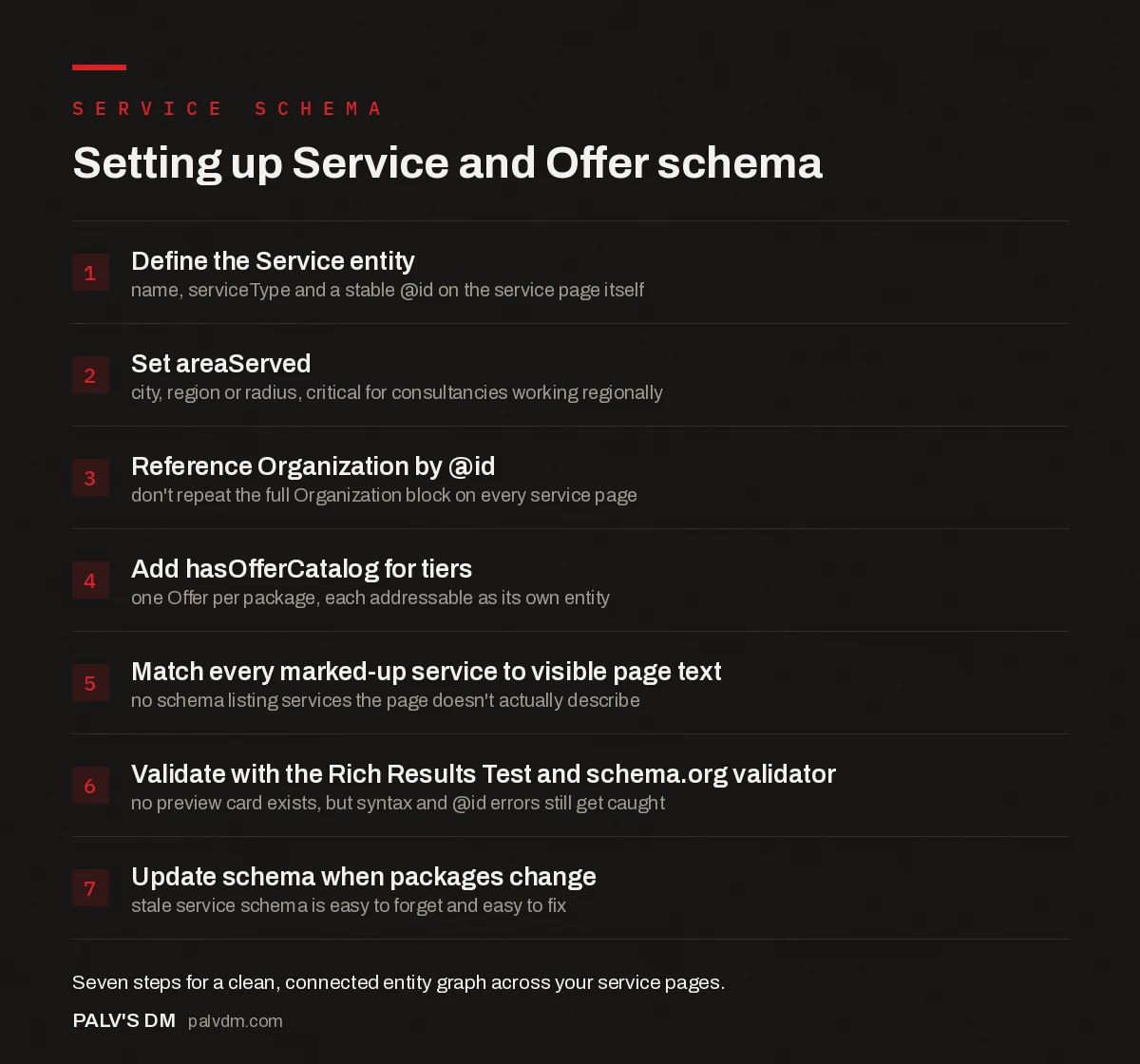
The infographic below is the sequence we actually run through when setting this up for a new client’s service pages.
Setting up Service and Offer schema
- Define the Service entity. name, serviceType and a stable @id on the service page itself.
- Set areaServed. city, region or radius, critical for consultancies working regionally.
- Reference Organization by @id. don’t repeat the full Organization block on every service page.
- Add hasOfferCatalog for tiers. one Offer per package, each addressable as its own entity.
- Match every marked-up service to visible page text. no schema listing services the page doesn’t actually describe.
- Validate with the Rich Results Test and schema.org validator. no preview card exists, but syntax and @id errors still get caught.
- Update schema when packages change. stale service schema is easy to forget and easy to fix.
Step three trips people up the most. If your homepage already carries an Organization block with your name, logo and address, don’t paste that entire block again on every service page. Reference it by @id. I’ve audited sites with the same 40-line Organization schema copy-pasted across eleven service pages, each with slightly different, slightly stale contact details because nobody remembered to update all eleven when the office moved. One source of truth, referenced everywhere, avoids that entirely.
How does this differ for a consultant without fixed pricing?
Custom-quote businesses, which describes most agencies and consultancies, don’t have a single retail price to publish the way an ecommerce store does. Offer schema still works here; you’re not required to hard-code a number. A priceSpecification can express a range, or you can omit the price property entirely and lean on description to explain the engagement model.
What you shouldn’t do is leave the Offer block so vague it says nothing. “Contact us for pricing” as your only description property gives an AI system nothing to extract when someone asks what a service costs. Even a qualitative range, such as project-based versus retainer, or an approximate starting point if you’re willing to publish one, gives the markup something useful to say.
Does Service schema help with AI visibility specifically?
This is where the case for bothering with it gets stronger, even without a traditional rich result. AI answer engines building a response to “who does SEO consulting in Ahmedabad” are working from whatever structured and unstructured signals they can extract quickly. A page that states its service, provider, area served and offer structure in clean JSON-LD gives that extraction process a shortcut, versus inferring the same facts from paragraphs of marketing prose that may or may not state them plainly.
This isn’t a guarantee of citation, the same caveat that applies to every other schema type. But it removes ambiguity from a system that has to make a fast decision about what your page is actually offering, and removing ambiguity is generally a good bet even when you can’t measure its exact contribution.
Should you still validate it if there’s no rich result to check?
Yes, and this is a step people skip precisely because there’s no visible payoff in the Rich Results Test the way there is for a Recipe or Product page. Run the markup through the Rich Results Test anyway. It won’t show you a preview card, because there isn’t one for Service, but it will catch syntax errors, missing required properties on nested types, and broken @id references before they sit live on the page for months unnoticed.
Schema.org’s own validator is worth a second pass too, specifically because it checks against the full schema.org vocabulary rather than only the subset Google chose to support with rich results. That distinction matters more for Service markup than for most types, since you’re relying on other consumers, AI crawlers among them, reading the full vocabulary rather than just what triggers a Google SERP feature.
Common mistakes worth avoiding
- Using Product schema for a service. Product properties like
sku,gtinandbranddon’t map cleanly onto consulting work, and Google’s Product guidelines assume a physical or licensed digital good. - Marking up services that aren’t actually described on the page. The same rule that applies everywhere in structured data applies here: if the schema lists five services but the visible page text only describes two, that’s a mismatch worth fixing before it becomes a bigger problem.
- Skipping
areaServedentirely. For a consultancy that works regionally rather than fully remote, this property is doing real work to establish geographic relevance, and it’s an easy field to forget. - Treating this as a one-time task. When you add a new service tier or retire an old package, the schema needs the same update the page copy gets. Stale service schema is a small but avoidable form of technical debt.
Frequently asked questions
What is Service schema and when should I use it?
Service is a schema.org type that describes something a business does for a customer rather than a physical product they sell, such as SEO consulting, legal representation or web development. Use it on service pages where you want to define exactly what’s offered, who it’s for, and where it’s available.
Does Service schema create a rich result in Google?
No. Unlike Product, Review or Event, Service does not have its own dedicated rich result in Google’s supported structured data gallery. Its value is entity clarity for search engines and AI systems, and supporting other markup like LocalBusiness, not a visible SERP enhancement of its own.
What’s the difference between Service and Product schema?
Product schema is built for physical or digital goods with SKUs, stock levels and shipping, and it does have dedicated rich result support including price and availability snippets. Service schema fits work performed for a client, like consulting or design, and does not carry that same rich result eligibility.
Do I need Offer schema for a consulting business with custom pricing?
You can still use Offer without a fixed price by describing a priceSpecification range or omitting price entirely and relying on the description field. Google does not require a hard number, but vague or missing pricing data does reduce how useful the markup is to AI systems trying to answer “how much does this cost” queries.
How do I mark up multiple service packages on one page?
Use hasOfferCatalog on your Service or LocalBusiness entity, containing an OfferCatalog with individual Offer items for each package or tier. This keeps every package as a distinct, addressable entity rather than one vague blob of text.
Where does Service schema nest inside my existing Organization or LocalBusiness markup?
Reference your Organization’s @id in the Service’s provider property, and reference the Service’s @id from the Organization’s hasOfferCatalog or makesOffer property where relevant. Connecting the @id values both ways is what turns separate blocks into one coherent entity graph.
Sources
- Service — Schema.org Type Definition
- Structured Data Markup That Google Search Supports — Google Search Central
- Schema Markup: A Practical Guide With Copy-Paste JSON-LD
- Organization Schema: The Entity Foundation for Your Brand
- Product Schema for Services: Where People Get It Wrong
- BreadcrumbList Schema: Small Effort, Visible Result
Want this done on your site?
Every PalV’s DM engagement starts with a free audit of your actual website — a 12-point
crawl covering what is blocking indexation, on-page gaps against your primary keywords, speed
findings, and the three to five fixes worth making first. Delivered in two working days. No
payment details, and the findings are yours whether you hire us or not.