How to Vet a Web Development Agency Before You Sign
A step-by-step method for vetting a web development agency: portfolio checks, ownership questions, contract terms and the red flags that predict a bad build.
Vetting a web development agency comes down to five checks: verifiable recent work, a clear account-ownership policy, a written scope, references you actually call, and a contract that names who owns the code when the project ends. Skip any one of these and you’re negotiating from a position of guesswork.
Most buying guides for this decision focus on price comparison, which is the least useful filter available. Two agencies quoting the same number can hand you wildly different outcomes: one delivers a site you own outright, the other delivers a site you’re locked out of the moment you stop paying a monthly “management fee.” The steps below are ordered the way we’d actually walk through them with a client.
How do you start vetting an agency?
Begin before you ever get on a call. Look at the agency’s own website: does it load fast, is it built on the platform they’re pitching you, does their own SEO look competent? An agency that can’t get its own site right is not going to get yours right either. That’s not a gotcha question, it’s the fastest filter available and it takes ninety seconds.
Vetting a web agency: the checklist
The infographic below walks through the order we’d actually check these in, from fastest to verify through to the contract terms that matter most.
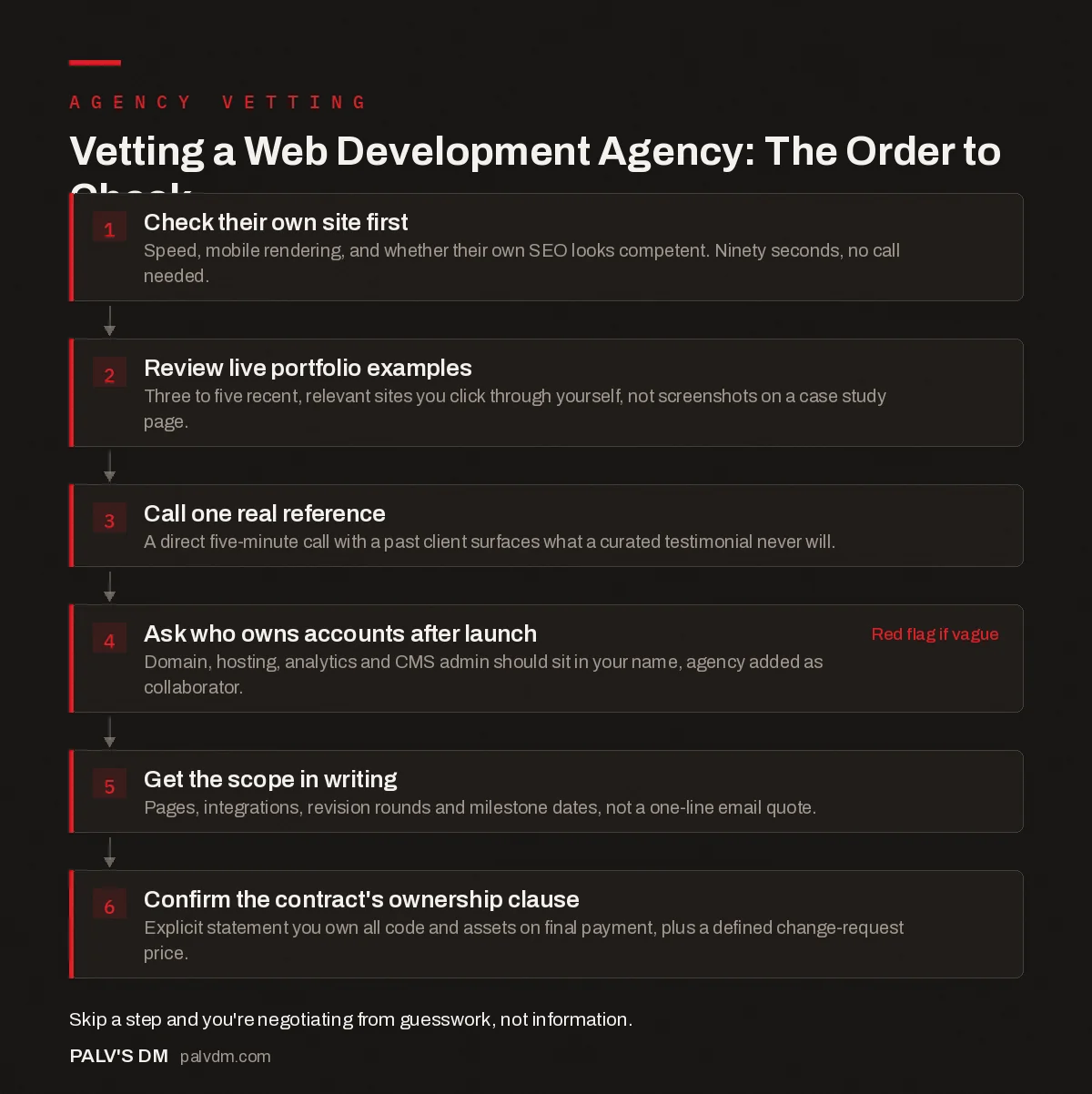
Vetting a Web Development Agency: The Order to Check
- Check their own site first. Speed, mobile rendering, and whether their own SEO looks competent. Ninety seconds, no call needed.
- Review live portfolio examples. Three to five recent, relevant sites you click through yourself, not screenshots on a case study page.
- Call one real reference. A direct five-minute call with a past client surfaces what a curated testimonial never will.
- Ask who owns accounts after launch. Domain, hosting, analytics and CMS admin should sit in your name, agency added as collaborator. Red flag if vague
- Get the scope in writing. Pages, integrations, revision rounds and milestone dates, not a one-line email quote.
- Confirm the contract’s ownership clause. Explicit statement you own all code and assets on final payment, plus a defined change-request price.
What should you look for in their portfolio?
- Recency over volume. A portfolio of forty projects from six years ago tells you less than three sites launched in the last year. Platforms, standards and pricing all move; ask what they’ve shipped recently.
- Live sites, not screenshots. Click through to at least three examples yourself. Check page speed, mobile rendering and whether the site still looks maintained, not abandoned a month after launch.
- Relevant complexity. A beautiful five-page brochure site doesn’t prove an agency can handle a booking system, a multi-language catalog, or an integration with your CRM. Match the portfolio examples to what you’re actually building.
- A client you can call. Ask for one direct reference, not a testimonial quote curated for the sales page. A five-minute call with a past client surfaces things a case study never will.
Who should own the accounts when it’s over?
This is the question that separates a healthy vendor relationship from a hostage situation, and it’s the one buyers skip most often because it feels awkward to ask before the relationship has even started. It shouldn’t. Domain registration, hosting, Google Analytics, Google Search Console and the CMS admin login all need to sit in accounts you control, with the agency added as a collaborator, not the other way around.
The default WordPress hosting setup an agency proposes trips people up constantly here: some agencies register the domain themselves “to make setup easier” and never transfer it. Ask directly, in writing, before the project starts: which accounts will be created in my name, and which will you create in yours? If any answer is “ours,” that’s the point to push back or walk away, not something to sort out after launch. Our rundown of the accounts you must own yourself covers exactly which ones matter and why.
What belongs in the written scope?
Get the scope in writing before any deposit changes hands. A solid scope document names the number of pages or templates, the specific integrations (payment gateway, CRM, booking system), who’s writing the copy, who’s sourcing images, the review and revision process, and a delivery date with named milestones along the way rather than one single deadline at the end.
Vague scopes are where budgets quietly double. “We’ll build you a modern, professional website” is not a scope. “Twelve template pages, one contact form with CRM integration, two rounds of revisions per page, delivered in six weeks with milestones at week two and week four” is a scope you can hold someone to.
What questions actually reveal how an agency works?
Ask these directly on the sales call, and pay closer attention to how they answer than to what they say:
- “What happens if I want to leave after launch?” A confident answer describes a clean handover process. A defensive or vague answer is a signal.
- “Who writes the code, in-house or subcontracted?” Subcontracting isn’t automatically bad, but you should know who’s actually building your site and whether that team changes mid-project.
- “What does ‘done’ look like, and who signs off?” This prevents the project from drifting into an open-ended relationship with no clear finish line.
- “What’s your process when a deadline slips?” Every project slips sometimes. What matters is whether there’s a documented process for communicating it.
What contract terms protect you?
Beyond scope and timeline, three clauses matter more than the rest of the document combined: an explicit statement that you own all code, assets and accounts on final payment; a defined change-request process with per-change or hourly pricing so scope creep doesn’t get billed as a surprise; and a kill clause specifying what you’re owed (files, access, partial refund) if either side ends the engagement early. If an agency resists putting these in writing, that resistance is itself the answer to whether you should sign.
What are the clearest red flags?
- Reluctance to name a hosting or accounts policy until after you’ve paid a deposit.
- Pressure to sign within 24 to 48 hours to “lock in” a price or slot. Legitimate agencies with real pipelines don’t need artificial urgency to close a deal.
- No written scope, just a verbal agreement and a quote in an email.
- A portfolio that can’t survive a click-through: broken links, dead demo sites, or examples that turn out to belong to a different company entirely.
How do you compare two quotes fairly?
Never compare quotes on price alone. Line them up against the same scope document and check what each one actually includes: number of pages, revision rounds, whether copywriting and photography are in or out, hosting setup, post-launch support window, and who owns what at the end. A quote that’s 40% cheaper almost always means less discovery time, a heavier reliance on a pre-built theme, or support hours priced separately after a short included window.
Ask both agencies the identical question and compare answers side by side: “If I need to add a fourth service page after we sign, what does that cost and how long does it take?” The agency with a clear, immediate answer has done this before. The one that hedges hasn’t thought it through, which usually shows up later as delay.
What happens during the build that you should watch for?
A healthy build has visible checkpoints: a wireframe or content structure review before design starts, a design approval step before development begins, and a staging link you can access throughout, not just at the very end. If an agency disappears for six weeks and reappears with a “finished” site, you’ve lost the chance to catch a wrong direction early, when it’s cheap to fix.
Ask for staging access from week one. Watching a build happen in real time, even briefly each week, catches misunderstandings about scope before they compound into a delivery you don’t recognize.
Frequently asked questions
What’s the single most important question to ask a web development agency?
Who owns the domain, hosting account and code after launch? The answer should be you, in your own accounts, with full admin access, not the agency holding any of it on your behalf. Everything else on a vetting checklist matters less than this one.
How much should a business website cost?
It depends heavily on scope, from a simple brochure site to a custom-built platform with integrations. Rather than anchoring on a number, ask for a written breakdown of what’s included, what counts as a change request, and what ongoing costs continue after launch.
Should I always go with the cheapest quote?
No. The cheapest quote usually means less discovery, a template build, or accounts held by the agency to keep you dependent on them for future work. Compare what’s actually included, not just the final number, before deciding.
Is a big portfolio always a good sign?
Not by itself. A large portfolio matters less than three to five recent, live examples in your industry or a similar one, with a client you can actually contact. Screenshots on a case study page don’t confirm the site still works or ranks.
What should be in the contract before I sign?
Scope of work, a fixed timeline with named milestones, who owns the final files and accounts, what happens if the project runs late, and the exact cost of changes outside the original scope. If any of these are missing or vague, ask for them in writing before paying anything.
Sources
- How to Choose a Web Development Company: 7-Step Checklist, Clutch.co
- How to choose a web designer: the best questions to ask, Orbit Media
- WordPress SEO: The Complete Configuration Guide
- What to Get in a Website Handover From Your Developer
- Website Platform Lock-In: How to Spot It Before You Sign
- How Much Should a Business Website Cost in India?
Want this done on your site?
Every PalV’s DM engagement starts with a free audit of your actual website — a 12-point
crawl covering what is blocking indexation, on-page gaps against your primary keywords, speed
findings, and the three to five fixes worth making first. Delivered in two working days. No
payment details, and the findings are yours whether you hire us or not.
Get your free SEO audit
See Web Development plans and prices