Service Support — Web Development
How Long a Business Website Takes to Build Properly
A properly built business site takes six to ten weeks, longer for e-commerce. See how long to build a website takes phase by phase, and why timelines slip.

A business website built properly takes roughly six to ten weeks from a signed brief to launch for a typical small-to-mid-size site of around 8-15 pages, and three to five months for a larger site with custom functionality, e-commerce, or a multi-stakeholder approval chain. That range assumes one thing: the client returns copy, images, and sign-off on schedule. The biggest single variable isn’t the agency’s calendar — it’s how fast decisions and content come back from the client’s side. A website quoted at “two weeks” is either a template with placeholder text swapped in, or a timeline about to slip.
Key takeaway
- A properly built business website takes six to ten weeks for a standard site and three to five months for a larger or custom-built one, measured from signed brief to launch.
- The build phase itself is rarely the bottleneck — content collection, review rounds, and client sign-off usually account for more elapsed time than design and development combined.
- Timelines quoted in days rather than weeks almost always mean a pre-made template with your logo dropped in, not a site built to your structure and content.
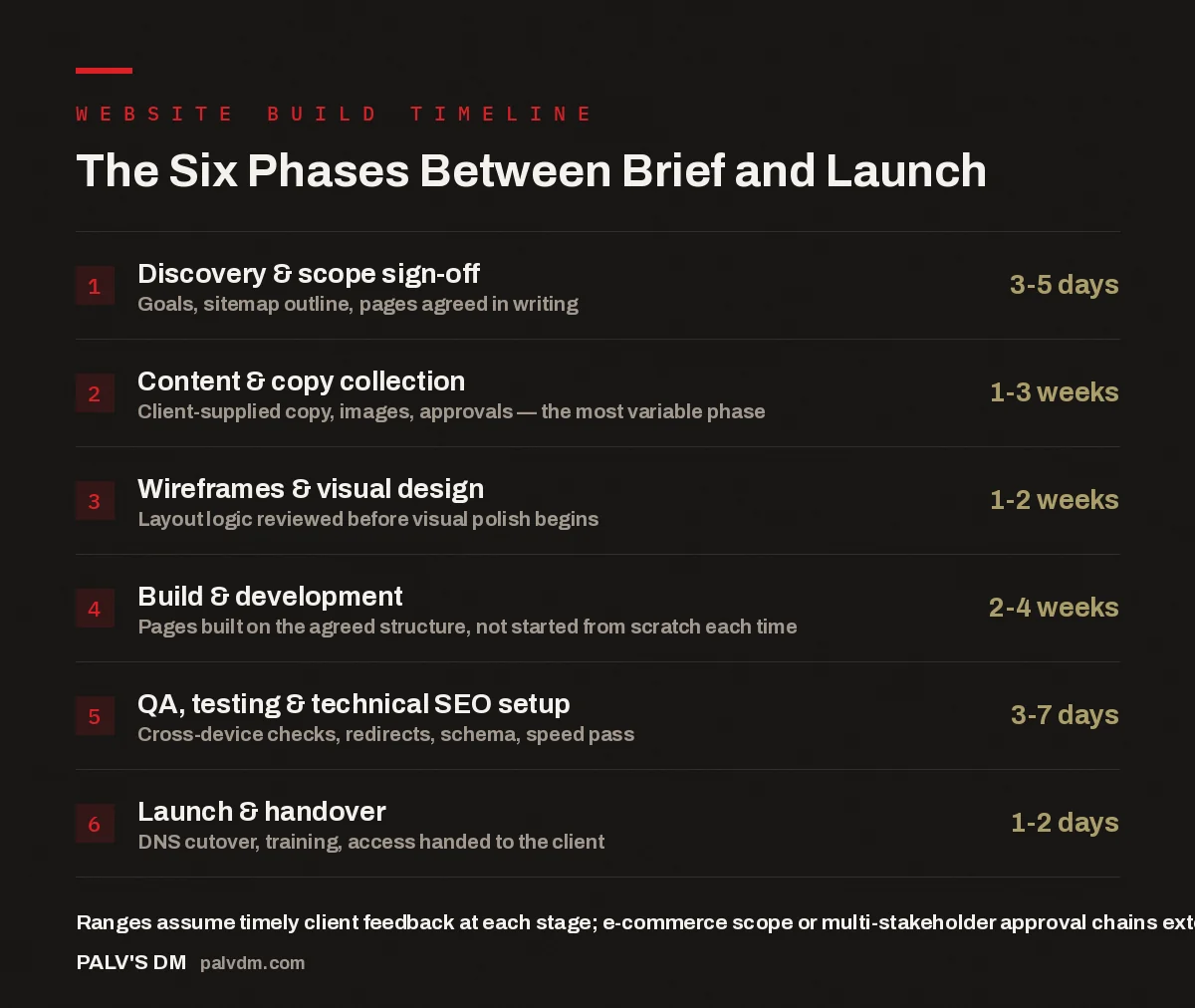
The Six Phases Between Brief and Launch
- Discovery & scope sign-off — 3-5 days. Goals, sitemap outline, pages agreed in writing.
- Content & copy collection — 1-3 weeks. Client-supplied copy, images, approvals — the most variable phase.
- Wireframes & visual design — 1-2 weeks. Layout logic reviewed before visual polish begins.
- Build & development — 2-4 weeks. Pages built on the agreed structure, not started from scratch each time.
- QA, testing & technical SEO setup — 3-7 days. Cross-device checks, redirects, schema, speed pass.
- Launch & handover — 1-2 days. DNS cutover, training, access handed to the client.
What actually happens in each phase of a website build?
Discovery comes first, and it’s short by design: three to five days to agree the sitemap, the pages that will exist, and what each page needs to do commercially. Skipping this step doesn’t save time — it just moves the disagreement about scope to week four, when it costs far more to fix. Once the sitemap is signed off, content collection starts, and this is where most timelines actually live or die. A client who sends finished copy and photography, with a decision-maker who reviews drafts within 48 hours, can compress this phase to a week. A client writing copy from scratch and routing every draft through three internal approvers can stretch it to a month, sometimes longer.
Wireframes and visual design happen in parallel with the tail end of content collection wherever possible, because layout decisions shouldn’t wait on every word being final. Development follows the agreed wireframes and content structure — the phase people picture when they think “building a website,” but on a well-scoped project it’s rarely the longest one. QA and technical SEO setup (redirects, schema markup, sitemap submission, a Core Web Vitals pass) happen before launch, not after, because fixing indexation problems on a live site is slower than catching them beforehand. Launch itself — DNS cutover, final checks, handover — is usually the fastest step in the whole sequence.
Why does a website build take longer than clients expect?
Because most people mentally model a website build as one continuous task — “building the site” — when it’s actually a chain of dependent phases, several of which depend on someone outside the agency responding on time. Development can’t meaningfully start until the sitemap and content structure are locked, since building pages against content that later gets restructured means rebuilding them. Every review round that takes a week instead of two days adds a week to the calendar, not because the agency is idle, but because the next phase is waiting on that decision.
The pattern that shows up repeatedly on the accounts we take over or build from scratch: phases within the agency’s direct control — design, development, QA — tend to land close to estimate. Phases that depend on the client — content delivery, internal approvals, choosing between design directions — are where a six-week project quietly becomes a twelve-week one. This isn’t a criticism of clients; most business owners are running a business, not sitting by to approve homepage copy the moment it lands in their inbox. It’s simply the honest reason “how long will my website take” rarely has one fixed answer independent of how the client’s side operates.
If you’re trying to work out what you’ll be asked to supply and when, we’ve written a full breakdown of what you need to provide before a build starts — worth reading before a project kicks off, not after it’s already slipping.
How does site size and complexity change the timeline?
Page count matters, but it’s not the main driver — structural complexity is. A 10-page brochure site with a contact form and a blog is a fundamentally different build from a 10-page site that also needs a booking system, a membership area, or a custom quote calculator. The extra functionality adds its own round of scoping, testing, and client decisions about how it should behave. E-commerce sites add product data collection, payment gateway setup, and shipping or tax logic on top of everything a standard site needs, which is why they routinely land in the three-to-five-month range rather than six to ten weeks.
| Site type | Typical timeline | Common bottleneck |
|---|---|---|
| Small business site (5-10 pages, no custom features) | 4-6 weeks | Content and photography delivery |
| Standard business site (8-15 pages, blog, forms) | 6-10 weeks | Review rounds and internal sign-off |
| Site with custom functionality (booking, calculators, portals) | 10-16 weeks | Functional spec and testing cycles |
| E-commerce site | 3-5 months | Product data, payment and tax setup |
| Migration of an existing large site | 3-5 months+ | Content audit and redirect mapping |
Migrations deserve a separate mention because they behave differently from a fresh build. An existing site with years of published content and inbound links needs every URL mapped to its new address before launch, or rankings and referral traffic take a hit the day the new site goes live. That mapping work happens alongside the build, which is one reason migrations of established sites often run as long as an e-commerce build even at a similar page count. We’ve covered the mechanics separately in how we migrate a site without a traffic drop.
What can a client do to keep the timeline on track?
The single highest-leverage thing a client can do is nominate one decision-maker for the project, rather than routing every draft through a committee. A round that needs sign-off from one person who replies within a couple of days moves fast. The same round routed through three stakeholders who each want changes, sequentially rather than together, can turn a two-day review into a two-week one — and that pattern repeats at every review point in the build.
- Gather core content (page copy, logo files, brand photography, testimonials) before the project starts, not after development is already underway.
- Agree who has final sign-off authority at each stage, and get that person into review meetings directly rather than relaying feedback secondhand.
- Set a turnaround expectation for feedback (48-72 hours is realistic) and hold to it the same way you’d expect the agency to hold to its delivery dates.
- Decide functionality requirements (booking, quote forms, membership areas) during discovery, not midway through development, since late additions restart parts of the scoping process.
It also helps to know what you’re actually getting for the timeline you’re agreeing to. A build that includes technical SEO groundwork, proper handover training, and a documented QA pass takes longer than one that doesn’t, because those things take real hours. Our breakdown of what’s included in a complete website build covers what should be inside that scope regardless of who builds it.
Clients almost never ask us why a build takes six weeks. They ask why the other quote said five days. The honest answer: five days is enough time to swap a logo and some stock text into a template. It isn’t enough time to build a sitemap that matches how customers actually search and check that none of it breaks on a phone before it goes live.
Palash, Founder, PalV’s DM
What makes a two-week website timeline unrealistic?
A two-week turnaround is realistic for placing your logo and some placeholder-adjacent copy into an existing template — it is not realistic for a site built around your actual sitemap, your own copy, tested across devices, with technical SEO set up before launch. Something has to be skipped to hit that timeline, and it’s usually one of: proper content (generic filler text gets published instead), cross-device QA (the site looks fine on the designer’s laptop and breaks on mobile), or technical SEO setup (no redirects, no schema, meta descriptions left as WordPress defaults). None of those gaps are visible on launch day. They show up weeks later, as a site that looks finished but underperforms or breaks in ways nobody caught.
This is really a scope question dressed up as a timeline question. Two sites can both be called “a business website” while representing entirely different amounts of work, which is why the cheapest and fastest quote usually isn’t comparable to a properly scoped one. We’ve written more directly about that gap in cheap website vs built-to-rank website: the real difference, worth reading alongside a timeline estimate, not instead of it.
Before you sign a timeline
- Ask what happens to the timeline if your content or approvals run late — a good agency will tell you honestly, not just quote a fixed date regardless.
- Ask whether technical SEO setup and cross-device QA are built into the quoted timeline, or treated as an afterthought.
- Nominate one internal decision-maker before the project starts — it’s the single biggest lever you control over how long the build actually takes.
How long does it take to build a business website from start to finish?
Typically six to ten weeks for a standard 8-15 page site, and three to five months for a larger site with e-commerce or custom functionality, measured from signed brief to launch. The main variable isn’t the build work itself but how quickly the client supplies content and returns approvals.
Which phase of a website build usually takes the longest?
Content and copy collection, in most cases — not development. Design and build phases tend to land close to estimate because they’re within the agency’s direct control. Content depends on the client writing or sourcing copy and getting internal sign-off, which is where timelines most often stretch.
Can a website really be built in a few days?
A template with your logo and generic copy dropped in, yes. A site built around your own sitemap and content, tested across devices, with technical SEO set up before launch, no — that work takes real hours regardless of how fast anyone works. A multi-day quote usually means something on that list is being skipped.
Does adding e-commerce significantly change the build timeline?
Yes. E-commerce adds product data collection, payment gateway integration, and tax or shipping logic on top of everything a standard site needs, which is why e-commerce builds typically run three to five months rather than six to ten weeks. The extra time goes into testing checkout flows, not just extra pages.
What’s the single biggest way a client can speed up their own website build?
Nominate one decision-maker with real sign-off authority before the project starts, and have that person review drafts within a couple of days rather than routing feedback through multiple people sequentially. Slow, multi-person review rounds are the most common reason a realistic timeline stretches past its original estimate.
Short version: a properly built business website takes six to ten weeks for a standard site and three to five months for a larger or custom one, and the pace is set less by the agency’s build schedule than by how quickly content and approvals come back from the client’s side. Treat a timeline quoted in days, not weeks, as a signal that something in scope — content, QA, or technical setup — is being skipped rather than delivered.