White Hat vs Black Hat vs Grey Hat SEO
Google recognises two categories, not three: policy-compliant and not. What each hat means, the named spam policies, and how to audit an agency's methods.
White hat SEO follows Google’s published spam policies, black hat SEO deliberately breaks them, and grey hat is a term the industry invented for tactics that are not explicitly named in the policies but clearly violate their intent. Google itself recognises only two categories: content and links that comply with its spam policies, and content and links that do not. The three-hat framing is useful for describing risk appetite, not for predicting what Google will tolerate. If a tactic’s only defence is that Google has not written a rule against it yet, it is a black hat tactic with a delay built in.
The practical question is not which hat a tactic wears. It is what happens to the business when the tactic stops working — because unlike a marketing experiment that simply underperforms, spam tactics can remove a site from search results and take months of rebuilding to reverse.
What is white hat SEO?
White hat SEO improves how well a site serves searchers, and improves how easily search engines can understand it, without misrepresenting either. It is defined by compliance with Google Search Essentials and the spam policies published alongside them.
In practice it covers a narrow, unglamorous list: making pages crawlable and indexable, writing content that answers the query better than the alternatives, structuring a site so related pages support each other, earning citations through work other people want to reference, and being transparent about who published the page and why. The on-page fundamentals and the technical foundations are almost entirely white hat by construction, because there is no deceptive version of a correct canonical tag.
White hat has one genuine drawback worth stating honestly: it is slower. Earned links arrive on other people’s schedules, and content quality takes time to produce. Anyone comparing approaches should compare them on a two-year horizon, because on a two-month horizon the shortcuts look better.
What is black hat SEO?
Black hat SEO deliberately violates Google’s spam policies to manufacture rankings a site has not earned. Google names these practices explicitly and publicly, which removes any ambiguity about whether they are allowed.
| Named policy | What it looks like in practice |
|---|---|
| Cloaking | Showing search engines different content from what users see |
| Doorway pages | Near-identical pages built for many locations or keywords, funnelling to one destination |
| Link spam | Buying links, exchanging them at scale, private blog networks, automated comment or forum links |
| Scaled content abuse | Mass-producing pages primarily to manipulate rankings rather than to help anyone |
| Site reputation abuse | Hosting third-party content on a trusted domain to borrow its ranking strength |
| Expired domain abuse | Buying a lapsed domain to repurpose its history for unrelated content |
| Hidden text and sneaky redirects | Text invisible to users, or a redirect that sends users somewhere search engines never saw |
Three of these entries are recent additions rather than legacy rules, which matters: scaled content abuse, site reputation abuse and expired domain abuse were named because those tactics had become widespread. The pattern is consistent — a tactic works, spreads, gets named as spam, and then stops working. Assume the same trajectory for whatever is currently working suspiciously well.
What is grey hat SEO, and does Google recognise it?
Grey hat describes tactics that exploit the space between the letter of Google’s policies and their intent. Google does not recognise the category. Its documentation distinguishes only between compliant and non-compliant behaviour, and its spam systems are built to detect manipulation rather than to check whether a specific technique has been written down.
The tactics usually placed in the grey zone share one feature: the manipulative version and the legitimate version look similar from the outside.
- Paid guest posting. A genuine contributed article on a relevant publication is normal. Paying for placement of a link-bearing article on a site that publishes anything for a fee is link spam, which is why the distinction between link insertions and guest posts matters more than the format.
- Aggressive content refreshing. Genuinely updating a page is encouraged. Changing the date without changing the content is a trust problem and does not work.
- AI-assisted writing at volume. Google’s position is about quality and purpose, not about the tool. Editing an AI draft into something with original evidence is fine; publishing 300 unedited pages is the scaled content abuse policy verbatim.
- Buying an expired domain and redirecting it. Acquiring a competitor and merging their site is legitimate. Buying an unrelated lapsed domain for its backlink profile is a named violation.
A workable test: could you describe the tactic in full to the person on the other side of it — the publisher, the reader, the client — without changing your wording? If not, it is not grey.
Has AI changed where the line sits?
Generative writing tools moved the volume ceiling, not the policy. Google’s published position on machine-generated content concerns quality and purpose: content produced primarily to manipulate rankings violates the spam policies whatever produced it, and content that genuinely helps people is acceptable whatever produced it. The scaled content abuse policy was written in exactly those terms, and it applies equally to a content farm with forty freelancers and to a single operator with an API key.
What has changed is how quickly a borderline decision becomes a serious one. Producing three hundred pages used to require a budget and several months, which gave a publisher time to reconsider. It now takes an afternoon. The tactics that look most tempting in 2026 — mass programmatic pages, automatic rewrites of competitor articles, bulk location pages differing only by place name — are the same doorway page and scaled content patterns Google has named, executed faster.
There is a defensible use of the same tools, and it points in the opposite direction. Peer-reviewed research presented at KDD 2024 found that adding statistics, quotations from named sources and citations to authoritative sources raised a page’s visibility in generative engine answers by up to around 40%, while keyword stuffing performed worse than the baseline. Evidence outperforms manipulation on the newer surface as well, which narrows rather than widens the space that grey hat tactics occupied.
What actually happens if you get caught?
Two different mechanisms, with very different diagnostics, and confusing them wastes months. Manual actions and algorithmic suppression behave nothing alike.
A manual action is a human reviewer at Google applying a sanction to your site. It appears in the Manual Actions report in Search Console, it names the problem, and it requires a reconsideration request after you fix it. It is the only case where Google tells you directly that you have been penalised.
Algorithmic suppression arrives with a spam update or a core update and generates no notification at all. Nothing appears in Search Console. Recent spam updates have been fast — the March 2026 spam update completed in under 24 hours and the June 2026 spam update ran roughly two days, against nearly four weeks for the August 2025 spam update — so the drop is often abrupt and easy to mistake for a tracking error. The way to tell the difference is to check the dates against the Search Status Dashboard, which is the distinction covered in core updates versus spam updates.
Recovery from spam-related suppression is not a support ticket. It requires removing the offending behaviour and waiting for Google’s systems to reassess, and there is no published timeline for that reassessment.
How do you check an agency is not using black hat tactics?
Most businesses do not choose black hat SEO. They buy it accidentally, from a vendor whose deliverables they never inspected. Six checks catch nearly all of it.
- Ask for the full link list, with URLs. Not a count, not a domain-authority average. Real URLs you can open. Refusal is the answer.
- Look up where the links sit on the page. Editorial links appear inside relevant articles. Links in footers, sidebars and unrelated “resources” pages across hundreds of sites are network patterns.
- Treat ranking guarantees as disqualifying. No vendor controls Google’s results, and a guarantee either means bidding on terms nobody searches or means paying for manipulation.
- Read one full article they published for another client. If it reads like a paraphrase of the top three results, you are buying volume, not evidence.
- Ask what happens if Google names the tactic as spam. A vendor with a defensible method can answer immediately. One relying on undisclosed link buying cannot.
- Insist on your own Search Console and analytics access. Without it you cannot see a manual action if one arrives, which is the single most expensive blind spot in any SEO proposal.
The economics are the real argument, more than the ethics. Black hat tactics produce rankings that must be defended against every update, on a site with no durable asset underneath; cheap SEO carries the risk precisely because manipulation is the cheapest way to look effective in month two. White hat work is slower, holds its value, and survives the fact that Google shipped five confirmed updates between February and June 2026 alone. Choose on that basis, not on the colour of the hat.
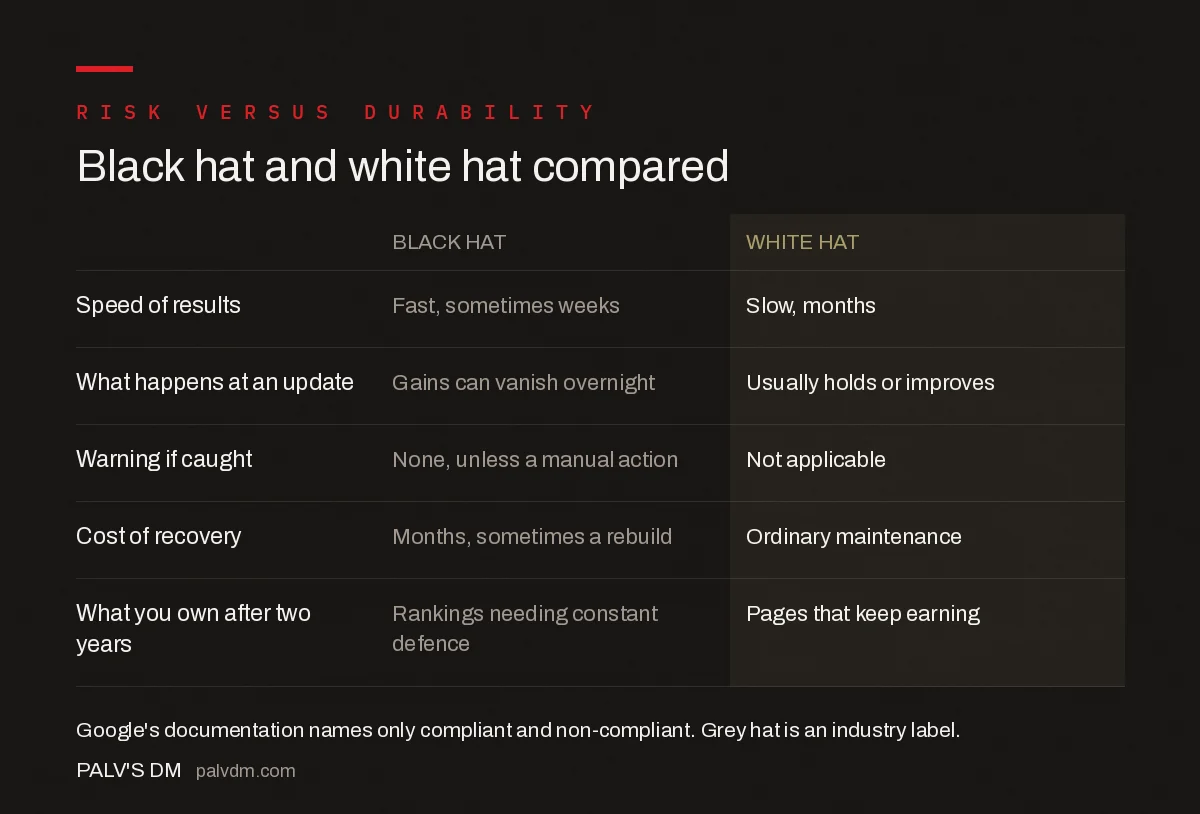
Black hat and white hat compared
| Black hat | White hat | |
|---|---|---|
| Speed of results | Fast, sometimes weeks | Slow, months |
| What happens at an update | Gains can vanish overnight | Usually holds or improves |
| Warning if caught | None, unless a manual action | Not applicable |
| Cost of recovery | Months, sometimes a rebuild | Ordinary maintenance |
| What you own after two years | Rankings needing constant defence | Pages that keep earning |
Frequently asked questions
What is the difference between white hat and black hat SEO?
White hat SEO follows Google’s published spam policies and improves how well a site genuinely serves searchers. Black hat SEO deliberately breaks those policies to manufacture rankings, through practices Google names explicitly such as cloaking, doorway pages, link spam and scaled content abuse. The practical difference is what happens at the next update: white hat work usually holds, black hat gains can vanish.
Is grey hat SEO safe?
Google does not recognise a grey category. Its documentation distinguishes only between compliant and non-compliant behaviour, and its spam systems detect manipulation rather than checking whether a technique has been written down. Tactics called grey hat are usually ones where the manipulative and legitimate versions look similar from outside. If the only defence is that no rule names it yet, treat it as delayed risk.
Will Google tell me if I have been penalised?
Only for manual actions. A manual action appears in the Manual Actions report in Google Search Console, names the problem, and requires a reconsideration request once fixed. Algorithmic suppression arriving with a spam or core update generates no notification anywhere. To tell them apart, check the Manual Actions report first, then compare your drop dates against the Search Status Dashboard.
Is buying backlinks always black hat?
Paying for links that pass ranking credit is link spam under Google’s published policies, regardless of how the transaction is described. Paid placements are acceptable when the links are marked as sponsored or nofollow, which is how advertising is supposed to work. A paid guest post carrying an unmarked followed link is a policy violation whatever the invoice calls it.
Is AI-generated content black hat SEO?
Not by itself. Google’s position concerns quality and purpose rather than the tool used to produce the text. Editing an AI draft into something carrying original evidence, first-hand experience and real sourcing is acceptable. Publishing large volumes of unedited pages primarily to manipulate rankings is exactly what the scaled content abuse policy describes.
How do I know if my SEO agency is using black hat tactics?
Ask for the full list of links built, with clickable URLs rather than a count or an authority average. Check where those links sit on the page: editorial links appear inside relevant articles, while footer, sidebar and unrelated resource-page links across many sites indicate a network. Ranking guarantees are disqualifying, and you should hold your own Search Console access.
Sources
- Spam policies for Google web search
- Google Search Essentials
- Google Search Status Dashboard — Confirmed spam and core update dates
- GEO: Generative Engine Optimization (Aggarwal et al., KDD 2024)
Want this done on your site?
Every PalV’s DM engagement starts with a free audit of your actual website — a 12-point
crawl covering what is blocking indexation, on-page gaps against your primary keywords, speed
findings, and the three to five fixes worth making first. Delivered in two working days. No
payment details, and the findings are yours whether you hire us or not.