Sites That Recovered: What They Actually Changed
No verifiable public dataset of core update recoveries exists. What Google has documented, what a real recovery claim needs, and which changes are defensible.

There is no verifiable public dataset of sites that recovered from Google core updates, which is why every recovery case study you have read is a before-and-after screenshot with no control group attached. Google publishes no recovery list, confirms nothing site by site, and states that no specific action guarantees recovery. What can be established honestly is narrower and more useful: what Google has documented about how recovery happens, what evidence a recovery claim would need to carry to mean anything, and which categories of change are consistent with Google’s own stated criteria.
That is a less satisfying article than a gallery of green arrows. It is also the only version that survives contact with the question “how do you know?” — which is the question worth asking of anybody selling core update recovery.
Why can nobody prove a core update recovery?
Four problems make a public recovery claim unfalsifiable, and all four apply to almost every case study in circulation.
- No control group. A site that improved after making changes cannot be compared against the same site not making them. Without a control, “we did X and recovered” is a sequence, not a cause.
- Multiple simultaneous changes. Recovery projects typically rewrite content, restructure internal links, add authors and prune pages together. Attribution is destroyed the moment more than one class of change ships in the same window.
- Ranking is relative. A site can rise because competitors fell. The graph looks identical either way.
- Survivorship bias. Nobody publishes the recovery project that did not work, so the visible sample is selected on outcome.
None of this means recovery does not happen. It means published examples cannot tell you why it happened, and treating them as a method is how sites end up copying a change that had nothing to do with the result.
What has Google actually documented about recovery?
Google’s published position is short and repeated after every rollout: there are no specific actions that guarantee recovery, a drop does not necessarily mean anything is wrong with your pages, some recovery may occur between core updates, and the largest changes tend to arrive with a subsequent core update rather than between them.
The last point is the load-bearing one. It says the assessment date is set by Google’s rollout calendar, not by when your work finishes, which is why recovery timing is not yours to control. Google also issued no new guidance at all with the March 2026 core update, at either launch or completion, so anyone who published “what the March 2026 update rewarded” was interpreting, not reporting.
Is there any documented case of an update doing what Google said?
One, at scale, and it is worth knowing precisely because it is unusual. The February 2026 Discover core update was the first core update aimed exclusively at Discover rather than Search, and Google stated three goals for it: showing users more locally relevant content from websites based in their country, reducing sensational content and clickbait in Discover, and showing more in-depth, original and timely content from sites with expertise in a given area.
Newzdash subsequently analysed the top 1,000 US domains and reported that the international share declined on a normalised basis — directionally consistent with the first stated goal. That is third-party analysis of an aggregate market, not a recovery case study, and it does not tell any individual publisher what to change. It does establish something narrower and genuinely useful: when Google states a goal, aggregate movement can be consistent with it.
What evidence would a real recovery example need?
Apply this test to any case study, including one from an agency you are considering hiring. A claim missing more than one of these is a story.
| Evidence required | What it rules out |
|---|---|
| Confirmed rollout dates from Google’s dashboard, both for the loss and the recovery | Recovery attributed to an update that was never confirmed |
| Equal-length comparison windows fully outside both rollouts | Numbers inflated by a window straddling a rollout |
| A dated change log showing what shipped and when | Unattributable multi-variable change |
| Segment-level data, not a site-wide total | A seasonal or branded recovery presented as a ranking recovery |
| A comparison set of untouched pages | Sitewide index churn read as a result |
| Positions, impressions and clicks reported separately | A click recovery driven by a SERP feature change |
The two cheapest items on that list are the ones almost always missing: confirmed dates from the Search Status Dashboard and a dated change log. Both take minutes, which is why their absence is informative — and why keeping an update log is what makes your own recovery, if it comes, provable.
Which changes are consistent with Google’s stated criteria?
In the absence of verified examples, the defensible guide is Google’s own self-assessment questions, organised around who produced the content, how it was produced and why it exists. Three categories map directly onto them and can be evidenced on your own site.
Attribution. Content published under no byline cannot answer Google’s “who” question at all. Adding a named author with relevant, stated experience and an author page that carries evidence of it is a structural change rather than an editorial one, and it is checkable — see why anonymous content struggles.
Comparative value. Google asks whether content provides substantial value compared with other pages in search results. That is a comparative test a competent rewrite cannot pass, because the field is already competent. Passing it requires something the field does not have: original testing, first-hand experience, published methodology, real numbers. The industry calls this information gain, though Google has never confirmed it as a named ranking system.
Inventory. Consolidating several thin pages competing for one intent, and retiring pages that exist only because a keyword tool returned a volume figure, is consistent with Google’s “why” question. It is also the change most often confused with panic deletion — the distinction is set out in panic moves after an update.
What about the percentage figures circulating in SEO blogs?
Figures of the form “sites with proprietary data gained 15 to 25 per cent” or “AI content farms lost 60 to 80 per cent” appeared widely after the 2026 core updates. They are vendor estimates with no published methodology, no stated sample, no definition of the categories being measured, and no way for anyone to reproduce them.
The claim attached to them is usually stronger still: that a specific update made some named factor the dominant ranking signal. Google said nothing of the kind about any 2026 update and issued no new guidance at all with the March 2026 core update. A percentage with no methodology is not evidence of a mechanism; it is a headline. Treat any such figure as an industry interpretation, cite it as one if you use it at all, and never build recovery work on it.
What we will not show you
PalV’s DM does not publish client recovery percentages, because we cannot evidence them to the standard set out above. A number without confirmed dates, a change log, a control set and segment-level data is decoration, and putting our logo next to it would not make it true.
What we will do is show the working: the diagnosis, the dated changes, the comparison windows, and what moved against what did not. That is checkable. Anyone quoting you a recovery percentage from a case study should be asked for the same six items in the table above, and the answer to that request tells you most of what you need to know. If you want the operational version, the 30-day recovery plan and the recovery approach itself set out the sequence.
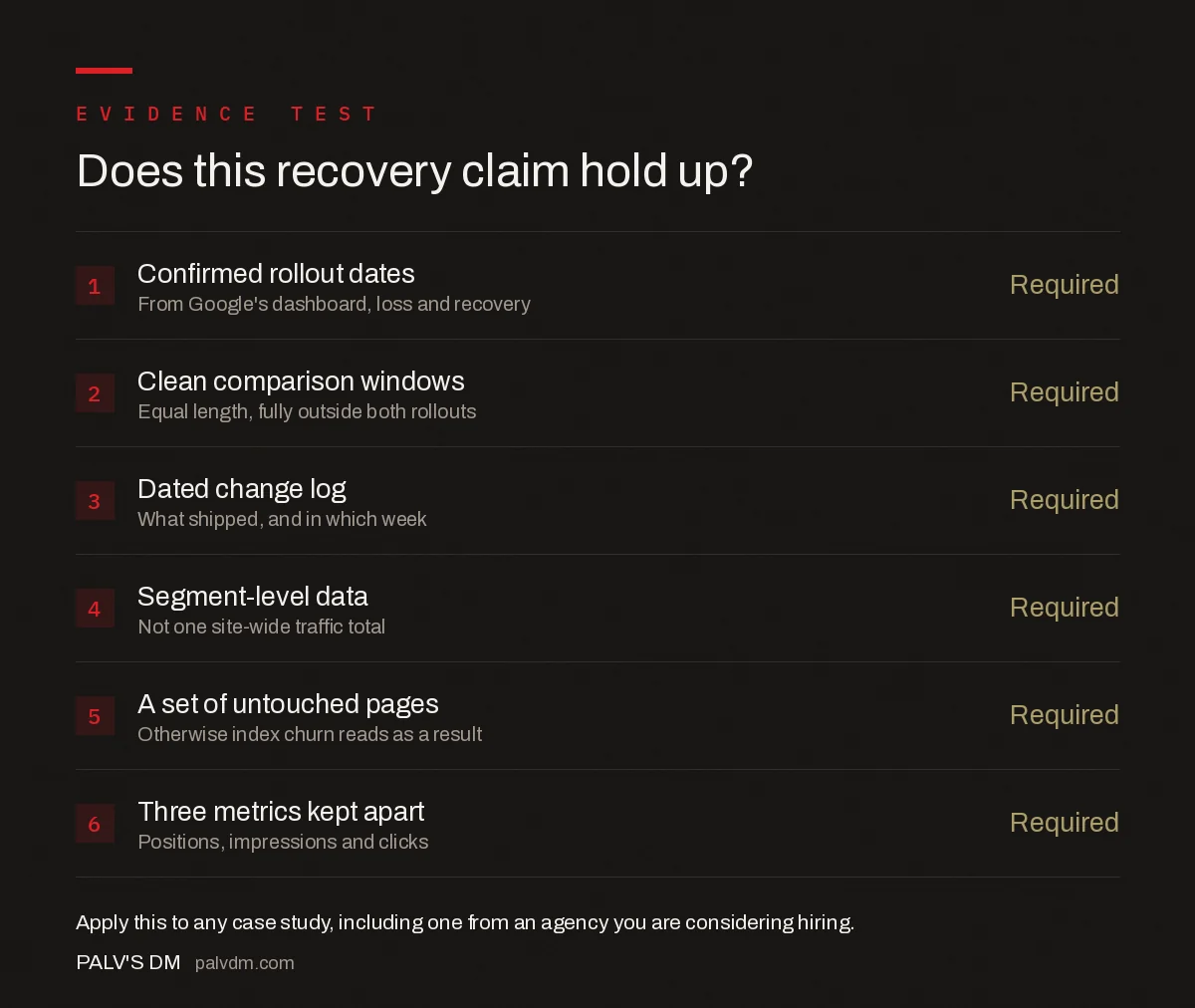
Does this recovery claim hold up?
- Confirmed rollout dates — Required. From Google’s dashboard, loss and recovery.
- Clean comparison windows — Required. Equal length, fully outside both rollouts.
- Dated change log — Required. What shipped, and in which week.
- Segment-level data — Required. Not one site-wide traffic total.
- A set of untouched pages — Required. Otherwise index churn reads as a result.
- Three metrics kept apart — Required. Positions, impressions and clicks.
Frequently asked questions
Are there real examples of sites recovering from a Google core update?
Recovery happens, but no verifiable public dataset of it exists. Google publishes no recovery list and confirms nothing site by site, so published case studies are before-and-after charts without a control group. They can show that a site improved; they cannot establish that the changes made caused the improvement.
Why are core update recovery case studies unreliable?
Four problems apply to nearly all of them: no control group, several classes of change shipped at once so attribution is impossible, ranking is relative so a site can rise because competitors fell, and survivorship bias means failed recovery projects are never published. Together these make the causal claim unfalsifiable.
What evidence should a core update recovery claim include?
Confirmed rollout dates from Google’s Search Status Dashboard for both the loss and the recovery, equal-length comparison windows sitting fully outside both rollouts, a dated change log, segment-level rather than site-wide data, a comparison set of untouched pages, and positions, impressions and clicks reported separately.
Did any 2026 update measurably do what Google said it would?
The February 2026 Discover core update is the clearest case. Google stated three goals, including showing users more locally relevant content from websites based in their country. Newzdash’s analysis of the top 1,000 US domains reported that the international share declined on a normalised basis, which is directionally consistent with that stated goal.
What changes are actually defensible after a core update?
Changes that map onto Google’s published self-assessment questions. Adding named authors with stated relevant experience answers the who question. Adding original testing, first-hand experience or published methodology addresses whether content provides substantial value compared with other search results. Consolidating or retiring pages that exist only to target keywords addresses why they exist.
Why does PalV's DM not publish client recovery percentages?
Because we cannot evidence them to the standard we apply to everyone else’s numbers. A recovery percentage without confirmed rollout dates, a dated change log, a control set of untouched pages and segment-level data is decoration. We show the diagnosis, the dated changes and what moved against what did not instead.
Sources
- Google core updates and your website — Search Central
- Creating helpful, reliable, people-first content — Search Central
- February 2026 Google Discover Core Update Done Rolling Out — Search Engine Roundtable
- Google Search Status Dashboard
Want this done on your site?
Every PalV’s DM engagement starts with a free audit of your actual website — a 12-point
crawl covering what is blocking indexation, on-page gaps against your primary keywords, speed
findings, and the three to five fixes worth making first. Delivered in two working days. No
payment details, and the findings are yours whether you hire us or not.