Google’s Own Questions to Ask After a Core Update
Google answers core updates with self-assessment questions, not fixes. Here is the Who, How, Why framework and how to run it against losing URLs.
Google’s official advice after a core update is not a checklist of fixes — it is a list of questions to ask about your own content, built around three axes: who produced it, how it was produced, and why it exists. Google publishes these questions in its helpful content documentation and points site owners at them every time a core update completes, because there is no ranking lever to pull. The questions are a self-assessment, and they only work if you answer them about specific losing URLs rather than about your site in the abstract.
Most people read the list, nod, and conclude their content passes. That reaction is the reason the list rarely helps anyone. Each question is only useful when you turn it into a test that a page can visibly fail.
Why does Google answer a core update with questions instead of instructions?
Because core updates are not enforcement. Google states there are no specific actions to take that guarantee recovery, that a drop does not necessarily mean anything is wrong with your pages, and that the largest changes tend to arrive with a subsequent core update rather than between them. There is no violation to undo, which is exactly why a core update is not a penalty and why a reconsideration request accomplishes nothing.
Google issued no new guidance at all with the March 2026 core update, neither at launch nor at completion, and used the same standing language for the May 2026 core update. The questions are what remains. They are a description of the target, not a route to it.
The Who, How, Why framework
Google groups its self-assessment around three questions about the origin of a page. Each has an operational test attached.
| Question | What Google is asking | How a page visibly fails |
|---|---|---|
| Who | Is it clear who produced the content, and are their credentials evident? | No byline, a generic “admin” or “editorial team” author, no author page, no stated relevant experience |
| How | How was the content produced, including any use of automation? | No methodology, no sourcing, no disclosure where automation was substantially involved |
| Why | Was it made primarily to help people, or primarily to rank? | The page exists because a keyword tool returned a volume figure and nothing else |
The “who” question is the cheapest to fix and the most commonly failed. A page published under no name cannot answer it at all, and the fix is structural rather than editorial — a real byline, an author page carrying evidence of expertise, and a consistent link between the two. The pattern is set out in why anonymous content struggles.
The “why” question is the hardest to answer honestly, because the honest answer for a large share of published content is “to rank”. If you cannot describe a reader who is better off for the page existing, the page is not going to pass on a rewrite.
Google’s content and quality questions
The second group asks what the page actually contains. Google’s published wording includes questions such as: does the content provide original information, reporting, research or analysis; does it provide a substantial, complete or comprehensive description of the topic; does it provide insightful analysis or interesting information beyond the obvious; and does it provide substantial value when compared to other pages in search results.
That last one is the sharpest. It is a comparative test, not an absolute one. A page can be accurate, well written, correctly structured and still fail it, because ten other pages say the same accurate, well-written thing. This is the same idea the industry has taken to calling information gain — a useful description of what recent core updates appear to reward, though Google has never confirmed it as a named ranking system and said nothing about it in connection with any 2026 update.
Two further questions in this group act as blunt instruments and are worth using as written: would you expect to see this content in or referenced by a printed magazine, encyclopedia or book, and is this the sort of page you would want to bookmark, share with a friend, or recommend. Both are deliberately uncomfortable.
Google’s expertise and trust questions
The third group asks whether a reader has any reason to believe the page. Google asks whether the content presents information in a way that makes you want to trust it — clear sourcing, evidence of the expertise involved, background about the author or the publishing site — whether you would trust it for a decision about your money or your life, and whether it contains easily verified factual errors.
“Easily verified factual errors” is the most testable question on the entire list and almost nobody runs it. Take a losing page, pull out every number, date and claim, and check each one. Content assembled from other blog posts inherits their errors, and inherited errors are a direct, checkable failure against Google’s own stated criterion. How these signals fit together is covered in the E-E-A-T guide.
How do the questions apply to AI-assisted content?
Directly, through the “how” question, which asks how content was produced including any substantial use of automation. Google’s published position is that its systems reward quality regardless of how content is produced, and that automation used primarily to manipulate search rankings is a spam policy problem rather than a quality question.
The practical consequence is that “was this written by AI” is the wrong self-assessment question. The right ones are whether the page contains anything the field does not already have, whether a named person with relevant experience stands behind it, and whether it survives the factual-error check. Content assembled by summarising the existing top ten fails the comparative value question whoever or whatever wrote it, which is why volume-first production tends to lose ground at core updates while the production method itself is not the stated criterion.
How do you actually use the questions?
Answering them about your site as a whole produces nothing. Answer them about individual URLs, in this order.
- Confirm an update was involved at all. Check the dashboard dates and rule out your own deployments first — the sequence is in was it an update or was it you.
- Pick the ten URLs that lost most by clicks, using clean comparison windows on either side of the rollout.
- Pull the pages that gained for the same queries. The questions are comparative, so you need something to compare against.
- Answer each question with a yes, a no, or evidence. “Probably fine” is not an answer. Write the evidence in the row.
- Count the noes per URL. Pages failing “who”, “why” and the substantial-value test at once are usually the ones to consolidate or retire, not rewrite.
- Do the work, then wait. Google is explicit that the biggest movement follows a subsequent core update, which is why recovery timing is set by Google’s calendar rather than yours.
What the questions do not mean
They are not a scoring system. There is no threshold, no weighting, and no evidence that Google’s systems evaluate pages by literally running this list. Google describes them as a way for creators to self-assess against what its systems are trying to reward, and treating them as a rubric with a pass mark invents precision that does not exist.
They also do not promise recovery. A site can answer every question well and still sit lower after a core update, because ranking is relative and the pages above it were reassessed upward. That is uncomfortable, and it is more honest than the alternative on offer — which is usually a vendor selling a percentage figure with no published methodology behind it.
What the questions are genuinely good for is ending an unproductive argument. When a team is split between “rewrite everything” and “wait it out”, a URL-level answer sheet against Google’s own published questions gives the decision a documented basis, and it slots straight into the diagnosis week of a 30-day recovery plan.
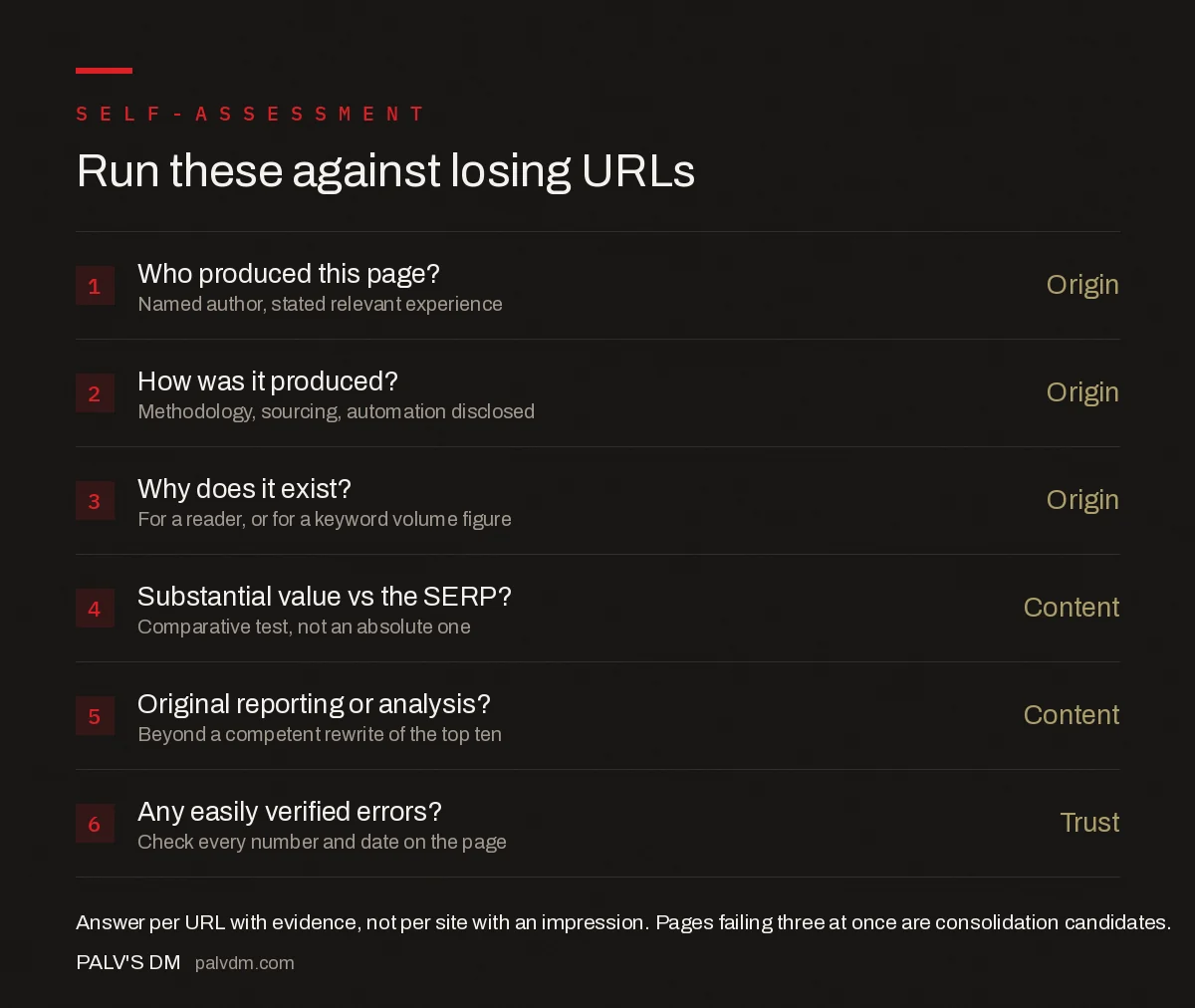
Run these against losing URLs
- Who produced this page? — Origin. Named author, stated relevant experience.
- How was it produced? — Origin. Methodology, sourcing, automation disclosed.
- Why does it exist? — Origin. For a reader, or for a keyword volume figure.
- Substantial value vs the SERP? — Content. Comparative test, not an absolute one.
- Original reporting or analysis? — Content. Beyond a competent rewrite of the top ten.
- Any easily verified errors? — Trust. Check every number and date on the page.
Frequently asked questions
What does Google say to do after a core update?
Google says there are no specific actions that guarantee recovery, that a drop does not necessarily mean anything is wrong with your pages, and that the biggest changes usually arrive with a subsequent core update rather than between them. It points site owners to its self-assessment questions, organised around who produced the content, how it was produced, and why it exists.
What are Google's Who, How and Why questions?
They are Google’s framework for self-assessing content. Who covers whether it is clear who produced the page and what their expertise is. How covers the way it was produced, including any substantial use of automation. Why covers whether the page exists primarily to help readers or primarily to attract search traffic.
Does answering Google's questions guarantee recovery from a core update?
No. Google offers no guarantee, and ranking is relative, so a site can answer every question well and still sit lower because competing pages were reassessed upward. The questions describe what Google’s systems aim to reward. They are a way to find work worth doing, not a mechanism that returns lost positions.
Which of Google's questions matters most after a core update?
In practice, whether the content provides substantial value compared with other pages in search results. It is a comparative test rather than an absolute one, so a page can be accurate, well written and correctly structured and still fail because several other pages say the same thing equally well.
Is Google's list of questions an actual ranking system?
No. Google presents the questions as a self-assessment for creators, not as a description of how its systems score pages. There is no threshold, no weighting and no published evidence that any system runs this list literally. Treating it as a rubric with a pass mark invents precision that Google has never claimed.
Sources
- Creating helpful, reliable, people-first content — Search Central
- Google core updates and your website — Search Central
- Google Search Status Dashboard
Want this done on your site?
Every PalV’s DM engagement starts with a free audit of your actual website — a 12-point
crawl covering what is blocking indexation, on-page gaps against your primary keywords, speed
findings, and the three to five fixes worth making first. Delivered in two working days. No
payment details, and the findings are yours whether you hire us or not.