How to Recover From a Google Core Update
Core update recovery is not undoing something. Google says no action guarantees it. Here is the work that qualifies and when results realistically land.

Recovering from a Google core update means being substantially better by the time the next core update runs — not undoing something. Google states plainly that there are no specific actions that guarantee recovery, that a drop does not necessarily mean anything is wrong, and that the largest recoveries tend to arrive with a subsequent core update rather than between them. That single sentence sets the whole strategy: the work is content and site quality, the assessment date is Google’s not yours, and anything sold as a fast core update fix is selling something else.
The practical question is therefore not “how do I get my rankings back” but “what work will read differently when the index is reassessed”. Those are different projects, and only the second one exists.
What does recovery actually mean after a core update?
A core update is a broad reassessment of how Google’s ranking systems judge relevance and quality across the whole index. Nothing was applied to your domain. You can lose positions without changing anything, because the pages around you were reassessed upward. Full mechanics are in what a core update actually is.
That has a consequence people find hard to accept: there is no state to restore. Returning a page to exactly what it was before the update does nothing, because the page was not the thing that changed. Recovery is competitive, not restorative — you are being marked against a field that has moved, and you have to beat the field as it now stands.
It also means the four instinctive responses are all wrong. A reconsideration request applies only to manual actions. A disavow file addresses link spam, not quality reassessment. Deleting pages that dropped three positions destroys evidence. Buying links converts a reassessment into an actual policy problem — the distinctions are set out in core update versus spam update versus manual action.
Before recovery: is it even a core update?
A meaningful share of “core update recoveries” are recoveries from something else, and the work is wasted. Three checks, ten minutes.
- Check Search Console for a manual action. Security & Manual Actions. No notice means no manual action, which eliminates the most feared possibility in thirty seconds.
- Confirm the update on Google’s dashboard. Not a volatility tracker. Around fourteen tracking tools registered spikes across 1–6 August 2026 while Google’s dashboard showed no ranking, indexing, crawling or serving incident at all — the industry named an update that did not exist.
- Rule out yourself. Deployments, theme and plugin changes, robots.txt edits, a redesign, a migration. Work through the update-or-you diagnostic before accepting the comfortable explanation.
Also confirm the rollout has finished. The May 2026 core update moved in three separate waves across twelve days, so a conclusion drawn on day four described a state that no longer existed a week later.
Which pages do you work on?
Recovery work fails most often through misdirected effort, not lack of effort. Narrow the target before touching anything.
Set equal-length comparison windows either side of the rollout, then rank URLs by absolute clicks lost rather than percentage lost — a page that fell 80 per cent from twelve clicks is noise. Take the top ten to twenty by absolute loss and stop there. Then break the loss down by page type, query cluster, device and country, because the shape of the damage names the problem. Loss concentrated in one template is a template problem. Loss concentrated in one query cluster is a topical authority problem. Loss spread evenly across everything is usually not an update at all.
What work actually qualifies as improvement?
Google’s own self-assessment questions are the only published description of the target, organised around who produced the content, how it was produced, and why it exists. Turned into decisions, they resolve into four options per URL.
| Decision | When it applies | What it involves |
|---|---|---|
| Improve | The page has a genuine reason to exist but nothing the top results lack | Add first-hand experience, original data, a named expert author, specifics the field does not have |
| Consolidate | Several thin pages compete for one intent | Merge into one page that answers the intent completely, redirect the rest |
| Retire | The page exists only because a keyword tool returned a volume figure | Remove or noindex, redirect only where a genuine equivalent exists |
| Leave alone | The page is strong and lost ground to a stronger competitor | Nothing. Spend the effort on the pages that can move |
The “leave alone” row is the one teams skip, and it is frequently correct. Rewriting a good page because it dropped four positions is how sites lose ground twice.
Where improvement is the answer, the specific gap is almost always the same one: your page competently restates what the top ten already say. Google’s published question asks whether content provides substantial value compared with other pages in search results, which is a comparative test. Closing that gap means adding something the field does not contain — original testing, real numbers, a methodology you publish, a practitioner’s account of what went wrong. The industry calls this information gain, though Google has never confirmed it as a named ranking system and issued no new guidance with either 2026 core update.
Do technical fixes help recovery?
Only where a technical problem is genuinely present, and it usually is not. Core updates reassess relevance and quality; they do not de-index sites. If your indexed page count is stable and crawl activity is unchanged, the cause is not technical and a technical audit will produce a tidy list of small wins that does not address the loss.
The exception worth checking: a technical change of your own that coincided with the rollout. Rollouts run 12 to 18 days and plenty of deployments land inside that window, which is precisely why the coincidence is so often misread as the update.
How long does recovery take?
Longer than anyone wants, and the timing is not yours to set. Google says partial movement can occur between core updates but that the largest changes tend to follow a subsequent one. Recent gaps between confirmed core updates give the realistic planning horizon.
| Core update | Started | Completed | Rollout length |
|---|---|---|---|
| December 2025 | 11 Dec 2025 | 29 Dec 2025 | 18 days |
| March 2026 | 27 Mar 2026 | 8 Apr 2026 | 12 days, 4 hours |
| May 2026 | 21 May 2026 | 2 Jun 2026 | ~12 days |
Google has never explained why rollout duration varies and has never committed to a core update schedule, so anyone quoting you a recovery date is guessing. Plan the work against the next confirmed rollout whenever it comes, not against a promised month — the reasoning is unpacked in why recovery waits for the next core update. If you need a sequenced calendar for the work itself, the 30-day recovery plan sets the order.
What to avoid while you wait
The waiting period is where most self-inflicted damage happens, because doing nothing feels indefensible. Two rules keep it survivable. Change one variable at a time, so that whatever happens at the next rollout is attributable. And record every change with its date in an update log, because six months later nobody remembers what shipped in which week, and unattributable improvement teaches you nothing. The specific moves that make things worse are catalogued in panic moves after an update.
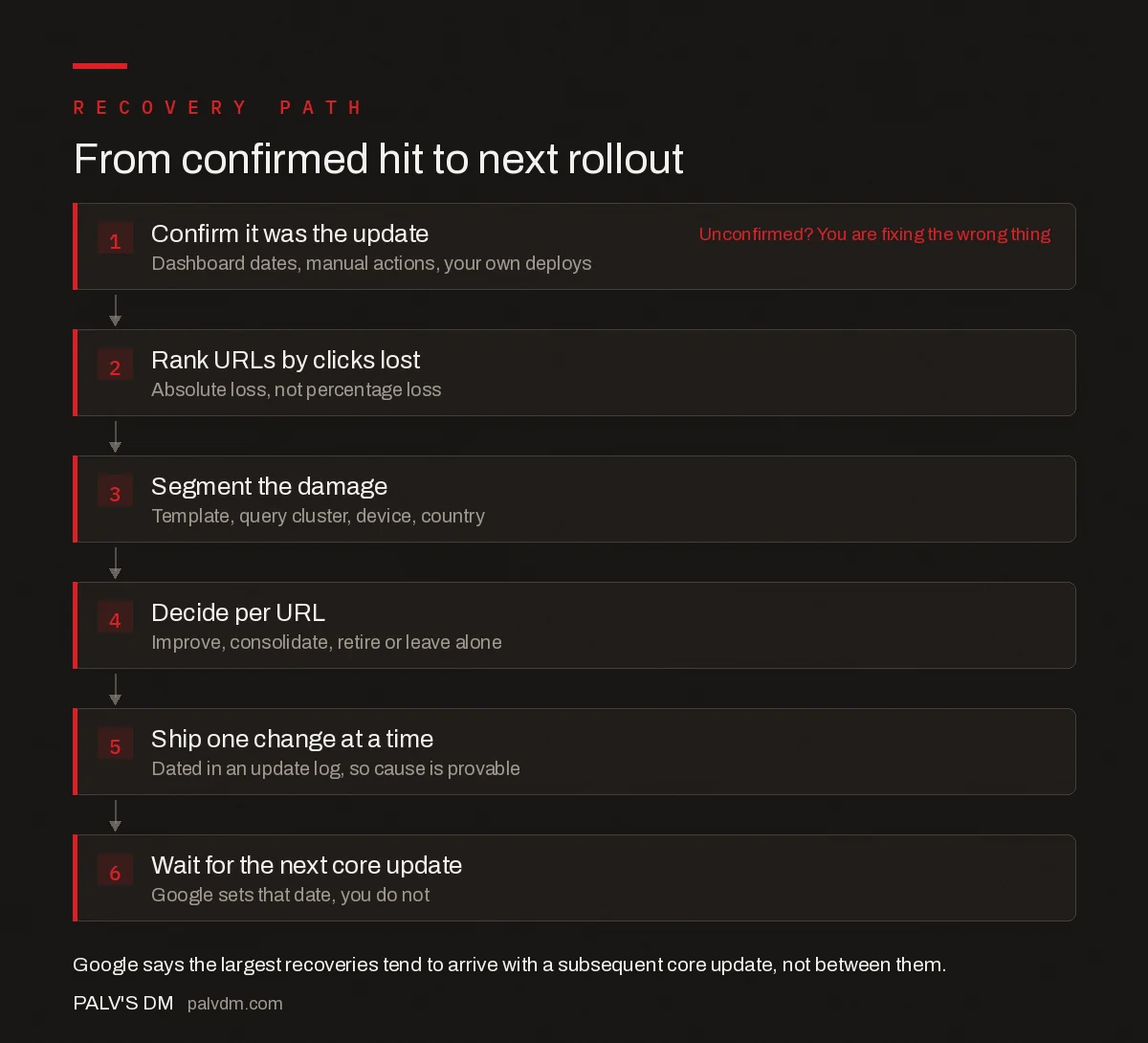
From confirmed hit to next rollout
- Confirm it was the update. Dashboard dates, manual actions, your own deploys. Unconfirmed? You are fixing the wrong thing
- Rank URLs by clicks lost. Absolute loss, not percentage loss.
- Segment the damage. Template, query cluster, device, country.
- Decide per URL. Improve, consolidate, retire or leave alone.
- Ship one change at a time. Dated in an update log, so cause is provable.
- Wait for the next core update. Google sets that date, you do not.
Frequently asked questions
How do you recover from a Google core update?
By improving the site substantially before the next core update runs. Google states there are no specific actions that guarantee recovery and that the largest changes tend to arrive with a subsequent core update. Identify which URLs lost most in absolute clicks, compare them against the pages that gained, and close the gap in originality, expertise and evidence.
How long does it take to recover from a core update?
There is no fixed period, because recovery is generally tied to the next core update rather than to a number of weeks. Google has never committed to a core update schedule. Recent rollouts themselves ran 12 days in March 2026, roughly 12 days in May 2026 and 18 days in December 2025, but the gap between updates varies considerably.
Should I delete pages that lost rankings in a core update?
Not on the basis of a ranking drop alone. Retiring genuinely weak pages that exist only to target a keyword is legitimate content pruning. Deleting a page because it fell a few positions destroys the evidence you need to diagnose the loss and removes a page that may recover at the next rollout without any intervention.
Does a disavow file or reconsideration request help after a core update?
No. Reconsideration requests apply only to manual actions, which always appear as a notice in Search Console. Disavow files address link spam. A core update is a reassessment of ranking systems rather than enforcement against your site, so neither mechanism has anything to act on and filing either changes nothing.
Can technical SEO fixes recover a core update loss?
Only where a real technical problem exists, which is uncommon after a core update. Core updates re-rank pages rather than de-indexing them, so a stable indexed page count and unchanged crawl activity point away from a technical cause. The exception worth checking is a deployment of your own that landed inside the rollout window.
Is partial recovery between core updates possible?
Yes. Google says you may see some recovery between core updates, but that the biggest changes tend to follow a subsequent one. In practice, small movement between rollouts is normal index churn and is difficult to attribute to any specific change, which is why dating every change in an update log matters.
Sources
- Google core updates and your website — Search Central
- Creating helpful, reliable, people-first content — Search Central
- Manual Actions report — Search Console Help
- Google Search Status Dashboard
Want this done on your site?
Every PalV’s DM engagement starts with a free audit of your actual website — a 12-point
crawl covering what is blocking indexation, on-page gaps against your primary keywords, speed
findings, and the three to five fixes worth making first. Delivered in two working days. No
payment details, and the findings are yours whether you hire us or not.