What Google’s Helpful Content Systems Reward Today
Google folded the helpful content system into core ranking in 2024. What the surviving guidance asks, and how to audit a site against it properly.
There is no longer a separate helpful content system to satisfy. Google folded those signals into its core ranking systems in March 2024, and what survives is a published set of self-assessment questions built around three axes: who produced the content, how it was produced, and why it exists. Content that answers all three convincingly is what Google’s guidance describes as people-first. Content that can only answer “why” with “because the keyword had volume” is what the guidance calls search-engine-first, and that is the distinction the ranking systems are built to draw.
The questions are not a checklist to tick. They are diagnostic, and the useful way to run them is against a specific URL that lost visibility rather than against the site in the abstract.
Is the helpful content system still a separate thing?
No. Google removed the standalone helpful content system from its ranking systems documentation after the March 2024 core update and explained that instead of relying on one signal, it now uses multiple signals and systems inside core ranking to identify unhelpful content.
Two things follow. First, there is no dedicated helpful content update to wait for; reassessment arrives with core updates, both of which ran twelve days in 2026. Second, the guidance page did not disappear with the system — Google’s document on creating helpful, reliable, people-first content is still maintained and is still the closest thing to a public specification of what core updates reward. The full history from 2022 to core integration covers how it got here.
What do Google’s self-assessment questions actually ask?
Google groups them under three headings. Reading them literally is more productive than reading them charitably.
Who wrote it. Is the person or organisation identified? Is there a byline, and does it lead anywhere that establishes relevant expertise? Content published under no name at all cannot answer this question, which is why anonymous content struggles and why a real author page does more work than most on-page tweaks.
How it was produced. If automation or AI was involved, is that disclosed where a reader would reasonably want to know? Was anything tested, measured or verified first-hand? Google’s position is that production method is not itself the test — quality and purpose are.
Why it exists. Was it made to help people, or primarily to attract search traffic? This is the question most pages fail. A page created because a keyword tool showed volume, covering a subject the business has no standing in, cannot answer it honestly.
What does Google’s guidance actually reward?
The specific questions in Google’s guidance are more concrete than the summary suggests. Among them:
- Does the content provide original information, reporting, research or analysis?
- Does it provide a substantial, complete or comprehensive description of the topic?
- Does it provide insightful analysis or interesting information beyond the obvious?
- Does it provide substantial value when compared with other pages in search results?
- Is it written by an expert or enthusiast who demonstrably knows the topic well?
- Would you expect to see it cited in a printed magazine, encyclopedia or book?
- Does it leave readers feeling they need to search again for better information?
The fourth is the one worth pinning to the wall. “Substantial value when compared with other pages in search results” is a comparative standard, not an absolute one. A competent, accurate, well-formatted article that says exactly what the current top ten already say meets no part of it. That comparative framing is the same idea the industry discusses as information gain — a useful description of what recent core updates appear to reward, though Google has never confirmed it as a named ranking system.
What does search-engine-first content look like?
Google’s guidance lists warning signs directly, and they read like a description of most content programmes.
| Search-engine-first signal | What it looks like in practice |
|---|---|
| Producing lots of content on many topics hoping some ranks | A blog covering subjects the business has no involvement in |
| Extensive automation to produce content across many topics | Templated pages differing only by a swapped noun |
| Mainly summarising what others say without adding value | A synthesis of the current top ten, better formatted |
| Writing to a word count because you heard Google prefers one | Padding to reach a target nobody at Google set |
| Entering a niche without any real expertise | A finance section on an unrelated site, written by nobody in particular |
| Promising to answer a question that has no answer | Pages built on speculative queries with invented certainty |
Google also asks a question that cuts through the rest: do you have an existing or intended audience who would find the content useful if they came to you directly, rather than through search? If the honest answer is no, the page exists for the ranking, and the guidance is describing it accurately.
How do you audit a site against the helpful content guidance?
- Start with URLs that lost, not with the site. Pull the specific pages and query clusters that declined. A site-wide judgement produces a site-wide rewrite, which is expensive and usually wrong.
- Run Who, How and Why on each losing page individually. Write the answers down. Pages that cannot answer one of the three in a sentence have identified their own problem.
- Compare each page against the pages that gained. Not against a rubric — against the actual competing results. What do they have that yours does not? The answer is usually specificity: real numbers, first-hand testing, named expertise.
- Decide per page: improve, consolidate, or remove. Not everything deserves a rewrite. Genuinely thin pages that serve no audience are candidates for consolidation or removal rather than expansion.
- Fix attribution across the site. Bylines that resolve to a real person with relevant standing, and an about page that establishes who is behind the site. This is the cheapest of the structural fixes and it addresses the “who” question directly.
- Then wait for a core update. Reassessment arrives with core updates, not between them. The 30-day recovery plan sequences the work against that timeline.
How does this connect to E-E-A-T and to AI content?
Google’s experience, expertise, authoritativeness and trust framing and the helpful content guidance are asking overlapping questions from different directions. E-E-A-T asks what evidence exists that this source should be believed. The helpful content questions ask what the content is for. A page with a credible named author and no original substance fails the second; an original, well-researched page published anonymously in a sensitive category struggles with the first.
On AI, Google’s published position is that it rewards quality however content is produced, while treating automation used primarily to manipulate rankings as a spam violation. That makes production method a non-question and purpose the whole question. Whether AI content breaks Google’s guidelines covers where the line sits.
The practical summary: helpfulness is now assessed inside every core update, the test is comparative rather than absolute, and the fastest improvements come from pages that can name who made them, show how the work was done, and explain why they exist to someone who is not a search engine.
The questions that actually bite
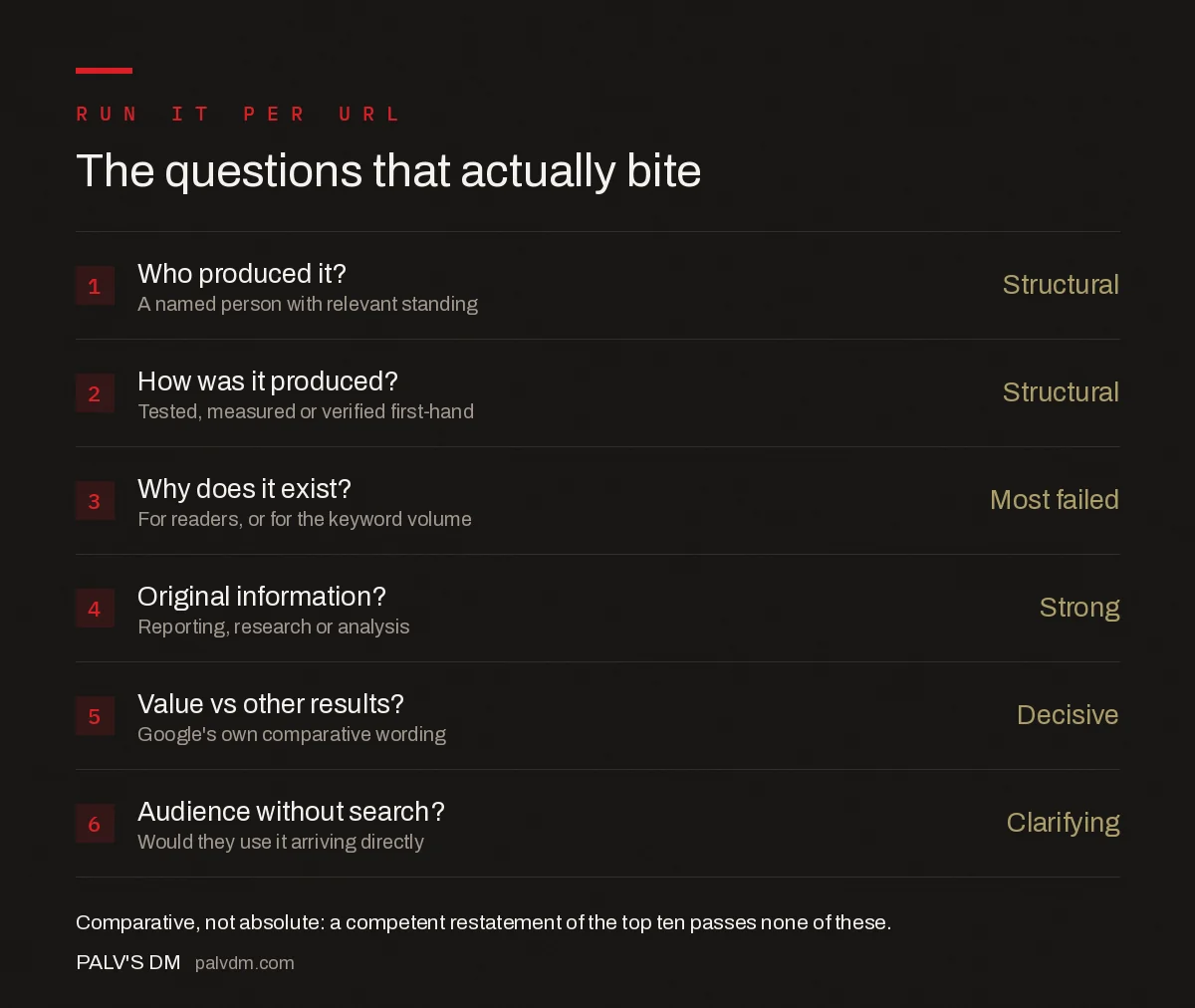
- Who produced it? — Structural. A named person with relevant standing.
- How was it produced? — Structural. Tested, measured or verified first-hand.
- Why does it exist? — Most failed. For readers, or for the keyword volume.
- Original information? — Strong. Reporting, research or analysis.
- Value vs other results? — Decisive. Google’s own comparative wording.
- Audience without search? — Clarifying. Would they use it arriving directly.
Frequently asked questions
What is Google's helpful content system?
It was a site-wide classifier launched in August 2022 to identify content made primarily for search engines rather than people. Google folded its signals into the core ranking systems with the March 2024 core update and removed the standalone system from its documentation. The guidance that came with it, on creating helpful, reliable, people-first content, is still maintained and still applies.
What are Google's helpful content self-assessment questions?
They group under three headings: who produced the content, how it was produced, and why it exists. Specific questions ask whether the content offers original information, reporting, research or analysis, whether it provides substantial value compared with other pages in search results, whether it is written by someone who demonstrably knows the topic, and whether readers leave needing to search again.
What is the difference between people-first and search-engine-first content?
People-first content is made for an audience that would find it useful arriving directly, without search. Search-engine-first content is produced because a keyword had volume. Google’s warning signs include publishing across many unrelated topics hoping something ranks, summarising what others say without adding value, and writing to a word count because you heard Google prefers one.
Does Google penalise AI-generated content?
Not for being AI-generated. Google’s published position is that it rewards high-quality content however it is produced, while treating automation used primarily to manipulate search rankings as a spam policy violation. Production method is not the test. What is tested is whether the content serves an audience and offers something the existing results do not.
How do I audit my site against the helpful content guidance?
Start with the specific URLs and query clusters that lost visibility rather than judging the site as a whole. Answer who, how and why in writing for each losing page, compare it against the pages that actually gained rather than against a rubric, then decide per page whether to improve, consolidate or remove. Reassessment arrives with core updates.
How long does it take to recover after improving content quality?
Reassessment generally arrives with a core update rather than between them, and Google states that no specific actions guarantee recovery. Both 2026 core updates ran twelve days each, so the realistic planning horizon is months rather than weeks. Improving pages and then waiting for the next core update is the sequence Google’s own guidance describes.
Sources
- Creating helpful, reliable, people-first content — Search Central
- A guide to Google Search ranking systems
- Google Search's guidance about AI-generated content
- Google core updates and your website — Search Central
Want this done on your site?
Every PalV’s DM engagement starts with a free audit of your actual website — a 12-point
crawl covering what is blocking indexation, on-page gaps against your primary keywords, speed
findings, and the three to five fixes worth making first. Delivered in two working days. No
payment details, and the findings are yours whether you hire us or not.