The Medic Update and the Birth of YMYL Scrutiny
The August 2018 Medic update was a broad core update Google never named. What it really changed about YMYL, E-E-A-T and how quality is judged in search.
The “Medic update” is an industry nickname for the broad core update Google confirmed on 1 August 2018. Google never used the name, never said the update targeted health sites, and stated at the time that there was no fix for pages that performed less well other than continuing to build great content. The nickname came from Search Engine Roundtable, after third-party analyses reported that health, medical and wellness sites appeared unusually often among the sites that lost visibility. That observation was real. The conclusion drawn from it — that Google had shipped a health-specific algorithm — was not something Google ever confirmed.
What the August 2018 update genuinely did was force the SEO industry to read Google’s quality rater guidelines properly for the first time. Two acronyms came out of that reading, YMYL and E-A-T, and both are still routinely misdescribed as ranking factors.
What was the Medic update?
On 1 August 2018 Google’s Search Liaison account confirmed a broad core algorithm update, using language that has barely changed since: this was a routine update of the kind Google releases several times a year, aimed at improving results overall rather than at any category of site.
Google’s guidance in the same statement was equally consistent with what it says today. There is no fix. A drop does not necessarily mean anything is wrong with your pages. The correct response is to continue building great content rather than to hunt for a violation. Anyone who has read Google’s advice after a 2026 rollout will recognise all of it, because core updates are not penalties and never were.
What made August 2018 feel different was timing. Google had published an update to its Search Quality Rater Guidelines in July 2018, weeks before the rollout, expanding its treatment of page quality, expertise and the category of topics it calls Your Money or Your Life. The industry read the two events together and concluded that the update had operationalised the guidelines. That reading is plausible and remains unproven.
Did the August 2018 update actually target health sites?
Google said no such thing. What can be said accurately is narrower and more useful:
- Multiple third-party visibility analyses published in August 2018 reported that health, medical and wellness domains were over-represented among sites that lost visibility.
- Google confirmed a broad core update, which by definition reassesses content across the whole index rather than one vertical.
- Google issued no vertical-specific guidance then, and has issued none since.
There is a straightforward explanation that requires no hidden health algorithm. Health queries are disproportionately the queries where quality assessment matters most, so a general improvement in how quality is assessed produces disproportionate movement there. A broad update can produce a vertical-shaped result without being a vertical-specific update. That distinction matters, because it determines whether you go looking for a health-specific fix or whether you do the ordinary core update work.
What is YMYL content?
YMYL stands for “Your Money or Your Life”. It is a category defined in Google’s Search Quality Rater Guidelines, covering topics where inaccurate or misleading information could damage a person’s health, financial stability, safety, or the wellbeing of society.
In practice, YMYL is broader than medicine. It reaches:
- Health, medicine, mental health, drugs and medical devices
- Financial advice, investments, taxes, insurance and loans
- Legal information, including immigration and family law
- Safety information, from electrical work to child car seats
- Civic information, news on major events, and groups of people
The guidelines instruct raters to apply the strictest scrutiny to these pages, because the cost of being wrong is highest. If you publish in any of these areas, meeting YMYL content standards is not a competitive advantage — it is the entry requirement.
Is E-E-A-T a ranking factor?
No, and this is the most consequential misunderstanding to come out of 2018. E-A-T is a framework used by Google’s human quality raters to judge whether search results look helpful. Google states in the guidelines themselves that rater ratings do not directly affect the ranking of any individual site, and Google representatives have said repeatedly that there is no E-E-A-T score.
The framework gained a second E on 15 December 2022, when Google announced that E-A-T was “gaining an E: experience”. Google’s stated reason is worth quoting because it explains the whole concept: does content “demonstrate that it was produced with some degree of experience, such as with actual use of a product, having actually visited a place or communicating what a person experienced?”
So E-E-A-T is not a dial you can turn. It is a description of what Google’s systems are collectively trying to approximate, which is why the useful reading of E-E-A-T is as a specification for evidence rather than as a checklist of tags. The evidence is what your ranking systems can actually see: who wrote it, what they have done, what the site is, and who stands behind it.
What should you actually do if you publish YMYL content?
Google’s current guidance points site owners at three questions after any core update — who produced the content, how it was produced, and why it exists. For YMYL publishers, answering those three convincingly is most of the work.
- Put a real, qualified name on every page. Medical, financial and legal content published under a brand byline or no byline cannot answer “who”. A proper author page with verifiable credentials is the single highest-leverage fix available to most YMYL sites.
- Make the credential visible where the claim is made. A qualification buried on an About page does nothing for a reader on an article. A concise, specific author bio at the point of publication does.
- Separate expertise from experience. Google’s own example distinguishes tax filing advice, where you want an accountant, from tax software reviews, where you want someone who has used the software. Work out which your page needs, then demonstrate that experience explicitly.
- Cite primary sources, and date them. Medical and financial claims that link to a guideline, a study or a regulator are checkable. Claims that link to another blog post are not.
- Make the organisation real. A physical address, a named team, registration details, a working contact route. These trust signals are trivially cheap and most competing sites still skip them, which is also the case for a substantive About page.
- Review and re-date content on a schedule. A three-year-old page on treatment guidance or tax thresholds is not just outdated, it is potentially harmful, which is precisely the scrutiny YMYL invites.
This is particularly sharp for healthcare publishers in India, where a large share of health search demand is served by sites with no named clinician anywhere on them. The gap between “brand publishes health content” and “named doctor with registration details publishes health content” is the widest, cheapest advantage available in that market.
How do you tell a trust problem from an ordinary ranking loss?
Not every drop on a YMYL site is a trust problem, and treating every drop as one wastes months rebuilding author pages when the actual cause was a template change or a lost featured snippet. The signature of a trust-shaped loss is specific.
Trust-shaped losses tend to be uniform across a topic rather than across a template: every page about a regulated subject slides, while commercial and navigational pages hold. They usually coincide with a confirmed core update rather than arriving gradually. And the pages that replaced you typically differ in an obvious, readable way — a named clinician, an institution, a citation trail — rather than in word count or formatting.
By contrast, a loss confined to one page template, or one that started on a deployment date with no announced update, is almost certainly self-inflicted. Working through why organic traffic actually dropped before assuming an E-E-A-T deficit saves the most expensive kind of wasted effort, because credential-building is slow work that cannot be reversed if you picked the wrong problem.
The honest test is to open the three pages that now outrank you and ask what a cautious reader would trust about them that they would not trust about yours. If the answer is nothing, your problem is elsewhere. If the answer is obvious within ten seconds, you have found the work.
What the Medic nickname got wrong
- It implied a targeted algorithm. Google confirmed a broad core update. There was no announced health system, and none has been announced since.
- It implied a penalty. No site was flagged, no notice appeared in Search Console, and there was nothing to appeal.
- It implied a fix. Google said explicitly there was no fix beyond building great content, which remains its position after every core update including the 2026 rollouts.
- It implied a deadline. Recovery from a core update generally arrives with a subsequent core update, not between them, which is why a structured recovery plan beats a frantic month of edits.
The most durable thing to take from August 2018 is not the nickname. It is that Google’s quality rater guidelines are a public document describing what Google is trying to build, and almost nobody in SEO had read them before an update forced the issue.
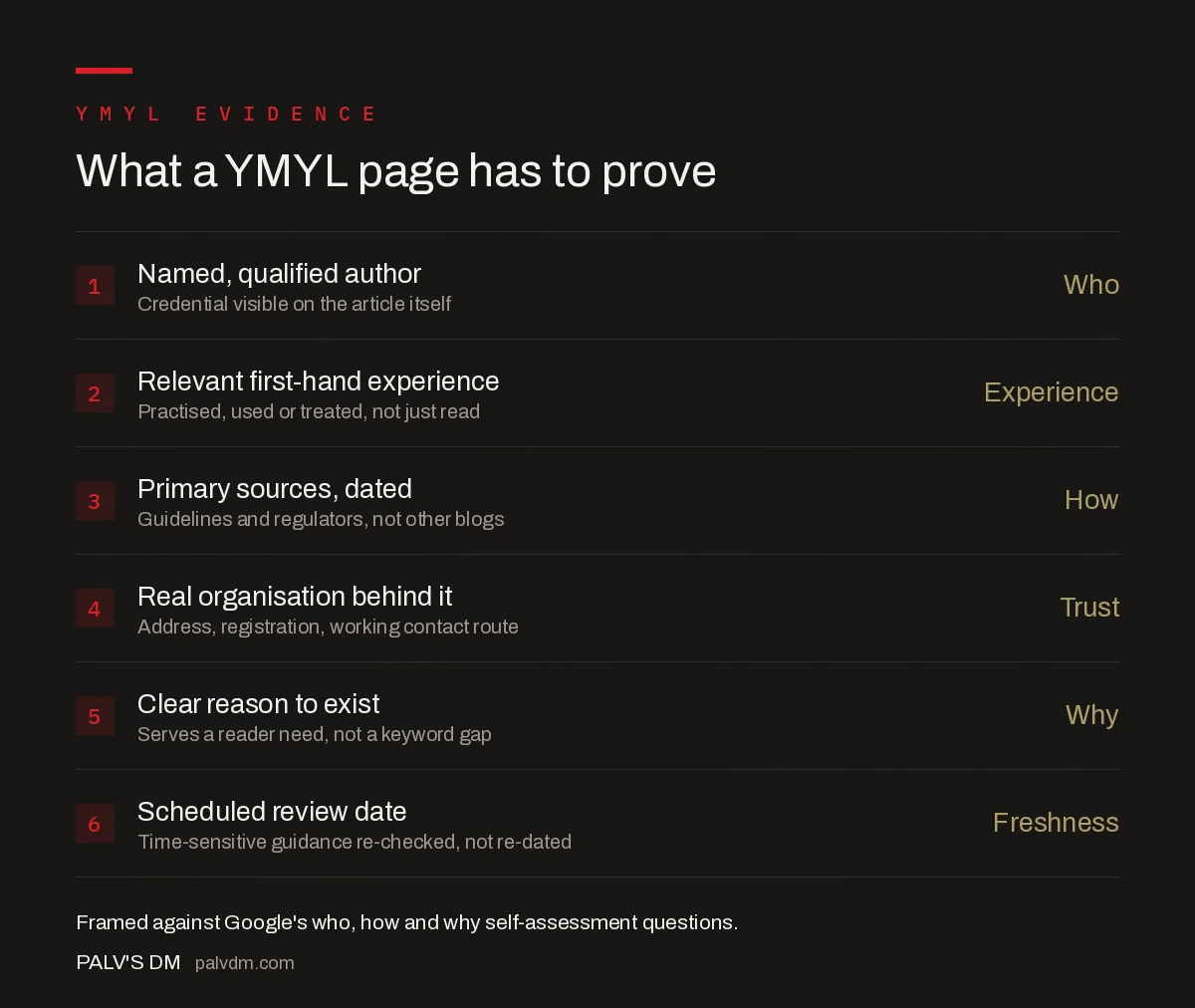
What a YMYL page has to prove
- Named, qualified author — Who. Credential visible on the article itself.
- Relevant first-hand experience — Experience. Practised, used or treated, not just read.
- Primary sources, dated — How. Guidelines and regulators, not other blogs.
- Real organisation behind it — Trust. Address, registration, working contact route.
- Clear reason to exist — Why. Serves a reader need, not a keyword gap.
- Scheduled review date — Freshness. Time-sensitive guidance re-checked, not re-dated.
Frequently asked questions
What was the Google Medic update?
Medic is an industry nickname for the broad core algorithm update Google confirmed on 1 August 2018. Google never used the name and never said the update targeted any vertical. The nickname arose because third-party visibility analyses reported that health, medical and wellness sites appeared unusually often among those that lost rankings during the rollout.
Did the Medic update target health and medical websites?
Google confirmed a broad core update, which reassesses content across the whole index rather than one category of site. It issued no health-specific guidance then and has issued none since. Health queries are among those where quality assessment matters most, so a general improvement in quality assessment can produce disproportionate movement in that vertical without being aimed at it.
What does YMYL mean?
YMYL stands for Your Money or Your Life. It is a category in Google’s Search Quality Rater Guidelines covering topics where inaccurate information could damage a person’s health, financial stability or safety, or the wellbeing of society. It includes medicine, finance, law, safety and civic information, and raters are instructed to apply the strictest scrutiny to these pages.
Is E-E-A-T a Google ranking factor?
No. E-E-A-T is a framework used by Google’s human quality raters to assess whether results look helpful. Google’s guidelines state that rater ratings do not directly affect the ranking of individual sites, and Google representatives have said there is no E-E-A-T score. It describes what Google’s systems collectively try to approximate rather than a signal you can set.
When did E-A-T become E-E-A-T?
On 15 December 2022, when Google announced that E-A-T was gaining an E for experience. Google explained the addition by asking whether content demonstrates that it was produced with some degree of experience, such as actual use of a product, having actually visited a place, or communicating what a person experienced first hand.
How do you improve E-E-A-T on a YMYL site?
Publish under named, qualified authors with verifiable credentials shown at the point of publication rather than only on an About page. Cite primary sources and date them. Make the organisation behind the site real and contactable. Review time-sensitive guidance on a schedule, because outdated medical, legal or financial information is the specific harm YMYL scrutiny exists to prevent.
Sources
- Google core updates and your website — Search Central
- What site owners should know about Google's core updates
- Our latest update to the quality rater guidelines: E-A-T gets an extra E — Published 15 December 2022
- Search Quality Rater Guidelines (PDF) — Defines YMYL and the E-E-A-T framework
Want this done on your site?
Every PalV’s DM engagement starts with a free audit of your actual website — a 12-point
crawl covering what is blocking indexation, on-page gaps against your primary keywords, speed
findings, and the three to five fixes worth making first. Delivered in two working days. No
payment details, and the findings are yours whether you hire us or not.