MUM: What Google Said It Would Do
Google MUM was announced in May 2021, but Google says it is not used for general ranking. What MUM actually does, and why there was never a MUM update.
MUM — Multitask Unified Model — is an AI system Google announced in May 2021, and Google’s current documentation states plainly that it “is not currently used for general ranking in Search”. There has never been a MUM update. No MUM rollout has ever appeared on Google’s Search Status Dashboard, no MUM guidance has ever been published for site owners, and no ranking movement has ever been attributed to it by Google. MUM is used for a small number of specific applications, and Google names them.
That gap — between a widely covered AI announcement and its actual deployment in ranking — is the most useful thing about MUM for anyone doing SEO. It is a working example of why announced capability and shipped ranking behaviour are different things, and why treating the first as the second produces advice built on nothing.
What is Google MUM?
Google announced MUM on 18 May 2021 at its I/O developer conference, in a post written by Pandu Nayak, then Google Fellow and Vice President for Search. Google’s description of the model was specific:
- MUM uses the T5 text-to-text framework and is 1,000 times more powerful than BERT, in Google’s own phrasing.
- It understands and generates language, rather than only interpreting it.
- It is trained across 75 different languages and many tasks at once.
- It is multimodal: Google said it “understands information across text and images and, in the future, can expand to more modalities like video and audio”.
The motivating problem Google described was multi-step research. Google stated that people issue eight queries on average for a complex task, and used the example of someone who has hiked Mt. Adams asking what to do differently to prepare for Mt. Fuji — a question requiring elevation, seasonality, terrain and equipment to be reasoned about together.
Was there ever a MUM update?
No. This is worth stating flatly because “the MUM update” appears in a large amount of SEO writing that has no source behind it.
Google announces ranking changes on its Search Status Dashboard, which is the only authoritative confirmation that a ranking update has run. The dashboard’s ranking history contains core updates, spam updates, link spam updates, reviews updates, helpful content updates and Discover updates. It contains no MUM update, and never has. Google also published no MUM optimisation guidance, no MUM report in Search Console and no MUM-related advice in its documentation for creators.
Compare that to how Google handles an actual ranking change. When a core update runs, it is posted to the dashboard with a start time, an end time and standing guidance. Nothing comparable exists for MUM, and the absence is the answer.
What is MUM actually used for?
Google’s guide to Search ranking systems names MUM’s applications directly. The system “is not currently used for general ranking in Search but rather for some specific applications”, and Google gives two:
- Improving searches for COVID-19 vaccine information. Google explained that broadly distributed vaccines have “over 800” different names worldwide — searches like “Coronavaccin Pfizer”, “mRNA-1273” or “CoVaccine” all refer to the same products. MUM was used to identify those name variations so Google could surface information from health authorities consistently across languages.
- Improving featured snippet callouts. Google has applied MUM to the advisories and callouts it displays alongside snippets, part of its wider information literacy work.
Both applications are about understanding queries and improving specific result features. Neither is a ranking system that reorders web results, and neither gives publishers anything to act on. If you want to influence how your content appears in snippets, the levers are structural — formatting for featured snippets works the same way it did before MUM existed.
It is also worth noting what Google has not added since 2021. There has been no announcement extending MUM to general ranking, no MUM section added to the SEO Starter Guide, and no change to the wording in the ranking systems guide beyond routine documentation edits. Five years of silence on a system this heavily covered is itself informative: Google is normally quick to publish guidance when a system starts affecting how sites rank, as it did with the helpful content system and the reviews system.
Why does the announcement-versus-deployment gap matter?
Google’s own MUM announcement was written almost entirely in the conditional. MUM “has the potential to transform how Google helps you with complex tasks”. It “could understand you’re comparing two mountains”. It “could also surface helpful subtopics”. Read closely, the post describes a capability and a direction, not a shipped ranking behaviour.
Five years later, Google’s documentation confirms the conditional was accurate. The capability exists; general ranking deployment did not follow. This pattern repeats constantly, and recognising it protects you from a whole category of bad advice:
- A model announcement is not a ranking system. Google publishes research and product capability regularly. Only a fraction becomes ranking behaviour.
- A patent is not a deployment. The same reasoning applies to the patents SEO writers build theories on — the information gain patent is the current example, useful as a description of what content wins but never confirmed as a named ranking system.
- Only the dashboard confirms an update. Third-party volatility tools show that results moved; they cannot show that Google moved them. That distinction is the whole basis of separating confirmed from unconfirmed updates.
How does MUM’s status compare with Google’s other AI systems?
Google’s guide to Search ranking systems is unusually explicit about which systems do what, and MUM is the only one carrying an exclusion in its description. Setting the systems side by side makes the point faster than any explanation.
| System | Status in Google’s documentation |
|---|---|
| RankBrain | Active. Helps Google understand how words relate to concepts for ranking |
| Neural matching | Active. Matches concept representations in queries against those in pages |
| BERT | Active. Understands how combinations of words express meaning and intent |
| Passage ranking | Active. Identifies individual sections of a page to judge relevance |
| MUM | Active, but explicitly “not currently used for general ranking in Search” |
| Hummingbird, Panda, Penguin, helpful content | Retired. Absorbed into core ranking systems |
Two readings follow. The first is that Google is more precise about deployment than the industry writing about it, and that precision is free to check — the documentation is public and dated. The second is that “Google announced an AI system” and “Google ranks pages using it” are separate claims requiring separate evidence, and only one of them is usually available. That habit of checking the documented status before building tactics on a system is worth more than any individual fact about MUM.
Can you optimise for MUM?
There is nothing to optimise for. Google has published no MUM guidance, and a system Google says is not used for general ranking cannot be the reason your rankings changed.
What MUM does tell you is where retrieval is heading, and that direction has been consistent since 2013. Google’s language systems — Hummingbird, RankBrain, neural matching, BERT, MUM — are each better than the last at working out what a person means. The useful responses are the same ones that worked for every previous system in that line:
- Answer complete tasks, not single queries. If Google’s stated goal is reducing the eight searches a complex task takes, the page that covers the whole task is structurally advantaged over eight thin pages covering one step each.
- Write self-contained sections. Systems that assemble answers pull passages, not documents. A section that only makes sense after reading the previous one cannot be used.
- Take other languages seriously. MUM’s cross-language design points at a real opportunity in markets like India, where regional language SEO is still far less contested than English.
- Use images that carry information. A multimodal system can read charts, diagrams and product photography as content. Generic stock imagery carries nothing, which is a practical argument for treating images as content rather than decoration.
- Build depth on a subject. Every system in this lineage rewards genuine coverage, which is the mechanical case for topical authority over scattered publishing.
None of those five actions is MUM-specific, and that is the point. They are the actions that have paid off against every language system Google has shipped since 2013, and they will still be sensible if MUM never touches general ranking at all.
What MUM tells you about the AI search era
MUM is best read as the bridge between Google’s language-understanding work and its generative results. A model that both understands and generates language, trained across 75 languages and multiple modalities, describes the architecture behind AI-generated answers rather than the architecture behind a blue-link ranking.
That is why the honest position on MUM is also the useful one. It did not change your rankings, there is nothing to fix, and any article promising MUM optimisation tactics is describing a system Google says it does not use for ranking. What it does confirm is that the direction of travel — towards answering complete questions across languages and media — has been public since 2021, and the work that pays off is the work that suits how AI search engines actually retrieve and cite sources.
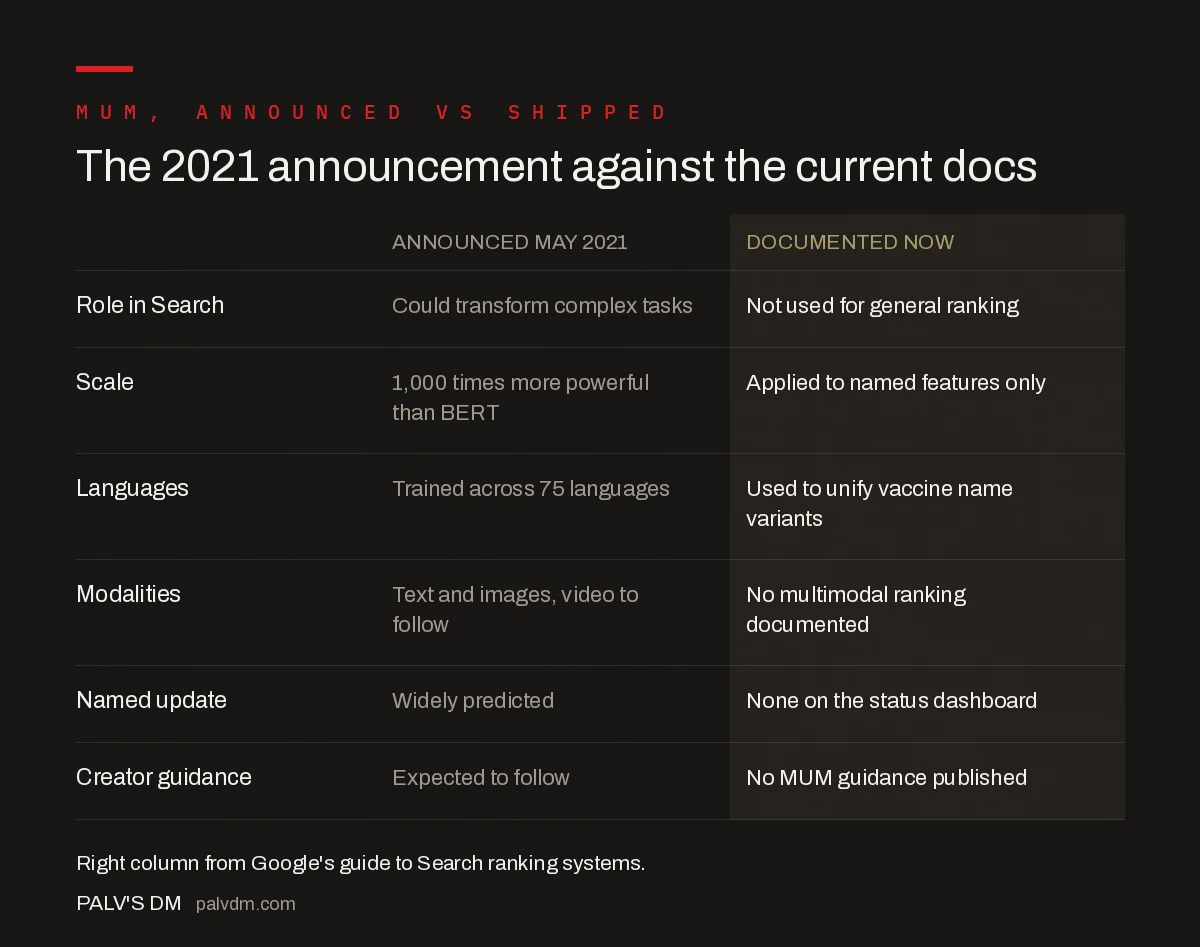
The 2021 announcement against the current docs
| Announced May 2021 | Documented now | |
|---|---|---|
| Role in Search | Could transform complex tasks | Not used for general ranking |
| Scale | 1,000 times more powerful than BERT | Applied to named features only |
| Languages | Trained across 75 languages | Used to unify vaccine name variants |
| Modalities | Text and images, video to follow | No multimodal ranking documented |
| Named update | Widely predicted | None on the status dashboard |
| Creator guidance | Expected to follow | No MUM guidance published |
Frequently asked questions
What is Google MUM?
MUM stands for Multitask Unified Model, an AI system Google announced on 18 May 2021. Google said it uses the T5 text-to-text framework, is 1,000 times more powerful than BERT, is trained across 75 languages and many tasks at once, and is multimodal, meaning it understands information across text and images. It both understands and generates language.
Is MUM a Google ranking factor?
Google’s guide to Search ranking systems states that MUM is not currently used for general ranking in Search. It is used for specific applications, which Google names as improving searches for COVID-19 vaccine information and improving the featured snippet callouts it displays. No ranking movement has ever been attributed to MUM by Google.
Was there ever a MUM algorithm update?
No. Google announces ranking changes on its Search Status Dashboard, and no MUM update has ever appeared there. The dashboard’s ranking history contains core updates, spam updates, link spam updates, reviews updates, helpful content updates and Discover updates. Google has also never published MUM optimisation guidance or a MUM report in Search Console.
How do you optimise for MUM?
You cannot, and there is nothing to gain by trying. Google publishes no MUM guidance and states the system is not used for general ranking. The durable response to the direction MUM represents is to cover complete tasks rather than single queries, write sections that make sense in isolation, and use images that carry real information.
What is the difference between MUM and BERT?
Google describes BERT as a system that helps it understand how combinations of words express different meanings and intent, and lists it among active ranking systems. MUM both understands and generates language, is multimodal, and is trained across 75 languages, but Google says it is not currently used for general ranking. BERT influences ranking; MUM powers specific features.
What did Google use MUM for with vaccine searches?
Google explained that broadly distributed COVID-19 vaccines have over 800 different names worldwide, based on its own analysis, with people searching phrasings such as Coronavaccin Pfizer, mRNA-1273 or CoVaccine. MUM was used to identify those name variations across languages so Google could reliably surface information from health authorities regardless of how the query was phrased.
Sources
- MUM: A new AI milestone for understanding information — The Keyword — The MUM announcement, 18 May 2021
- A guide to Google Search ranking systems — States MUM is not currently used for general ranking
- How MUM improved Google Searches for vaccine information — The Keyword
- Google Search Status Dashboard — ranking update history
Want this done on your site?
Every PalV’s DM engagement starts with a free audit of your actual website — a 12-point
crawl covering what is blocking indexation, on-page gaps against your primary keywords, speed
findings, and the three to five fixes worth making first. Delivered in two working days. No
payment details, and the findings are yours whether you hire us or not.