RankBrain: Machine Learning Enters Ranking
RankBrain helps Google match words to concepts so pages rank without exact keywords. What Google documents, what it does not, and what to actually do.
RankBrain is a machine learning system Google introduced in 2015 that helps Search understand how words relate to concepts, so a page can rank for a query even when it does not contain the exact words the searcher typed. Google’s current ranking systems documentation defines it in one sentence: RankBrain “is an AI system that helps us understand how words are related to concepts. It means we can better return relevant content even if it doesn’t contain all the exact words used in a search”. RankBrain was Google’s first widely publicised use of machine learning inside ranking itself, and it is still listed as an active system.
It is also the most over-explained system in SEO. Almost everything written about “optimising for RankBrain” describes mechanisms Google has never documented. What Google has documented is narrow, specific and genuinely useful — and it points at how you choose topics rather than how you place keywords.
What is RankBrain?
RankBrain is one of several AI systems Google lists in its guide to Search ranking systems. It handles the gap between the words in a query and the concepts behind them. If someone searches for a phrase Google’s systems have never encountered, RankBrain lets Search reason about what that phrase is probably related to instead of failing to find a literal match.
Google made RankBrain public in October 2015, in an interview its senior research scientist Greg Corrado gave to Bloomberg. That interview, not a Google blog post, is the origin of most RankBrain lore — including the widely repeated claim about its importance, discussed further below.
Two things follow from Google’s own definition. First, RankBrain operates on query understanding and relevance matching, not on quality judgement: it is not the system deciding whether your content is good. Second, it is not “the Google algorithm”. It is one component among the systems Google documents publicly, alongside link analysis, freshness systems, spam detection and the rest.
Why did Google build RankBrain?
Google has said for years that around 15% of the searches it sees every day have never been seen before. At Google’s volume that is an enormous number of queries with no historical data attached to them — no click history, no previous results to learn from, sometimes no matching documents containing the exact phrasing.
Before machine learning, an unfamiliar query was handled by breaking it into terms and matching those terms. That works badly for long, conversational or oddly-worded searches. RankBrain gave Google a way to map an unfamiliar query onto concepts it already understood, which is the same problem Hummingbird had started addressing in 2013 by shifting Search from string matching towards meaning.
The practical result is that ranking for a phrase no longer requires containing that phrase. This is why chasing every variant of a keyword produces bloated, repetitive pages, and why a well-built long-tail keyword strategy now works by covering a topic properly rather than by creating one page per phrasing.
It also changed how Google could handle typos, slang, regional phrasing and the compressed shorthand people use on mobile keyboards. A query typed badly is still a query with a clear intent behind it, and a system that reasons about concepts can recover that intent where literal term matching cannot. None of that requires anything from publishers, which is precisely why there is no RankBrain checklist worth following.
How is RankBrain different from BERT, neural matching and MUM?
Google runs several AI systems in Search and describes each one differently. Treating them as interchangeable is the single most common error in SEO writing about Google’s machine learning. The descriptions below are Google’s own, from its guide to Search ranking systems.
| System | Introduced | What Google says it does |
|---|---|---|
| RankBrain | 2015 | Helps Google understand how words are related to concepts, so relevant content can be returned without containing the exact words searched |
| Neural matching | 2018 | Helps Google understand representations of concepts in queries and pages and match them to one another |
| BERT | 2019 | Allows Google to understand how combinations of words express different meanings and intent |
| MUM | 2021 | Understands and generates language, but is “not currently used for general ranking in Search” |
| Passage ranking | 2020 | Identifies individual sections of a page to better understand how relevant that page is to a search |
Read across that table and a pattern emerges: every one of these systems is about understanding language, not about rewarding it. None of them is a quality system. Quality judgement sits elsewhere — in core ranking, which is what moves during a broad core update. The distinction matters when diagnosing a drop, because a ranking loss is far more likely to be a core update reassessment than an AI system suddenly reinterpreting your page. BERT and MUM are worth understanding on the same terms.
Can you optimise for RankBrain?
No, and this is verifiable rather than a matter of opinion: Google’s documentation contains no RankBrain optimisation guidance of any kind. There is no RankBrain report in Search Console, no RankBrain section in the SEO Starter Guide, and no published signal you can influence.
What you can do is remove the reasons a system built to understand meaning would fail to understand your page:
- Write about a subject, not a string. Cover the entity, its attributes and its relationships. That is what entity-based SEO means in practice, and it is a better fit for a concept-matching system than phrase repetition.
- Answer the actual question in the first paragraph. Passage ranking evaluates sections of a page individually, so a clear, self-contained answer near a heading gives Google something to isolate.
- Use the vocabulary real people use. Not synonym stuffing — the LSI keywords myth is a decade-old misunderstanding — but the terms your readers actually type, which is what proper question-level keyword research surfaces.
- Match the intent behind the query. A concept-matching system will find you; it will not save a page that answers a different question from the one asked. Working out which intent type a query carries does more than any phrasing change.
- Stop counting keywords. Density was never a ranking input and is even less meaningful against a system built to work without exact matches. The keyword density myth survives purely because tools still report a number.
What RankBrain is not
Three claims about RankBrain circulate constantly and none of them come from Google’s documentation.
- “RankBrain is the third most important ranking signal.” This traces to a remark by a Google representative in a 2016 question-and-answer session, naming content, links and RankBrain as the top three. It was never published as documentation, never repeated in Google’s official guidance, and Google has since said explicitly that ranking signals are not usefully ranked in a fixed order. Treat it as a decade-old off-hand comment, not a specification.
- “RankBrain measures dwell time and click-through rate.” Google’s own description of RankBrain concerns the relationship between words and concepts. Nothing in Google’s documentation attaches user engagement metrics to RankBrain. This claim is inferred, then repeated until it sounds official.
- “RankBrain replaced the algorithm.” It did not replace anything. Google’s ranking systems guide lists RankBrain among many active systems, and separately lists Panda, Penguin, Hummingbird and the helpful content system as retired — RankBrain is not on that retired list, but nor is it presented as dominant. The history of Google’s algorithm updates is a story of accumulation, not replacement.
Does RankBrain still matter now that AI answers dominate results?
RankBrain matters more, not less, because the shift it started has continued in every system built since. Google’s move from matching strings to matching meaning is the same move that makes AI Overviews and generative engines possible: all of them retrieve on the basis of what a passage means rather than which words it contains.
Three consequences follow for anyone publishing in 2026. First, exact-match optimisation has almost no remaining leverage, because no modern retrieval system requires an exact match. Second, self-contained passages have become the unit of retrieval — a section that makes sense in isolation can be pulled into an answer, while one that depends on the paragraph above it cannot. Third, coverage beats repetition: a page that explains a concept, its constraints and its exceptions gives a concept-matching system far more to work with than a page that repeats a phrase twelve times.
That is why the practical advice for RankBrain and the practical advice for being cited by AI search engines converge so tightly. Both reward clear, complete, well-structured explanations of a subject, and both are indifferent to keyword placement. The tactics that stopped working for RankBrain in 2015 are the same ones that produce nothing in generative results a decade later, for the same underlying reason.
The honest summary is short. RankBrain made Google better at understanding what people mean, which lowered the value of writing for exact phrases and raised the value of covering a subject completely. There is nothing to configure, no score to chase, and no setting to change — only the ordinary discipline of building genuine coverage of a topic so that a system designed to understand concepts finds something worth understanding.
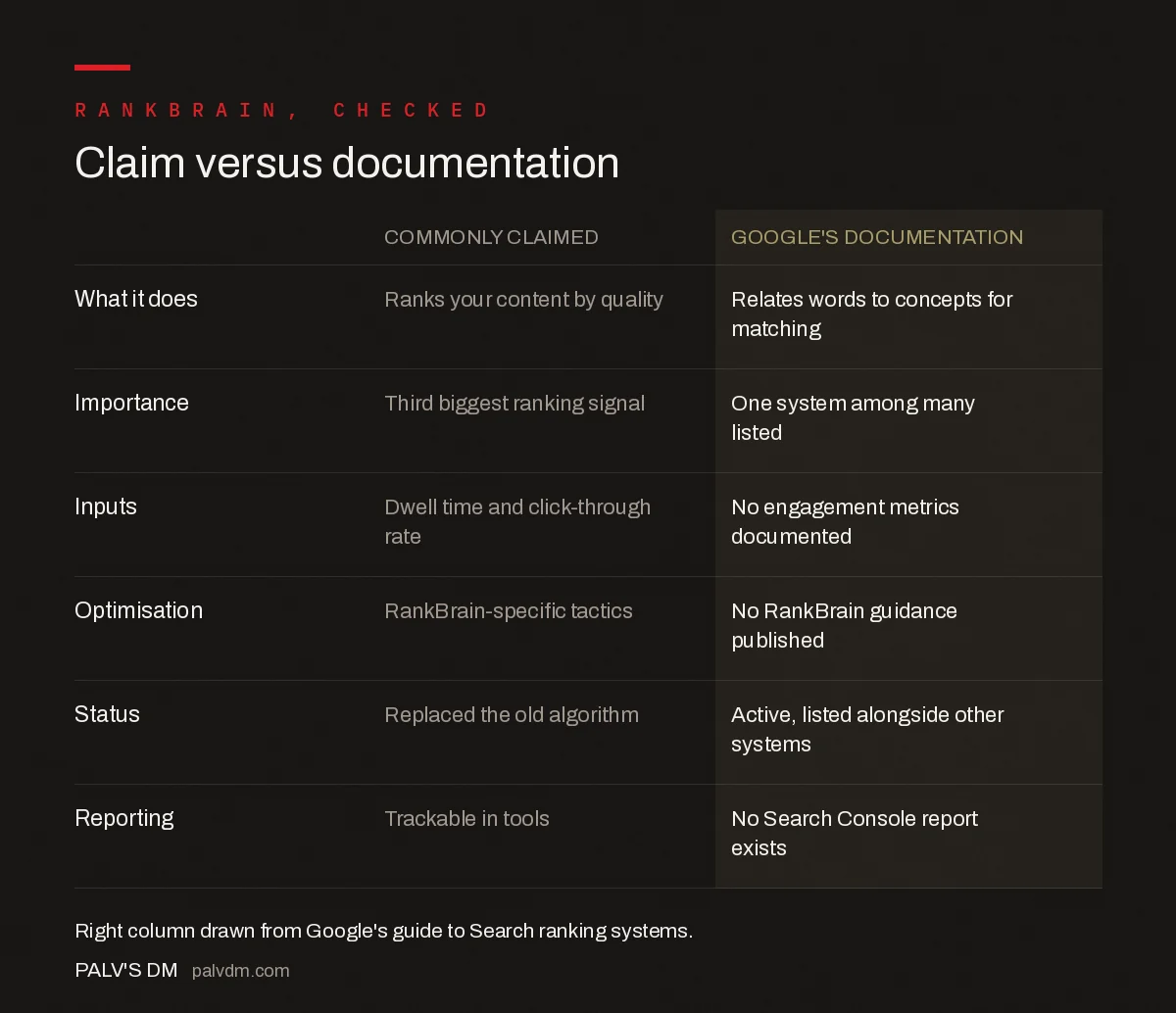
Claim versus documentation
| Commonly claimed | Google’s documentation | |
|---|---|---|
| What it does | Ranks your content by quality | Relates words to concepts for matching |
| Importance | Third biggest ranking signal | One system among many listed |
| Inputs | Dwell time and click-through rate | No engagement metrics documented |
| Optimisation | RankBrain-specific tactics | No RankBrain guidance published |
| Status | Replaced the old algorithm | Active, listed alongside other systems |
| Reporting | Trackable in tools | No Search Console report exists |
Frequently asked questions
What is Google RankBrain?
RankBrain is a machine learning system Google introduced in 2015 and still lists among its active ranking systems. Google describes it as an AI system that helps it understand how words are related to concepts, so relevant content can be returned even when a page does not contain all the exact words used in the search. It handles query understanding rather than content quality.
Is RankBrain still used in 2026?
Yes. RankBrain appears in the active section of Google’s guide to Search ranking systems, not in the retired section that lists Panda, Penguin, Hummingbird and the helpful content system. Google has never announced its removal, and its published description has remained essentially unchanged since the guide was first published in 2022.
How do you optimise for RankBrain?
You cannot optimise for RankBrain specifically. Google publishes no RankBrain guidance, no RankBrain report in Search Console, and no influenceable signal. The useful response is to cover a topic and its related concepts thoroughly, answer the query directly near a relevant heading, and use the vocabulary real searchers use rather than repeating an exact phrase.
Is RankBrain the third most important ranking signal?
That claim comes from a remark by a Google representative in a 2016 question-and-answer session naming content, links and RankBrain as the top three signals. It never appeared in Google’s documentation and has not been repeated in official guidance. Google has since said its ranking signals are not usefully ordered in a fixed hierarchy, so the claim should not be treated as a specification.
What is the difference between RankBrain and BERT?
Google describes RankBrain as a system for understanding how words relate to concepts, so content can be returned without containing the exact search terms. It describes BERT, introduced in 2019, as a system that understands how combinations of words express different meanings and intent. RankBrain works at the level of concept association; BERT works at the level of sentence-level meaning and word order.
Does RankBrain use click-through rate or dwell time?
Google’s published description of RankBrain concerns the relationship between words and concepts, not user engagement metrics. No Google documentation attaches click-through rate or dwell time to RankBrain. That association is an industry inference that has been repeated often enough to sound official, and there is no primary source supporting it.
Sources
- A guide to Google Search ranking systems — Google's current definitions of RankBrain, BERT, MUM and neural matching
- How AI powers great search results — The Keyword
- How Google Search works — Search Central
- Creating helpful, reliable, people-first content
Want this done on your site?
Every PalV’s DM engagement starts with a free audit of your actual website — a 12-point
crawl covering what is blocking indexation, on-page gaps against your primary keywords, speed
findings, and the three to five fixes worth making first. Delivered in two working days. No
payment details, and the findings are yours whether you hire us or not.