How Google Search Console Data Differs From Your Rank Tracker
Search Console reports real impressions; a rank tracker simulates one query. Why the two disagree, how to reconcile them, and which belongs in a report.
Google Search Console reports what actually happened to real users; a rank tracker reports a simulated search run from one fixed location, on one device, at one moment. The two measure different things, so they are supposed to disagree. Search Console’s average position is the mean position of your topmost result across every impression a query generated, blended across devices, countries, personalisation and time of day. A rank tracker fires a single depersonalised query and records what came back. Neither number is wrong. Reporting them as if they were the same metric is.
The practical consequence is that “we rank third” is an incomplete sentence. Third where, on what device, for whom, and averaged over what period? Every serious reporting argument between an agency and a client traces back to that missing detail.
What does Search Console’s average position actually measure?
Search Console records a position only when your site appeared in results — that is, when an impression occurred. For each impression it notes the position of your topmost ranking URL for that query, then averages those positions across the period and the filters you have applied.
Four properties follow, and each one surprises somebody every week.
- It is impression-weighted. A query searched 900 times from Mumbai and 10 times from Delhi produces an average dominated by Mumbai’s results.
- It blends everything you have not filtered out. Mobile and desktop, every country, every date in the range. Splitting by device and country usually explains most of an apparent discrepancy on its own, which is what combining Search Console dimensions is for.
- Non-appearances are simply absent. If you did not rank for a query on a given day, there is no impression and no position — so the average silently excludes your worst days rather than counting them as position 100.
- Some data is withheld. Rare queries that could identify an individual are filtered for privacy, and the interface caps exports at 1,000 rows, which is one of several documented Search Console limits rather than a bug.
What does a rank tracker actually measure?
A rank tracker issues a search query on a schedule, from a specified location and device profile, with personalisation suppressed, and records the position of your URL in the results it receives. It measures a controlled sample of one.
That control is the point. Because location, device and timing are held constant, a rank tracker produces a clean day-to-day comparison — the number moves when rankings move, not when your traffic mix changes. Search Console cannot do that, because a shift in where your visitors happen to be searching from will move average position without any ranking change at all.
The trade-off is coverage. A rank tracker only knows about keywords you told it to track, which for most sites is a small fraction of the queries actually producing impressions. Search Console shows the long tail you never thought to add. Any rank tracking setup that is not periodically topped up from Search Console query data drifts away from what the site really ranks for.
Where exactly do the two data sources diverge?
| Dimension | Search Console | Rank tracker |
|---|---|---|
| What is measured | Real impressions from real searchers | One simulated query per check |
| Location | Everywhere your searchers were | Whatever you configured |
| Device | Mixed unless filtered | Fixed per tracked keyword |
| Keyword coverage | Every query that produced an impression | Only keywords you added |
| When you do not rank | No row at all | Recorded as not found or beyond limit |
| Data freshness | Typically a day or two behind | As often as the tool checks |
| History available | 16 months | As far back as you have tracked |
Read that table once and most reporting disputes resolve themselves. A tracker showing position 4 while Search Console shows 7.8 is not a contradiction: the tracker checked from one city on desktop, and Search Console averaged in every mobile impression from places where you rank tenth.
Why does Search Console show a worse position than my rank tracker?
Almost always one of four causes, checkable in order.
- Device mix. Filter Search Console to desktop only and compare against a desktop tracker profile. Mobile results differ from desktop results for many queries, and mobile usually carries more impressions.
- Geography. Filter to the country your tracker simulates. A site tracked from Ahmedabad but earning impressions across several countries will look worse in the blended average.
- Query variants. Search Console groups nothing — every phrasing is its own row. Your tracked head term may rank third while a dozen variants rank twentieth, and the page-level average absorbs all of them.
- Date range. An average over 28 days includes the days before your fix went live. Comparing a tracker’s today against Search Console’s month is comparing a snapshot with a film, and it is the most common form of date comparison error in monthly reports.
How did the num=100 removal change this comparison?
Substantially, and anyone comparing year on year across September 2025 needs to know it. Google stopped serving the &num=100 URL parameter around 12 September 2025. Rank tracking tools had relied on that parameter to retrieve 100 results in a single request, so position tracking across the industry broke within days.
Search Console data moved at the same time, for a different reason: scraper-generated impressions from tools pulling 100 results at a time disappeared from the data. Many sites saw reported impressions fall and average position appear to improve, with no change in rankings and no announced update. That is a measurement change, not a performance change, and reading it as either a win or a loss produces the wrong decision. The detail sits in what the num=100 removal actually broke and in why impressions fell without traffic falling.
The lasting lesson is narrower than the incident: rank trackers depend on scraping Google, scraping depends on Google’s tolerance, and that tolerance is not a contract. Search Console is first-party data reported by Google itself, which is why it should anchor any long-running comparison.
Does either tool show where you appear in AI answers?
Not usefully, and this is the largest blind spot in both instruments as of 2026. Google has stated that performance data for AI Overviews is included within the overall Search totals in the Performance report rather than broken out as its own dimension, so an impression earned inside an AI Overview and an impression earned from a standard blue link arrive in the same row. You cannot separate them in Search Console.
Rank trackers are equally limited, for a different reason. A tracker records a numeric position within the standard results block. When an AI Overview, a featured snippet, a local pack and a set of product listings sit above that block, position three can mean well below the fold on a phone. The number has not changed; the value of the number has. That is why click-through rate at a stable position is often a better early warning than position itself.
Neither tool sees ChatGPT, Perplexity, Copilot or Gemini at all. Those surfaces produce no Search Console impressions and appear in no rank tracker, so a brand can be cited daily in AI answers with nothing visible in either report. Closing that measurement gap requires prompt-level checking against the engines themselves, which is a separate exercise from measuring AI visibility with the tools you already run for classic search.
The practical adjustment is small. Keep reporting Search Console for clicks and impressions, keep the rank tracker for change diagnosis, and add a periodic manual check of the AI surfaces for the ten or fifteen prompts that matter commercially. Three instruments, three known biases, no pretence that any of them is complete.
Which should you report, and how do you reconcile them?
Use both, for different jobs, and say which is which on the page.
Report Search Console for performance. Impressions, clicks and click-through rate are commercial outcomes and they come from Google directly. This is the number that belongs in a monthly report, because no vendor sits between the client and the data.
Use the rank tracker for diagnosis. Its stability makes it far better at answering “did this specific page move after Tuesday’s change” — a question Search Console’s blended average answers slowly and vaguely.
Reconcile before you escalate. When the two disagree, filter Search Console to the tracker’s device and country, narrow the date range to match, and isolate the exact query rather than the page. Most gaps close entirely at that point. If a gap survives all four filters, then look for a genuine cause: a SERP feature changing what position one means visually, a canonical pointing somewhere unexpected, or results that vary by personalisation and search history.
Treat every tool as an instrument with a known bias rather than a source of truth, which is the same discipline required for validating any SEO tool’s data. Search Console tells you what happened to your searchers. A rank tracker tells you what one hypothetical searcher would have seen. Both are useful. Only one of them is what your business actually earned.
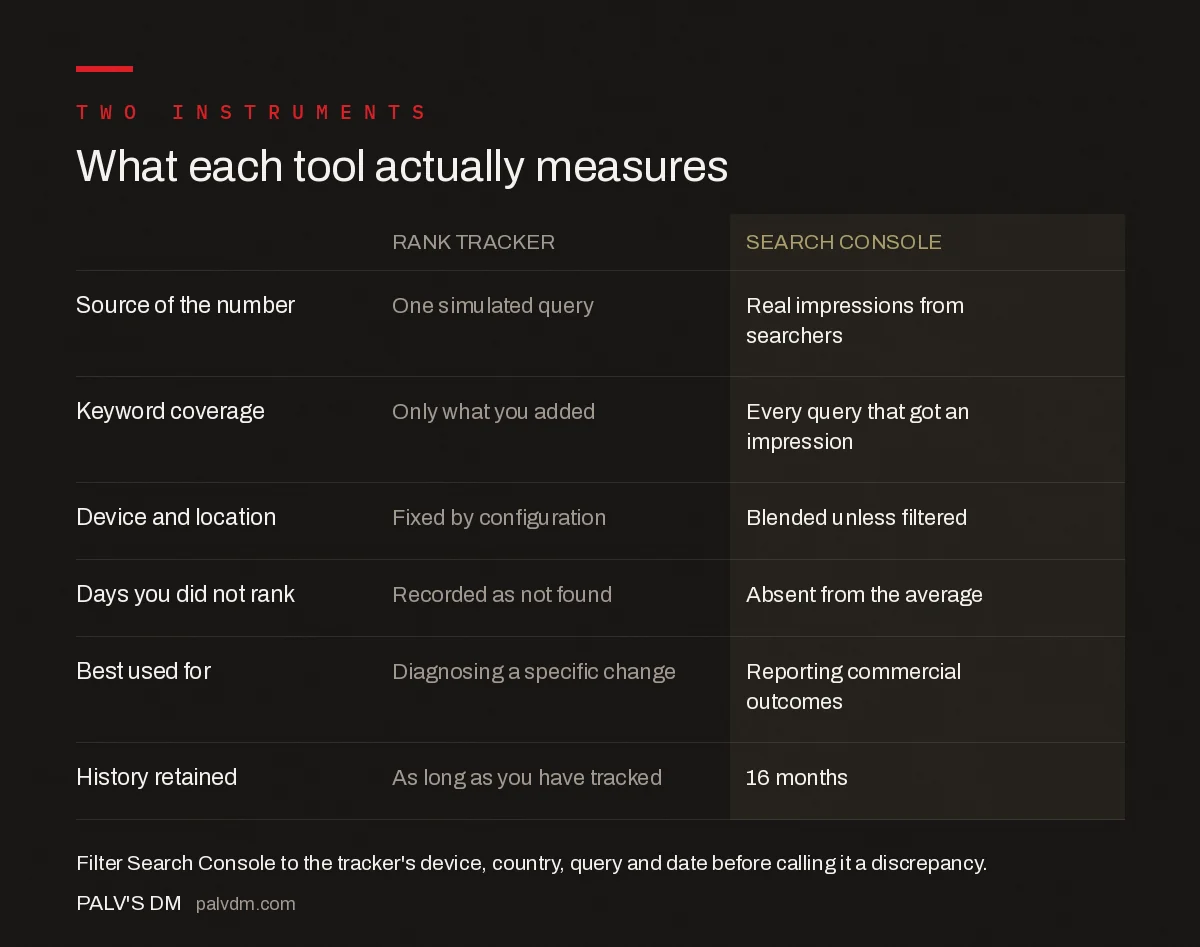
What each tool actually measures
| Rank tracker | Search Console | |
|---|---|---|
| Source of the number | One simulated query | Real impressions from searchers |
| Keyword coverage | Only what you added | Every query that got an impression |
| Device and location | Fixed by configuration | Blended unless filtered |
| Days you did not rank | Recorded as not found | Absent from the average |
| Best used for | Diagnosing a specific change | Reporting commercial outcomes |
| History retained | As long as you have tracked | 16 months |
Frequently asked questions
Why is my Search Console average position different from my rank tracker?
Because they measure different things. Search Console averages the position of your topmost result across every real impression, blending devices, countries and dates. A rank tracker runs one depersonalised query from one configured location and device. Filter Search Console to the tracker’s device, country, exact query and date range, and most of the gap disappears.
Which is more accurate, Search Console or a rank tracker?
Neither is more accurate; they answer different questions. Search Console is first-party data from Google describing what real searchers saw, which makes it the right source for impressions, clicks and reporting. A rank tracker holds location and device constant, which makes it better for diagnosing whether one specific page moved after one specific change.
Why does Search Console not show all my keywords?
Two reasons. Queries rare enough to potentially identify an individual are filtered out for privacy, so they never appear. And the Search Console interface caps results at 1,000 rows per report, which is a documented limit rather than a fault. Using the Search Console API with pagination retrieves substantially more rows than the interface will show.
Does Search Console average position include days when I did not rank?
No. A position is only recorded when an impression occurred, so days where your site did not appear at all contribute nothing to the average rather than counting as a poor position. This means the average quietly excludes your worst days, and it is one reason Search Console can look more favourable than a rank tracker that records a not-found result.
How far back does Google Search Console data go?
Sixteen months. Anything older is not retained, which is why year-on-year comparisons need exporting before the window closes. A rank tracker keeps history for as long as you have been tracking the keyword, so it can hold a longer series, but only for the specific keywords you chose to add at the time.
Did the num=100 removal affect Search Console data?
Yes. Google stopped serving the num=100 URL parameter around 12 September 2025, and scraper-generated impressions from tools that pulled 100 results at a time disappeared from the data. Many sites saw impressions fall and average position appear to improve with no ranking change. Any comparison spanning that date compares two different measurement regimes.
Sources
- Search Console Performance report — Search Console Help
- Search Console API: searchanalytics.query
- Google Search confirms it does not support the results per page parameter — Search Engine Land
Want this done on your site?
Every PalV’s DM engagement starts with a free audit of your actual website — a 12-point
crawl covering what is blocking indexation, on-page gaps against your primary keywords, speed
findings, and the three to five fixes worth making first. Delivered in two working days. No
payment details, and the findings are yours whether you hire us or not.