Why Your Impression Counts Fell Off a Cliff in 2025
Search Console impressions collapsed in September 2025 while average position jumped. Here is why, how to check it, and how to rebuild reporting.

If your Google Search Console impressions dropped sharply in September 2025 while clicks stayed roughly flat and average position improved, you did not lose traffic. You lost impressions that were never human. Around 12 September 2025 Google stopped serving the &num=100 URL parameter, which rank-tracking tools had used to request 100 results in a single page load. Every one of those loads had generated an impression for every site listed in those 100 positions. When Google withdrew the parameter, those impressions disappeared from Search Console permanently.
The reason this reads as a catastrophe on a chart is that it is a step change, not a decline. Impressions do not taper down over a fortnight the way a core update loss usually does. They fall on a specific day and stay there, which is precisely the shape people associate with something being badly broken.
How do you tell a num=100 impression drop from a real traffic loss?
Five checks, in order. The whole sequence takes about fifteen minutes in Search Console and it resolves the question definitively.
- Plot clicks and impressions on the same chart. In the Performance report, tick both metrics and set a date range that spans July 2025 to November 2025. If impressions step down and clicks continue on their existing trend, the missing impressions were scraper traffic. If clicks fell too, you have a genuine problem and the parameter change is not it.
- Find the date of the break. A drop that begins on or around 12 September 2025 and holds at the new level is the parameter change. A drop that begins on a different date needs a different explanation.
- Split desktop from mobile. Use the Devices tab. Scraping ran predominantly against desktop results, so the impression loss is heavily skewed to desktop. A drop distributed evenly across desktop and mobile is not this.
- Check average position in the same window. If average position improved at the same moment impressions fell, that is diagnostic. It happens because the impressions removed sat at deep positions, so the average of what remains rises without any page moving.
- Filter by position. Compare the count of queries reported at positions 21 and beyond before and after the break. That is where the losses concentrate. Top-ten queries are largely untouched, because humans and scrapers both saw those.
If all five point the same way, stop investigating and start relabelling your reports. If any of them disagrees — particularly clicks — then something else happened and the full traffic-drop diagnostic is the right next step.
What did the drop look like across sites?
Tyler Gargula, director of technical SEO at LOCOMOTIVE Agency, analysed 319 Search Console properties after the change. Search Engine Land reported the results in September 2025:
| Metric | Finding across 319 properties |
|---|---|
| Impressions | 87.7% of properties declined |
| Unique query count | 77.6% of properties lost ranking terms |
| Keyword type affected | Short-tail and mid-tail keywords hit hardest |
| Position distribution | Fewer queries on page three and beyond; more in the top three and on page one |
Almost nine in ten properties losing impressions is close to universal, which is itself useful context for a stakeholder conversation: this was not something that happened to your site. It happened to nearly every site with a Search Console property.
Why did average position improve at the same time?
Average position in Search Console is a weighted average across every impression recorded. It is not a measure of where your best pages rank; it is a measure of where the results people saw were positioned, averaged together.
Scraper page loads requesting 100 results contributed a huge volume of impressions at positions 40, 60 and 90 — positions that essentially no human ever scrolls to. Those impressions dragged the site-wide average down for years. Remove them and the average rises immediately, even though not a single page moved up a single place.
This is a good illustration of why site-wide average position was a poor metric even before September 2025, and why average position is so routinely misread. A number that can improve substantially because measurement changed is not measuring performance. Segment it by query group or page group, or do not report it.
What actually counts as an impression in Search Console?
Google Search Console records an impression when a link to your site appears in a search result that a user views. Crucially, Google counts the impression when the result is in the loaded portion of the results page — the user does not have to scroll to it or notice it, and they certainly do not have to click.
That definition is what made the &num=100 situation possible. A rank-tracking tool loading a results page is, as far as the counting logic is concerned, a view. When one request loaded 100 results, all 100 listed sites were credited with an impression apiece. A tool checking one keyword daily across a year generated 365 impressions for every site in the top 100 for that keyword, none of them corresponding to a human being.
Two implications follow, and both outlive this particular change. First, an impression has never been a reliable proxy for attention — it is a proxy for appearing in a rendered results page, which is a much weaker claim. Second, any metric derived from impressions inherits that weakness: click-through rate, visibility share, and the “keywords you rank for” count are all built on the same foundation.
Which reports do you need to rebuild?
Any report whose primary metric was impressions, visibility or average position needs work. Specifically:
- Year-on-year impression comparisons. Any comparison where one period sits before 12 September 2025 and the other after is comparing two different counting methods. Replace impressions with clicks for those comparisons and say so explicitly.
- Keyword-count reporting. “Number of keywords we rank for” fell for 77.6% of properties in the Gargula analysis without any ranking changing. If that number is in a client dashboard, it needs an annotation and probably a replacement.
- Third-party visibility scores. Rank trackers rebuilt their collection methods at different times and in different ways, which is why they now disagree with each other more than they used to. Rank tracking after the num=100 change sets out what to expect.
- Any dashboard blending Search Console with tracker data. The two sources diverged further in September 2025. Why Search Console and your rank tracker disagree explains which source answers which question.
- Click-through-rate reporting. CTR is clicks divided by impressions. Removing phantom impressions raises reported CTR without any behavioural change, so CTR benchmarks drawn from before and after the change are not comparable.
What should you tell a client or your board?
Say it directly and early, because the alternative is being asked about it in a meeting where you look defensive. Three sentences usually do it: Google removed a URL parameter in September 2025 that let automated tools load 100 results at once; those tool page loads had been counted as impressions for our pages even though no person saw them; our impressions figure is now smaller and more accurate, and our clicks, leads and revenue are unaffected.
Then show the clicks chart. A flat or rising click line beside a collapsed impression line makes the argument better than any explanation, and it moves the conversation onto the metrics that actually matter. It is also worth agreeing at that point which numbers you will report going forward — this is a natural moment to demote impressions from headline metric to supporting diagnostic.
What if clicks fell too?
Then the parameter change is a distraction and you need a real diagnosis. September 2025 was a crowded month: the August 2025 spam update ran from 26 August to 22 September 2025 and reintensified around 9 September, only days before the parameter change. A site could plausibly have been hit by spam enforcement and lost scraper impressions in the same fortnight.
Untangling that requires separating the two signatures. Spam enforcement costs clicks and rankings on real queries, shows up in top-ten positions, and affects mobile and desktop alike. The parameter change costs impressions at deep positions, is skewed to desktop, and leaves clicks alone. Work through how to confirm what actually hit your site, and rule out your own deployments with the update-or-you checklist before concluding anything. The 2025 update timeline has the confirmed dates you need to check against.
Is the lower number here to stay?
Treat it as permanent for planning purposes. Google framed the parameter as something it never formally supported, which is not a commitment either way, but no restoration has been announced. More importantly, the new figure is the better one: it counts impressions that plausibly correspond to a human seeing a result.
The durable lesson is about which metrics deserve a place in a report at all. Impressions, keyword counts and visibility indices are inferences built on assumptions about how data is collected, and those assumptions change without notice. Clicks, enquiries and revenue do not have that problem. Reading what impressions, clicks and position each actually measure alongside a proper Search Console walkthrough is the cheapest insurance against the next measurement change being mistaken for a business event.
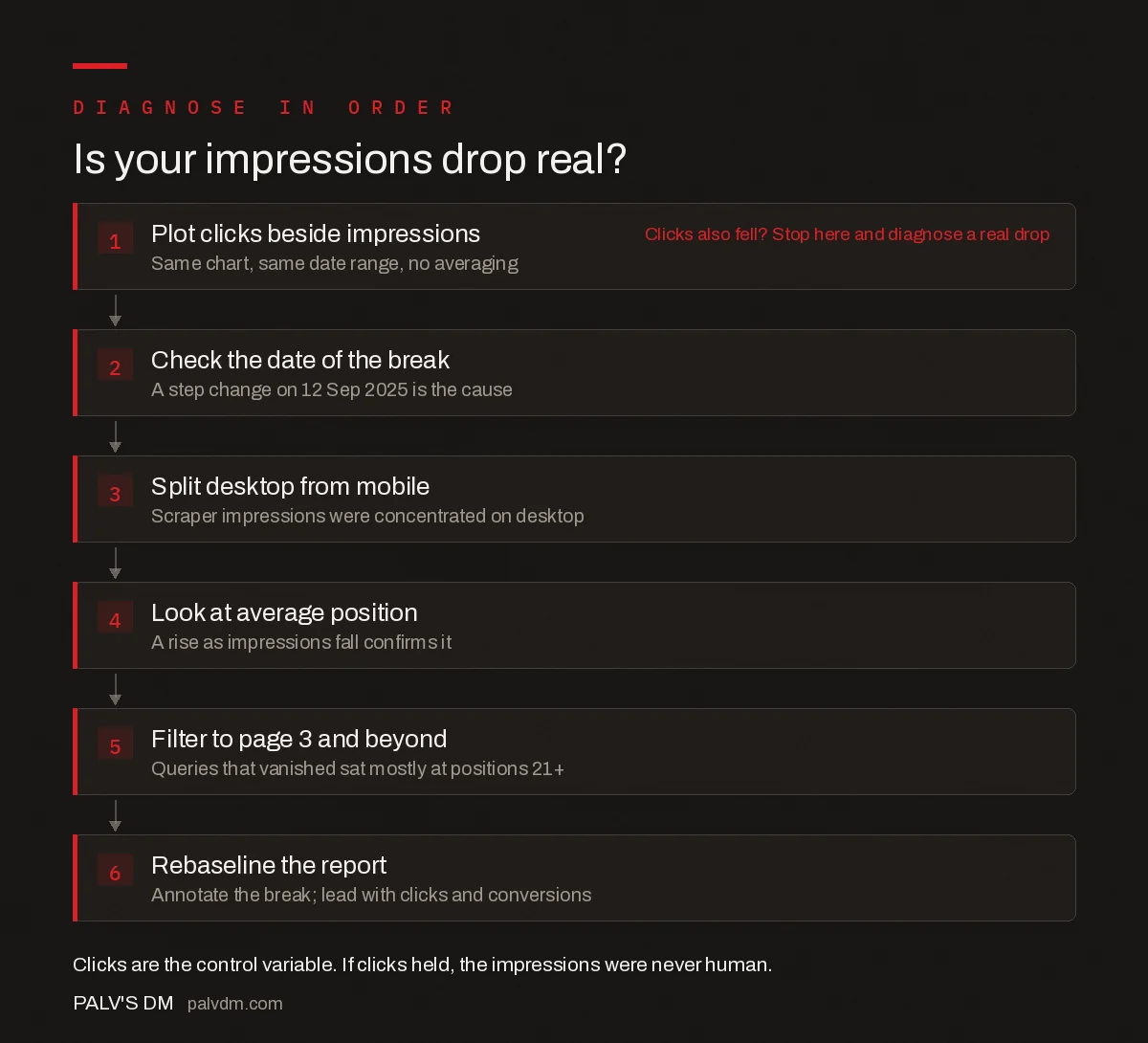
Is your impressions drop real?
- Plot clicks beside impressions. Same chart, same date range, no averaging. Clicks also fell? Stop here and diagnose a real drop
- Check the date of the break. A step change on 12 Sep 2025 is the cause.
- Split desktop from mobile. Scraper impressions were concentrated on desktop.
- Look at average position. A rise as impressions fall confirms it.
- Filter to page 3 and beyond. Queries that vanished sat mostly at positions 21+.
- Rebaseline the report. Annotate the break; lead with clicks and conversions.
Frequently asked questions
Why did my Google Search Console impressions drop in September 2025?
Around 12 September 2025 Google stopped supporting the num=100 URL parameter, which let rank-tracking tools load 100 search results in one page view. Each of those page views generated an impression for every site listed in the 100 positions. When the parameter stopped working, those non-human impressions disappeared. In one analysis of 319 properties, 87.7% saw impressions decline.
How do I know if my impressions drop is real or a measurement change?
Plot clicks and impressions on the same Search Console chart across July to November 2025. If impressions step down sharply around 12 September while clicks continue their existing trend, the lost impressions were tool-generated. Check devices too: the loss is heavily skewed to desktop. If clicks fell as well, something else caused it and needs separate diagnosis.
Why did my average position improve while impressions fell?
Average position is a weighted average across all recorded impressions. The impressions removed by the num=100 change were concentrated at deep positions such as 40, 60 and 90, which dragged the site-wide average down. Removing them raises the average of what remains, so average position improved without any page actually moving up in the results.
Did the num=100 change affect clicks or traffic?
No. Clicks come from a person choosing a result, and automated tools do not click. Only impressions, query counts and average position were affected, along with click-through rate, which is calculated from impressions. If clicks fell in the same period, the cause is something else, such as a confirmed algorithm update or a change on your own site.
Should I still report Search Console impressions?
Report them as a diagnostic rather than a headline. Impressions are useful for spotting indexing problems and for comparing query groups within a single period, but they are now discontinuous across September 2025 and were inflated by automated tools for years before that. Clicks, conversions and revenue are unaffected by collection changes and belong at the top of a report.
Will Search Console impressions go back to previous levels?
There is no basis to expect that. Google described the num=100 parameter as something it never formally supported and has not announced any restoration. The lower figure also reflects reality better, because it counts impressions that plausibly correspond to a person seeing a result rather than a rank tracker requesting one hundred of them at once.
Sources
- 77% of sites lost keyword visibility after Google removed num=100: Data — Search Engine Land
- Why Google Search Console impressions fell (and why that's good) — Search Engine Land
- Search Console Performance report — Search Console Help
- Google Search Status Dashboard
Want this done on your site?
Every PalV’s DM engagement starts with a free audit of your actual website — a 12-point
crawl covering what is blocking indexation, on-page gaps against your primary keywords, speed
findings, and the three to five fixes worth making first. Delivered in two working days. No
payment details, and the findings are yours whether you hire us or not.