SEO KPIs Your Founder Will Actually Accept
Five SEO KPIs that connect to revenue, the diagnostic metrics that should never reach a board deck, and what to report in the months before results arrive.
The SEO KPIs a founder will accept are the ones that connect to money or to a decision: qualified organic enquiries, revenue or pipeline attributed to organic landing pages, non-branded organic clicks, and impressions on the specific keywords you agreed to target. Everything else — keyword positions, sessions, bounce rate, domain authority — belongs in the diagnostic layer that the SEO team uses to do its job, not in the report that goes to the person paying for it. Founders do not reject SEO reporting because they dislike detail. They reject it because it answers questions they did not ask.
The second problem is timing. Every KPI worth reporting is a lagging indicator, and organic search lags by months. A reporting set that only contains lagging indicators gives a founder nothing to judge for two quarters, which is exactly when the budget conversation happens.
Why do founders reject standard SEO reports?
Three failures account for almost all of it, and all three are fixable without changing the underlying work.
The metrics are not connected to revenue. A report showing forty keywords improved does not tell a founder whether to keep spending. A report showing eleven enquiries from organic, of which four were qualified, does.
The numbers cannot be verified. If the figures only exist inside an agency dashboard, they are unfalsifiable by design. Reporting from the client’s own Search Console and GA4 properties removes the objection entirely — what an agency should actually report starts with whose account the data comes from.
Branded traffic inflates everything. If the company runs ads, gets press or has a growing customer base, branded searches rise on their own. Counting those as SEO results is the single most common way SEO reporting loses credibility, because the founder can usually tell.
Which SEO KPIs survive a board conversation?
Five KPIs cover almost every early-stage and mid-market case. Each answers a question a founder actually asks, and each can be read from a source the founder owns.
| KPI | The question it answers | Where it is read | Typical lag |
|---|---|---|---|
| Qualified organic enquiries | Is this producing customers? | CRM, tagged by landing page | 4–6 months |
| Revenue or pipeline from organic landing pages | Is it worth the spend? | GA4 plus CRM | 5–9 months |
| Non-branded organic clicks | Are we reaching people who did not know us? | Search Console, brand terms filtered out | 3–5 months |
| Impressions on mapped keywords | Is the work registering at all? | Search Console | 4–8 weeks |
| Indexed pages against published pages | Is anything blocking us? | Search Console Pages report | Days |
Read top to bottom, the table also solves the timing problem. The bottom two move in weeks and are the honest early evidence; the top two move in quarters and are what the budget decision rests on. Explaining the gap between impressions and outcomes before month one is what stops it becoming an argument in month four.
What is the difference between a KPI and a diagnostic metric?
A KPI is a number that changes a decision. A diagnostic metric is a number that changes an action. Both are necessary, and mixing them in one report is why SEO reporting has a reputation for being unreadable.
Average position is diagnostic: it tells an SEO which pages to work on next, and it tells a founder nothing, partly because average position is routinely misread as a ranking rather than an average across every query a page appears for. Crawl errors, Core Web Vitals scores, internal link counts and click-through rate by page are all diagnostic. They belong in a working document that the team reviews weekly — a weekly metrics review is the right home for them — while the monthly report carries the five KPIs and nothing else.
The test is simple. Ask what the founder would do differently if the number doubled. If there is no answer, it is not a KPI.
How do you separate branded from non-branded traffic?
Branded and non-branded organic traffic answer different questions and must be reported separately, because branded search largely measures demand your other marketing created rather than anything SEO did.
In Search Console, filter queries that do not contain your brand name and its common misspellings, then report clicks and impressions on that filtered set as the SEO number. Segmenting branded from non-branded search takes one saved filter and permanently changes the quality of the conversation. Report branded volume too, but label it honestly as a brand-awareness indicator.
The same discipline applies to sudden movements. When impressions shift sharply without a matching change in clicks, check for a reporting change before diagnosing a performance change — the September 2025 impressions step change is the clearest recent example of a chart that looked like a collapse and was not.
What do you report before the results arrive?
Months one to three of an SEO programme produce almost no lagging-indicator movement, and pretending otherwise is how trust is lost. Report leading indicators instead, and say plainly that they are leading indicators.
- Indexation coverage. Pages published against pages indexed. Moves in days and directly reflects work done.
- Distinct queries earning impressions. A widening query count shows topical coverage being recognised before any position is won.
- Impressions on mapped keywords. Impressions rise before positions improve, and positions improve before clicks arrive.
- Work shipped against the plan. Not a search metric, but the one a founder can verify without any tool. If nothing shipped, no metric will move later.
Leading indicators across marketing work the same way: they are permission to keep going, not proof of return. Agreeing which ones count, before the programme starts, is the actual purpose of a KPI discussion.
Which metrics should you stop reporting entirely?
- Keyword rankings as a headline number. Positions vary by location, device and personalisation, and a rankings table has no denominator. Report clicks on the queries instead.
- Domain authority or similar third-party scores. These are vendor estimates, not Google signals, and no decision should rest on one.
- Total sessions. Undifferentiated traffic hides the branded and non-branded split that matters.
- Bounce rate as a quality signal. A visitor who found the answer and left is a success, not a failure.
- Backlinks acquired as a count. One relevant editorial citation and forty directory listings are not comparable quantities.
The full list of SEO vanity metrics has a common structure: each is easy to move and hard to connect to money, which is precisely the combination that makes a founder suspicious.
How do you present a flat quarter without losing the budget?
Flat quarters happen in every SEO programme, and how they are presented decides whether the programme survives one. The failure mode is finding a metric that did move and leading with it, which a founder reads correctly as evasion.
Lead with the flat number instead, then answer three questions in order. What did move, at the leading-indicator level — impressions, query count, indexed pages — and what does that predict. What did not ship, and why, since unshipped work is the most common cause of a flat quarter and is a resourcing problem rather than a channel problem. And what changes next quarter as a result, stated as specific tasks rather than intentions.
If a confirmed Google update landed inside the reporting window, say so with the date and the source, and separate what the update explains from what it does not. Google’s own guidance after core updates is that a drop does not necessarily mean something is wrong with your pages, and that is a more credible thing to say than a recovery promise.
How do you attribute revenue to organic search honestly?
Attribution is where SEO reporting most often overclaims, and overclaiming once costs more credibility than a flat quarter ever does.
Three practices keep it defensible. Report last non-direct click and assisted conversions side by side rather than choosing whichever is larger. Tag enquiry forms with the landing page so revenue can be attributed to specific pages rather than to a channel in aggregate. And state the known limits out loud — long sales cycles, cross-device journeys, and enquiries that arrive by phone or WhatsApp after an organic visit. How SEO attribution actually works and calculating SEO return both depend on admitting what the data cannot see.
A founder who is told the limits will trust the number. A founder who discovers them later will not trust the next one.
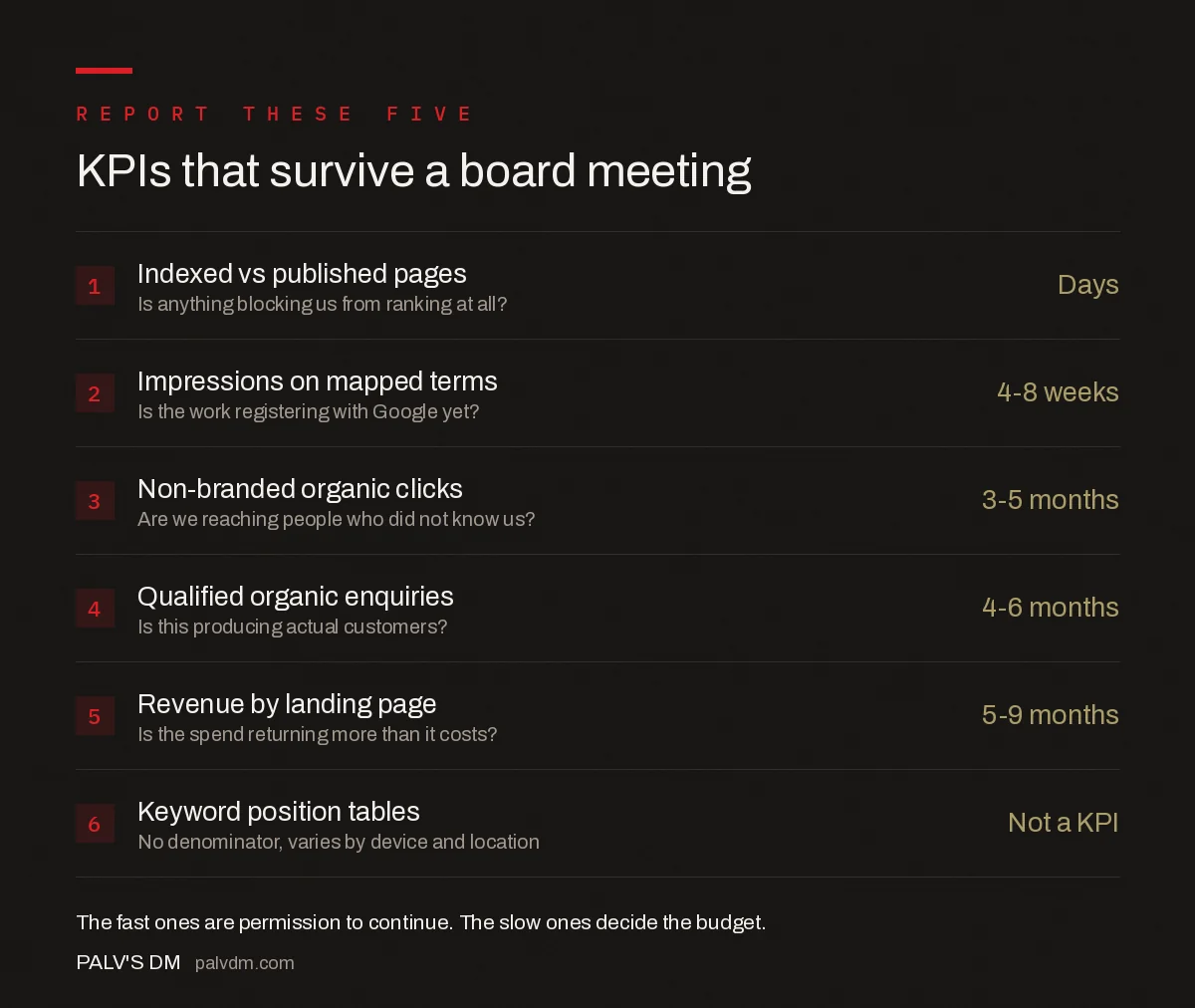
KPIs that survive a board meeting
- Indexed vs published pages — Days. Is anything blocking us from ranking at all?.
- Impressions on mapped terms — 4-8 weeks. Is the work registering with Google yet?.
- Non-branded organic clicks — 3-5 months. Are we reaching people who did not know us?.
- Qualified organic enquiries — 4-6 months. Is this producing actual customers?.
- Revenue by landing page — 5-9 months. Is the spend returning more than it costs?.
- Keyword position tables — Not a KPI. No denominator, varies by device and location.
Frequently asked questions
What are the most important SEO KPIs?
Five cover most businesses: qualified organic enquiries, revenue or pipeline attributed to organic landing pages, non-branded organic clicks, impressions on the keywords you agreed to target, and indexed pages against published pages. The first two decide budgets and take months to move. The last two move within weeks and are the honest early evidence that work is registering.
Why are keyword rankings a bad KPI?
Positions vary by location, device and personalisation, and a rankings table has no denominator, so improving forty keywords tells a founder nothing about whether to keep spending. Average position in Search Console is also routinely misread, because it averages across every query a page appears for. Report clicks on those queries instead.
How do I separate branded from non-branded organic traffic?
In Search Console, apply a query filter excluding your brand name and its common misspellings, then report clicks and impressions on that filtered set as your SEO number. Branded search largely measures demand created by your other marketing, so counting it as an SEO result is the fastest way for reporting to lose credibility.
What should an SEO report show in the first three months?
Leading indicators, clearly labelled as such: indexation coverage, the number of distinct queries earning impressions, impressions on mapped keywords, and work shipped against the plan. Lagging indicators like enquiries and revenue will not have moved yet, and presenting early noise as results is what makes month four uncomfortable.
How do you attribute revenue to SEO?
Report last non-direct click and assisted conversions side by side rather than choosing the larger figure, tag enquiry forms with the landing page so revenue attaches to specific pages rather than a channel, and state the limits explicitly — long sales cycles, cross-device journeys, and phone or WhatsApp enquiries that follow an organic visit but never appear in analytics.
How often should SEO KPIs be reported?
Diagnostic metrics weekly with the delivery team, KPIs monthly, and direction reviewed quarterly. Monthly reviews of a compounding channel encourage panic decisions because the numbers look flat for two quarters. Quarterly review catches genuine problems while there is still time to change course, provided the KPI set was agreed before the work started.
Sources
- Performance report (Search results) — Search Console Help
- Get started with Search Console — Google Search Central
- Do you need an SEO? — Google Search Central
Want this done on your site?
Every PalV’s DM engagement starts with a free audit of your actual website — a 12-point
crawl covering what is blocking indexation, on-page gaps against your primary keywords, speed
findings, and the three to five fixes worth making first. Delivered in two working days. No
payment details, and the findings are yours whether you hire us or not.