How to Build a 12-Month SEO Roadmap (With a Free Template)
A 12-month SEO roadmap is sequenced work, not goals. Copy the eight-column template, use the quarter-by-quarter order, and keep the plan alive past month two.

A 12-month SEO roadmap is a sequenced, dated list of work — not a list of goals — organised so that each quarter unblocks the next: fix what prevents indexing first, improve pages that already rank second, build new coverage third, and earn authority last. The template is the column structure and quarterly sequence set out below; copy it into a spreadsheet and it is done. A roadmap that cannot be read as “who does what, by when, and how we will know it worked” is a wish list with dates attached.
The reason sequence matters more than content is dependency. Publishing thirty articles on a site where a third of pages are not indexed wastes the entire investment, and earning links to pages that have not yet been optimised spends the most expensive resource in SEO on the wrong targets.
How is a roadmap different from an SEO strategy?
A strategy states which searchers you intend to win and why you can. A roadmap states what will be done in which order to get there. They are separate documents and both are needed — the distinction between an audit, a strategy and a plan is where most confusion about deliverables originates.
In practice the roadmap is downstream of three inputs: a technical audit that tells you what is broken, keyword research that tells you what is worth targeting, and a content audit that tells you what already exists. Without all three, a roadmap is guesswork with a Gantt chart. The technical audit and the content audit are the two that most often get skipped, and skipping either produces a roadmap full of new-content tasks when the real constraint was elsewhere.
What columns does the template need?
Eight columns are enough for a twelve-month roadmap, and adding more reliably reduces the chance anyone maintains it. Copy this structure into a spreadsheet, one row per task.
| Column | What goes in it |
|---|---|
| Task | One concrete action. “Rewrite /pricing title and H1”, not “improve pricing page” |
| Type | Technical, on-page, content, links, measurement |
| Target URL or keyword | The specific page or query the task serves |
| Owner | A named person, never a team name |
| Quarter | Q1 to Q4, not a precise date twelve months out |
| Dependency | What must finish first, if anything |
| ICE score | Impact, confidence and ease, scored 1 to 10 each |
| Success signal | The specific metric that will move, and where you will read it |
Add three tabs beside the task list rather than more columns: a keyword map, a change log with dates, and a parking lot for ideas that did not make the quarter. The parking lot matters because it gives good ideas somewhere to live other than the current sprint, which is how roadmaps get quietly overloaded.
The success-signal column is the one that changes behaviour. Forcing yourself to write “impressions on this URL in Search Console” before starting a task kills a surprising number of tasks that turn out to have no measurable outcome at all.
How should twelve months be sequenced?
The sequence below assumes an existing site with typical problems. A brand-new domain runs a different first quarter — the first 90 days of a new website is largely foundations rather than remediation.
| Quarter | Focus | Why it comes here |
|---|---|---|
| Q1 | Technical remediation, measurement setup, keyword mapping | Everything downstream is wasted if pages cannot be crawled, indexed or measured |
| Q2 | On-page work on existing pages, internal linking, pruning or merging thin pages | Fastest returns available — pages already ranking 8 to 20 move with on-page work alone |
| Q3 | New content in the highest-intent cluster, plus evidence added to existing pages | Coverage compounds, and depth in one area builds faster than breadth across many |
| Q4 | Authority work, digital PR, original research, refresh of anything plateaued | Links are the slowest input and should point at pages that are already good |
Two caveats keep this from being a straitjacket. Seasonal businesses invert it — if your revenue arrives in October, the content targeting that peak must be published by July, so planning around seasonality overrides the default order. And any quarter can be interrupted by a confirmed Google core update, which is a reason to reassess rather than to abandon the plan.
How do you decide what goes in the first quarter?
Q1 should contain the smallest set of tasks that removes constraints on everything else. Score candidates rather than arguing about them.
- List every finding from the audits without filtering. Technical issues, content gaps, on-page problems, measurement gaps.
- Score each on impact, confidence and ease, one to ten. ICE scoring for SEO tasks takes minutes and produces a defensible order rather than the loudest stakeholder’s order.
- Force the dependencies to the top regardless of score. An indexation blocker outranks a high-scoring content task because the content task depends on it.
- Cap the quarter at what the team can actually ship. Capacity, not ambition, sets the line. A roadmap with three quarters of work in Q1 will be ignored by February.
- Attach a success signal to every surviving task. If you cannot name the metric, the task is decoration.
How does content fit into a 12-month roadmap?
Content on a roadmap should be planned as clusters, not as individual articles, because topical coverage is what compounds. One cluster of twelve connected pages around a single commercial subject will outperform twelve unrelated posts, and it gives internal linking something to connect.
Plan each cluster with a target query per page, decided in advance. Mapping keywords to specific URLs before writing prevents two pages competing for the same term, which is the most common self-inflicted content problem and the most tedious to fix afterwards.
Include refreshes as scheduled roadmap items, not as reactive work. Pages published in Q1 should have a review date in Q3 or Q4 with an owner attached. A defined content refresh process turns “we should update that” into a dated task, and refreshing an existing page that already has links is usually cheaper than writing a new one.
How do you keep a roadmap alive after month two?
Most SEO roadmaps die in week six, when the first urgent thing arrives. Three mechanisms keep them running.
Break quarters into sprints. A quarter is too long to feel accountable to. Running SEO in weekly or fortnightly sprints turns roadmap rows into scheduled work with visible completion, and makes slippage obvious within days rather than months.
Review quarterly, not monthly. Monthly reviews of a compounding channel produce panic decisions, because the honest numbers look flat for the first two quarters. Quarterly reviews catch genuine problems while there is still time to change direction. Agreeing the KPIs in advance is what makes a quarterly review survivable.
Keep one change log. Record every deployment, redesign, content publication and confirmed algorithm update with a date. When traffic moves, that log is the difference between diagnosis and speculation — annotating updates and site changes costs a minute per entry and repeatedly saves a week of investigation.
What should not go on the roadmap?
- Ranking targets as tasks. “Rank number one for [term]” is an outcome, not work. Positions are not directly controllable, and putting them in the task column makes the roadmap unfalsifiable.
- Anything without a named owner. Tasks owned by “marketing” are owned by nobody.
- Precise dates beyond the current quarter. A task dated for week 34 will be wrong. Quarters absorb reality; week numbers do not.
- Tactics that depend on unpublished assumptions. If a task exists because a tool suggested it and nobody can explain the mechanism, cut it.
- Volume targets with no quality gate. “Publish eight articles a month” is a production quota, and Google’s guidance asks whether content adds substantial value compared with what already ranks.
One more omission is worth naming, because it is invisible: work that has no home. Schema implementation, image optimisation and internal linking all tend to sit outside both the technical and content columns, get assigned to nobody, and never happen. Give each a row and an owner even if the row spans a whole quarter.
A finished roadmap should be readable in five minutes by someone who was not in the meeting. If it needs narration, it is a strategy document wearing a spreadsheet’s clothes — and the person doing the work will build their own list instead. Running SEO as a managed project and reporting against the same rows in the monthly report keeps the plan and the reporting describing the same reality.
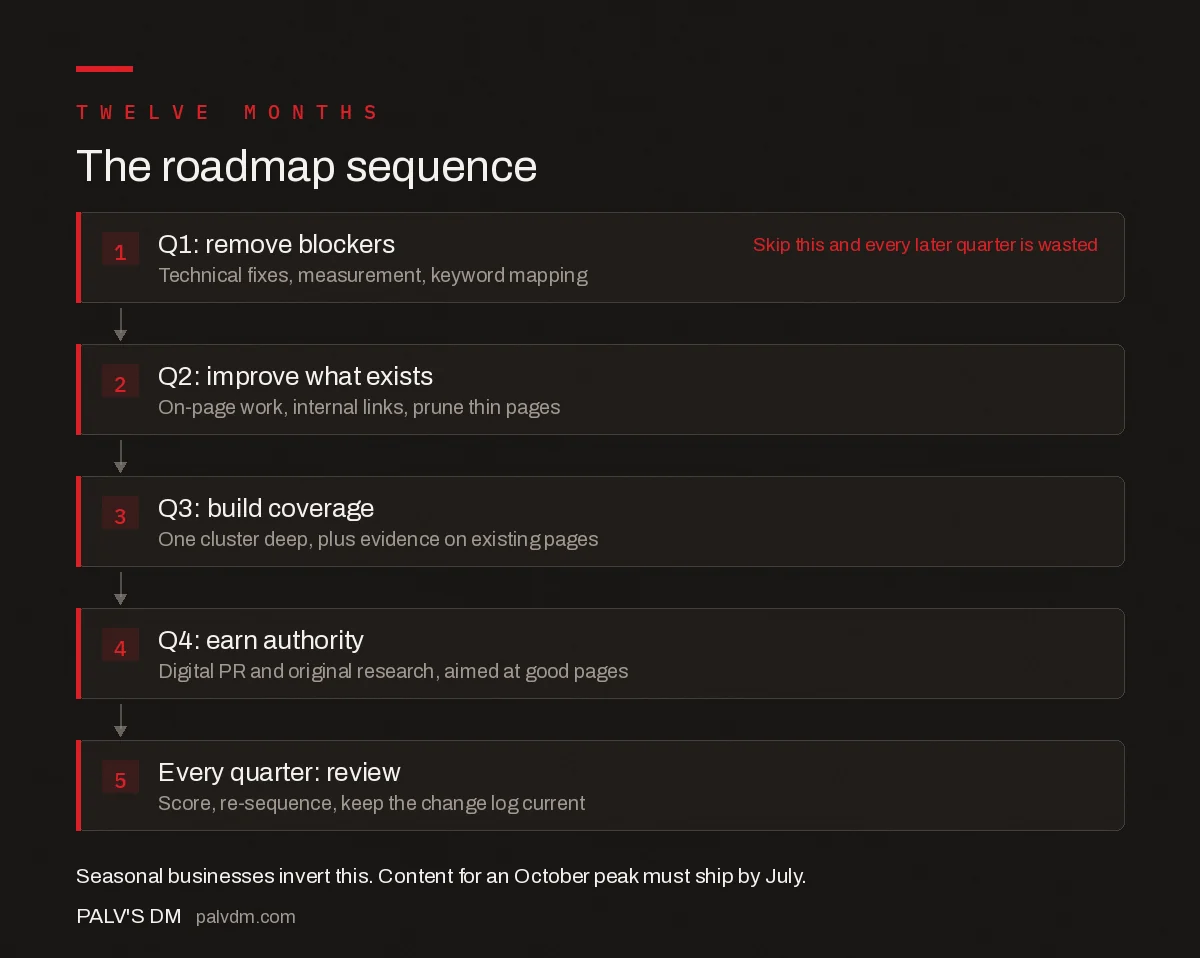
The roadmap sequence
- Q1: remove blockers. Technical fixes, measurement, keyword mapping. Skip this and every later quarter is wasted
- Q2: improve what exists. On-page work, internal links, prune thin pages.
- Q3: build coverage. One cluster deep, plus evidence on existing pages.
- Q4: earn authority. Digital PR and original research, aimed at good pages.
- Every quarter: review. Score, re-sequence, keep the change log current.
Frequently asked questions
What is an SEO roadmap?
An SEO roadmap is a sequenced, dated list of work showing who does what, by when, and how success will be measured. It differs from an SEO strategy, which states which searchers you intend to win and why you can win them. The roadmap is downstream of a technical audit, keyword research and a content audit.
What should be in the first quarter of an SEO roadmap?
The smallest set of tasks that removes constraints on everything else: technical remediation, measurement setup and keyword mapping. Indexation blockers belong at the top regardless of their score, because content and link work depend on them. Cap the quarter at what the team can genuinely ship, since an overloaded first quarter gets abandoned by February.
How long should an SEO roadmap be?
Twelve months of sequence, with detail only in the current quarter. Tasks dated to a specific week eleven months out will be wrong, so use quarters beyond the near term. Eight columns per task is enough: task, type, target URL or keyword, owner, quarter, dependency, ICE score and success signal.
How often should an SEO roadmap be reviewed?
Quarterly for direction, with weekly or fortnightly sprints for delivery. Monthly reviews of a compounding channel tend to produce panic decisions, because honest numbers look flat for the first two quarters. A confirmed Google core update is a reason to reassess the plan, not to abandon it.
What should not go on an SEO roadmap?
Ranking targets, because positions are outcomes rather than controllable work. Tasks without a named owner, since work owned by a team is owned by nobody. Precise dates beyond the current quarter. Publishing quotas with no quality gate. And any tactic nobody can explain the mechanism behind.
Should content be planned as articles or clusters?
Clusters. Twelve connected pages covering one commercial subject compound faster than twelve unrelated posts, and they give internal linking something coherent to connect. Map a target query to each URL before writing so two pages never compete for the same term, and schedule refresh dates for published pages as roadmap items rather than reactive work.
Sources
- SEO Starter Guide — Google Search Central
- Google core updates and your website
- Creating helpful, reliable, people-first content — Google Search Central
Want this done on your site?
Every PalV’s DM engagement starts with a free audit of your actual website — a 12-point
crawl covering what is blocking indexation, on-page gaps against your primary keywords, speed
findings, and the three to five fixes worth making first. Delivered in two working days. No
payment details, and the findings are yours whether you hire us or not.