Building an In-House SEO Team: Roles, Order of Hire, Salaries
Which SEO role to hire first, what order the rest should follow, how to benchmark salaries honestly, and the four conditions an in-house team needs to work.

The first in-house SEO hire should be a generalist who can diagnose, prioritise and write — not a specialist — and the second hire should address whichever constraint that person identifies, which is usually content production or developer capacity. Most companies build the team in the wrong order: they hire a content writer before anyone has decided what to write, or a technical specialist for a site with no technical debt. The correct sequence is diagnosis first, then production capacity, then specialisation, and only then leadership above it.
The harder question is whether you should build a team at all. An in-house team is a fixed cost that pays back through accumulated context — someone who knows your product, your customers and your codebase compounds in value. If organic search is not going to be a primary channel for you, that compounding never arrives and a retainer is simply cheaper.
What roles exist in an SEO team?
Six roles cover almost every in-house structure. In a small company one person holds three or four of them; the point of naming them separately is to know which hat is missing.
| Role | Owns | Typically hired at |
|---|---|---|
| SEO lead / generalist | Diagnosis, keyword strategy, prioritisation, reporting | Hire one |
| SEO content writer | Briefs to published pages, subject research, editing | Hire two, usually |
| Technical SEO specialist | Crawling, indexing, rendering, site speed, schema | Hire three, or a contractor |
| Digital PR / outreach | Earned links, original research, relationships | Later, or agency-supplied |
| Analytics / data | Measurement, dashboards, attribution | Shared with wider marketing |
| Head of organic | Budget, roadmap, cross-team negotiation | Only above four or five people |
Two of those roles are frequently misunderstood. A digital PR function is not a link buyer — it earns citations by making things worth citing, which is closer to publishing than to sales. And the analytics role rarely justifies a dedicated SEO hire; it is normally shared with the wider marketing function.
Who should you hire first?
Hire a generalist SEO with implementation ability. The first hire’s job is not to execute a plan someone else made — it is to work out what the plan should be and then get enough of it shipped to prove the channel.
Three capabilities matter more than years of experience. Diagnostic skill: can they read a crawl and a Search Console export and tell you what is actually constraining the site? Prioritisation: can they order twenty findings by commercial impact rather than by severity? And enough writing and technical ability to ship work themselves for the first six months, because nobody else will be doing it. What to look for in a first SEO hire weights those over specialism, and the skills that matter now increasingly include AI-visibility work as a tracked surface rather than an afterthought.
The anti-pattern is hiring a specialist first. A technical SEO on a site with no technical debt, or a link builder on a site with nothing worth linking to, produces activity rather than results.
What is the right order of hire?
- Generalist SEO lead. Diagnoses, prioritises, ships. Proves whether the channel is viable before anything else is committed.
- Content production capacity. The most common bottleneck once a plan exists. Whether that is a writer, an editor or a freelance bench depends on volume — and the difference between a writer and a strategist is worth being explicit about in the job description, because conflating them produces a bad hire.
- Developer time, guaranteed rather than requested. Not necessarily a hire. A standing allocation of engineering capacity solves more SEO problems than a technical SEO with no way to deploy anything.
- Technical SEO specialist. Justified once the site is large, JavaScript-heavy, or has an ongoing migration and replatform cadence.
- Digital PR or outreach. Last, because links should point at pages that already deserve them.
Step three is the one companies skip, and it is the most damaging omission. An in-house SEO with no development capacity produces recommendations that queue indefinitely, which looks identical to an SEO who is not doing their job.
What does an in-house SEO team cost?
Published salary ranges for SEO roles in India vary enormously by city, company stage and how the role is scoped, and most figures circulating in blog posts have no stated methodology behind them. Rather than repeat numbers we cannot source, here is how to benchmark your own.
- Pull ten live job listings for the same title in your city, from companies of comparable size, and record the stated range where one is given.
- Discount listings that bundle roles. A posting asking for technical SEO, content writing and paid media is three jobs and its range is not comparable.
- Add employer costs — statutory contributions, equipment, tools and recruitment — to get a true annual figure rather than a salary figure.
- Add the tool stack. One keyword tool, one crawler and one rank tracker are the realistic minimum, and they are a recurring cost independent of headcount.
- Compare against the alternative at the same total. PalV’s DM publishes its retainer prices — SEO Foundation at ₹5,000 a month, Growth at ₹10,000, Ultimate at ₹15,000, with standalone services from ₹500 — so the comparison can be made with a real number on both sides rather than a quote request.
The honest framing is that a full-time hire is a materially larger and less reversible commitment than any retainer, and it buys something a retainer cannot: accumulated context. The in-house versus agency comparison and freelance rates in India give you the other two points on the curve.
When should you not build an in-house team?
- When organic search is not a primary channel. If most revenue arrives through partnerships, outbound or marketplaces, a fixed SEO headcount is hard to justify.
- When you cannot supply developer capacity. Hiring an SEO into an organisation that cannot deploy their work wastes the salary and the person.
- When the work is genuinely finite. A one-off migration or a site rebuild is project work. Standalone services versus a retainer is the relevant decision, not a hire.
- When nobody internally can manage the role. A first SEO hire with no manager who understands the channel will be measured on the wrong things within a quarter.
- Before you have a working product-market fit. Organic search compounds over quarters and cannot rescue a positioning problem.
How do in-house teams and external help fit together?
The common and sensible structure is in-house ownership with external specialism. An internal generalist owns the roadmap, the relationships and the context; external suppliers provide the things that are uneconomic to keep on payroll — deep technical audits, digital PR campaigns, surge content capacity, and a second opinion after a confirmed algorithm update.
Advisory support for an existing in-house team is a different product from full-service delivery, and buying the wrong one creates overlap rather than coverage. Deciding whether to train or outsource usually resolves by asking which capability you want to still have in two years.
What does an in-house team need to actually succeed?
Structure is necessary and not sufficient. Four conditions determine whether an in-house SEO function produces anything.
Account ownership. Search Console, analytics, the domain registrar, the CMS and the ad accounts must be owned by the company, not by an individual or a supplier. The accounts a business must own itself is the first thing to check on day one of any new hire.
A mandate to change pages. An SEO who must request permission for every title tag change will ship nothing. Agree in advance what they can change unilaterally.
Documented process. Written SEO standard operating procedures are what survive a departure. Without them, the second hire restarts from zero and the accumulated context you were paying for evaporates.
Realistic measurement. A first-year in-house SEO judged on rankings will optimise for rankings. Agreeing KPIs a founder will accept before the hire starts is the single highest-leverage thing a manager can do, and it is free.
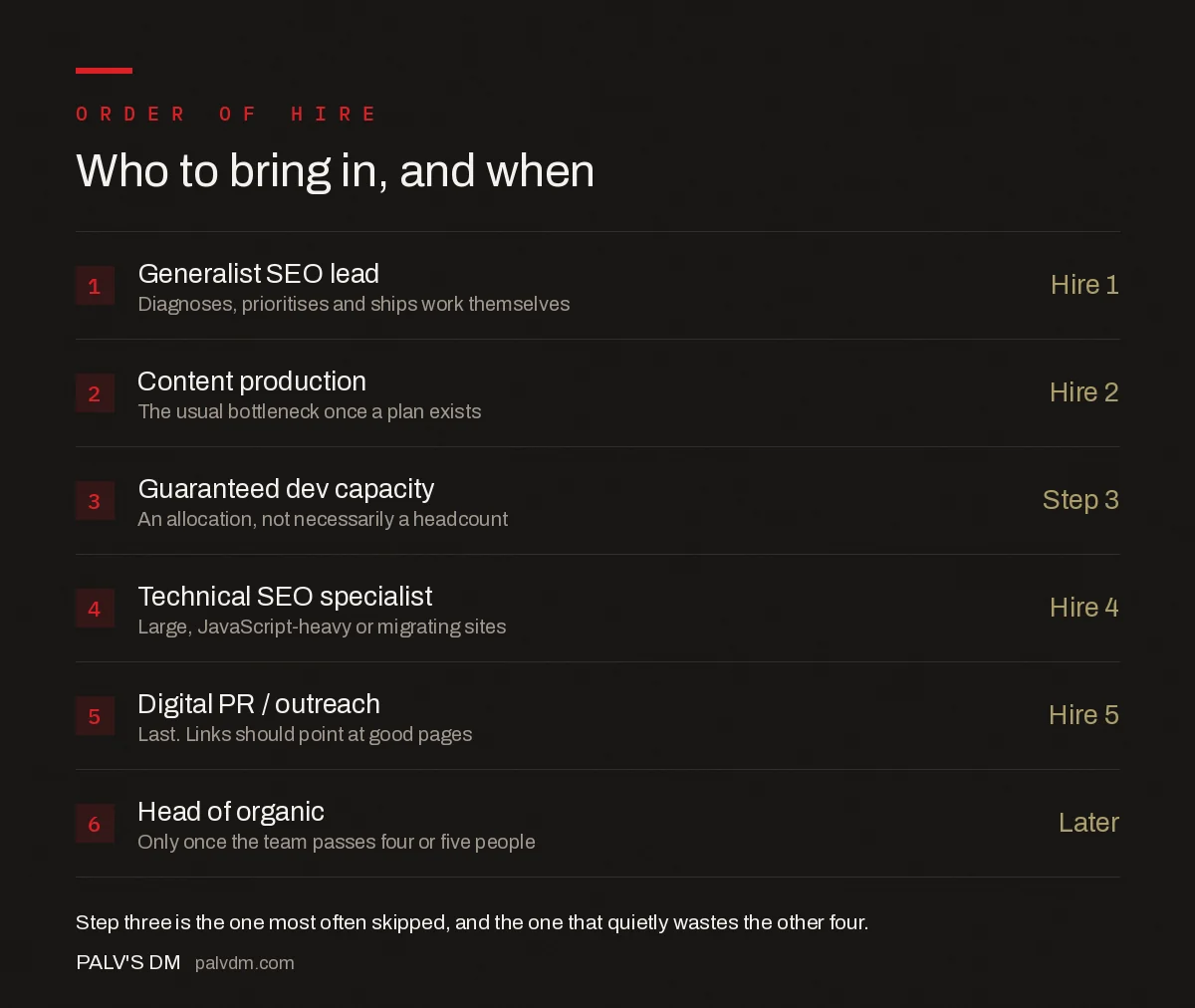
Who to bring in, and when
- Generalist SEO lead — Hire 1. Diagnoses, prioritises and ships work themselves.
- Content production — Hire 2. The usual bottleneck once a plan exists.
- Guaranteed dev capacity — Step 3. An allocation, not necessarily a headcount.
- Technical SEO specialist — Hire 4. Large, JavaScript-heavy or migrating sites.
- Digital PR / outreach — Hire 5. Last. Links should point at good pages.
- Head of organic — Later. Only once the team passes four or five people.
Frequently asked questions
Who should be the first in-house SEO hire?
A generalist who can diagnose, prioritise and ship work themselves. The first hire’s job is to work out what the plan should be and prove the channel, not to execute someone else’s plan. Diagnostic skill and prioritisation matter more than years of experience or specialism, because a specialist hired first tends to produce activity rather than results.
What roles make up an SEO team?
Six: an SEO lead or generalist who owns strategy and prioritisation, an SEO content writer, a technical SEO specialist, a digital PR or outreach function, an analytics role usually shared with wider marketing, and a head of organic once the team exceeds four or five people. In small companies one person holds several of these simultaneously.
How much does an in-house SEO team cost?
Benchmark it rather than trusting published ranges, which vary hugely by city and role scope and rarely state a methodology. Pull ten live listings for the same title in your city from comparable companies, discard postings that bundle three jobs into one, add employer costs and the tool stack, then compare the total against published agency or consultancy retainer prices.
When should a company not hire an in-house SEO?
When organic search is not a primary channel, when you cannot guarantee developer capacity to deploy their work, when the work is genuinely finite such as a single migration, when no manager internally understands the channel well enough to measure the role fairly, or before product-market fit, since organic search compounds over quarters and cannot fix positioning.
Should an in-house SEO team still use an agency?
Commonly yes, in a specific shape: in-house ownership with external specialism. The internal generalist holds the roadmap, relationships and product context, while external suppliers provide what is uneconomic to keep on payroll — deep technical audits, digital PR campaigns, surge content capacity, and a second opinion after a confirmed algorithm update.
What does an in-house SEO need to succeed?
Four things: company ownership of Search Console, analytics, the registrar and the CMS; a defined mandate to change pages without requesting permission for every title tag; written standard operating procedures so knowledge survives a departure; and KPIs agreed before the hire starts, because an SEO measured on rankings will optimise for rankings.
Sources
- Do you need an SEO? — Google Search Central
- SEO Starter Guide — Google Search Central
- Creating helpful, reliable, people-first content — Google Search Central
Want this done on your site?
Every PalV’s DM engagement starts with a free audit of your actual website — a 12-point
crawl covering what is blocking indexation, on-page gaps against your primary keywords, speed
findings, and the three to five fixes worth making first. Delivered in two working days. No
payment details, and the findings are yours whether you hire us or not.