First-Hand Experience: Showing It Without Faking It
Experience is the one thing you cannot research your way into. Five honest routes to getting it, how to capture it, and how to show it without overclaiming.
First-hand experience is the one component of content quality you cannot research your way into — either you did the thing, or you get it from someone who did. Google added Experience to E-A-T in December 2022, and its helpful content guidance asks directly whether content “demonstrate[s] first-hand expertise and a depth of knowledge (for example, expertise that comes from having actually used a product or service, or visiting a place)”. A writer who has only read about a subject can produce accurate content. What they cannot produce is the specific, unexpected, slightly inconvenient detail that only shows up when you have actually done it.
The uncomfortable part is that most content briefs do not have a plan for where experience will come from. They specify a keyword, a word count and a structure, then hand the work to somebody who has never performed the task. The result reads as competent and adds nothing, which is exactly the kind of content that has been losing ground since the helpful content system arrived.
What does Google actually mean by experience?
Experience is the newest letter in the E-E-A-T framework and the most concrete. Expertise is about formal knowledge; experience is about having been there. A person with no medical qualification can write with genuine authority about living with a condition, and Google’s rater guidelines explicitly recognise that kind of everyday, lived expertise as valuable for the right query.
Two things follow. First, experience is query-dependent: for a product review it means having used the product; for a how-to it means having performed the procedure; for a local guide it means having been to the place. Second, experience is not a score. There is no measurement, no lever and nothing to optimise. What exists is a description of what Google’s systems are attempting to reward, and content that visibly demonstrates having done the thing is a reasonable response to it.
Why can’t experience be written from research?
Because research produces the consensus version of a task, and the consensus version is missing everything that made the task difficult. Four absences give researched content away.
No failure modes. Researched instructions describe the happy path. Anyone who has actually done a migration knows which step breaks, what the error message says, and what you do when it appears at eleven at night.
No costs or durations. “It takes some time” instead of “the crawl of 40,000 URLs ran for about six hours”. Real numbers attach themselves to real work, and their absence is the fastest way to spot content written from a search results page.
No decisions or trade-offs. Doing something forces choices between imperfect options. Content that presents a single obvious path has usually never met the situation where the obvious path does not apply.
No texture. The interface that behaves oddly, the setting nobody documents, the client objection that comes up every time. These details cannot be inferred and are the clearest evidence of having been there. They are also, not coincidentally, the strongest form of information gain available to most writers.
How do you get first-hand experience when you do not have it?
Five routes, roughly in order of cost. All five are honest; simulating the experience is not one of them.
- Do the thing at small scale. You do not need a year of practice to write about a tool. Set it up, run it on one real project, record what happened. A single genuine attempt yields more usable detail than a week of reading.
- Interview someone who has. Twenty minutes with a practitioner produces quotes, numbers and failure stories that no amount of desk research will surface. How to get expert quotes covers finding and approaching them, and using expert quotes in content covers integration.
- Co-author or attribute. If a colleague did the work, put their name on it. Attribution to whoever actually has the experience is more credible than a byline for whoever happened to type.
- Mine the work you already do. Delivery generates experience continuously and almost nobody records it. Aggregated observations from real engagements are publishable — how to cite your own data covers doing it without breaching confidentiality.
- Run a deliberate test. The most expensive route and the most defensible. Design it, state the method, publish the result including the parts that did not work.
How do you capture experience while the work is happening?
Experience is perishable. Three months after a project, the specific detail that made the story worth telling has been smoothed over by memory. The fix is a capture habit rather than a writing habit.
- Screenshot as you go. Errors, dashboards, before-and-after states, settings screens. Original screenshots outperform stock imagery precisely because they are impossible to fake convincingly.
- Keep a dated decision log. One line per decision: what was chosen, what was rejected, and why. This is the raw material for every interesting paragraph you will ever write about the project.
- Write the “what surprised me” note at the end of each week. Surprise is a reliable marker of information that is not in the consensus version.
- Export the data before it rotates. Search Console holds 16 months. Rank tracking histories get archived. Export at the time, not when you need it.
- Record client questions verbatim. The phrasing people actually use is both a content idea and evidence you have spoken to real buyers.
How do you show experience on the page without overclaiming?
Precision protects you. State exactly what you did, when, and at what scale, and let the reader draw the conclusion.
“In four WordPress migrations we ran between March and July 2026, the redirect map was the step that consumed the most time” is a claim you can stand behind. “We are experts in WordPress migrations” is not checkable, and “migrations always fail at the redirect stage” is an overclaim from a sample of four. Scope every statement to what you observed, name the period, and give the sample size.
Where the experience is somebody else’s, say so and quote them by name. Where you have not done the thing at all, say that too — a sentence acknowledging that a section is drawn from documentation rather than practice costs nothing and protects everything else on the page. That kind of scoping is also what makes a published methodology believable rather than promotional.
What does faking experience cost?
More than fabricating most other things, because invented experience is unusually easy to detect. Practitioners spot it immediately — wrong terminology, a step in the wrong order, a screenshot from an interface version that never existed. Once a reader who knows the subject catches one fabricated detail, every other claim on the site becomes suspect.
There is also a category of fabrication that crosses into Google’s spam policies rather than merely being unwise: fake reviews, invented testimonials and content produced at scale without regard for quality. Inventing a personal anecdote to satisfy a brief is not usually a policy violation, but it destroys the asset you are supposedly building. Where AI drafting fails is largely a description of this gap — a language model can produce the shape of an anecdote without any of the specifics that make one credible.
Does first-hand experience help with AI citations?
Indirectly, through the properties that experience tends to produce. Peer-reviewed research on generative engine optimisation (Aggarwal et al., KDD 2024) found that adding statistics, quotations from named sources and citations to authoritative sources raised a source’s visibility in generative engine responses by up to around 40%. Content written from genuine experience naturally contains more of exactly those elements: real numbers, named people, dated observations.
There is a second-order effect worth noting. Generative engines are trained on and retrieve from the open web, which means the consensus version of any topic is already thoroughly represented. A page that only restates it has nothing distinctive to contribute to an answer. A page carrying an observation that exists nowhere else is the only candidate when that specific point comes up, which is the argument running through SEO in the age of AI search.
How to build this into a content process
Add one line to your content brief template: where is the experience coming from? If the honest answer is “nowhere”, either arrange an interview, assign it to someone who has done the work, or narrow the topic to something the writer genuinely knows. Briefing freelance writers properly means telling them what evidence to gather, not just which keyword to target.
The rest is a capture habit maintained by the people doing the work, and a bias in editing towards specificity — every time a draft says “some”, “often” or “significantly”, ask what the actual number was. Demonstrating experience on the page itself is the downstream half of this; without the capture habit there is nothing to demonstrate.
Where a topic genuinely sits outside anyone’s experience in the business, the reviewer model is the honest fallback: a named practitioner reads the draft before publication and is credited for doing so. A line reading “reviewed by [named person], who has run this process on live sites since 2021”, linked to an author page carrying their credentials, is a truthful claim about who stands behind the content. It is weaker than having done the work yourself and considerably stronger than a byline nobody can question.
None of this requires more writing time. It requires deciding, at brief stage, whose experience the article is drawing on — and being willing to change the topic when the answer is nobody’s.
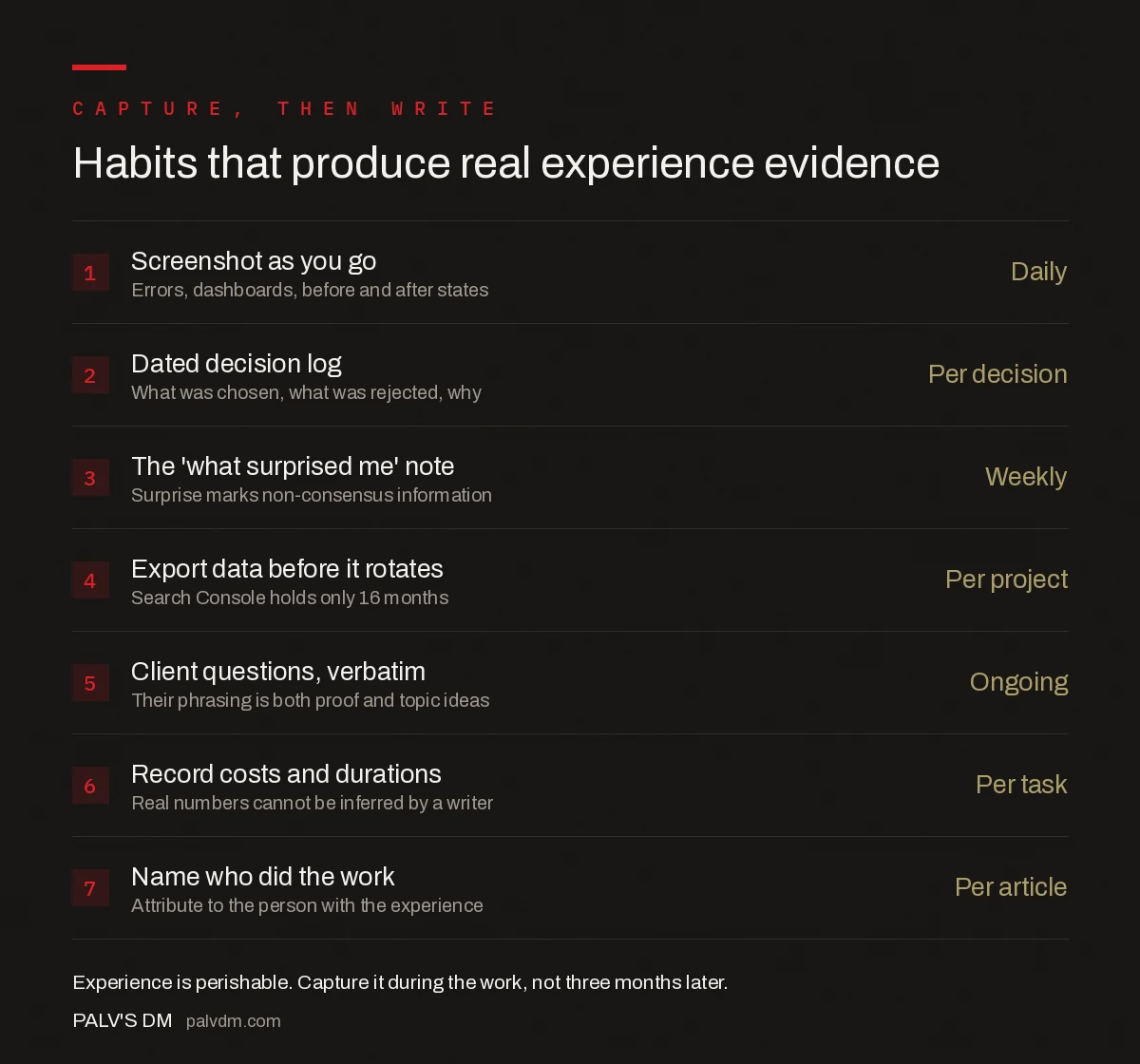
Habits that produce real experience evidence
- Screenshot as you go — Daily. Errors, dashboards, before and after states.
- Dated decision log — Per decision. What was chosen, what was rejected, why.
- The ‘what surprised me’ note — Weekly. Surprise marks non-consensus information.
- Export data before it rotates — Per project. Search Console holds only 16 months.
- Client questions, verbatim — Ongoing. Their phrasing is both proof and topic ideas.
- Record costs and durations — Per task. Real numbers cannot be inferred by a writer.
- Name who did the work — Per article. Attribute to the person with the experience.
Frequently asked questions
What does first-hand experience mean in E-E-A-T?
Experience is the E that Google added to E-A-T in December 2022. It means having personally done the thing the content describes — used the product, performed the procedure, visited the place, lived through the situation. It is distinct from expertise, which is about formal knowledge. Google’s helpful content guidance asks explicitly whether content demonstrates first-hand expertise and depth of knowledge.
How can you write about something you have not personally done?
Honestly, through five routes: do it once at small scale and record what happened, interview a practitioner and quote them by name, attribute or co-author with the person who did the work, publish aggregated observations from work your business already delivers, or run a deliberate test with a stated method. Simulating the experience is not one of the options.
How do you tell if content was written from research rather than experience?
Four absences give it away: no failure modes, only the happy path; no real costs or durations; no trade-offs between imperfect options; and no texture such as the setting nobody documents or the error message that appears at the worst moment. Researched content describes the consensus version of a task, which is missing everything that made the task difficult.
Is it against Google's guidelines to invent a personal anecdote?
Inventing an anecdote is not usually a direct spam policy violation, though fake reviews, fabricated testimonials and mass-produced content without regard for quality are covered by Google’s spam policies. The practical cost is reputational: practitioners detect fabricated experience quickly through wrong terminology or impossible details, and one caught fabrication makes every other claim on the site suspect.
How do you record experience so it is usable later?
Capture during the work, not afterwards. Screenshot errors, dashboards and before-and-after states; keep a dated log of decisions taken and rejected; write a short weekly note on what surprised you; export data before tools rotate it out; and record client questions in their exact wording. Three months later the specific details that made a story worth telling have already faded.
Does first-hand experience help with AI search visibility?
Indirectly. Content written from genuine experience contains more real numbers, named people and dated observations, and the KDD 2024 GEO study found that statistics, named quotations and citations to authoritative sources lifted visibility in generative answers by up to around 40%. Experience-based observations are also the only material an engine cannot already find in the consensus version of a topic.
Sources
- Creating helpful, reliable, people-first content — Google Search Central — asks whether content demonstrates first-hand expertise
- Google Search Quality Rater Guidelines — Experience added to E-A-T in December 2022
- Google Search spam policies
- GEO: Generative Engine Optimization (Aggarwal et al., KDD 2024)
Want this done on your site?
Every PalV’s DM engagement starts with a free audit of your actual website — a 12-point
crawl covering what is blocking indexation, on-page gaps against your primary keywords, speed
findings, and the three to five fixes worth making first. Delivered in two working days. No
payment details, and the findings are yours whether you hire us or not.