
Why Core Updates Roll Out in Stages
Google core updates roll out over days or weeks and Google has never explained the mechanism. What is documented, what is inference, and what to do meanwhile.

Google core updates roll out over days or weeks rather than switching on at once, and Google has never published the mechanism. What Google has documented is that a rollout takes time, that rankings fluctuate while it runs, and — in one case, the February 2026 Discover core update — that the update launched in a single country and language with expansion promised later. Everything else you will read about data centres, traffic percentages and test-then-revert cycles is inference, not Google statement.
The undocumented mechanism matters less than the documented consequence. A staged rollout means your ranking data during the rollout is a snapshot of an unfinished process, and treating it as a result is the most common and most expensive error in core update response.
Why does a core update take days rather than minutes?
A core update changes how Google’s ranking systems assess content across the entire index, which is billions of documents. Reassessment is not instantaneous and Google’s own notices treat it as a process with a duration: every core update entry on the Search Status Dashboard carries a start timestamp, a completion timestamp and language such as “the rollout may take up to 2 weeks to complete.”
That is the extent of what Google confirms about timing. It does not say what is being staged — whether by index segment, by query type, by geography, by traffic share, or by something with no public name at all. Anyone who tells you which one it is has not read a Google source, because no Google source says.
What has Google actually said about staged rollouts?
Three statements are on the record, and it is worth being precise about what each one covers.
- Rollouts have a duration and an estimate. Google’s launch notices state a ceiling — “up to 2 weeks”, or “up to 3 weeks” for the December 2025 core update. It is a ceiling, not a schedule, and Google has exceeded it.
- Rankings fluctuate during a rollout. Google’s core update guidance tells site owners that positions may move while an update is running and to wait until it is marked complete before assessing impact.
- At least one core update staged by geography and language. Google released the February 2026 Discover core update to English-language users in the US, stating it would expand to all countries and languages in the months ahead. That is the clearest documented example of an axis along which a core rollout can be staged.
The Discover case is the only one where Google named the staging dimension. It has not said whether Search core updates stage the same way, and it would be wrong to assume they do.
What does a staged rollout look like from the outside?
It looks like bursts, not a ramp. The May 2026 core update is the best-documented recent example. Google announced it on the afternoon of Thursday 21 May 2026. Large movement was felt by Saturday 23 May. Further large movements landed on Saturday 30 May, more than a week later. There was additional volatility in the final twenty-four hours before Google marked the rollout complete on 2 June.
Three separate movement events inside one twelve-day window. A site that dropped in the first burst and recovered in the third would have shown three different “results” to anyone checking, and only the last one was the outcome.
The February 2026 Discover core update shows the other failure mode: overrun. Google estimated up to two weeks and the rollout ran 21 days and 17 hours, finishing on 27 February. Publishers who assessed at the two-week mark were assessing a rollout with a week still to run.
Why does mid-rollout data mislead you?
Because a mid-rollout position is not a decision, it is a state in transit. Three specific distortions follow.
- Partial reassessment reads as a verdict. If part of the index has been reassessed and part has not, your position reflects a mixed comparison set. That number is not what you will end up with.
- Averaged reporting blends two regimes. Any comparison window that straddles the rollout mixes pre-update and mid-update data into a single average, which describes neither. Choosing the comparison window correctly is the fix, and it means both windows sitting entirely outside the rollout dates.
- Your own changes become unattributable. Ship a template change on day four of a rollout and you have permanently lost the ability to know which of the two moved your traffic. This is the real cost, and it lasts long after the update is forgotten.
What should you do while a core update is rolling out?
The sequence below is deliberately unexciting. Staged rollouts reward patience and punish reaction, and there is no version of this that produces a faster recovery.
- Log the start timestamp and the incident ID on day one. Take them from the Search Status Dashboard in Pacific time and convert them to your reporting timezone. This is the boundary every later comparison depends on.
- Freeze large structural changes, not all work. Continue publishing and continue committed fixes. Postpone redesigns, migrations, URL changes and mass content pruning until after the completion notice.
- Record what you observe without acting on it. Note the dates of visible movement. In May 2026 those were 23 May, 30 May and the final day — useful evidence later, useless as a basis for action at the time.
- Wait for the completion notice, then wait about another week. Positions continued moving in the last twenty-four hours of the May 2026 rollout. Settling is not instant.
- Then analyse properly. Compare equal-length windows outside the rollout, split positions from impressions from clicks, and separate Discover and News from Search. Confirming update impact properly covers the full method.
- Rule out your own deployments before blaming Google. Establishing whether it was an update or you resolves a large share of drops that get attributed to core updates.
If the analysis shows genuine damage, the response is the 30-day recovery plan rather than emergency edits, and the payoff normally arrives with a subsequent core update rather than between them. That is Google’s own standing guidance, not an agency’s excuse.
What can nobody tell you about rollout staging?
A large amount of confident-sounding commentary exists on this topic and almost none of it is sourced. The following claims are not supported by any Google statement:
- That rollouts propagate data centre by data centre. This was a plausible model in an older Google architecture. It is not something Google has said about modern core updates.
- That Google rolls out to a percentage of queries and increases it. No published figure exists for any core update.
- That Google tests, reverts and re-applies during a rollout. Multiple movement bursts are consistent with several explanations, and Google has confirmed none of them.
- That a short rollout means a small update, or a long one means a large one. The 45-day March 2024 core update and the 6-day December 2024 core update were both broad reassessments of the same kind. The full rollout-duration record shows no relationship between length and impact.
- That you can predict the end date from the pattern. Google’s own estimates have missed in both directions.
Saying “Google has not explained this” is a better answer than a confident wrong one, and it is the answer that protects a client relationship when the prediction fails. Explaining an update to a client is far easier when you never promised a mechanism you could not evidence.
Does staged rollout change how you should think about recovery?
Only in one respect: it moves the assessment date, not the work. A staged rollout means the honest earliest point at which you can judge impact is roughly a week after Google’s completion notice, not the day movement first appears.
Everything after that is the ordinary core update response. Identify the URLs and query clusters that lost, compare them against the pages that gained, and close the gap in substance. What a core update actually is covers why there is no violation to undo, and the 2026 update timeline gives you the confirmed dates to anchor every comparison against.
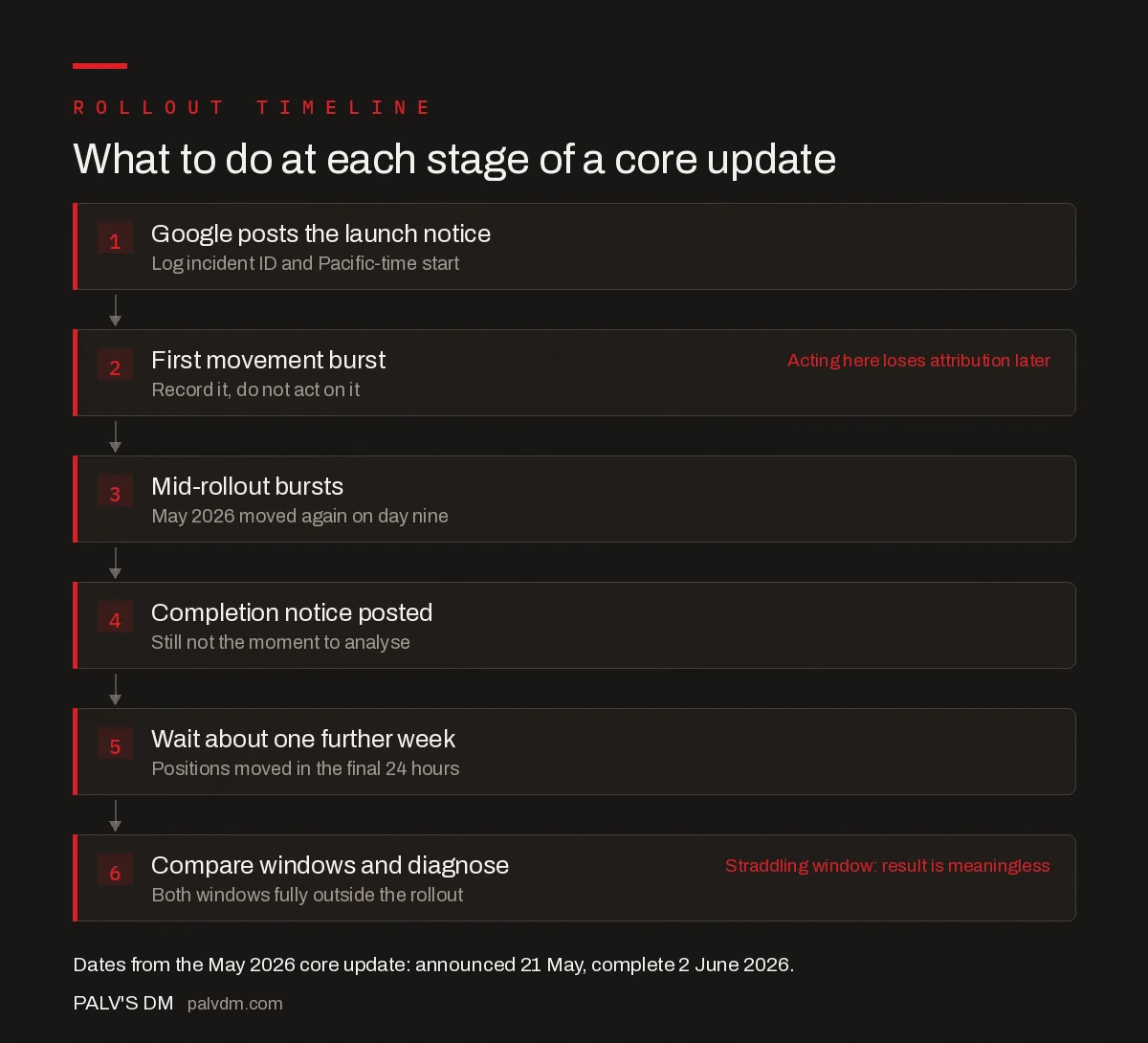
What to do at each stage of a core update
- Google posts the launch notice. Log incident ID and Pacific-time start.
- First movement burst. Record it, do not act on it. Acting here loses attribution later
- Mid-rollout bursts. May 2026 moved again on day nine.
- Completion notice posted. Still not the moment to analyse.
- Wait about one further week. Positions moved in the final 24 hours.
- Compare windows and diagnose. Both windows fully outside the rollout. Straddling window: result is meaningless
Frequently asked questions
Why do Google core updates roll out over several weeks?
Google has never published the mechanism. What Google confirms is that a rollout takes time, that its launch notices state an estimated ceiling such as up to two weeks, and that rankings fluctuate while the rollout is running. Core updates reassess ranking across the entire index, which Google treats as a process with a start and completion timestamp rather than a switch.
Does Google roll out core updates by country?
In at least one documented case, yes. Google released the February 2026 Discover core update to English-language users in the US only, stating it would expand to all countries and languages in the months ahead. That is the clearest published example of a core rollout staged by geography and language. Google has not said whether Search core updates stage the same way.
Should I wait for a core update to finish before making changes?
Wait before making large structural changes such as redesigns, migrations, URL changes or mass content pruning. Continue publishing and continue committed fixes. The reason is attribution rather than punishment: shipping a big change mid-rollout permanently removes your ability to tell whether the update or your change moved the traffic.
Why did my rankings move several times during one core update?
Multiple movement bursts inside a single rollout are normal. During the May 2026 core update, large movement was felt on 23 May, again on 30 May, and again in the final twenty-four hours before Google marked it complete on 2 June. Google has not explained why bursts occur, so any specific mechanism you read is inference.
When can I judge the impact of a core update?
Roughly a week after Google posts the completion notice on the Search Status Dashboard. Positions continued moving in the final day of the May 2026 rollout, so settling is not immediate. Compare equal-length periods that both sit fully outside the rollout window, and split positions, impressions and clicks rather than averaging them.
Does a short rollout mean a small update?
No. Rollout length shows no relationship to impact. The March 2024 core update ran 45 days and the December 2024 core update ran 6 days and 4 hours, and both were broad reassessments of the same kind. Google has never explained why duration varies, so treat rollout length as a measurement rather than a signal.
Sources
- Google core updates and your website — Search Central
- February 2026 Discover core update — Search Central blog
- Google Search Status Dashboard — Ranking incident history
- Performance report (Search results) — Search Console Help
Want this done on your site?
Every PalV’s DM engagement starts with a free audit of your actual website — a 12-point
crawl covering what is blocking indexation, on-page gaps against your primary keywords, speed
findings, and the three to five fixes worth making first. Delivered in two working days. No
payment details, and the findings are yours whether you hire us or not.