AI Writing Tools: Where They Help and Where They Wreck Quality
AI writing tools speed up drafting and structure but can't supply real data or first-hand experience. Here's the honest split, with a workable process.
AI writing tools genuinely help with speed, structure, and first-draft momentum, but they can’t supply first-hand experience, real data, or a defensible opinion — and content that skips those things reads as generic and struggles to rank or get cited. The useful split isn’t “AI content good” or “AI content bad.” It’s which parts of the writing process AI handles well (outlining, drafting boilerplate sections, summarising research you provide) and which parts still need a human doing something AI structurally cannot do.
Published August 2026 — SEO team at PalV’s DM.
What do AI writing tools actually do well?
They’re fast at structure and synthesis. Given a clear brief, a good outline, and source material, AI tools can turn a two-day writing task into a same-day one, mostly by handling the first-draft scaffolding — headings, transitions, a rough pass at each section — that a human writer would otherwise spend hours building from scratch. That compounds meaningfully across a large content calendar where consistency and turnaround matter as much as any single piece.
- Outlining and structure — turning a brief into a logical H2/H3 skeleton in minutes.
- First-draft momentum — getting past a blank page, especially for boilerplate sections like a standard FAQ or a straightforward how-to step.
- Summarising source material you provide — condensing a long report or transcript into usable bullet points.
- Formatting consistency — matching heading style, tone markers, and length across a large batch of similar posts.
- Meta descriptions and title variants — generating options fast for a human to pick from and edit.
Where does AI-generated content actually wreck quality?
Anywhere the content needs to say something only a real person, doing real work, could know. AI models generate the statistically likely next words based on training data; they don’t have first-hand experience of your business, your clients, or last week’s Google update, and they will confidently produce plausible-sounding claims that aren’t true if you don’t check them.
| Where it breaks down | Why |
|---|---|
| Specific statistics and numbers | Models can fabricate plausible-sounding stats with no real source; every number needs manual verification |
| First-hand experience claims | An AI tool has never actually run a campaign or used a tool; anything phrased as “we found” or “in our testing” is false unless a human actually did it |
| Genuinely novel opinions | Models tend toward the median, hedge-everything view rather than a real, defensible position |
| Current events and recent changes | Training cutoffs mean models can be confidently wrong about anything recent unless given current source material |
| Nuanced, industry-specific context | Generic phrasing that could apply to any business in any country tends to replace specific, local detail |
Does Google penalise AI-written content?
No, not for how it was produced. Google’s official spam policy documentation is explicit that content is evaluated on quality and helpfulness, not on the production method — the policy Google previously called “automatically generated content” was updated to “scaled content abuse” specifically to clarify that the concern is volume and manipulation intent, not whether AI was involved. A single well-edited AI-assisted post is treated the same as a single well-edited human-written post. The risk is publishing large volumes of unedited, low-value AI output purely to occupy keyword real estate, which falls under scaled content abuse regardless of whether a human or a tool generated it.
What’s a workable process for using AI tools without wrecking content quality?
- Brief first, generate second. Feed the tool a real outline, real source material, and your actual angle — don’t just prompt “write a blog post about X” and publish what comes back.
- Add the human-only ingredients before editing for style. Insert real data, a genuine quote, and any first-hand detail before you polish the prose — polishing generic text first wastes effort on content that still needs to change.
- Fact-check every number and claim manually. Treat every statistic in an AI draft as unverified until you’ve traced it to a real source.
- Run a humanising edit. Cut AI-typical phrasing, vary sentence length, and make sure the piece reads like one person wrote it with an actual point of view.
- Have a named person take ownership of the final piece. Someone should be able to defend every claim in it if asked.
How much of a content calendar can realistically use AI assistance?
Most of the first-draft structure, very little of the final substance. Teams commonly use AI tools for outlines, research summaries, and rough drafts across nearly their whole calendar, but the posts that actually rank and get cited well are the ones where a human added something specific after that first draft — a number from your own data, a client detail, an opinion you’d stand behind in a client meeting. Skipping that step is where the quality damage happens, not the act of using an AI tool in the first place.
If your team is publishing a high volume of AI-assisted content and rankings or AI citations aren’t showing up, the likely cause isn’t that you used AI — it’s that nothing was added after the draft that a competitor’s AI tool couldn’t have produced too. Our content writing service uses AI tools for exactly the parts they’re good at and puts a human editor in charge of the parts that require real judgment, real data, and a real point of view.
What does this look like for a small in-house marketing team, practically?
Most small teams don’t need a formal AI policy document; they need one rule enforced consistently: nothing publishes without a named person having added at least one thing the AI draft didn’t already contain. That could be a client example, a number pulled from the team’s own dashboard, or a genuine opinion about which approach the team actually recommends and why. The rule is simple enough to check in a five-minute review before a post goes live, and it catches the majority of the quality problems that come from treating an AI draft as a finished product.
Teams that skip this step tend to notice the damage slowly rather than all at once. Individual posts don’t fail dramatically; they just underperform quietly, get thin engagement, and rarely earn the kind of backlinks or AI citations that a more substantive competitor post picks up instead. By the time it’s obvious in the traffic numbers, months of publishing volume have gone into content that needed one more editing step it never got.
Assign the check to a specific person, not “the team” collectively. Shared responsibility for a quality gate tends to mean nobody actually owns it, and the check quietly stops happening once deadlines get tight. A single named editor, even part-time, who signs off on the “did we add something real” question before anything publishes is a small structural change that prevents most of the slow quality drift AI-assisted content is prone to.
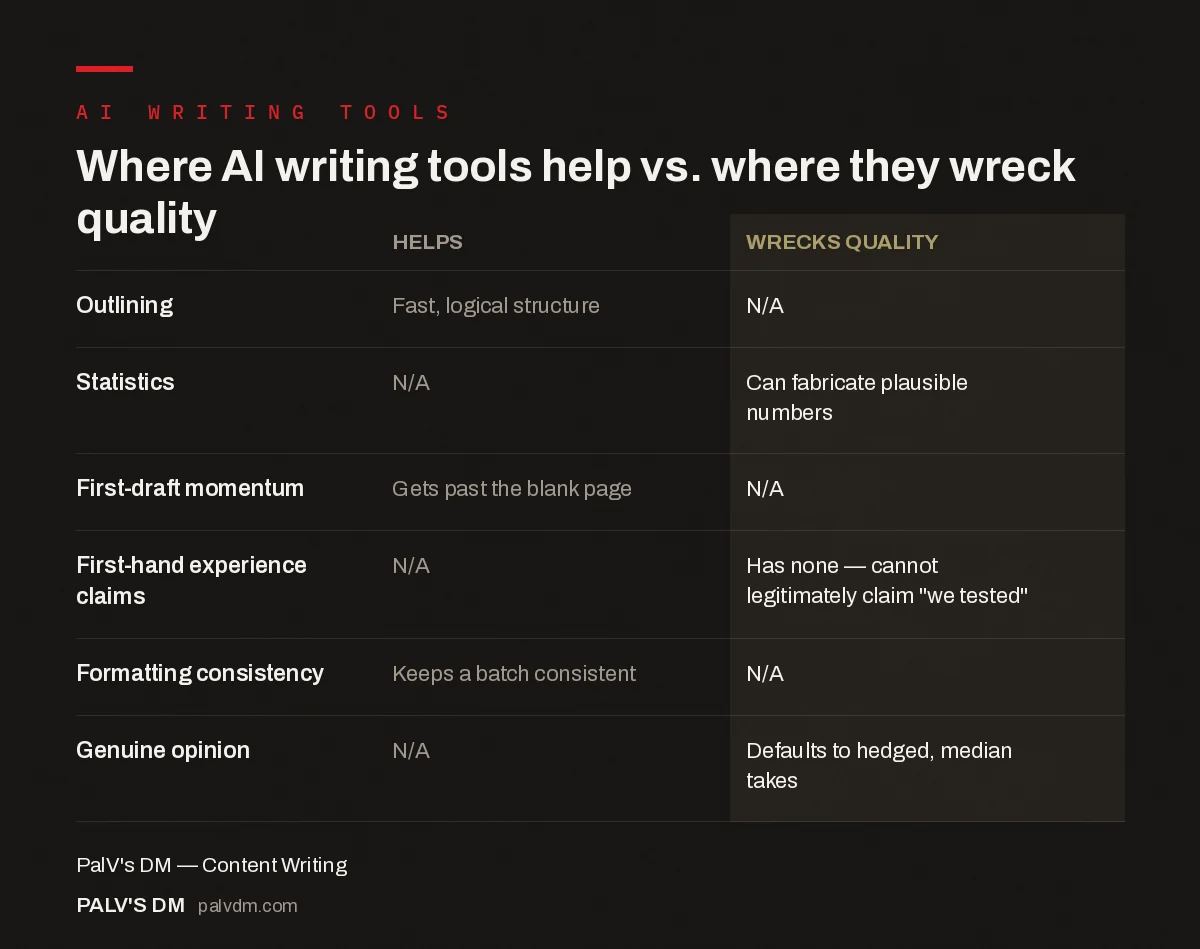
Where AI writing tools help vs. where they wreck quality
| Helps | Wrecks quality | |
|---|---|---|
| Outlining | Fast, logical structure | N/A |
| Statistics | N/A | Can fabricate plausible numbers |
| First-draft momentum | Gets past the blank page | N/A |
| First-hand experience claims | N/A | Has none — cannot legitimately claim “we tested” |
| Formatting consistency | Keeps a batch consistent | N/A |
| Genuine opinion | N/A | Defaults to hedged, median takes |
Related reading on AI content and quality
This post is part of our content strategy guide cluster on AI writing and humanising. If you’re building a process around AI drafts, pair this with how to humanise AI-written copy for the practical editing checklist, and is AI-generated content against Google’s guidelines if you want the policy detail behind the “no penalty for method” claim above. For the specific vocabulary to strip out during editing, see the banned phrase list we edit out of every draft. And if information gain is the real underlying problem, information gain: saying something the top 10 didn’t covers why generic AI output struggles to rank regardless of how it was produced.
FAQ
Can Google detect AI-written content and rank it lower automatically?
There’s no confirmed classifier that detects “AI-written” and demotes it purely for that reason. Google’s stated policy evaluates helpfulness and quality signals, not production method, and public AI-detection tools are separately known to be unreliable at scale.
Is it safe to publish AI drafts with only a light edit?
It’s risky for both quality and accuracy. A light edit rarely catches fabricated statistics or generic claims that need a real source, and generic content struggles to rank or get cited even if it’s technically accurate.
Do AI writing tools help more with short-form or long-form content?
They tend to help most with structure on longer pieces — outlines, section drafts, formatting consistency — where the scaffolding work is substantial. Short-form content like social captions needs less structural help and more of a distinct voice, which is harder for a generic tool to nail without heavy editing.
What’s the biggest mistake teams make when adopting AI writing tools?
Treating the AI draft as the finished product instead of the starting point. The tools are strong at getting to a rough draft fast; they’re weak at everything that makes a piece worth reading once that draft exists.
Should every AI-assisted post disclose that AI was used?
There’s no universal requirement to disclose AI assistance in the writing process for standard blog content, though some publications choose to for transparency. What matters more for both readers and search systems is accuracy and genuine value, not a disclosure label.