How Much Should a Business Website Cost in India?
Realistic 2026 price bands for business websites in India, what drives the cost up or down, and the questions to ask before accepting a quote.
A professionally built, mobile-responsive, SEO-ready business website in India realistically costs between Rs 80,000 and Rs 2,00,000 in 2026. Below that range you’re usually buying a templated site with minimal customisation. Above it, you’re paying for custom design work, more pages, or functionality beyond a standard brochure site, like booking systems or payment integration.
The honest answer to “how much should a website cost” is “it depends on what you’re actually asking for,” which is unsatisfying but true. The more useful question is what specifically drives the number up or down, so you can tell whether a quote of Rs 25,000 or Rs 4,00,000 is reasonable for what you need, not just cheap or expensive in the abstract.
What does a website actually cost by project type?
These bands come from current market pricing across Indian agencies and freelancers, not a single source, so treat them as ranges to sanity-check a quote against, not exact numbers to expect.
| Website type | Typical range (INR) | What’s usually included |
|---|---|---|
| Basic static site | Rs 15,000 – Rs 40,000 | Template-based, 3-5 pages, minimal customisation |
| Standard business site | Rs 80,000 – Rs 2,00,000 | Custom design, 5-10 pages, mobile-responsive, basic SEO setup |
| Ecommerce (WooCommerce) | Rs 25,000 – Rs 15,00,000+ | Ranges from a basic store on an existing theme to a fully custom build with inventory sync |
| Custom web application | Rs 5,00,000+ | Custom features, integrations, or functionality beyond standard CMS capability |
Why do two agencies quote such different prices for the same brief?
Because “a website” isn’t a standardised product the way a laptop or a car is. Two agencies can look at the same one-paragraph brief and produce wildly different quotes because they’re each assuming a different scope: one assumes a template with your logo dropped in, the other assumes custom design, copywriting support, and three rounds of revisions. Neither is lying. They’re answering different questions with the same price tag.
Indian development rates also blend far more widely than in the US or UK: agencies here typically charge somewhere in the $25 to $60 an hour range blended across a team, against $80 to $180 an hour for comparable teams in the US. That gap alone explains a lot of the “why is this agency in Mumbai cheaper than the one in Chicago quoting the exact same scope” confusion business owners run into when shopping internationally.
What actually drives the cost up or down?
Ignore the marketing language on an agency’s pricing page and check for these instead.
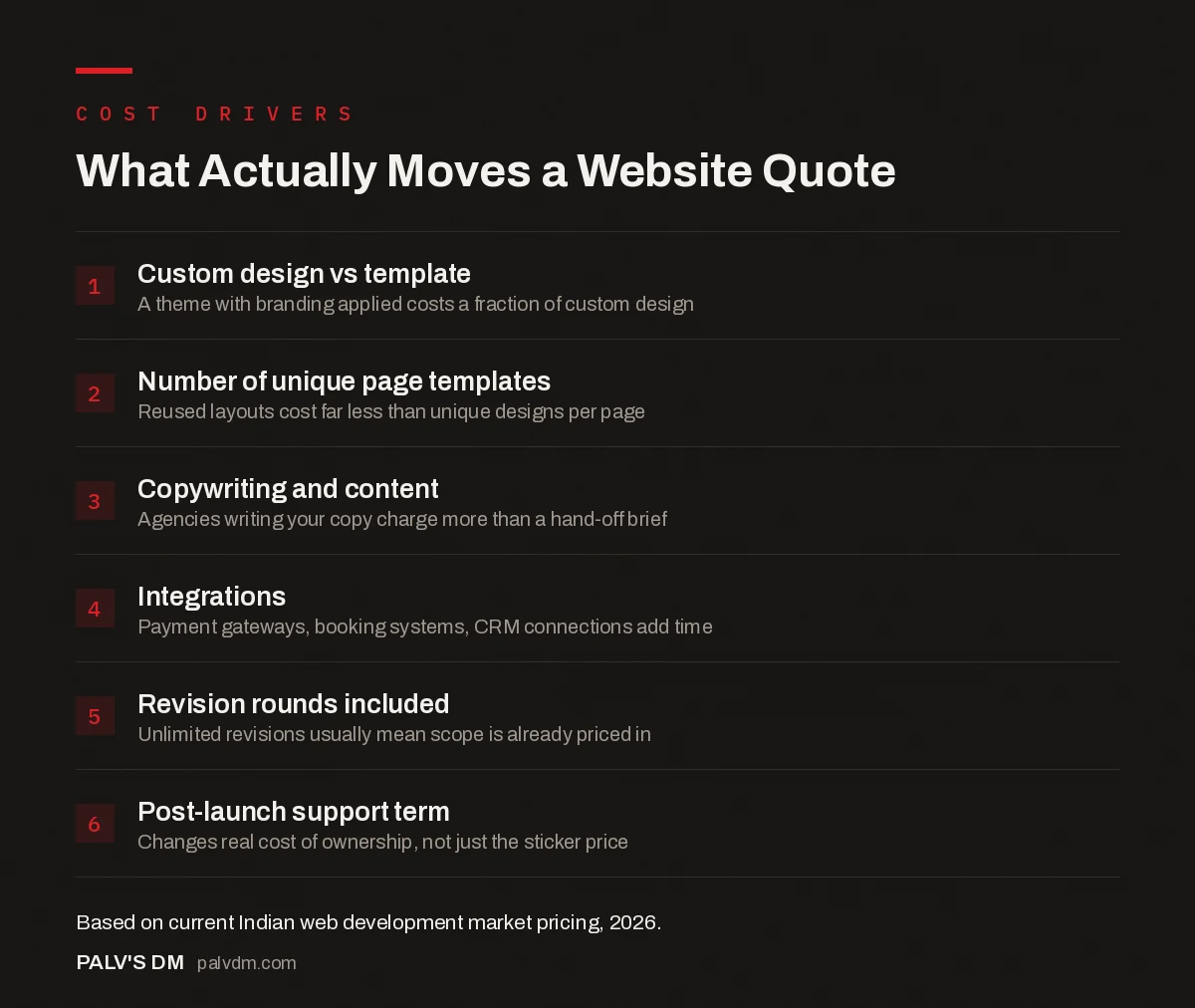
What Actually Moves a Website Quote
- Custom design vs template. A theme with your branding applied costs a fraction of a from-scratch design process.
- Number of unique page templates. Ten pages using the same three layouts costs far less than ten pages that are all uniquely designed.
- Copywriting and content. Agencies that write your copy for you charge more than ones that expect you to hand over finished text.
- Integrations. Payment gateways, booking systems, CRM connections and custom forms all add development time.
- Revision rounds included. Unlimited revisions sound generous but usually mean the price already accounts for scope creep.
- Post-launch support term. Three months of included support versus none changes the real cost of ownership, not just the sticker price.
Should you go with a freelancer, a small agency, or a large firm?
Each has a real trade-off, not just a price difference. Freelancers typically offer the lowest cost and the most direct communication, but continuity risk is real: if that one person gets busy, gets sick, or moves on, you may be left with no documentation and no one who understands your setup. Small agencies sit in the middle, usually two to eight people, with more redundancy than a solo freelancer but still personal enough that you’re not lost in a account-manager hierarchy. Larger firms bring process and specialization (dedicated designers, developers, project managers) at a price that reflects all those salaries, which makes sense for complex builds and can be overkill for a five-page brochure site.
We’ve watched businesses overpay a large agency for a simple site that a competent freelancer could have delivered for a third of the cost, and we’ve watched businesses underpay a freelancer for a complex ecommerce build that then broke in ways nobody could fix quickly. Match the provider size to the actual complexity of what you’re building, not to what feels “safe” or “cheap.”
How do you vet a developer or agency before paying?
Before signing anything, confirm who will own the domain, hosting account and analytics after launch, ask to see three live sites they’ve actually built (not mockups), and get the post-launch support term in writing. We go deeper on this in our guide to vetting a web development agency, which covers the specific questions that surface whether a provider is set up to hand you a site you actually control.
Fixed price or hourly: which protects you better?
Fixed price protects your budget when the scope is genuinely well defined before work starts. You know the number, and it doesn’t move unless you ask for something new. Hourly protects you from paying for a rigid scope when requirements are likely to shift, which is common on more complex builds where nobody fully knows the shape of the project on day one. For a first business website with a clear brief (pages, features, rough content plan), fixed price is usually the lower-risk choice for an owner who isn’t managing developers day to day and wants a number they can budget against.
What are the red flags in a suspiciously cheap quote?
A Rs 10,000 quote for a “complete business website” almost always means one of a few things: a recycled template with your logo swapped in and nothing else changed, stock images pulled without a license check, or content the freelancer wrote themselves in ten minutes without ever asking about your business. None of that is illegal, but none of it does what a business owner actually needs a website to do, which is convert visitors into leads or sales.
Watch for quotes that don’t mention who owns the domain and hosting after launch. This sounds like a legal formality until the developer disappears and you discover the domain is registered in their name, not yours. It’s a genuinely common problem, common enough that we wrote a full guide on the five accounts you must have in your own name before any developer touches your site. Also watch for “free” ongoing maintenance in a suspiciously cheap quote. Someone is paying for that time somewhere, and it’s usually recovered through upsells, ad revenue you don’t see, or corners cut on security updates.
What happens after the site launches?
The build cost is rarely the full cost of ownership. Domain renewal, hosting, plugin licenses, and periodic maintenance or content updates continue after launch, and a clean handover matters more than most business owners realize until they need to switch providers. Our guide to spotting platform lock-in before you sign covers how some providers structure contracts to make leaving expensive, regardless of how reasonable the original build quote looked.
Frequently asked questions
What is a realistic budget for a small business website in India?
For a professionally built, mobile-responsive, SEO-ready business website with five to ten pages, a realistic range is roughly Rs 80,000 to Rs 2,00,000. Below that, you’re usually paying for a template site with limited customisation. Above it, you’re paying for custom design, more pages, or added functionality.
Why do website quotes vary so much between agencies?
Because “a website” isn’t a fixed product. A five-page template build and a custom-designed site with a booking system, payment integration and a content team behind it are both called “a website” but cost entirely different amounts. Quotes vary because scope, not the word “website,” drives price.
Is a cheap website from a freelancer a bad idea?
Not automatically. Freelancers can deliver good work at lower overhead than an agency. The risk is continuity: if that one person becomes unavailable, you may have no documentation, no handover, and no one who understands the setup. Ask about backup support and get account ownership in writing regardless of who builds it.
How much does an ecommerce website cost in India?
Ecommerce sites in India typically range from roughly Rs 25,000 for a basic WooCommerce setup on an existing theme to Rs 15,00,000 or more for a custom-built storefront with inventory integration, custom checkout flows and a larger product catalog.
Should I pay a fixed price or hourly for a website?
Fixed price protects your budget if scope is well defined upfront. Hourly protects you from paying for work you didn’t need if scope is likely to change. For a first website with a clear brief, fixed price is usually the safer choice for a business owner who isn’t managing developers day to day.
Sources
- Website Development Costs and Prices in India, Aalpha
- Website Development Cost in India, FODUU
- WordPress SEO: The Complete Configuration Guide
- How to Vet a Web Development Agency
- Website Platform Lock-In: How to Spot It Before You Sign
- What to Get in a Website Handover From Your Developer
Want this done on your site?
Every PalV’s DM engagement starts with a free audit of your actual website — a 12-point
crawl covering what is blocking indexation, on-page gaps against your primary keywords, speed
findings, and the three to five fixes worth making first. Delivered in two working days. No
payment details, and the findings are yours whether you hire us or not.
Get your free SEO audit
See Web Development plans and prices