Trends & Industry Developments
The Collapsing Overlap Between Ranking #1 and Being Cited
AI citation overlap ranking is shrinking: ranking #1 no longer predicts which page AI Overviews and AI Mode actually cite. Here's the pattern and fix.
Ranking #1 used to be the finish line. Now it is just one input, and a weakening one at that. When we pull citation logs from AI Overviews and AI Mode alongside classic organic rankings for the same query sets, the ai citation overlap ranking pattern is consistent: the page that wins position one in blue-link search is less and less likely to be the page an AI engine actually quotes. Sometimes it is the page ranked fourth. Sometimes it is a page that does not appear on page one at all. The overlap is not gone, but it is shrinking, and the reason is that ranking and citation are now answering two different questions.
Key takeaway
- Ranking #1 in organic results no longer reliably predicts which page an AI engine cites in its answer — in the accounts we audit, the cited page is frequently ranked lower on the page.
- Classic ranking rewards authority and link signals; citation rewards extractable, self-contained answer passages that an LLM can lift cleanly.
- Treating “rank #1” and “get cited” as the same goal means optimising for one and quietly losing the other — they need separate tracking and, often, separate page structure.
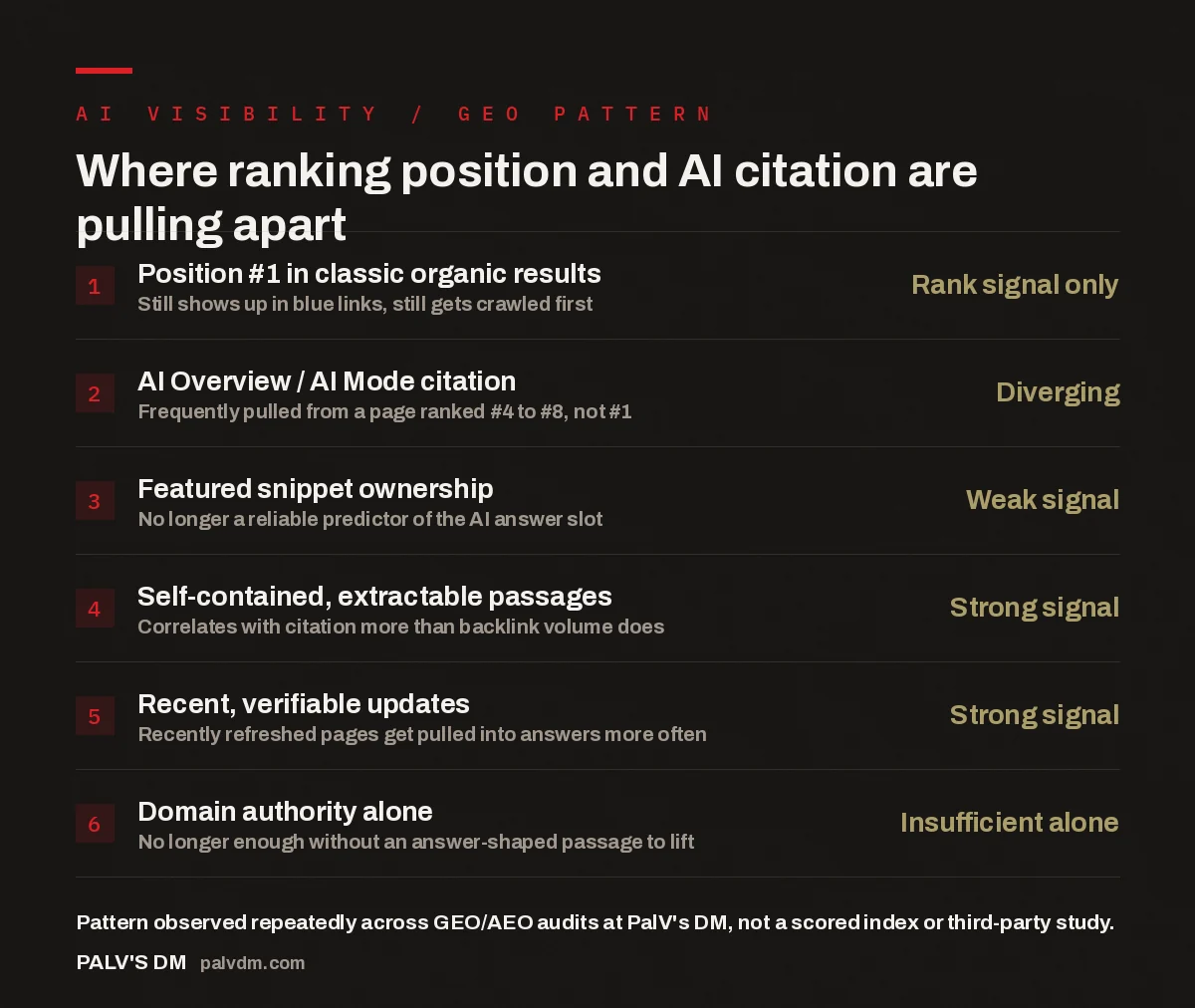
Where ranking position and AI citation are pulling apart
- Position #1 in classic organic results — Rank signal only. Still shows up in blue links, still gets crawled first.
- AI Overview / AI Mode citation — Diverging. Frequently pulled from a page ranked #4 to #8, not #1.
- Featured snippet ownership — Weak signal. No longer a reliable predictor of the AI answer slot.
- Self-contained, extractable passages — Strong signal. Correlates with citation more than backlink volume does.
- Recent, verifiable updates — Strong signal. Recently refreshed pages get pulled into answers more often.
- Domain authority alone — Insufficient alone. No longer enough without an answer-shaped passage to lift.
What does “ranking and citation overlap” actually mean?
Overlap is the simplest possible measure: for a given query, is the page Google shows in position one the same page an AI Overview, AI Mode, or a chatbot cites when it answers that query? A few years ago, the honest answer for most commercial queries was “usually, yes.” Ranking signals and citation signals pointed at the same handful of authoritative, well-linked pages, so the two lists looked almost identical. What we are seeing now, query set after query set, in the accounts we manage, is that overlap has started to fray at the edges first and is now fraying in the middle. The top result still ranks. It just does not automatically get the quote anymore.
This matters because most teams still track one number — rank position — as a proxy for visibility. If overlap were still near-total, that proxy would be fine. It is the gap between the two that makes rank position an increasingly unreliable stand-in for whether you are actually being seen by the growing share of searchers who read an AI answer and never click through.
Why is the overlap shrinking?
Classic ranking and AI citation are built to optimise for different things, and that difference is the root cause. A ranking algorithm is, at its core, a relevance-and-authority sort across an entire index: it weighs backlinks, on-page relevance, site trust, user behaviour signals, and dozens of other factors to decide which page deserves to sit at the top of a results page a human will scroll. An AI answer engine is doing something narrower and more mechanical: it needs one paragraph, or one table row, or one clean list item, that answers the specific question the user asked, in a form it can lift without heavy rewriting or risk of misrepresenting the source.
Those are not the same job. A page can earn position one through years of accumulated authority and links while still burying its actual answer three paragraphs deep, wrapped in qualifiers. That page ranks fine. It is a poor citation candidate, because the engine assembling the answer will not do the extraction work a human reader would — it prefers whatever page hands over a self-contained, unambiguous answer first. Ranking still rewards the whole page; citation rewards the single best passage on any page in the eligible set, and those are not always the same page.
The other driver is surface fragmentation. Ranking used to mean one list, one algorithm, one thing to optimise for. Now there is the classic organic result, the AI Overview panel above or beside it, AI Mode’s more conversational surface, and separate chat assistants that crawl and cite independently of any of it. Each surface can pull from a different page for the same query, because each one runs its own retrieval and synthesis process over a broadly similar index. Overlap was never guaranteed to survive that fragmentation, and what we see in practice suggests it hasn’t.
What predicts citation now, if rank position doesn’t?
Nobody outside the platforms has the actual citation-ranking algorithm, so treat what follows as pattern recognition from repeated audits, not a formula. Directionally, the pages that keep getting cited despite not holding position one tend to share a few structural traits rather than a few authority traits.
- The answer sits near the top, in a self-contained sentence or two. If a page needs three paragraphs of scene-setting before it states the actual answer, an extraction engine is more likely to skip it in favour of a page that leads with the answer.
- Claims are attributable to something concrete. A specific source, a named methodology, or a clearly dated observation is easier for a model to cite with confidence than an unattributed generalisation.
- Structure does the disambiguation. Headings phrased as the actual question, short lists, and tables let an engine map a query to a passage without inferring intent from prose.
- The page has been touched recently. Pages with a visible, credible update cadence appear to get pulled into answers more often than stale pages sitting on old authority.
None of these traits replace the fundamentals that still drive ranking — technical health, relevance, and genuine authority still matter for showing up in the eligible set at all. What has changed is that clearing that bar no longer guarantees the citation. It gets you into contention; structure and extractability decide who wins once you’re there.
Most sites we audit are still measuring visibility with one number: rank position. That number is now describing only half of what’s happening. The other half — whether the AI answer actually cites you — has to be tracked separately, because the two increasingly diverge on the same query.
Palash, Founder, PalV’s DM
How do you audit this gap on your own site?
You do not need a proprietary citation-tracking platform to get a first read on this. Start with a manageable list of your highest-intent queries — the twenty to thirty terms that actually drive pipeline, not your entire keyword list. For each one, record your current rank position, then check, manually if necessary, whether an AI Overview or AI Mode response appears and which page it cites. Do this over a few weeks rather than once, since AI answer composition shifts more often than classic rankings do.
Look for the pattern across the set, not a single alarming gap. If your ranked page and the cited page match on most queries, your content structure is probably already close to citation-ready. If the mismatch shows up repeatedly, especially on queries where you rank one through three, that’s a signal the ranking page and the ideal citation passage have drifted apart on your own site, not just in the algorithm.
From there, the fix is usually structural rather than a rewrite: pull the actual answer higher on the page, give it its own heading phrased as the question, and make sure it can stand alone as a sentence or two without needing the rest of the page for context. That is a smaller lift than a content overhaul, and it’s the lever that seems to move citation odds without touching the ranking factors that already work for you.
Should you stop optimising for rank position?
No, and this is worth being direct about because it’s the most common overcorrection we see. Rank position still gates whether you’re in the eligible set an AI engine draws from at all — pages that don’t rank reasonably well for a query are far less likely to be considered as citation candidates for it in the first place. The claim here is not that ranking stopped mattering. It’s that ranking stopped being sufficient. Chasing citation at the expense of the fundamentals that get you ranked would just remove you from consideration entirely.
The practical shift is to stop treating “rank #1” as the finished job and start treating it as the entry ticket. The work that used to end at position one now continues into how the page is structured for the surfaces sitting on top of that ranking.
Related reading
- How often AI Overviews actually appear, broken down by query type, so you know where this overlap gap matters most.
- AI Mode vs AI Overviews — why these two surfaces cite differently even on the same query.
- Why earned media is dominating AI citations, and what that means if you’re relying on owned-page authority alone.
- Building a multi-surface visibility scorecard that tracks rank and citation as separate metrics instead of one blended number.
FAQ
Does ranking #1 guarantee my page gets cited in AI Overviews?
No. Ranking #1 puts you in contention because it signals relevance and authority, but the citation itself is decided by a separate extraction step that favours whichever page offers the clearest, most self-contained answer passage. In the queries we audit, the cited page is often ranked lower than #1.
How can I check whether my top-ranking pages are being cited?
Build a shortlist of your highest-intent queries, note your rank position for each, and separately check whether an AI Overview or AI Mode response appears and which page it cites. Repeat over a few weeks, since AI answers change composition more frequently than organic rankings do.
Should I restructure a page that ranks well but isn’t getting cited?
Usually yes, and usually as a structural edit rather than a rewrite. Move the direct answer higher on the page, give it its own question-phrased heading, and make sure it reads as a complete statement on its own. That tends to improve citation odds without disturbing the ranking factors already working in your favour.
Is this overlap gap the same across every industry or query type?
No, it varies. Broad informational queries where an AI Overview appears often show wider gaps between rank and citation than narrow transactional or branded queries, where AI answers appear less frequently in the first place. Auditing your own query set is more reliable than assuming a general figure applies to your business.
Does this mean traditional SEO is becoming less important?
No — ranking well is still the gate you have to clear before an AI engine will even consider citing you. What’s changing is that clearing it is no longer the whole job. The page also needs to be structured so an extraction engine can use it, which is additional work layered on top of ranking fundamentals, not a replacement for them.
Short version: Ranking #1 no longer guarantees you get cited by AI Overviews or AI Mode — the two are decided by different mechanisms and, in the accounts we work on, they diverge on a meaningful share of queries. Ranking still gets you into contention; a self-contained, question-led answer passage is what wins the citation once you’re there. Track the two separately, fix the structural gap where it shows up, and treat rank position as the entry ticket rather than the finish line.