Trends & Industry Developments
A/B Tests and Search Results: Google’s Current Position
Wondering about ab testing seo impact? Google allows A/B testing if you avoid cloaking, use 302 redirects, keep canonicals correct, and time-box tests.

A/B testing does not hurt SEO by default. Google has said for years that running experiments on your site is fine, provided you follow a small set of rules: don’t cloak, use temporary redirects for redirect-based tests, keep your canonical tag pointed at the original page, and don’t run the test forever. Most of the “A/B testing SEO impact” panic that shows up in forums traces back to sites that broke one of those four rules, not to testing itself being risky.
Key takeaway
- Google’s documented position is that A/B and multivariate testing is acceptable as long as you don’t cloak — Googlebot must see what real users see.
- Redirect-based tests should use 302s, JavaScript-based tests should keep rel=canonical on the original URL, and both should be time-boxed.
- The actual SEO impact of ab testing usually comes from test hygiene mistakes — permanent redirects, blocked variants, or tests left running for months — not from the concept of testing itself.
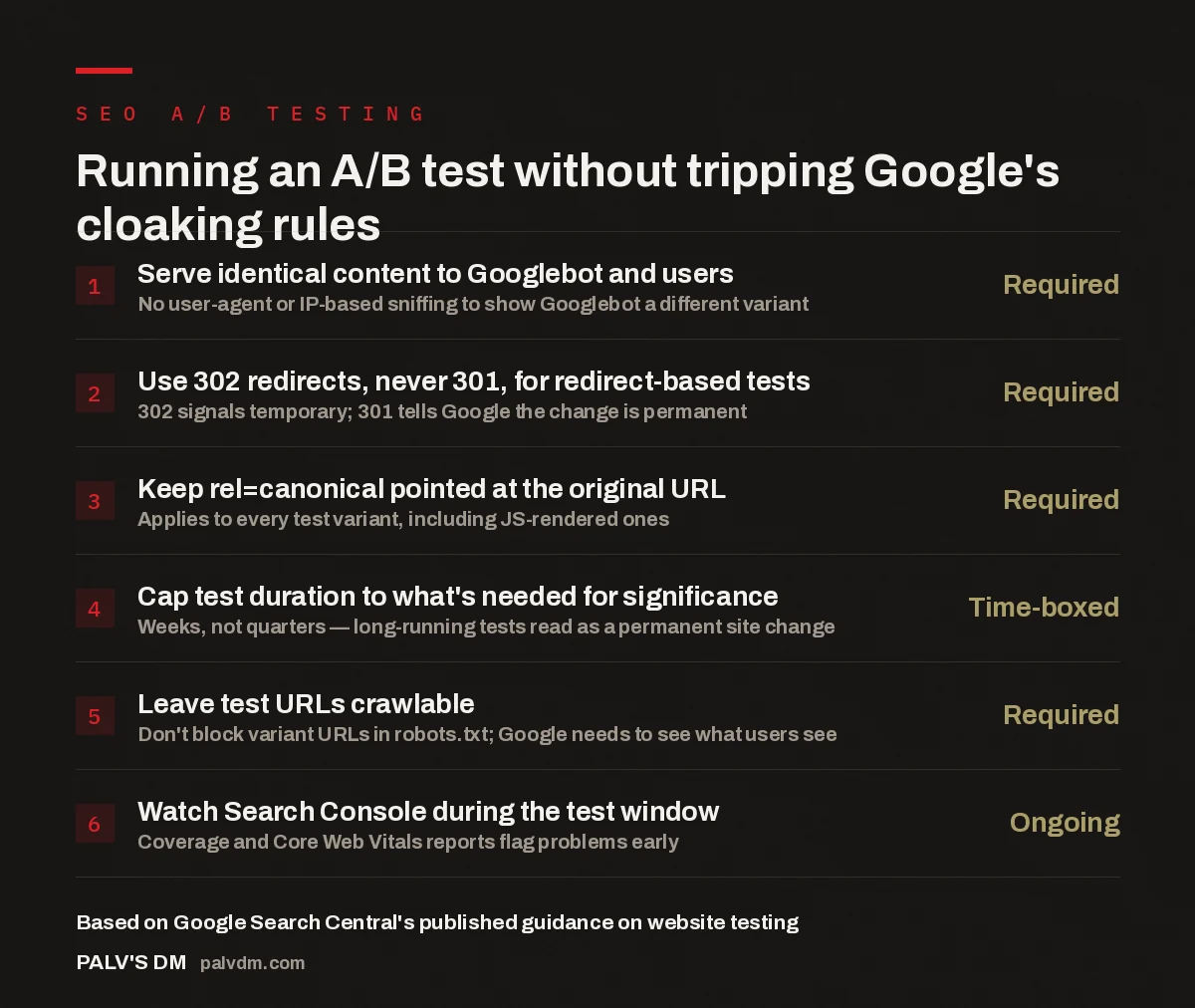
Running an A/B test without tripping Google’s cloaking rules
- Serve identical content to Googlebot and users — Required. No user-agent or IP-based sniffing to show Googlebot a different variant.
- Use 302 redirects, never 301, for redirect-based tests — Required. 302 signals temporary; 301 tells Google the change is permanent.
- Keep rel=canonical pointed at the original URL — Required. Applies to every test variant, including JS-rendered ones.
- Cap test duration to what’s needed for significance — Time-boxed. Weeks, not quarters — long-running tests read as a permanent site change.
- Leave test URLs crawlable — Required. Don’t block variant URLs in robots.txt; Google needs to see what users see.
- Watch Search Console during the test window — Ongoing. Coverage and Core Web Vitals reports flag problems early.
What is Google’s actual position on A/B testing?
Google’s Search Central documentation treats website testing as a normal part of running a site, not as a risk to be tolerated. The core rule is simple: whatever variant a real visitor sees, Googlebot should be able to see the same thing. Testing tools that swap content based on cookies, session identifiers, or randomised buckets are fine, because every visitor — human or crawler — is eligible for the same set of variants under the same rules. What crosses the line is deliberately showing Googlebot one version of a page while showing users something different, which is the textbook definition of cloaking regardless of whether the intent was an “experiment.”
This matters for the ab testing seo impact question because most teams aren’t worried about testing itself — they’re worried about accidentally cloaking through a testing tool’s default configuration. Some third-party experimentation platforms historically offered a “server-side rendering for bots” option that served a static version to known crawler user-agents. That pattern, even when well-intentioned, is exactly the setup Google’s guidance warns against. If your testing tool has a bot-detection or crawler-optimisation toggle, treat it with suspicion rather than assuming it helps.
How should redirect-based tests be set up?
Redirect-based A/B tests — where variant B lives on a separate URL and a portion of traffic is redirected there — are the oldest and most misunderstood form of testing on this topic. The rule Google has published consistently is to use a 302 (temporary) redirect, not a 301 (permanent) redirect, to send users to the test URL. A 301 tells search engines the destination has permanently replaced the original, which can shift ranking signals toward a page that might get deleted the moment the test ends. A 302 keeps the original URL as the canonical destination in Google’s eyes while the test runs.
The second half of the setup is the canonical tag. The test variant’s page should carry a rel=canonical pointing back to the original, control URL. This tells Google explicitly which page should accumulate ranking signals and appear in results, even while a chunk of your traffic is being routed to the variant. Skipping the canonical tag is a common oversight — teams remember the redirect but forget that the destination page also needs to declare itself a variant of the original, not a standalone page competing for the same query.
Does client-side JavaScript testing carry different rules?
Client-side tests — where the DOM is modified after page load using JavaScript, without a URL change — follow the same underlying principle but with a different mechanical detail. Because there’s no separate URL, there’s no redirect to manage, but there’s also no automatic canonical relationship to rely on. The page needs to load its default, control content first, then apply variant changes via JavaScript for the portion of visitors bucketed into a test. As long as Googlebot renders the page and sees the same DOM manipulation logic that a real browser would run, there’s no cloaking concern, because Googlebot executes JavaScript during rendering in most modern crawl scenarios.
Where client-side tests go wrong is less about Google’s rules and more about crawl efficiency and rendering budget. A test that injects large blocks of new content via JavaScript adds rendering work every time Googlebot processes the page. On a small site this is irrelevant. On a large site running several simultaneous experiments across high-traffic templates, it can meaningfully slow down how quickly Google re-renders and re-indexes pages, simply because there’s more script execution required per page. That’s a technical performance issue, not a policy violation — but it’s worth tracking if experimentation is a constant, not occasional, part of how your team ships changes.
How long can a test run before it becomes a ranking risk?
Google has never published an exact day count for how long an A/B test can run safely, and treat any source that claims a precise number with skepticism. The guidance is directional: run the test only as long as it takes to reach a valid result, then either roll the winning variant into the permanent page or roll it back. A test that’s technically still “in progress” six months later stops looking like an experiment and starts looking like the site’s actual, permanent state — at which point the 302-and-canonical setup that made sense for a two-week test starts to look inconsistent with what’s really happening on the site.
The practical guidance that holds up across the accounts we work on: decide the test’s statistical stopping point before launch, not after. Teams that leave tests running indefinitely “just to keep collecting data” are usually the ones who eventually get asked, internally, why a redirect that was supposed to be temporary has been live for a year. At that point, the fix isn’t an SEO fix — it’s a decision to finish the test and update the canonical page with the winning version.
Every “A/B testing killed our rankings” story we’ve dug into on client sites traces back to one of three things: a 301 where a 302 belonged, a canonical tag that got dropped somewhere in the test setup, or a test that quietly became permanent without anyone updating the page. It’s never the concept of testing that’s the problem — it’s test hygiene nobody owns after week two.
Palash, Founder, PalV’s DM
What should be monitored while a test is live?
Search Console is the primary instrument here, not third-party rank trackers. The Page Indexing report and the URL Inspection tool will show whether Google is indexing the control URL, the variant URL, or both — if both show up as indexed and competing, something in the canonical or redirect setup needs a second look. The Core Web Vitals report is worth watching too, particularly for client-side tests, since a poorly built experimentation script can quietly push Largest Contentful Paint or Cumulative Layout Shift into a worse bucket for the pages carrying the test.
It’s also worth checking crawl behaviour specifically for the test’s date range, not just overall traffic. A spike in crawl requests to variant URLs, or a drop in crawl frequency to the pages under test, is a useful early signal that Googlebot is treating the test setup differently than expected — often before that shows up in rankings or organic traffic at all. Catching it during the test window means the fix is a configuration change, not a recovery project after the fact.
Where does this fit into a broader search strategy?
A/B testing questions are a small, specific example of a larger pattern: Google publishes guidance, that guidance changes in small ways over time, and most of the risk comes from teams working off an outdated mental model rather than the current documentation. The same is true of canonical handling more broadly — see our note on recent canonical guidance updates for how Google’s stance on duplicate and near-duplicate content has shifted. And crawl behaviour during a test is really just a subset of the larger crawl budget question, covered in our piece on how Google’s crawl budget guidance has changed.
Testing hygiene also matters more, not less, as measurement gets harder across the board. If your rank tracking data is already noisier than it used to be — a trend we cover in why third-party SEO data got less reliable — then a poorly configured test adds a second layer of noise on top of a signal that was already hard to read cleanly. Clean test setup is one of the few variables actually within your control.
Get this checked before you launch
If you’re planning a redirect-based or JavaScript-based test on pages that already rank, it’s worth a second set of eyes on the canonical and redirect setup before launch, not after traffic starts moving.
FAQ
Does A/B testing hurt SEO?
Not by default. Google’s published guidance treats testing as normal site behaviour as long as Googlebot sees the same content real users see, redirect-based tests use 302s rather than 301s, and variant pages carry a canonical tag pointing to the original URL. Ranking problems usually come from misconfiguration, not from the act of testing.
Can Google penalise a site for running an A/B test?
Google can act on cloaking, which is a policy violation, but running a well-configured test is not cloaking and is not treated as one. The risk is specifically tied to serving different content to Googlebot than to users, not to the presence of a test itself.
Should I use a 301 or 302 redirect for a redirect-based test?
Use a 302. It signals that the redirect is temporary, which matches what a test actually is. A 301 tells search engines the move is permanent and can shift ranking signals toward a page that may not exist once the test concludes.
How long can an SEO A/B test safely run?
Google hasn’t published a fixed limit. The practical guideline is to run the test only until it reaches statistical significance, then implement the winner permanently or roll it back. Tests left running for months without a decision start to look like the site’s permanent state rather than an experiment.
Do client-side JavaScript tests need a canonical tag?
There’s no separate URL in a pure client-side test, so there’s no canonical relationship to declare — the control content should simply load first, with variant changes applied afterward via script. The more important safeguard is making sure Googlebot’s rendered view matches what a real visitor sees.
Short version: Google allows A/B testing. The ab testing seo impact that shows up in case studies almost always traces back to a 301 used where a 302 belonged, a missing or misdirected canonical tag, or a test that ran indefinitely without ever being finalised. Set the redirect type and canonical tag correctly before launch, time-box the test, and check Search Console’s indexing and Core Web Vitals reports while it’s live. Do those four things and testing on your search-facing pages carries no more SEO risk than any other change you’d ship to production.