Do You Need SEO If You Already Run Google Ads?
Do I need SEO with Google Ads? Yes — ads rent visibility per click while SEO earns rankings that stay. Here's where the two actually overlap.
Yes — running Google Ads well is usually a reason to add SEO, not a reason to skip it. The two channels don’t compete for the same job: ads buy you visibility for exactly as long as you keep paying, while SEO builds a ranking asset that keeps sending traffic after the campaign budget is spent elsewhere. If you already run Google Ads with a decent return, you have proof that the demand for what you sell exists and that your landing pages convert — which is precisely the data an SEO plan needs to work faster, not evidence that SEO would be redundant.
Key takeaway
- Google Ads and SEO answer different questions — one rents attention for as long as you pay, the other earns a position that stays after you stop paying for that specific click.
- If you’re already bidding on your own brand name or core category terms, part of your ads budget is paying for clicks SEO could win for free.
- The accounts where this question comes up most are the ones where ad spend has been flat for a year with nothing to show for it once the campaigns pause.
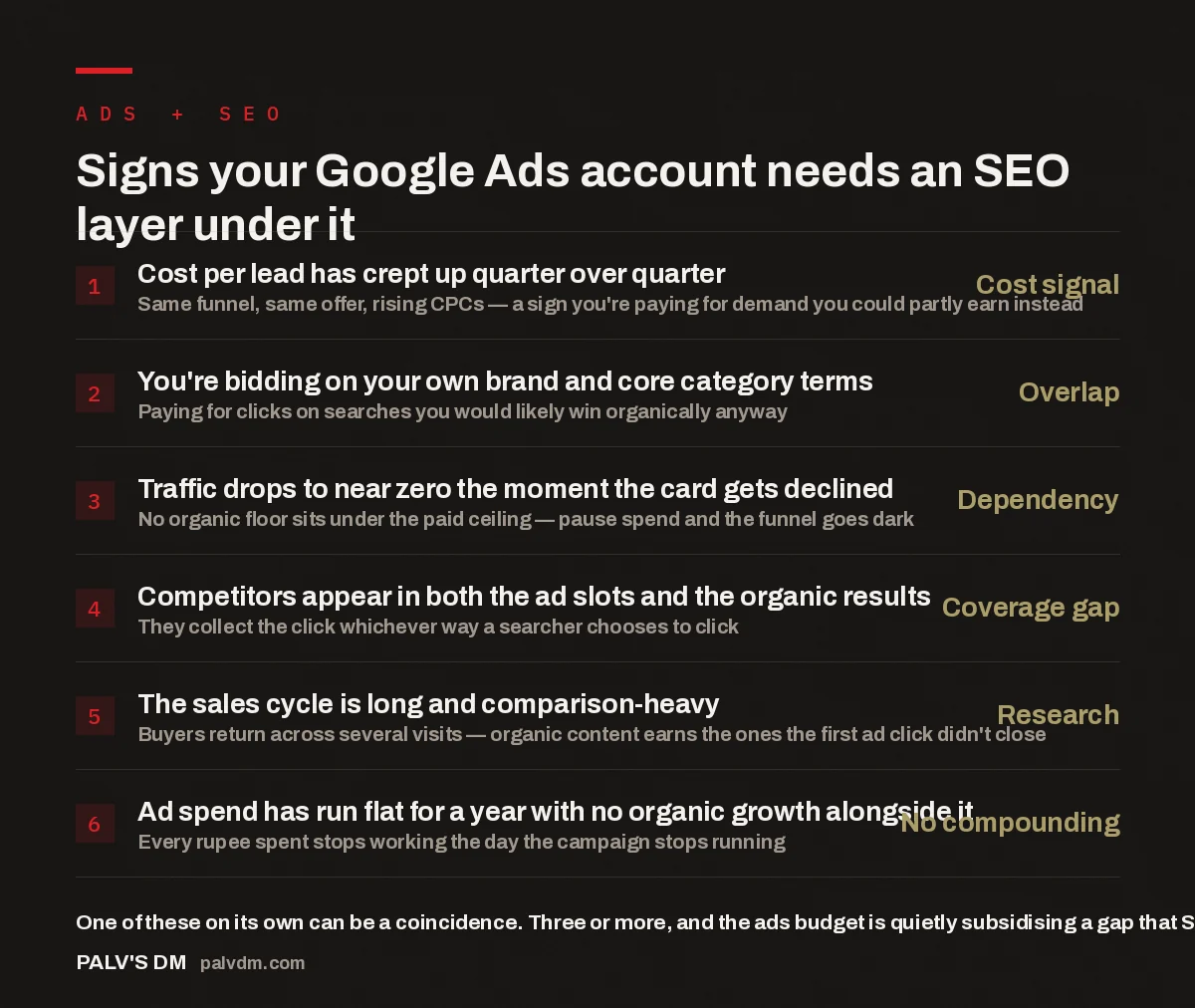
Signs your Google Ads account needs an SEO layer under it
- Cost per lead has crept up quarter over quarter — Cost signal. Same funnel, same offer, rising CPCs — a sign you’re paying for demand you could partly earn instead.
- You’re bidding on your own brand and core category terms — Overlap. Paying for clicks on searches you would likely win organically anyway.
- Traffic drops to near zero the moment the card gets declined — Dependency. No organic floor sits under the paid ceiling — pause spend and the funnel goes dark.
- Competitors appear in both the ad slots and the organic results — Coverage gap. They collect the click whichever way a searcher chooses to click.
- The sales cycle is long and comparison-heavy — Research. Buyers return across several visits — organic content earns the ones the first ad click didn’t close.
- Ad spend has run flat for a year with no organic growth alongside it — No compounding. Every rupee spent stops working the day the campaign stops running.
The myth: “I’m already showing up on Google, so SEO would just double up on the same clicks”
This is the version of the question we hear most often, and it treats a Google search results page as one thing when it’s actually two separate auctions happening on the same screen. The ad slots at the top are rented — you win them by bidding, and you lose them the second you stop bidding. The organic results underneath are earned — through relevance, content, technical health and links — and once you hold a position there, you keep it without paying per click. A business “already showing up on Google” through ads has bought placement in one of those two systems. The other one is sitting empty, and a competitor is very likely occupying it instead.
The reality: ads and SEO win different clicks, not the same click twice
Some searchers click the top ad without a second thought. Others scroll past ads on habit and go straight to the organic listings. Others search the same thing three or four times over a week — comparing options, reading reviews, checking pricing pages — and see your ad on visit one, then find a competitor’s organic guide on visit three because you don’t have a page that answers the question they’re asking by then. Google Ads and organic SEO are not two routes to the identical audience; they’re two different layers of intent, and a business that only occupies one of them is leaving the other layer to whoever bothered to build for it.
There’s also a simpler reason the “doubling up” worry doesn’t hold: appearing in both the ad slot and the organic result for the same query tends to increase the total click share you capture, not cannibalise it. Searchers who don’t trust ads skip straight to organic; searchers in a hurry click the ad. Owning both isn’t redundancy — it’s covering both kinds of searcher instead of betting the whole result on one.
What happens to your traffic if you pause Google Ads with no SEO underneath it?
It goes to close to zero, on the same day the campaigns stop running. This is the clearest way to test whether a business actually has an organic presence or just an ads presence that looks like visibility from the inside. Pull the campaigns for a week — because of a cash flow gap, a platform issue, a strategy pause — and check what’s left in Google Search Console and analytics. If the answer is “almost nothing,” every visitor that channel ever sent you was rented, and none of that spend built anything that outlives the invoice.
Compare that to an account with organic rankings running in parallel. Pausing ads there still drops total traffic, but a floor remains — people finding the site through search without a campaign pushing them there. That floor is what SEO is actually for: not a replacement for paid traffic, but a base layer that doesn’t disappear the moment budget gets reallocated, a new competitor bids more aggressively, or a platform policy change disrupts the account. If you’re weighing whether that base layer is worth building right now versus later, we’ve laid out the honest cases where it genuinely isn’t yet in when you genuinely don’t need an SEO agency yet.
The businesses that ask us this question aren’t usually asking because SEO seems unnecessary. They’re asking because ads have gotten more expensive and they’ve noticed the growth stopped compounding. That’s not an SEO pitch — that’s what an ads-only account looks like after a year or two.
Palash, Founder, PalV’s DM
Where does SEO actually reduce what you’re spending on Google Ads?
The clearest overlap is branded and core category search. If your company name, or the two or three terms that describe exactly what you sell, still cost you money on every click instead of the organic listing below the ad, that’s worth checking directly in your account rather than assuming. Look at what share of your Google Ads spend goes to terms you’d plausibly rank for organically within a reasonable timeframe. For an established brand with decent domain history, that share is often larger than expected, because ad platforms will happily keep charging for a click a searcher was going to give you anyway.
The second overlap is further down the keyword list, on terms with real intent but softer competition — the kind of long-tail, comparison and “how to choose” queries that rarely justify aggressive ad bids on their own but add up across a site with proper content coverage. These are usually the first keywords an SEO plan targets, because they’re realistic to win without years of authority building. How that keyword list actually gets prioritised, rather than chased in the order a spreadsheet happens to list them, is covered in how we choose which keywords to chase first — the same logic that decides which of your current ad terms are worth trying to win organically first.
None of this means cutting Google Ads once SEO starts working — it means shifting the ads budget toward the moments where paid genuinely outperforms organic (new launches, time-sensitive offers, terms you can’t realistically out-rank soon) while SEO absorbs the terms that don’t need to be rented forever.
When does it actually make sense to run ads only, without SEO yet?
There are a few honest cases, and pretending otherwise would be its own kind of myth. A brand-new offer with no proven demand is often better tested through ads first — turn a campaign on, read the data in weeks, and kill it if the offer doesn’t land, a far faster loop than SEO can give you. A business with no budget beyond ad spend, and genuinely no capacity to produce content or fix technical issues for the next several months, may be better off making the ads account itself more efficient before adding a second channel it can’t properly resource.
And a business that just closed a funding round and is deciding where the next tranche of marketing spend goes has a slightly different version of this question — less “ads or SEO” and more “how much of each, and in what order.” That allocation question is worth treating separately from the yes/no question this article is answering; we’ve written about it directly in SEO after a funding round: spending it without waste. Outside of these specific situations, though, “we already run ads” isn’t itself a reason to leave SEO out. It’s usually the opposite — proof the demand and the conversion path already work, which is exactly what makes SEO faster to get right.
What does adding SEO to an existing ads account actually cost?
Less than most businesses assume, and it doesn’t require pausing ads while it ramps up. SEO plans typically run as a fixed monthly retainer rather than a per-click auction, which means the cost doesn’t rise just because your ad competitors got more aggressive this quarter — a real difference from how Google Ads pricing behaves in a competitive category. We’ve broken down what a modest monthly SEO spend actually buys in concrete terms in what Rs 8,000 a month of SEO buys you, which is useful context if the number that’s holding you back from adding SEO is a guess rather than an actual quote.
Already running ads and want the organic floor underneath them?
We’ll look at your actual ads account and tell you honestly which terms are worth trying to win organically first — no generic pitch, just where the overlap really is.
Will adding SEO cannibalise the traffic I already get from Google Ads?
No — the two occupy different positions on the same results page, and owning both an ad slot and an organic listing for the same query typically increases the total share of clicks you capture rather than splitting an existing number. What it does change is which clicks you’re paying for, since you stop needing to bid on terms you already rank for organically.
How long before SEO reduces my Google Ads spend?
It varies by how competitive the overlapping terms are and how much technical or content work the site needs first, but branded and low-competition long-tail terms are usually where organic rankings show up soonest — often within the first few months — which is where the earliest budget reallocation tends to happen. Competitive category terms take longer and may still be worth bidding on in parallel for some time.
Should I stop bidding on my own brand name once SEO kicks in?
Not automatically. Some businesses find competitors bidding on their brand name, in which case keeping a brand campaign running protects that top ad slot even after organic ranking is secure. The decision should be based on what’s actually happening in the auction for your brand terms, not a blanket rule either way.
Does running Google Ads help or hurt my organic SEO rankings?
Running ads doesn’t directly boost or penalise organic rankings — the two are separate systems. Where ads genuinely help is indirectly: campaign data shows which keywords and landing pages actually convert, which is useful evidence for deciding what an SEO plan should prioritise first, rather than guessing.
Is it ever better to just run ads and skip SEO entirely?
For an unproven offer being tested for demand, or a business with genuinely no capacity to support a second channel right now, running ads only for a period can be the right call. Outside those specific situations, an established, converting ads account is usually a sign SEO would work faster, not evidence it’s unnecessary.
Short version: Google Ads and SEO aren’t competing for the same click — ads rent a position for as long as you pay, SEO earns one that stays after you stop. If you already run Google Ads profitably, you’ve proven the demand exists and the funnel converts, which makes SEO faster to get right, not redundant. The real test is simple: pause the campaigns for a week and see what traffic is left. If the answer is close to zero, that’s the gap SEO exists to close.