When to Upgrade Your SEO Plan (And When Not To)
Thinking about an SEO package upgrade? Here is how to tell when upgrading your SEO plan is the right move, and when to wait, using real capacity signals.

Upgrade your SEO package when the current plan is the bottleneck, not the market. In practice that means: your keyword list has outgrown what the plan budgets for, your content briefs are sitting in a queue because there’s no capacity to write them, or you’ve cleared every on-page fix and rankings have flattened because the next gains need backlinks, authority content or expanded scope your current tier doesn’t cover. If none of that is true — if the current plan simply hasn’t had enough time to compound, usually the first four to six months — the right move is to wait, not to pay for more.
Key takeaway
- Upgrade when the plan is the constraint — capacity, keyword competitiveness or site scope has outgrown it — not because growth has simply slowed for a month or two.
- Don’t upgrade to fix a problem more spend can’t fix: a broken conversion funnel, an under-resourced content process, or a plan that hasn’t had time to work yet.
- The clearest signal is usually two or more indicators showing up together for several months running, not any single metric in isolation.
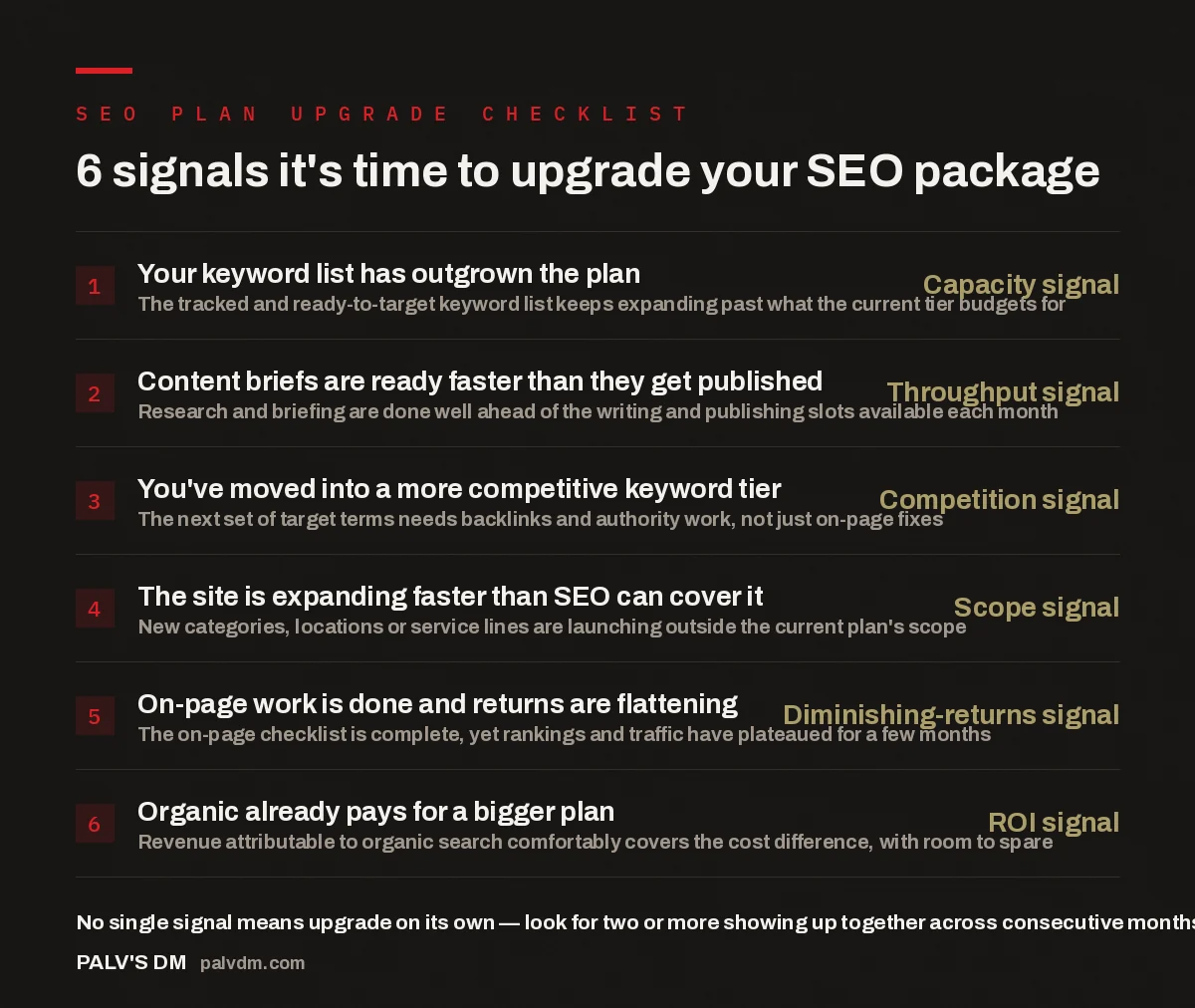
6 signals it’s time to upgrade your SEO package
- Your keyword list has outgrown the plan — Capacity signal. The tracked and ready-to-target keyword list keeps expanding past what the current tier budgets for.
- Content briefs are ready faster than they get published — Throughput signal. Research and briefing are done well ahead of the writing and publishing slots available each month.
- You’ve moved into a more competitive keyword tier — Competition signal. The next set of target terms needs backlinks and authority work, not just on-page fixes.
- The site is expanding faster than SEO can cover it — Scope signal. New categories, locations or service lines are launching outside the current plan’s scope.
- On-page work is done and returns are flattening — Diminishing-returns signal. The on-page checklist is complete, yet rankings and traffic have plateaued for a few months.
- Organic already pays for a bigger plan — ROI signal. Revenue attributable to organic search comfortably covers the cost difference, with room to spare.
What actually signals it’s time to upgrade an SEO package?
The honest answer is that it’s rarely one thing. Most SEO plans are sized around a set of assumptions: how many keywords are realistic to chase, how many pieces of content can be researched and published a month, how much technical and link-building work a site actually needs. An upgrade makes sense when reality has outrun those assumptions — not when a founder feels like more should be happening.
The pattern that shows up repeatedly in accounts that genuinely need to move up a tier looks like this: the keyword list built in month one or two, which felt generous at the time, is now fully “in progress” or “won,” and there’s a second wave of relevant terms sitting untouched because there’s no room in the plan to start them. Or the content calendar has a backlog — briefs are approved, but the writing and publishing slots in the current retainer are already full for the next six to eight weeks. Or the site itself has changed shape: new product categories, a second city, a new service line, and the SEO plan that was scoped for the old sitemap doesn’t reach the new pages.
A different but equally valid signal is a plateau after real progress. If a site moved from an on-page-only plan through the obvious technical fixes — page speed, internal linking, metadata, schema, content gaps — and rankings improved for a while and then stalled, that’s often the point where the next unit of progress needs backlinks, digital PR, or competitor-led keyword targeting that the current scope simply doesn’t include. That’s a legitimate reason to move up, because the ceiling isn’t effort, it’s scope.
When should you not upgrade, even if it’s tempting?
Three situations come up often enough to call out specifically, because in each of them, upgrading spends money without fixing the actual problem.
- The plan hasn’t had time to work yet. SEO compounds slowly by design — new pages need to be crawled, indexed, and given time to earn trust signals. If a plan is three months old, a slow start usually means “wait,” not “spend more.”
- Traffic is growing but leads or sales aren’t. If organic sessions are climbing and conversions aren’t following, the bottleneck is very often the site’s offer, forms, or page experience — not the volume of SEO work being done. More traffic into a leaky funnel just produces more of the same disappointing result at a higher cost.
- A competitor or industry peer is “doing more” and it feels like falling behind. Scope should be driven by what a specific site’s keyword opportunity and content backlog actually require, not by matching another company’s spend. Two businesses in the same industry can need very different plans depending on site size, current rankings, and how competitive their specific keyword set is.
In all three cases, the fix isn’t a bigger retainer — it’s patience, a funnel audit, or a keyword-specific gap analysis. Upgrading in these situations tends to just delay the real conversation.
The upgrade conversation should always start with “what is the current plan unable to do,” not “what does the next tier include.” If we can’t point to a specific piece of work that’s stuck because of scope, we tell clients to hold off — even when it costs us the upsell.
Palash, Founder, PalV’s DM
How does the upgrade conversation usually play out?
With a properly run SEO retainer, the case for upgrading — or not — should already be visible in the monthly reporting, well before anyone has to raise it. A report that shows the keyword backlog, what got published versus what’s queued, and where rankings have plateaued gives both sides the same picture. If that reporting doesn’t exist, or if “upgrade” conversations happen out of nowhere with a generic pitch about a “premium tier,” that’s usually a sign the plan was never scoped tightly enough to know whether it was working in the first place.
A useful way to pressure-test any upgrade pitch: ask specifically what work is currently not happening because of the plan’s scope, and what that work is expected to change. “More content” or “more optimisation” isn’t a specific answer. “Twelve keywords in the backlog that need competitor-led targeting and link building, which this tier doesn’t include” is a specific answer, and it’s the kind of answer that should come with a report attached, not just a sales call.
What happens if you upgrade too early?
The most common outcome of an early upgrade isn’t wasted money in some dramatic sense — it’s diluted focus. A bigger plan usually means a longer keyword list, more content in motion, and more moving parts to manage, all before the foundational work from the smaller plan has finished compounding. Instead of a tight, well-executed core keyword set producing steady gains, the account ends up spread across more targets with less depth on any of them. It’s not that the money is gone; it’s that the same budget would have moved the original keyword set further if it had stayed focused.
What happens if you wait too long to upgrade?
The opposite failure mode is just as real, and it’s the one that costs more in the long run: staying on a plan that’s clearly maxed out. The tell here is a keyword backlog that keeps growing without shrinking, or a content calendar that’s permanently three to four briefs behind what’s actually approved and ready. When that happens for a couple of consecutive months, the plan isn’t underperforming — it’s simply full, and every additional month spent waiting is a month where the next tier of keywords sits untouched while competitors who aren’t capacity-constrained keep moving on them.
The practical middle ground is to review scope against output every quarter, using the same signals in the checklist above, rather than waiting for a single dramatic moment to decide. Sites that grow steadily tend to need a plan adjustment roughly once a year on average — sometimes sooner if a funding round, a new product line, or a market expansion changes the site’s shape all at once.
How should you decide, in practice?
Run through the six signals in the checklist above against the last two or three months of reporting, not just the current month. A single strong month of traffic growth or a single slow month doesn’t tell you much either way — SEO data is naturally noisy month to month. What matters is whether two or more of those signals are showing up consistently: a growing, uncompleted keyword backlog; a content queue that keeps missing its own publish dates; a plateau after the on-page work is genuinely finished; or organic revenue that’s already comfortably covering a bigger spend. If that pattern is there, the plan is the constraint, and upgrading is the direct fix. If it isn’t, the better next step is usually a conversation with whoever runs the account about what specifically is limiting progress before paying for more of the same scope.
Two sibling questions worth checking before making the call: whether the current retainer actually includes everything it’s supposed to (see what’s actually included in a monthly SEO retainer), and whether the current plan even matches the site’s size and complexity in the first place (see which SEO plan fits a 10-page site vs a 500-page site). Both of those can explain a plateau without an upgrade being the real answer.
If the business has just come into new capital or a step-change in scale — a funding round, a major product launch, a new market — the calculus changes, since the site’s scope is about to outgrow the old plan by design rather than by accumulation. That scenario is covered in more detail in SEO after a funding round: spending it without waste. And if the concern behind the upgrade question is really “the current plan isn’t producing results at all,” that’s a different problem with a different answer, laid out in what happens if results don’t come.
Get a second opinion first
Before paying for a bigger tier, it’s worth having someone outside your current agency look at the keyword backlog, content throughput and scope against what your site actually needs. That’s a quick, concrete way to know whether an upgrade is justified — or whether the current plan just needs to be run differently.
How soon after starting an SEO plan is it reasonable to consider an upgrade?
Give a new plan at least four to six months before judging whether it needs to grow. Early months are usually spent on technical fixes and foundational content, which take time to get crawled, indexed and to earn ranking trust. An upgrade decision made in month two is almost always premature — there isn’t enough data yet to know if the plan is actually the constraint.
Does upgrading an SEO package mean paying for more of the same work?
It should mean paying for different work, not just more hours of the same activity. A well-scoped upgrade usually adds capability the current tier doesn’t have — backlink building, competitor-led keyword targeting, a bigger content allocation, or coverage for new site sections — rather than simply repeating the existing checklist at a higher price.
Can you downgrade an SEO plan later if the upgrade doesn’t pay off?
Yes, with a properly structured retainer this should be a normal, low-friction option, not a penalty situation. If an upgrade doesn’t produce the expected results within a reasonable review window, scaling back to the previous tier — or pausing certain workstreams — should be straightforward, and a trustworthy agency will say so upfront rather than locking clients into long minimum terms.
What’s the difference between upgrading a plan and just adding a one-off project?
An upgrade raises the ongoing monthly scope and budget permanently, while a one-off project — a content sprint, a technical migration, a link-building push — adds a fixed amount of work for a defined period. If the underlying issue is temporary, like a one-time site migration or a seasonal content push, a project is usually the better fit; if the issue is a permanent increase in keyword scope or site size, an upgrade makes more sense.
Should you upgrade an SEO plan and start running Google Ads at the same time?
Not automatically — they solve different problems, and combining two new spends at once makes it hard to tell which one produced any result. If the goal is faster visibility while SEO scope expands, it’s worth separately weighing whether ads make sense alongside SEO rather than assuming they should launch together; see do you need SEO if you already run Google Ads? for that specific decision.
Short version: upgrade when the current plan is visibly the constraint — a growing keyword backlog, a content queue that can’t keep up, a plateau after finishing the on-page work, or site growth that’s outpaced the plan’s scope, with two or more of those signals showing up over several consecutive months. Don’t upgrade to compensate for a plan that hasn’t had time to work yet, a conversion problem the SEO team can’t fix, or pressure to match what a competitor is spending. Check the reporting first; if it doesn’t clearly show what work is stuck and why, that’s the conversation to have before signing up for a bigger tier.