What Happens If Results Don’t Come
SEO no results, what next? The exact 6-point diagnostic we run before changing any plan, budget, or strategy — timeline, rankings, execution, and more.

If SEO isn’t producing results, the honest first question isn’t “what do we change” — it’s “have we actually reached the point where results should exist yet.” Most SEO no-results situations fall into one of three buckets: too early to judge, execution didn’t happen as planned, or the plan itself was wrong for the site. Each one has a different fix, and none of them start with panic-switching agencies or doubling the budget. At PalV’s DM, when a client asks what happens if results don’t come, the answer is a documented review process, not a shrug.
Key takeaway
- Before anything changes, we run a fixed diagnostic — timeline, rankings, indexation, conversion, scope, and execution — to find out whether “no results” actually means “no results.”
- SEO has a real floor: most sites need a full quarter before organic traffic and rankings move in a way that means anything. Judging month one or two is judging the wrong number.
- If the diagnostic shows the plan itself was wrong — wrong keywords, wrong scope for the site’s competition — you get a revised plan in writing, not vague reassurance to “give it more time.”
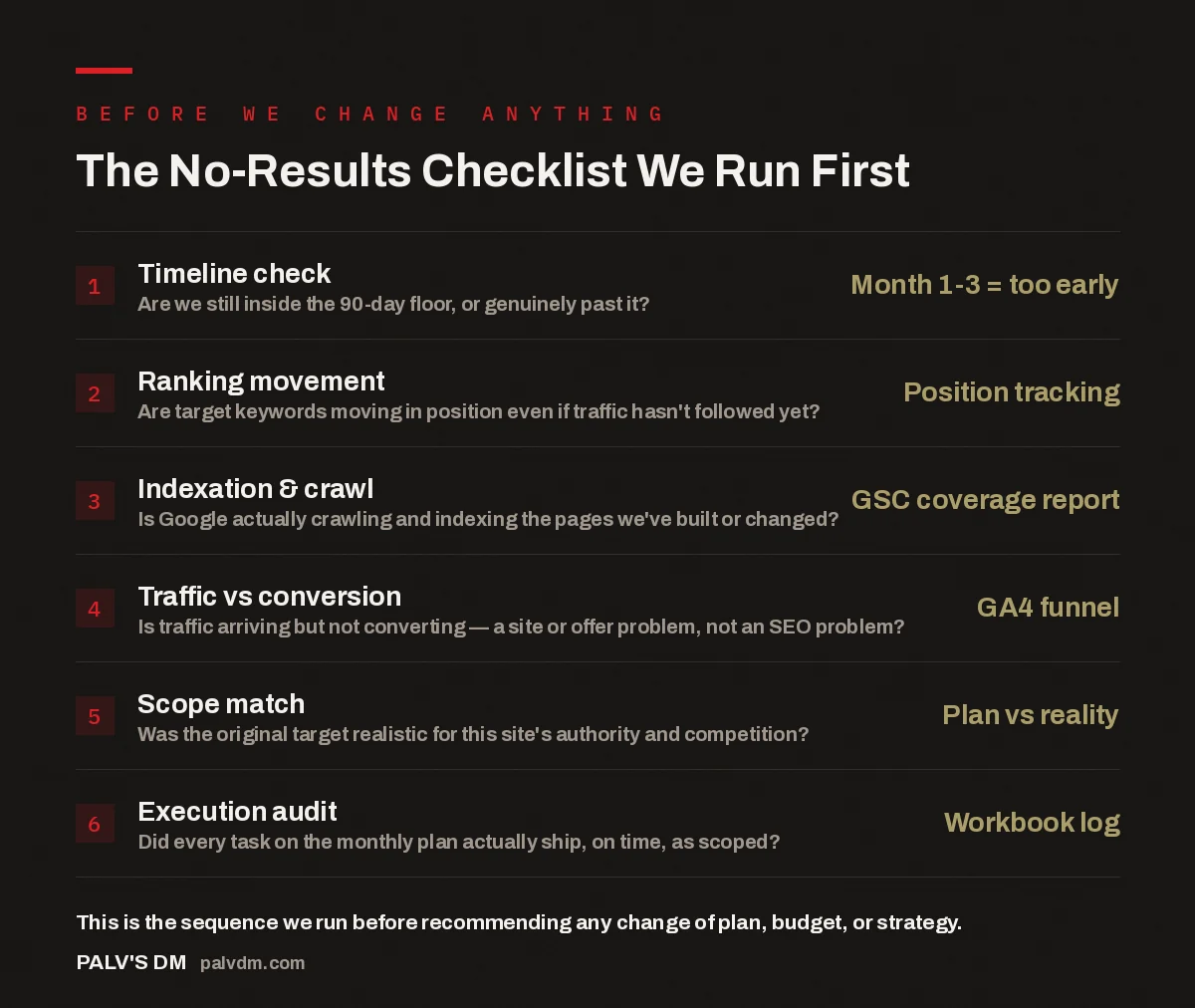
The No-Results Checklist We Run First
- Timeline check — Month 1-3 = too early. Are we still inside the 90-day floor, or genuinely past it?.
- Ranking movement — Position tracking. Are target keywords moving in position even if traffic hasn’t followed yet?.
- Indexation & crawl — GSC coverage report. Is Google actually crawling and indexing the pages we’ve built or changed?.
- Traffic vs conversion — GA4 funnel. Is traffic arriving but not converting — a site or offer problem, not an SEO problem?.
- Scope match — Plan vs reality. Was the original target realistic for this site’s authority and competition?.
- Execution audit — Workbook log. Did every task on the monthly plan actually ship, on time, as scoped?.
What does “SEO no results” actually mean?
“No results” is rarely a single, clean fact — it’s a mix of a few different signals that clients bundle together into one frustrated sentence. Rankings might not have moved, but impressions in Search Console are climbing. Traffic might be up, but leads aren’t. A page might be published and optimised, but Google hasn’t indexed it yet. Each of those is a different problem with a different timeline, and treating them as one undifferentiated “it’s not working” is how good campaigns get killed for the wrong reasons.
Before we look at strategy, we separate the claim into its parts: rankings, traffic, indexation, and conversions. A site can be genuinely underperforming on one of these while doing exactly what it should on the other three. That’s the first thing the diagnostic checklist above is built to catch — it stops the conversation from starting at “nothing is happening” and forces it to start at “which specific thing isn’t happening, and by when should it have.”
How long is too early to call SEO a failure?
SEO has a floor, and it’s set by how search engines actually work, not by how patient a client feels. A new or changed page has to be crawled, indexed, and then given time to settle into a position before it earns any meaningful traffic — and Google’s own crawl and re-evaluation cycles run on weeks, not days, even on sites it visits often. Content published in week one of a campaign is realistically not going to be a stable ranking signal by week four. That’s not a caveat we add to soften expectations; it’s how the mechanism works.
In practice, the accounts where clients report “no results” and are actually right about it almost always fall past the 90-day mark with genuinely flat movement across rankings, impressions, and indexation. The accounts where clients report “no results” and are wrong about it are almost always still inside month one or two, judging a metric — usually raw sessions — that hasn’t had time to reflect the work done underneath it. This is exactly why our first-90-days plan is structured the way it is: the first quarter is deliberately front-loaded with foundational work — technical fixes, content architecture, competitive research — that doesn’t show up as traffic yet but has to happen before traffic can follow.
What do we check before recommending any change?
When a client raises a no-results concern, the checklist runs in order, because each step rules something out before the next one is worth investigating.
- Confirm the timeline. We pull the exact publish and change dates for the work in question against today’s date. If we’re inside the floor described above, the review stops here with a clear “too early to judge, here’s what to expect and when.”
- Check ranking movement, not just position. A keyword moving from position 43 to position 19 is real progress even though it produces close to zero traffic — and it’s the strongest early signal that the work is landing. We look at the trend line, not just where a keyword sits today.
- Verify indexation and crawl. Google Search Console’s coverage report will show if pages are excluded, marked as duplicate, or simply not yet crawled. Work that Google hasn’t indexed can’t rank, full stop — this catches a technical block before anyone blames the content strategy.
- Separate traffic from conversion. If organic sessions are up but leads or sales aren’t, that’s frequently a site, offer, or tracking problem sitting downstream of SEO — not evidence that the SEO work failed. We check GA4 funnels and event tracking before touching the content plan.
- Re-test scope against reality. Was the original target keyword set realistic given the site’s domain authority and the competition actually ranking for those terms? Plans built on unrealistic targets need revising, not more months of the same approach.
- Audit execution. Did every task scoped for the period actually ship — on time, to spec? This is the one place we hold ourselves accountable first, before asking the client’s site or market to explain the gap.
This sequence is the same one described in what goes into every monthly update — the diagnostic isn’t a special process reserved for complaints, it’s the same data we’re already tracking, just read in a different order when a client wants a direct answer to “why isn’t this working.”
Most “SEO isn’t working” conversations are actually “SEO hasn’t had time to work yet” conversations. The job isn’t to make that sound better — it’s to show the client exactly which of the six checks we’re on, so patience isn’t blind.
Palash, Founder, PalV’s DM
What happens if the plan itself was wrong?
Sometimes the diagnostic doesn’t land on “too early” — it lands on “the original scope didn’t fit the site.” This happens more often with sites that came to us after chasing keywords set by a previous agency, or a founder’s own guesswork, without checking those keywords against the site’s actual competitive position. A ten-page local service site targeting the same broad national terms as a 500-page enterprise competitor isn’t a patience problem; it’s a targeting problem, and no amount of additional months fixes it.
When that’s the finding, the response is a revised plan, not a vague promise to “keep working on it.” That means going back through how keyword targets get chosen and rebuilding the priority list around terms the site can realistically compete for in the near term, alongside a longer-range set it can grow into. It also means being explicit with the client about what changed and why, in writing, rather than quietly redirecting effort and hoping nobody asks. If the site’s tier no longer matches what it needs — more content production, different technical work — that’s also the moment to discuss whether upgrading the plan makes sense, based on the diagnostic findings rather than a sales conversation.
What if the diagnostic shows we’re genuinely not delivering?
Step six of the checklist — the execution audit — exists precisely so that this question gets asked honestly instead of skipped. If scoped work didn’t ship, or shipped late, or was done to a lower standard than agreed, that’s on us, and the fix is operational: we correct the delivery gap and show the client the corrected workbook, not a new explanation for why the old one didn’t matter. Clients on any tier can see exactly what was scoped and what was delivered because that record already exists — it’s not reconstructed after the fact to make a case.
If, after a genuine execution correction and a full run through the diagnostic, a client still isn’t seeing the trajectory they were promised, the honest options are laid out directly rather than left implied: revise the plan and targets, change the service tier, or leave. Every client keeps full ownership of their accounts, logins, and content regardless of which of those they choose, and the process for doing so — with nothing held hostage — is covered in how to pause or leave without losing your work. An agency that makes leaving difficult is telling you something about how confident it is in its own results.
What if we’re taking over from a previous agency that produced nothing?
A meaningful share of “SEO doesn’t work” conversations actually start with a previous engagement that genuinely didn’t deliver — thin content, no technical work, no documentation of what was even attempted. The diagnostic still applies, but the first step usually reveals a different problem: there’s no reliable baseline to measure “no results” against, because nobody can say with confidence what was actually done. In that situation, the work starts with reconstructing that baseline before any new targets get set, which is exactly the process covered in rebuilding SEO after a bad agency experience. It’s slower than starting from a clean, well-documented site, but skipping it just repeats the same accountability gap with a new vendor.
If you’re not seeing results right now
You don’t need to wait for a scheduled review to ask where things stand. If your SEO plan has been running for a full quarter or more and you’re still not seeing the movement you expected, get a straight read on where the gap actually is — timeline, execution, or plan — before deciding what to change.
FAQ: SEO no results, what next
How long should I wait before judging whether SEO is working?
Give a new SEO plan at least a full quarter before drawing conclusions, since the first weeks are typically spent on crawling, indexing, and foundational work that doesn’t show up as traffic yet. If rankings, impressions, and indexation are all still flat well past the 90-day mark, that’s a legitimate point to ask for a direct review.
What’s the first thing to check if SEO results haven’t come?
Check the timeline first — how long the current plan has actually been running versus how long it’s reasonable to expect results to take. Most premature “it’s not working” conclusions come from judging month one or two against a timeline that realistically needs a full quarter to show up in rankings and traffic.
Can traffic go up while SEO still feels like it isn’t working?
Yes, and it’s a common gap. Organic sessions can rise while leads or sales stay flat, which usually points to a conversion problem on the site or in the offer, not a failure of the SEO work itself. Checking GA4 funnels separately from ranking and traffic data is what surfaces this distinction.
What if the SEO plan I was sold doesn’t fit my site?
If a diagnostic review shows the original keyword targets or scope were unrealistic for the site’s current authority and competition, the right response is a revised plan built around achievable near-term targets and a longer-range growth path, not additional months spent chasing the original, unrealistic goal.
What are my options if an agency genuinely isn’t delivering?
After a fair execution review, the honest options are to revise the plan and targets, change service tier, or leave. A client should be able to leave with full ownership of every account, login, and piece of content created for them — if that’s difficult or restricted, that’s worth weighing on its own.
Short version: if SEO results haven’t come, don’t start with “what needs to change” — start with “which of six specific things is actually true right now”: is it too early, are rankings moving even without traffic, is Google indexing the work, is traffic converting, was the plan realistic for the site, and did every scoped task actually ship. Three of those six point to patience. Two point to a plan revision. One points to us needing to fix our own delivery. Getting a straight answer on which one you’re in is what turns “SEO isn’t working” from a feeling into a decision you can actually act on.