What We Will Not Do, and Why
The SEO tactics we avoid — PBNs, bought links, spun content, fake reviews, guaranteed rankings — and why refusing them protects your rankings long-term.
The SEO tactics we avoid are the ones that trade a short-term ranking bump for a long-term risk to your site: bought links, private blog networks, spun or stuffed content, guaranteed-rank promises, fake reviews, and account setups that lock you out of your own assets. We turn down every one of these when a prospective client asks for them, and we’ve walked away from work rather than run them. This isn’t a marketing line — it’s a working policy that shapes how every account here gets managed, because the fastest way to lose a client’s rankings for good is to win them the fast way first.
Key takeaway
- The SEO tactics we avoid — PBNs, bought links, spun content, keyword stuffing, fake reviews, fabricated citations — all share one trait: they manufacture a signal instead of earning it, and search and AI systems are built to find manufactured signals.
- We never promise a specific ranking position, and we never hold your domain, analytics, ad accounts or CMS logins in an agency-owned account — everything sits in your name from the first day.
- Avoiding these tactics isn’t caution for its own sake — it’s what makes the results defensible when Google runs a core update or an AI system changes how it sources answers.
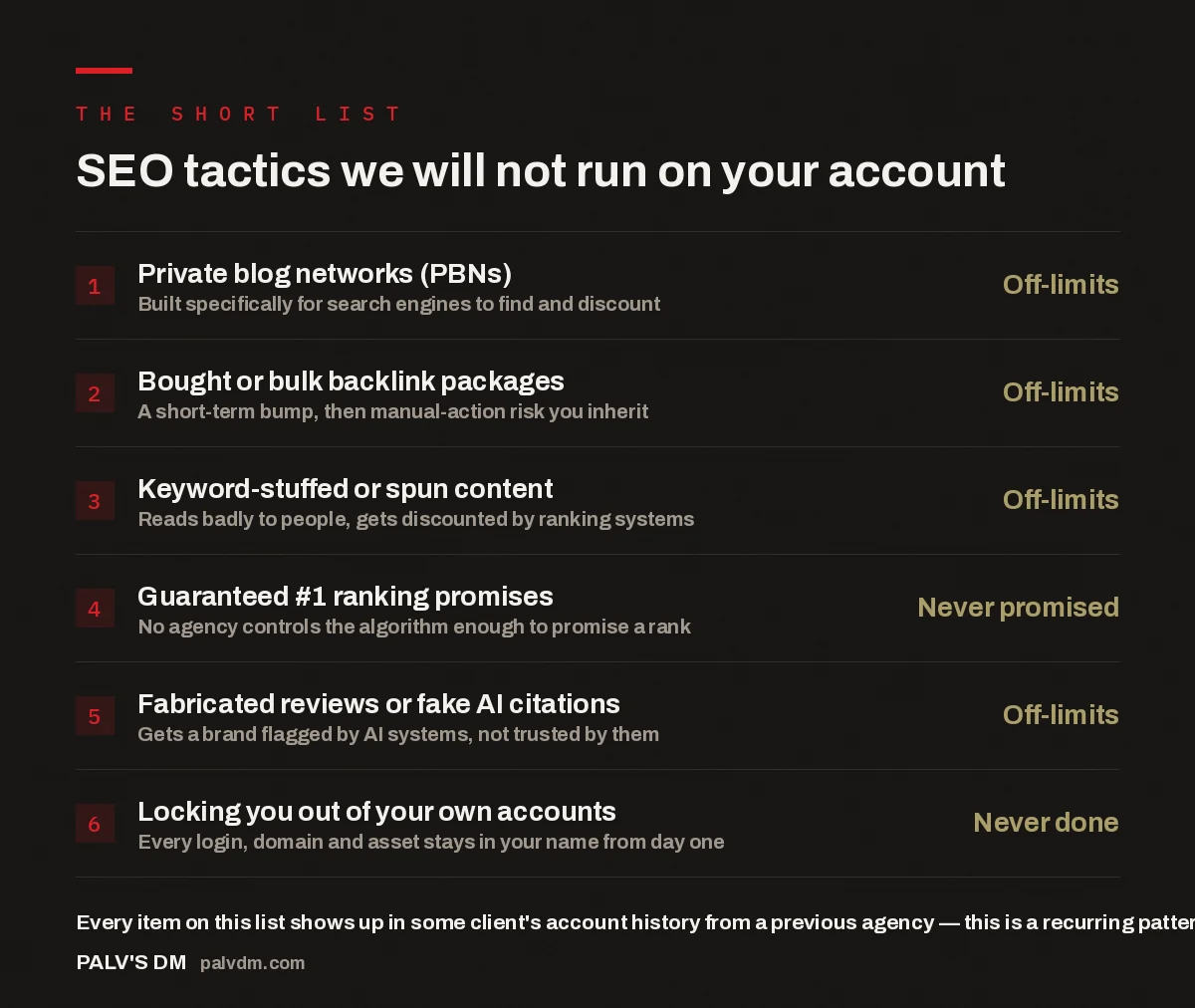
SEO tactics we will not run on your account
- Private blog networks (PBNs) — Off-limits. Built specifically for search engines to find and discount.
- Bought or bulk backlink packages — Off-limits. A short-term bump, then manual-action risk you inherit.
- Keyword-stuffed or spun content — Off-limits. Reads badly to people, gets discounted by ranking systems.
- Guaranteed #1 ranking promises — Never promised. No agency controls the algorithm enough to promise a rank.
- Fabricated reviews or fake AI citations — Off-limits. Gets a brand flagged by AI systems, not trusted by them.
- Locking you out of your own accounts — Never done. Every login, domain and asset stays in your name from day one.
What SEO tactics do we avoid, and why does each one backfire?
Every tactic on this list produces a result that looks good in a screenshot and gets worse the longer it runs. Here’s what each one actually does to a site, in practice.
Why do we refuse private blog networks and bought backlinks?
A private blog network is a cluster of sites built or bought purely to link back to a client’s domain. Bought backlink packages — the kind sold in bulk on freelance marketplaces — work the same way with less pretence about it. Both exist to manufacture the one signal Google’s link algorithms were originally designed to measure honestly: that other independent sites find your content worth referencing.
The problem isn’t just that this is against Google’s guidelines, though it is. It’s that link networks are structurally easy to detect — they share hosting patterns, footprint templates, and linking behaviour that looks nothing like organic citation. When a network gets caught, it doesn’t just stop working; it can trigger a manual action that suppresses the entire site, not just the pages the links pointed to. We’ve taken over accounts that were still recovering from a link scheme a previous agency ran two years earlier. Disavowing a bad backlink profile is real work we do for clients who arrive with one — it’s not work we’re willing to create for a client who doesn’t have one yet.
Why won’t we write keyword-stuffed or AI-spun content?
Keyword stuffing — repeating a target phrase unnaturally through a page to force relevance — was a viable tactic in a much older version of search. It reads badly, it’s easy for a human reader to spot, and modern ranking systems are explicitly built to discount pages that optimise for a term instead of answering the question behind it. Content spinning — running an article through a paraphrasing tool to produce dozens of near-duplicate variants for different pages or clients — has the same failure mode: it produces text that technically passes a plagiarism check but reads as generic, occasionally nonsensical, and offers a reader nothing a competitor’s page doesn’t already say better.
The reason this matters more now than it did five years ago is that AI answer engines — the systems behind AI Overviews, ChatGPT search, and Perplexity — are even less forgiving of thin, repetitive content than traditional search rankings are. These systems are choosing which sources to cite and summarise, and a page that reads as filler is a page that doesn’t get cited, no matter how many times the target keyword appears on it. We write for the person asking the question first, on the reasonable assumption that content built that way is also what a citation-hungry AI system is looking for.
Why don’t we guarantee a specific ranking or promise a fixed timeline?
No agency sets Google’s algorithm, and no agency controls what a competitor does with their own SEO budget next quarter. A guarantee to hit position one for a named keyword by a fixed date is either a coincidence dressed up as a promise, or it’s backed by exactly the manipulative tactics covered above — because manufacturing a short-term rank is the only way to make that kind of promise reliably true, briefly.
What we commit to instead is a defined scope of work — the pages we’ll optimise, the technical issues we’ll fix, the content we’ll publish, the keywords we’ll prioritise and why — and a reporting cadence that shows what actually moved. If you want to see how that scope gets set for a new account, our post on how we decide what goes into a client’s first 90 days walks through the sequencing. Rankings are the output of that work, not the input we sell.
A tactic that only works because Google hasn’t caught up to it yet isn’t a strategy — it’s a countdown timer on your account. We’d rather build something that’s still working the day an algorithm update ships, because one always does.
Palash, Founder, PalV’s DM
Why do we avoid fake reviews and fabricated AI citations?
This one is newer to the list, but it follows the same logic as the tactics above it. As AI Visibility and answer-engine optimisation (GEO/AEO) have become part of what clients ask for, a market has appeared around manufacturing the signals these systems appear to trust: purchased review volume, fabricated “as seen in” citations, and content designed to look like it was independently referenced when it wasn’t.
These tactics carry the same risk as link schemes, just on a newer surface. Review platforms actively detect and remove suspicious review patterns, and a brand caught faking citations doesn’t get a second chance at being treated as a trustworthy source — by a platform or by the AI systems increasingly pulling from that platform’s data. We build AI visibility the way we build search visibility: through content that’s genuinely citable, structured data that accurately describes what a business does, and a presence across the review and reference sites that AI systems already pull from — not manufactured proof that a business is trustworthy.
Why do you keep every account, login, and asset in your own name?
Some agencies register a client’s domain, Google Business Profile, Search Console property, or ad accounts under an agency-controlled login “for convenience.” It’s convenient until the client wants to leave and finds a renewal they didn’t know they were paying for. We set every account up in the client’s own name from day one — the details are in why you keep every account, login and asset. It’s a small operational choice with an outsized effect on how much leverage an agency has over you — none, if it’s done right.
The same principle applies to the work itself, not just the accounts. If you’ve inherited an account from a previous agency and aren’t sure what was actually done to it, our post on rebuilding SEO after a bad agency experience covers how we audit for exactly the tactics listed here before we start any new work.
What do we do instead of these tactics?
Ruling out manufactured signals doesn’t leave a gap — it points to the work that actually holds up. On the technical and content side, that means fixing crawlability, indexing, and page-experience issues that are genuinely limiting a site, then publishing content that answers real questions a buyer is searching for, sequenced by how we prioritise which keywords to chase first rather than which ones are easiest to spin content for — the logic behind that sequencing is in how we choose which keywords to chase first. On the link side, it means earning references through content worth citing, partnerships, and digital PR, which moves slower than a bought package but doesn’t carry a manual-action risk.
On the AI visibility side, it means making sure a business’s information is accurate and consistent everywhere an AI system might pull it from — the website, structured data, review platforms, directories — and building content that’s genuinely quotable, because that’s what gets pulled into an AI-generated answer. None of this is faster than the tactics we avoid. It’s just still standing after the next update.
Want to see this applied to your site?
Frequently asked questions
Will avoiding these SEO tactics slow down my results?
It can mean the visible movement in month one looks less dramatic than a bought-link campaign’s initial bump, yes. What it avoids is the reversal that tends to follow — a manual action, a link disavow project, or a core update that specifically targets manufactured signals. We’d rather set expectations honestly at the start than explain a rankings collapse later.
What if a client specifically asks us to run one of these tactics?
We explain the risk and decline. This has come up — usually from a founder who’s seen a competitor’s rankings spike and assumes a shortcut is behind it. We’ll show what we think is actually driving that competitor’s result, and if it turns out to be a manipulative tactic, we’ll say so and explain why we still won’t replicate it on your account.
How do I know if my current or previous agency used any of these tactics?
Signs include a backlink profile full of unfamiliar low-quality sites, a sudden traffic drop after a Google core update with no clear cause, content that reads oddly generic across many pages, or not having your own login to Search Console, Analytics, or your domain registrar. Any of these is worth a proper audit before continuing the relationship.
Do these same rules apply to AI visibility and GEO/AEO work, or just traditional SEO?
Both. The specific tactics differ — fake reviews and fabricated citations instead of link schemes — but the underlying rule is the same: we won’t manufacture a signal an AI system is trying to read honestly. AI systems are, if anything, faster to penalise a source once it’s caught being unreliable, because trust is the entire basis for citing it.
Does refusing these tactics mean SEO results take longer to show up?
Technical fixes and clear on-page improvements can show measurable movement within weeks. Content and link-earning work, which compound over months rather than spike overnight, is the part that takes longer than a manufactured shortcut — but it’s also the part that keeps compounding instead of resetting every time search or AI systems tighten their standards.
Short version: the SEO tactics we avoid — PBNs, bought links, keyword-stuffed or spun content, guaranteed rankings, fake reviews, fabricated AI citations, and agency-owned account setups — all share the same flaw: they manufacture a signal instead of earning one, and every system reading that signal, from Google’s core algorithm to an AI answer engine, is built to eventually catch the difference. Avoiding them isn’t a compliance checkbox. It’s the only version of SEO and AI visibility work that’s still worth something a year from now.