SEO for Startups: The Realistic First-Year Path
SEO for startups in India takes a full year, not a quarter: foundation work first, early leads by month six, a predictable channel by month twelve. Here's the realistic path.

SEO for startups in India realistically takes a full year to become a dependable channel, and it moves in stages: months one and two are foundation work with almost no visible ranking change, months three through six bring the first long-tail traffic and early leads, and months seven through twelve are when organic starts contributing a predictable slice of pipeline alongside paid. Any plan that promises page-one rankings inside 90 days for a new domain with no backlink history is either describing a low-competition niche keyword or setting an expectation it can’t keep. The honest version is slower, but it compounds — which paid acquisition, by itself, does not.
Key takeaway
- A realistic first year of SEO for startups has five phases: foundation, first indexed pages, early compounding, authority building, and a repeatable channel — not a straight line to rank #1.
- Startups that expect SEO to behave like Google Ads — turn it on, get leads next week — usually cancel around month three, right before the channel would have started paying off.
- The startups that get the most from year one spend it building pages tied to what they actually sell, not chasing broad, high-volume keywords with no commercial intent.
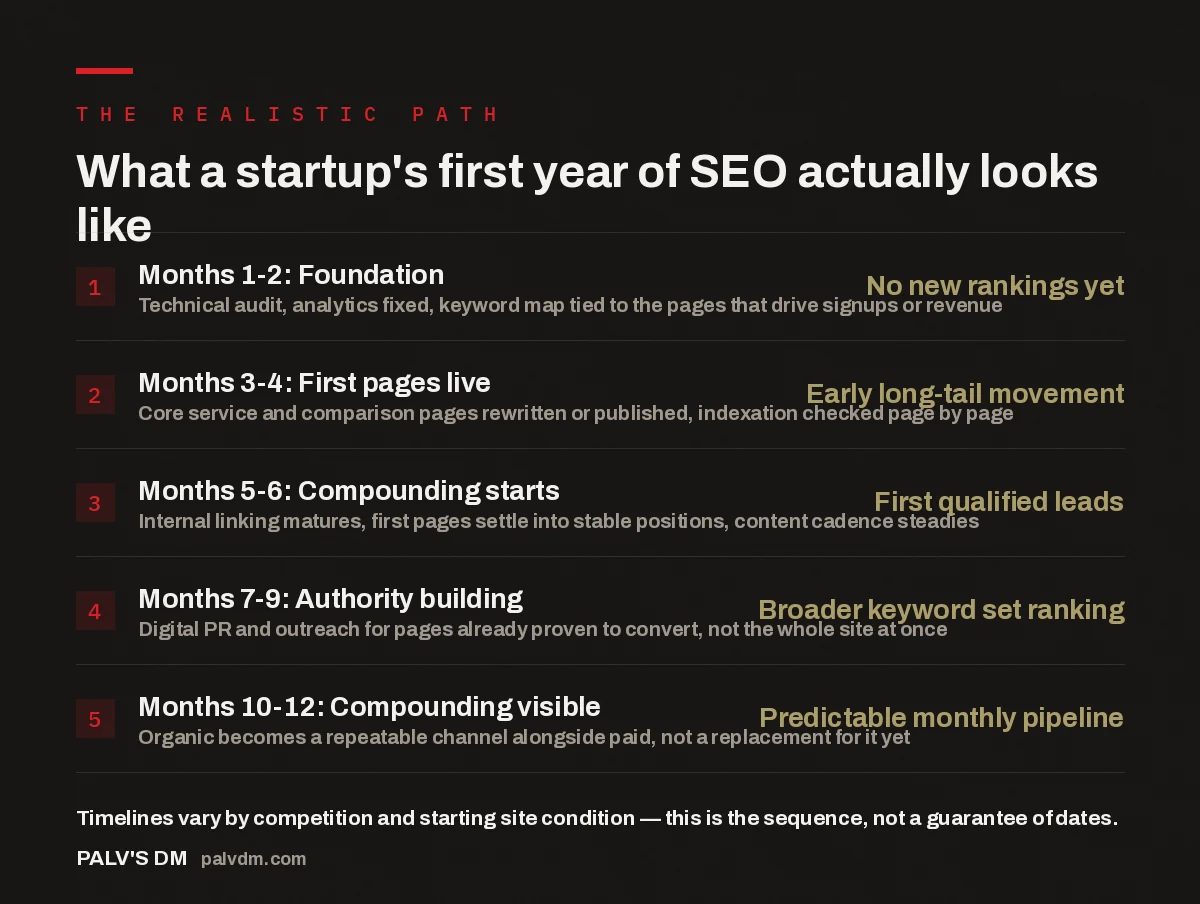
What a startup’s first year of SEO actually looks like
- Months 1-2: Foundation — No new rankings yet. Technical audit, analytics fixed, keyword map tied to the pages that drive signups or revenue.
- Months 3-4: First pages live — Early long-tail movement. Core service and comparison pages rewritten or published, indexation checked page by page.
- Months 5-6: Compounding starts — First qualified leads. Internal linking matures, first pages settle into stable positions, content cadence steadies.
- Months 7-9: Authority building — Broader keyword set ranking. Digital PR and outreach for pages already proven to convert, not the whole site at once.
- Months 10-12: Compounding visible — Predictable monthly pipeline. Organic becomes a repeatable channel alongside paid, not a replacement for it yet.
Why does SEO for startups in India take a full year, not a quarter?
Because a new domain has no history for Google to trust yet, and trust is built through consistent signals over time — indexed pages that stay indexed, content that keeps getting updated, links that arrive because the pages are genuinely useful, and users who click through and don’t bounce straight back. None of that compresses into a fixed number of weeks just by spending more money in month one. A startup with a six-month-old domain competing against incumbents that have been publishing and earning links for five years isn’t behind because of bad execution — it’s behind because of time, and the only way to close that gap is showing up consistently long enough for the newer domain to earn equivalent trust.
This is also why the first quarter looks deceptively quiet. The technical and analytics groundwork, the competitor research, and the keyword map tied to actual revenue pages all happen before anything visible changes in Search Console. We’ve written separately about what we do in month one that most agencies skip — it’s the same reason a startup’s first 30 days on SEO won’t look like progress even when the work is on schedule.
What actually happens in the first six months?
Months one and two are diagnostic and structural: fixing indexation issues, correcting titles and internal linking on pages that already exist, setting up or repairing GA4 and Search Console tracking, and building a keyword map that starts from the pages a startup actually needs people to land on — the pricing page, the comparison page, the specific use-case page — rather than a generic list of high-volume terms with no buying intent behind them. We go into how that prioritisation gets built in how we choose which keywords to chase first, and how the whole quarter gets sequenced in how we decide what goes into a client’s first 90 days.
By months three and four, new and rewritten pages start getting crawled and indexed, and the first movement usually shows up on long-tail, lower-competition terms — specific enough that a newer domain can realistically compete, and specific enough that the searcher is already close to a buying decision. This is also the stage where founders get impatient, because the traffic numbers are still small. That impatience is understandable, and it’s also the exact point at which stopping does the most damage: months five and six are when the pages published in month three typically start compounding — settling into more stable positions, picking up secondary keywords, and producing the first qualified leads rather than just impressions.
What changes in the second half of the year?
Months seven through nine are where authority-building work — digital PR, outreach, guest coverage — starts making sense, because there are now specific pages worth pointing links at that have already shown they convert, rather than spreading outreach effort thin across the whole site on a guess. Pursuing links before that point is usually wasted motion: a link to a page that later gets rewritten or dropped never compounds into anything.
Months ten through twelve are usually the first stretch where organic search behaves like a channel a startup can actually plan around — not the dominant source of pipeline yet in most cases, but predictable enough to model into a growth plan alongside paid acquisition, rather than treated as a bonus that might or might not show up. The pattern that shows up repeatedly on the startup accounts we work with is that the ratio between paid and organic pipeline starts shifting meaningfully in year two, once the content and authority built in year one keeps producing without needing fresh spend behind every visit.
Founders don’t usually cancel SEO because it stopped working. They cancel it in month three, right when the foundation work is done and the first pages are about to start compounding, because the dashboard still looks the same as it did in month one. The founders who stay past that point are the ones who get the channel most competitors never build.
Palash, Founder, PalV’s DM
Does a startup need SEO if it’s already running paid ads?
Yes, and the two work better as a pair than as alternatives. Paid ads give a startup traffic and data from day one — which keywords actually convert, which landing pages hold attention, which audience segments respond — and that data can shorten the SEO learning curve considerably, because the keyword and page priorities for organic don’t have to be guessed from scratch. SEO, in turn, is what keeps a startup from being permanently dependent on a rising cost-per-click as competitors bid up the same terms. We’ve covered this trade-off in more depth in do you need SEO if you already run Google Ads, but the short version for a first-year startup is: run paid to generate revenue now, and use SEO to build a channel that doesn’t disappear the moment the ad budget gets cut.
That budget question matters more for startups than for established businesses, because a lot of first-year SEO spend follows a funding event rather than a steady monthly plan. A large lump sum spent on SEO in month one doesn’t compress the year-long timeline above — trust-building still takes the time it takes — so the more useful question after a raise is what that spend should buy across the year, not how fast it can move month one. That’s covered separately in SEO after a funding round: spending it without waste.
What should a startup actually expect to measure, month by month?
In months one and two, the honest metrics are process metrics: pages fixed, tracking corrected, keyword map delivered. Traffic and ranking metrics in this window are close to meaningless either way. From month three, impressions and average position in Search Console start being worth watching, even before clicks move much — a keyword moving from position 40 to position 18 is real progress even though it produces almost no traffic yet. From month five or six, organic clicks and, more importantly, organic-sourced signups or leads become the metric that matters, tracked against the specific pages built to earn them rather than the domain as a whole. By months ten to twelve, the useful comparison is month-over-month organic pipeline contribution set next to paid, so a founder can see the ratio shifting.
One practical note specific to SEO for startups in India: category competition varies enormously by vertical. A first-of-its-kind product in a narrow B2B niche can see meaningful movement inside four to five months, because there’s genuinely little competing content for the terms that matter. A startup entering a crowded consumer category — fintech, ed-tech, D2C — against domains with years of content and links already built is working against a longer runway, and the honest first-year plan there looks more conservative than the timeline above, not less.
If you’re a startup deciding when to start
- Start once you have product-market fit signal, not before — SEO built on pages that will be rewritten in three months wastes the trust-building time it needs.
- Budget for a year, not a quarter, and ask any agency to show you what month three, six, and twelve are each supposed to produce.
- Keep paid running through year one — it’s the fastest way to validate which keywords are actually worth the SEO investment.
How long does SEO for startups in India realistically take to show results?
Early, low-competition movement can show up around month three to four; qualified leads typically start arriving around month five to six; and organic becomes a channel worth planning revenue around somewhere in months ten to twelve. Narrow B2B niches with little existing competition can move faster; crowded consumer categories usually take longer.
Should a pre-revenue or early-stage startup even invest in SEO yet?
Only once there’s reasonable confidence in the product and its core pages, since SEO’s value comes from consistency, and pages rewritten every few weeks while a startup is still finding fit never get the chance to build trust. Pre-product-market-fit startups are usually better served spending that budget on paid channels and customer research first.
Can a startup do SEO in-house in year one instead of hiring an agency?
Yes, if someone on the team can commit real, consistent hours to it — the timeline above assumes steady execution, and inconsistent effort stretches it further, not less. The honest constraint for most early-stage teams isn’t knowledge, it’s time: founders and early hires get pulled toward product and sales, which is exactly where SEO work tends to slip first.
Why do some startups see faster SEO results than others?
Mainly category competition and site history, not effort or budget alone. A startup entering a niche with few established competitors publishing content can move meaningfully faster than one entering a category already dominated by well-linked incumbents. A domain that’s existed for a couple of years with some prior content, even unoptimised, also tends to move faster than a brand-new domain with zero history.
Is it a waste to run SEO and paid ads at the same time in year one?
No — for most startups it’s the more efficient path, not a waste. Paid ads generate revenue and real conversion data while SEO is still building trust, and that data helps prioritise which pages and keywords the SEO work should target first, rather than guessing. Dropping paid the moment SEO starts also removes the interim revenue the business likely still needs before organic matures.
Short version: SEO for startups in India is a year-long build, not a quarter-long campaign — foundation work in months one and two, first movement in months three and four, early leads by months five and six, authority building in months seven through nine, and a genuinely predictable channel by month twelve. The startups that benefit most are the ones that plan a year of budget and attention around that sequence instead of judging the channel by what month one’s dashboard looks like.