About Pages That Establish Trust Instead of Filling Space
Most about pages are a mission statement nobody reads. What to put on yours so a sceptical buyer, a quality rater and an AI engine can all verify you.
An about page earns trust when it answers the three questions a sceptical buyer actually has: who is behind this, what have they actually done, and how would I reach them if something went wrong. Most about pages answer none of the three. They open with a mission statement, move through a paragraph about passion and innovation, and close without naming a single person, a registered address or one checkable fact. Google’s published guidance on helpful content asks directly whether a page gives readers background about the site that publishes it, naming an About page as one of the ways to do that. A page made of adjectives does not.
The sharper point is that an about page is not an SEO asset because of keywords. Almost nobody searches for your about page. It matters because it is the page a prospect opens after reading something useful, the page a journalist checks before citing you, and one of the pages a quality rater or a language model reads to decide whether your organisation is a real, identifiable entity. Its job is verification, not ranking.
Why do most about pages fail?
Three failure patterns account for the overwhelming majority of weak about pages, and all three are failures of evidence rather than writing.
The mission-statement opening. “We are a passionate team committed to delivering innovative solutions that empower our clients.” Every word of that sentence is true of every company and therefore tells a reader nothing. It is also the sentence most likely to be the first thing an extraction system pulls when it wants a description of your business.
No named humans. A page that says “our team” repeatedly, without a single name, photograph or role, cannot answer the question Google’s own guidance puts first — who is responsible for this. Anonymity on the one page whose entire purpose is identification is a structural problem, and it is the same failure described in why anonymous content is losing ground.
Nothing checkable. No founding year, no city, no registered entity name, no client names, no numbers. A reader who wants to verify that this business exists has nowhere to go. Verification is the whole point, and third-party corroboration of credentials is what makes the claim stand up.
What does Google’s guidance actually say about about pages?
Two documents are worth quoting rather than paraphrasing. Google’s helpful content guidance asks whether content “present[s] information in a way that makes you want to trust it, such as clear sourcing, evidence of the expertise involved, background about the author or the site that publishes it, such as through links to an author page or a site’s About page”. That is Google naming the About page explicitly in its own quality rubric.
Google’s Search Quality Rater Guidelines, the manual used by human contractors who assess sample results, lean heavily on identifying who is responsible for a website and finding reputation information about them. Raters are instructed to look for About and contact information, and a lack of it counts against a page — particularly for money-or-your-life topics such as finance, health and legal.
What none of that establishes is a ranking factor. There is no about page score, and E-E-A-T is not a ranking factor in the sense of a measurable lever. What the documentation gives you is a description of what Google’s systems are trying to approximate, which makes the about page a sensible thing to build properly rather than a hack.
What belongs on an about page?
The test for every element below: could a stranger check it in under a minute?
| Element | What weak pages do | What a verifiable page does |
|---|---|---|
| Who runs it | “Our team of experts” | Named founder and key people, real photographs, roles, links to profiles |
| What you do | “End-to-end digital solutions” | Named services, named market, what you deliberately do not do |
| Track record | “Years of experience” | Founding year, number of clients or projects, named sectors, published work |
| Location | Nothing, or “global” | City and country, registered address, service area stated plainly |
| Legitimacy | Nothing | Registered entity name, registration or tax identifiers, professional memberships |
| Contactability | A form with no address | Email, phone, address, and a link to a real contact page |
The last two rows are the ones most often skipped and the ones that do most of the work, which is why contact and business details function as trust signals in their own right rather than as administrative housekeeping.
How do you write the story section without it becoming filler?
An origin story is worth including, but only if it is specific enough that a competitor could not paste it onto their own page. Four constraints keep it honest.
- Start with a date and a decision, not a feeling. “PalV’s DM started in Ahmedabad in 2023 after five years of in-house SEO work” carries more than any sentence containing the word passion.
- Name what you rejected. The decisions you did not take define a business faster than the ones you did. Publishing prices rather than quoting on request is a position; explaining why you publish prices tells a buyer more than a values list.
- Say who you are not for. A page that admits which clients are a bad fit is far more credible than one claiming to serve everyone.
- Show the method, not the mission. If you have a repeatable process, describe it or link to it. Publishing your methodology converts a claim of competence into something a reader can inspect.
What should an Indian business include specifically?
Buyers in India are assessing whether a supplier is a registered business or one person with a template site, and the about page is where that gets settled. Include the registered entity name and structure — proprietorship, LLP, private limited — the registered office address with city and state, the GSTIN if you are registered, and the founding year. Where the business is regulated or certified, name the issuing body rather than displaying an unlabelled badge.
These details cost nothing and remove the single most common objection in the Indian SME market, which is uncertainty about whether the other party will still exist in six months. Building trust in the Indian market covers the wider set of signals buyers look for.
How should an about page be marked up?
The about page is the natural home for Organization schema. Give it a stable @id, then reference that same @id from every other schema block on the site so the organisation is one entity rather than a repeated string. Include name, legalName where it differs, url, logo, address as a PostalAddress, foundingDate, founder pointing at the Person entity, and sameAs listing the profiles that corroborate the claim.
Two rules apply. Structured data must describe what is visibly on the page — marking up an address that does not appear anywhere in the rendered content is a trust problem rather than a shortcut. And the sameAs list should point at profiles you control or that genuinely reference you; how sameAs actually works and how to build Organization schema properly cover the mechanics. The same entity discipline underpins entity SEO generally.
Does an about page affect how AI answers describe your brand?
Generative engines assemble a description of a company from whatever pages describe it plainly, and an about page written in declarative sentences is the easiest such source to extract from. If your about page opens with three sentences of abstraction, the description an engine produces will be abstract too, or it will be assembled from a directory listing you do not control.
Peer-reviewed research on generative engine optimisation (Aggarwal et al., KDD 2024) found that adding statistics, quotations from named sources and citations to authoritative sources lifted a source’s visibility in generative answers by up to around 40%, while keyword stuffing performed worse than doing nothing. The applicable lesson for an about page is narrow but real: concrete, attributable, specific text is easier for a retrieval system to use than promotional prose. Writing “founded in Ahmedabad in 2023, working with 40 clients across SaaS and manufacturing” gives an engine something to quote. Writing “a leading provider of innovative solutions” gives it nothing.
A ten-minute about page audit
- Read the first sentence aloud. If a competitor could publish it unchanged, rewrite it with a date, a place and a name in it.
- Count the checkable facts. Anything with a number, a proper noun or a date counts. Fewer than five and the page is decoration.
- Find the humans. At least one named person with a photograph and a link to an author page that signals real expertise.
- Find the address. If it is not on the page, add it, and make sure it matches what appears on your Google Business Profile and directory listings.
- Check the outbound corroboration. LinkedIn, registers, professional bodies, published work. At least two links leaving your domain.
- Check the schema against the visible text. Every claim in the markup should exist in the rendered page.
- Confirm it is indexable and internally linked. Header or footer, plus links from author bios. An about page nobody reaches does nothing, and a site-wide trust signal audit usually finds this one first.
The honest summary: an about page will not rank for anything valuable and was never meant to. It exists so that a reader, a rater or a retrieval system that wants to know who is behind your content can find out in under a minute. Judged against that job, most about pages are unfinished, and finishing one is an afternoon of work that applies to every other page on the site.
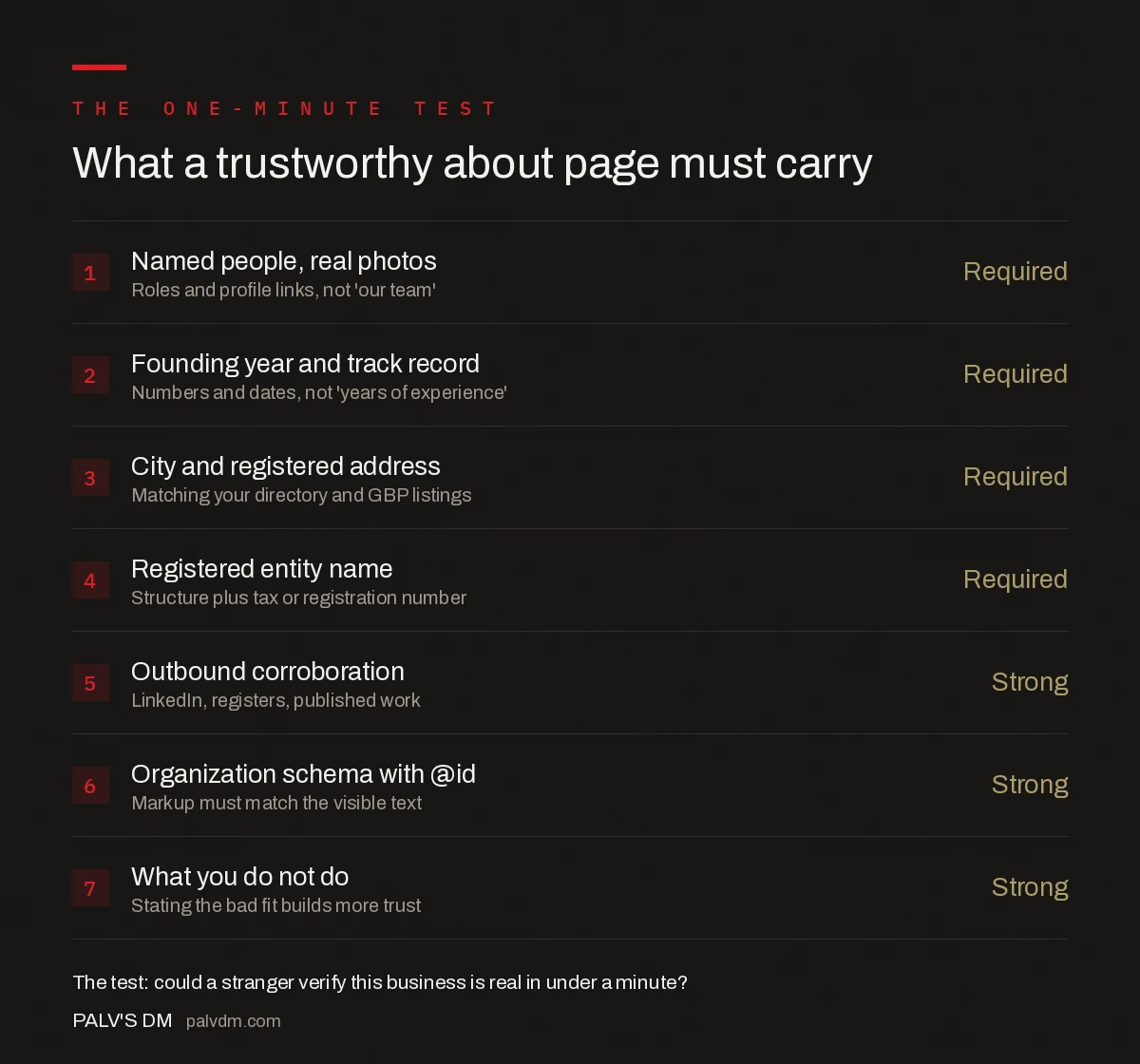
What a trustworthy about page must carry
- Named people, real photos — Required. Roles and profile links, not ‘our team’.
- Founding year and track record — Required. Numbers and dates, not ‘years of experience’.
- City and registered address — Required. Matching your directory and GBP listings.
- Registered entity name — Required. Structure plus tax or registration number.
- Outbound corroboration — Strong. LinkedIn, registers, published work.
- Organization schema with @id — Strong. Markup must match the visible text.
- What you do not do — Strong. Stating the bad fit builds more trust.
Frequently asked questions
Does an about page help SEO?
Not directly through rankings. Google’s helpful content guidance names an About page as one way a site can give readers background about who publishes its content, and its rater guidelines instruct assessors to look for information about who is responsible for a website. There is no about page ranking factor. The value is that it makes your organisation verifiable to readers, raters and AI answer engines.
What should an about page include?
Named people with real photographs and roles, a plain statement of what the business does and for whom, a founding year and track record expressed in numbers, a city and registered address, the registered entity name and any registration or tax identifiers, links to profiles that corroborate the claims, and a genuine way to make contact.
How long should an about page be?
Long enough to carry the checkable facts and no longer, which in practice is usually 400 to 800 words. Length is the wrong measure. Count verifiable specifics instead: names, dates, places, numbers, registrations and outbound links to profiles. A 300-word page with ten checkable facts beats a 1,500-word page of mission statements.
Should an about page use Organization schema?
Yes, and it is the natural home for it. Include name, legalName where it differs, url, logo, address as a PostalAddress, foundingDate, founder pointing at a Person entity, and sameAs listing corroborating profiles. Give the block a stable @id and reference the same @id elsewhere on the site. Every marked-up claim must also appear in the visible page content.
Should a one-person business still have an about page?
Yes, and it is easier to do well. A solo consultant can name themselves, show a photograph, state their qualifications and experience, link to LinkedIn and to published work, and give a real address and email. That is more verifiable than most agency about pages, which hide behind collective pronouns and never identify anyone.
Do AI search engines read about pages?
Generative engines build descriptions of companies from whatever pages describe them plainly, and an about page is usually the most direct such source. If yours is written in abstractions, the description that gets assembled will either be abstract or drawn from a third-party directory listing you do not control. Concrete, declarative sentences containing dates, places and numbers are far easier to extract accurately.
Sources
- Creating helpful, reliable, people-first content — Google Search Central — names the About page in its own quality rubric
- Google Search Quality Rater Guidelines
- Organization structured data — Google Search Central
- GEO: Generative Engine Optimization (Aggarwal et al., KDD 2024)
Want this done on your site?
Every PalV’s DM engagement starts with a free audit of your actual website — a 12-point
crawl covering what is blocking indexation, on-page gaps against your primary keywords, speed
findings, and the three to five fixes worth making first. Delivered in two working days. No
payment details, and the findings are yours whether you hire us or not.