Trends & Industry Developments
Agentic Search: When the Buyer Is a Bot
Agentic search means AI agents now research, compare, and sometimes buy on a human's behalf. Here's what it means and how to prepare your site.

Agentic search is when an AI agent — not a human — runs the query, evaluates the options, and sometimes completes the transaction. Think of a shopping assistant that compares five vendors and books the cheapest one that meets a spec, or a research agent that reads twenty product pages and returns a shortlist of three. The buyer is still a person, but the party actually reading your page, clicking through, and making the first-pass decision is a bot. If your site is built only to be read by humans and ranked by Google’s classic crawler, it is invisible to a growing slice of this traffic — not because it ranks poorly, but because it was never built to be machine-actionable in the first place.
Key takeaway
- Agentic search means an AI agent — a shopping assistant, a research tool, an autonomous browser — runs the query and evaluates your page on a human’s behalf, often without a screen involved.
- Agents read structured data, plain HTML, and machine-readable facts first; visual polish and JavaScript-heavy interactivity that a human would appreciate can be functionally invisible to them.
- Getting found by agents is less about ranking and more about being parseable, consistent, and reachable — schema, clean markup, accurate feeds, and explicit crawler access.
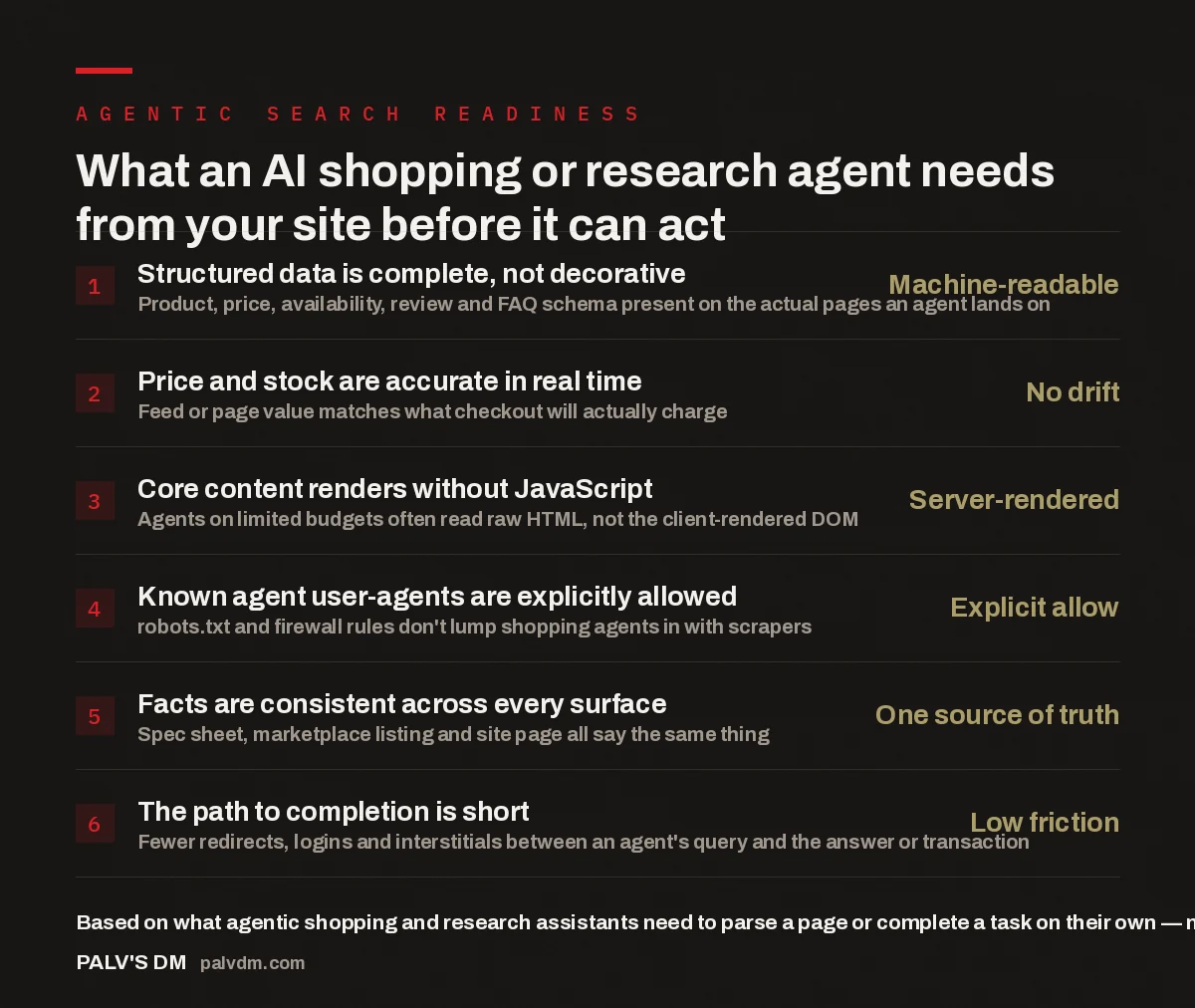
What an AI shopping or research agent needs from your site before it can act
- Structured data is complete, not decorative — Machine-readable. Product, price, availability, review and FAQ schema present on the actual pages an agent lands on.
- Price and stock are accurate in real time — No drift. Feed or page value matches what checkout will actually charge.
- Core content renders without JavaScript — Server-rendered. Agents on limited budgets often read raw HTML, not the client-rendered DOM.
- Known agent user-agents are explicitly allowed — Explicit allow. robots.txt and firewall rules don’t lump shopping agents in with scrapers.
- Facts are consistent across every surface — One source of truth. Spec sheet, marketplace listing and site page all say the same thing.
- The path to completion is short — Low friction. Fewer redirects, logins and interstitials between an agent’s query and the answer or transaction.
What does “agentic search” actually mean?
Agentic search describes a class of tools that don’t just answer a question — they take the next step. A conversational assistant that cites a source is still, functionally, a search result with commentary. An agent is different: it can open multiple pages in sequence, compare structured attributes across them, discard the ones that fail a constraint, and either hand you a recommendation or act on it directly — add to cart, fill a form, book a slot. The defining trait is autonomy over a multi-step task, not just a single retrieval-and-answer loop.
This is already visible in narrow, practical forms rather than as one unified product. Shopping-focused assistants built into browsers and chat interfaces compare prices across retailers. Coding agents pull documentation pages to decide which library to use. Travel and research agents assemble itineraries from multiple booking sites. None of these fully replace a human clicking around yet — most still hand a shortlist back to a person for the final call — but the reading and comparison step, once entirely human, now increasingly has a bot in the loop before a person sees the page.
How is an agent different from a normal search crawler?
A traditional crawler like Googlebot indexes a page once, on a schedule, to build a database that gets queried later. An agent fetches a page live, in response to a specific task, and needs to extract an answer within that single visit — often on a compute or time budget, since someone is waiting on the other end. That distinction matters for three reasons.
- Speed and simplicity beat polish. An agent parsing a page under time pressure favours clean, fast-loading markup over a heavy, JavaScript-rendered experience it has to wait on or fail to render at all.
- Structure beats prose. A crawler indexing for later retrieval can tolerate ambiguity because a ranking algorithm smooths it out. An agent making a decision in the moment needs the fact — price, availability, spec — in a form it can extract with confidence, which is exactly what schema markup and clean tables provide.
- The visit is transactional, not archival. If an agent can’t complete its task on your page — because a price is stale, a form requires a login it can’t pass, or a key fact is buried in an image — it moves to the next option instead of coming back later the way a human researcher might.
Why does this matter more for some businesses than others?
The pattern that shows up repeatedly in the accounts we work on is that exposure to agentic search tracks closely with how comparable and transactional the category is. A commodity product with a clear spec sheet — electronics, SaaS subscriptions, flights, insurance policies, anything with a price and a defined feature set — is exactly what an agent is built to compare. A high-consideration, relationship-driven purchase — enterprise consulting, bespoke manufacturing, anything sold through a multi-call sales cycle — is much harder for an agent to shortlist on structured attributes alone, so it stays more human-mediated for now.
That doesn’t mean relationship-driven businesses can ignore this. Even where the final decision stays human, the research phase is getting delegated earlier. A prospective client asking a research assistant to “find agencies that specialise in X and summarise their approach” is still a form of agentic evaluation — the agent is reading your about page, your case studies, and your service pages to build a summary a human will act on. If that content is thin, inconsistent, or locked behind interactive elements the agent can’t parse, you don’t get shortlisted, and you never find out why.
Most sites are still optimised for the moment a human lands on the page. Agentic search asks a harder question: can a machine extract the right answer from your page in one pass, with nobody around to fill in the gaps?
Palash, Founder, PalV’s DM
What should you actually change on your site?
None of this requires rebuilding your site. It requires treating machine-readability as a first-class requirement alongside human readability, which in most cases is a set of fixes rather than a redesign.
- Put the facts an agent needs in structured data, not just in a paragraph. Price, availability, specifications, ratings, and FAQs should exist as schema markup on the page, not only as prose a human would read and an agent might mis-extract.
- Make sure the core content survives without JavaScript. Test what your product and service pages look like with client-side rendering stripped out. If the price, the description, and the call to action disappear, an agent on a limited crawl budget may see the same blank page.
- Check your robots.txt and firewall rules for known agent user-agents. Rules written to block scraping bots sometimes catch legitimate shopping and research agents in the same net. Decide deliberately which agents you want reading your pages, rather than blocking by default.
- Kill inconsistency between your site, your marketplace listings, and your directory profiles. An agent comparing your Amazon listing to your own product page and finding two different specs doesn’t flag the discrepancy — it just trusts whichever source it read first, and it may not be yours.
- Shorten the distance between “found” and “done.” Every login wall, unnecessary redirect, or CAPTCHA between an agent’s query and the answer is a point where the agent gives up and tries a competitor instead.
Does this replace SEO, or sit alongside it?
It sits alongside it, and mostly reinforces the same fundamentals SEO has always rewarded — clean markup, fast pages, accurate structured data, consistent facts. What changes is the audience for that work. Classic SEO optimises for a ranking algorithm that a human then browses. Agentic search optimises for a task-executing reader that a human never directly watches. You’re no longer just earning a click; you’re earning a correct extraction, because the agent’s summary or shortlist is often the only exposure a human gets before a decision is made. Get the underlying facts wrong or unreachable, and you don’t lose a ranking position — you lose the shortlist entirely, invisibly, with no click data to tell you it happened.
This is also why agentic readiness compounds with the rest of AI visibility work rather than replacing it. A page that’s well-structured for agents tends to be well-structured for AI Overviews and chat citations too, because the underlying requirement — extractable, unambiguous, consistently stated facts — is the same across all three surfaces.
If you want a fuller picture of how these AI-driven surfaces fit together, our breakdown of what actually changed in search in 2026 covers the shift from ranking to being read by machines in more depth. For the shopping and comparison side specifically, it’s worth looking at which AI search platforms are actually being used, since agent behaviour differs by platform, and at how AI Mode and AI Overviews cite sources differently, since the extraction logic isn’t identical across surfaces.
How do you prepare product and service data specifically?
The single highest-leverage fix is usually the data layer, not the copy. Agents don’t read your marketing language the way a human does — they extract entities and attributes. A product page that says “our flagship plan starts at a competitive price” gives an agent nothing to compare. A page with a clearly marked price, currency, billing period, and feature list in structured data gives it everything. We go into the mechanics of this — schema types, feed formats, and the common gaps that make otherwise-good pages unreadable to agents — in preparing product and service data for AI agents.
Access control is the other half of the equation. Even a perfectly structured page is useless to an agent that isn’t allowed to fetch it. Agent user-agent strings change more often than most teams expect, and a robots.txt file written eighteen months ago can be silently blocking traffic you’d actually want. Our guide on managing AI crawler access through Cloudflare content signals covers how to control this deliberately instead of by accident.
Where to start
If you don’t know whether your site is currently readable by shopping or research agents, that’s the first thing to find out before investing further. An AI visibility audit checks exactly this — structured data coverage, JavaScript dependency on key pages, crawler access, and factual consistency across the sources an agent is likely to read.
Frequently asked questions
Is agentic search the same as AI Overviews or ChatGPT search?
No, though they overlap. AI Overviews and chat search answer a question and cite sources — a human still reads the result and decides what to do next. Agentic search goes a step further: the agent evaluates multiple options against a task and can act on the outcome, sometimes without a human reviewing every candidate page along the way.
Do I need separate content for AI agents versus human visitors?
Not separate content — the same content, made extractable in more than one way. Keep the human-facing copy as it is, and add structured data that states the same facts explicitly. Agents and humans should be reading the same underlying claims; the structured data is a translation layer, not a duplicate site.
Will blocking AI crawlers protect me from agentic search, or hurt me?
It depends what you’re blocking and why. Blocking crawlers that train models is a separate decision from blocking agents acting on a live user’s behalf — the latter is closer to a customer visiting your site through an unusual browser. Blocking indiscriminately by user-agent pattern risks cutting off exactly the traffic you’d want, so review the list of agent user-agents deliberately rather than blocking by default.
How would I even know if agents are reading my site?
Server logs are the most direct source — filtering for known agent user-agent strings shows fetch activity that analytics tools built around JavaScript tracking often miss entirely, since many agents don’t execute JavaScript or fire tracking pixels. It’s worth reviewing raw logs periodically rather than relying only on dashboard-level analytics for this.
Is this worth prioritising if my category isn’t very “shoppable”?
It’s worth doing the basics regardless — clean markup and structured data help every AI surface, not just transactional agents. But if your category involves a long, relationship-driven sales cycle, treat agentic readiness as groundwork for the research phase rather than expecting agents to complete a purchase on your behalf; that part of the funnel is likely to stay human-led for longer.
Short version: agentic search means AI tools are increasingly reading, comparing, and sometimes acting on your pages before a human ever sees them. The businesses least affected are the ones already treating structured data, clean markup, and factual consistency as core infrastructure rather than an afterthought — which, not coincidentally, is also what good SEO has always asked for.