Trends & Industry Developments
How AI Surfaces Are Being Monetised, and What It Means for Organic
AI search ads are showing up inside AI Overviews, chat answers, and shopping surfaces. Here's what's live, what's piloting, and what it means for organic visibility.
AI search ads are no longer a hypothetical. Google has started placing labelled sponsored links inside AI Overviews, Perplexity and ChatGPT are testing shopping and checkout flows inside chat answers, and Microsoft Copilot carries ad units alongside its cited sources. None of this replaces organic visibility yet — but it does mean the space above and around AI-generated answers is being sold, the same way the space above traditional search results was sold for two decades. If you rank or get cited today, you are increasingly sharing that surface with a paid unit sitting right next to you.
Key takeaway
- AI search ads are rolling out unevenly across platforms — sponsored links in AI Overviews, shopping carousels in chat, and pilot checkout flows are the current formats, not a single unified ad product.
- Monetisation inside AI answers doesn’t shrink the value of organic citations — it raises the bar, because now you’re competing with a paid unit for the same limited attention, not just other organic results.
- The practical response isn’t to buy your way into AI surfaces yet — it’s to make earned citation strong enough that it survives sitting next to a paid one.
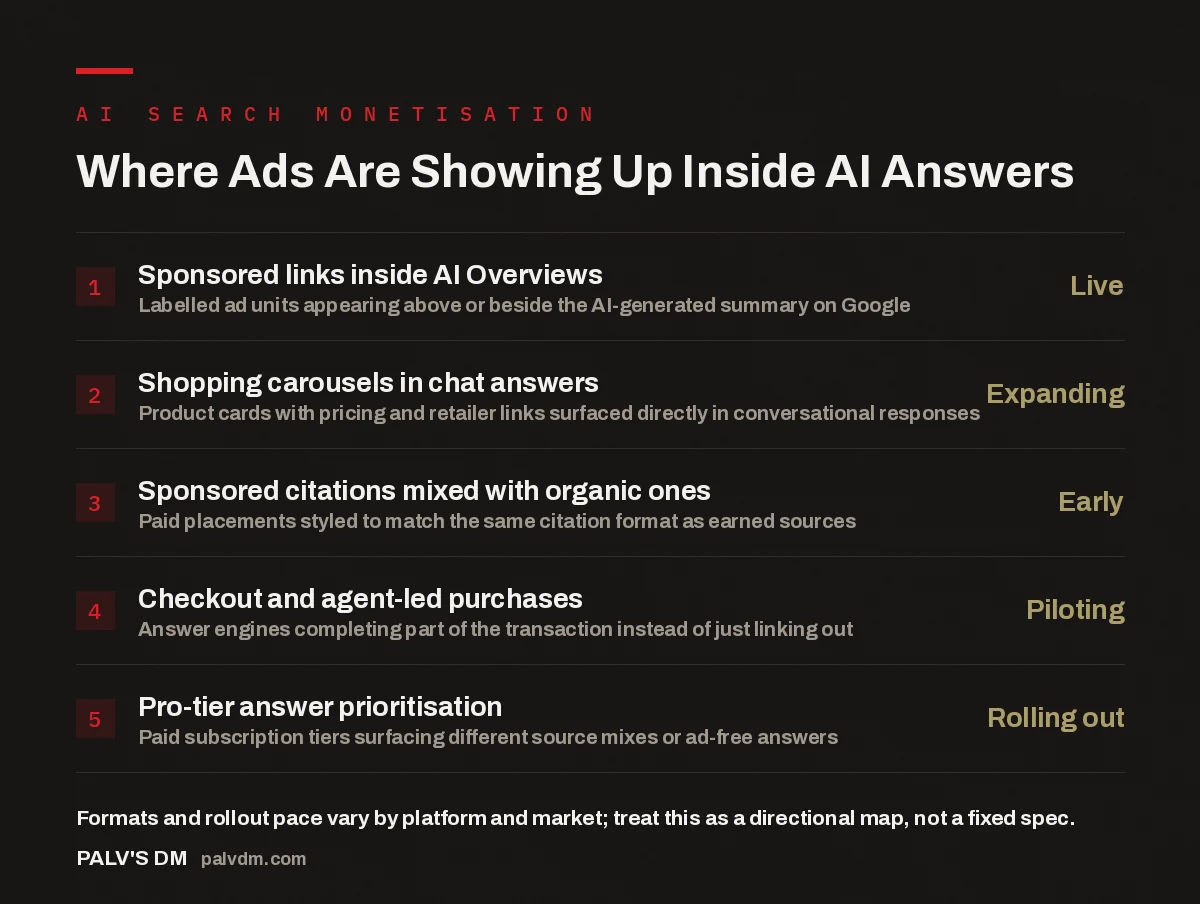
Where Ads Are Showing Up Inside AI Answers
- Sponsored links inside AI Overviews — Live. Labelled ad units appearing above or beside the AI-generated summary on Google.
- Shopping carousels in chat answers — Expanding. Product cards with pricing and retailer links surfaced directly in conversational responses.
- Sponsored citations mixed with organic ones — Early. Paid placements styled to match the same citation format as earned sources.
- Checkout and agent-led purchases — Piloting. Answer engines completing part of the transaction instead of just linking out.
- Pro-tier answer prioritisation — Rolling out. Paid subscription tiers surfacing different source mixes or ad-free answers.
What does advertising inside AI answers actually look like right now?
It’s fragmented, and that fragmentation matters more than any single format. Google has been testing sponsored links positioned around AI Overviews on mobile and desktop — visually separated from the AI-generated text but sitting in the same viewport, competing for the same eyeball. Shopping-oriented AI experiences, including product-focused answers inside Google’s AI Mode and inside conversational tools like Perplexity, surface retailer cards with price and availability baked into the answer itself, not as a separate results list underneath. Microsoft has run ad formats inside Copilot’s conversational responses for a while now, styled to sit close to — but distinguishable from — the cited sources.
None of these are mature, standardised ad products in the way Google Search Ads or Meta Ads are. Formats change, placements shift between desktop and mobile, and what one platform pilots this quarter may be pulled back next quarter. What’s consistent across all of them is the direction: every major AI answer surface is building a way to sell attention inside the answer, not just around a results page.
Why is this happening now?
AI answers reduce the number of clicks that make it to a traditional results page, and that reduction is well documented across the industry — it’s part of why “zero-click” has become a standard term in search discussions again. Fewer clicks to a search engine’s own ad inventory is a direct revenue problem for any platform whose business model depends on paid placements. Building ad units inside the AI answer itself is the straightforward fix: if users are getting their answer without leaving the surface, the ad has to move into the surface too.
There’s a second driver worth naming: AI answer engines need a monetisation path independent of search-ad auctions to justify their own existence as standalone products. A conversational assistant that only ever routes people to a traditional search results page isn’t defending much territory. One that can complete a purchase, recommend a product with a sponsored nudge, or surface a paid listing inside the conversation is building a business model that doesn’t depend on anyone clicking through to somewhere else.
How does this change the economics of organic visibility?
It doesn’t eliminate the value of being cited or ranked — it changes what you’re competing against for attention once you get there. On a traditional results page, an organic listing competes with other organic listings and a handful of ads at the top. Inside an AI answer, an organic citation competes with the framing the AI model chooses to give it, other cited sources, and now, increasingly, a paid unit sitting inside the same compact answer block. The real estate is smaller, so every element inside it — including a sponsored one — has a bigger relative effect on where attention lands.
The pattern we see repeatedly in the accounts we manage is that businesses treat this as a reason to chase paid placement inside AI surfaces immediately. That’s premature for most categories — the ad products are still too new, too inconsistent across platforms, and too limited in reach to be a reliable acquisition channel on their own. The more durable response is making sure your earned citation is strong enough on its own terms: clear, structured, well-sourced content that an AI model has a reason to pull from and attribute to you by name, regardless of what’s being sold next to it.
| Factor | Paid placement in AI answers | Organic/earned citation |
|---|---|---|
| Cost model | Pay per placement or campaign, ongoing spend required | One-time content and technical investment, no per-click cost |
| Persistence | Stops the moment budget stops | Persists as long as the source stays authoritative and current |
| Availability today | Limited to a few platforms and formats, still rolling out | Available on every major AI answer surface right now |
| Trust signal to the model | Labelled as sponsored, weighted differently by design | Treated as a source the model chose to cite on merit |
| Who controls it | The platform’s ad product and auction rules | You, through content quality, structure, and authority signals |
Every platform that has ever built an answer surface has eventually sold space inside it. The businesses that win aren’t the ones who panic and buy in on day one — they’re the ones whose earned visibility was already strong enough that the paid unit next to them barely mattered.
Palash, Founder, PalV’s DM
What should you actually do about AI search ads right now?
- Track what’s actually happening on your queries, not the category average. Search your own priority terms across Google AI Overviews, AI Mode, and whichever chat tools your buyers use, and note where sponsored units are appearing versus where organic citations still dominate. Formats vary enough by query type that generic industry commentary won’t tell you what’s true for your terms.
- Prioritise citation quality over citation quantity. A model choosing what to cite next to a paid unit is more likely to pick a source that answers the question cleanly and can be attributed with confidence — clear structure, direct answers near the top of the page, and content that doesn’t require inference to summarise.
- Don’t rush into pilot ad programs without a clear test structure. If you do experiment with sponsored placement inside an AI surface, treat it like any new ad channel — a bounded budget, a defined success metric, and a comparison against what unpaid citation is already delivering for the same query set.
- Watch referral quality, not just referral volume. Traffic that arrives via an AI citation tends to behave differently from traffic that clicks a sponsored unit — different intent, different stage in the decision. Segment the two in analytics as soon as either becomes a meaningful source, so you’re not judging one against the other with the wrong yardstick.
- Revisit this quarterly, not annually. Ad formats inside AI surfaces are changing faster than traditional search ad products ever did. A format that doesn’t exist on a platform today can appear within a single product update cycle.
This connects to a broader shift worth understanding on its own — how marketing budgets are moving as search fragments across paid, organic, and AI-native channels. It’s also worth reading alongside a look at how much organic traffic has actually disappeared to zero-click behaviour, since that decline is a big part of why platforms are building ad units inside answers in the first place. If you haven’t already, our broader rundown of what actually changed in search in 2026 gives useful context for where this monetisation trend sits relative to everything else moving at once.
For platform-specific detail, our piece on what Google AI Mode is and how to be visible in it covers the mechanics of the surface where sponsored placement is furthest along, and our analysis of why earned media dominates AI citations makes the case for why the strategic response described here isn’t just risk-averse — it’s currently the higher-leverage move for most businesses.
Where this leaves you
Building strong AI visibility now — before paid placement inside these surfaces becomes standard and competitive — is the more durable move than waiting to see how the ad products shake out.
Frequently asked questions about AI search ads
Are AI search ads the same as Google Ads?
No. Google Ads run on the traditional search results page and shopping tabs. AI search ads are a newer, separate category of sponsored units placed in or around AI-generated answers, such as AI Overviews or conversational chat responses. They use different placements, different formats, and in most cases different bidding and eligibility rules than standard search ads.
Should I stop investing in SEO now that AI surfaces sell ad space?
No. Sponsored placement inside AI answers is still limited, inconsistent across platforms, and only available for a subset of queries. Organic citation remains the primary way most businesses get mentioned inside AI answers, and it’s available on every platform today, not just the ones running ad pilots.
Can small businesses realistically compete once AI answers carry ads?
Yes, on the organic side. Earned citation inside an AI answer isn’t an auction — it’s based on how clearly your content answers the question and how confidently the model can attribute the answer to you. A well-structured page from a smaller business can still be cited even when a larger competitor is running a paid placement next to it.
How can I tell if ads are appearing on my important search queries?
Manually search your priority queries across Google (checking both standard results and AI Overviews/AI Mode) and across the chat tools relevant to your audience, on both desktop and mobile. Formats and placements are inconsistent enough right now that automated rank trackers don’t reliably capture them yet, so a periodic manual check is still the most accurate approach.
Will AI platforms eventually let you pay for a citation?
Platforms have generally kept sponsored units visually and structurally separate from organic citations, labelling them as ads rather than blending them into the cited-source list. That distinction matters for trust, and there’s no confirmed indication that any major platform plans to sell placement inside the organic citation set itself — though this is worth watching as formats mature.
Short version: AI search ads are real and expanding — sponsored links in AI Overviews, shopping carousels in chat answers, and early checkout pilots are the current formats. They add competition for attention inside AI answers, but they haven’t replaced organic citation as the primary way most businesses get mentioned. The move that holds up regardless of how the ad products evolve is making your earned visibility strong enough to stand next to a paid placement and still get noticed.