Trends & Industry Developments
Where Marketing Budgets Are Moving as Search Fragments
As search fragments across AI platforms, marketing budget ai search shifts from pure rank tracking toward AI visibility, citations, earned media.
Marketing budget is moving away from line items that assume a search results page full of blue links, and toward work that gets a brand named inside an AI-generated answer. That means less money treated as pure “SEO” spend and more of it labelled AI visibility, content authority, or digital PR — even when the underlying work overlaps heavily with what SEO always did. The shift isn’t about abandoning search; it’s about reallocating inside search as the definition of “search” splits across Google, AI Overviews, AI Mode, ChatGPT, Perplexity, and a growing list of agentic tools.
Key takeaway
- Budget isn’t leaving search, it’s redistributing inside it — from pure ranking work toward the content, structure, and authority signals that get cited by AI answers.
- The clearest signal a reallocation is overdue is a gap between rankings and citations: showing up in position one on Google while being invisible when the same question is asked of an AI assistant.
- The teams handling this well aren’t cutting SEO budgets, they’re widening the scope of what “search marketing” is allowed to fund and who is accountable for tracking it.
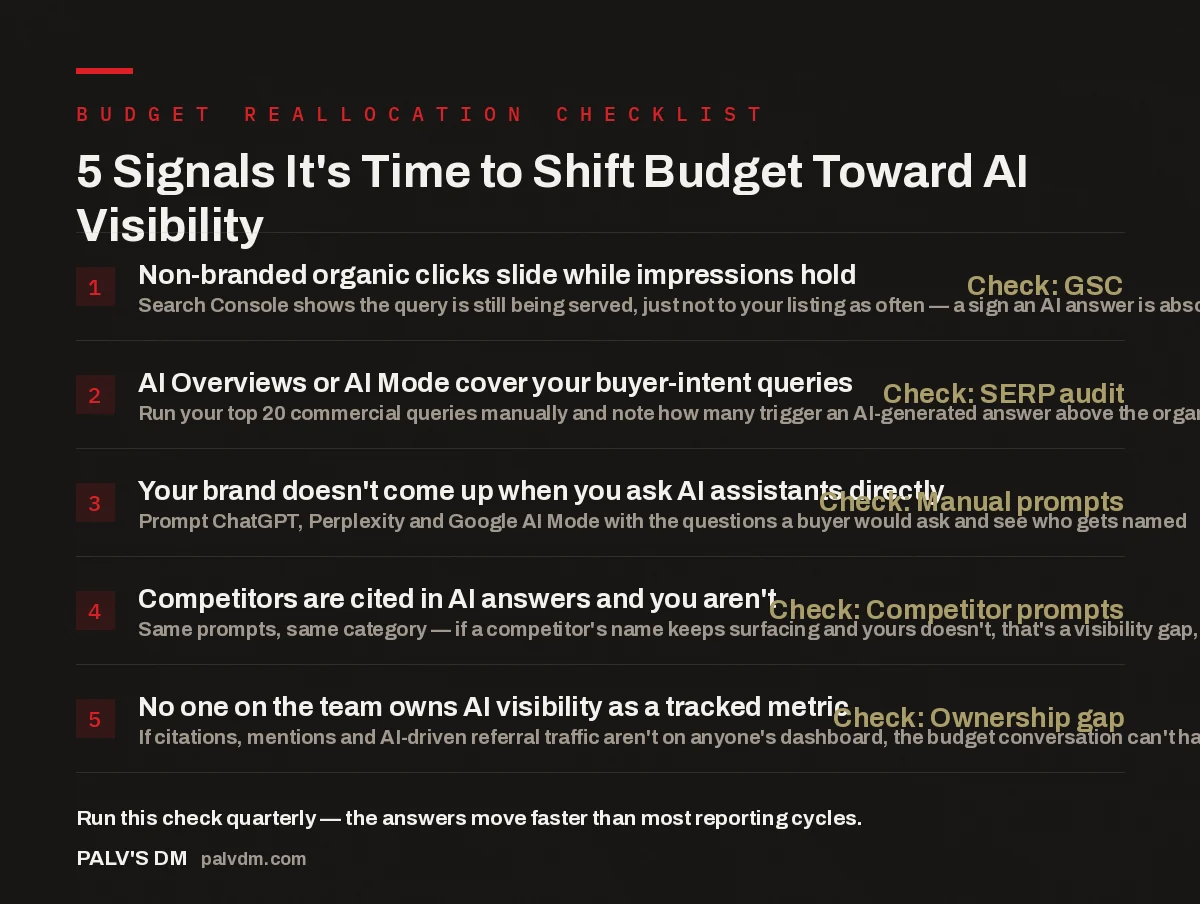
5 Signals It’s Time to Shift Budget Toward AI Visibility
- Non-branded organic clicks slide while impressions hold — Check: GSC. Search Console shows the query is still being served, just not to your listing as often — a sign an AI answer is absorbing the click.
- AI Overviews or AI Mode cover your buyer-intent queries — Check: SERP audit. Run your top 20 commercial queries manually and note how many trigger an AI-generated answer above the organic results.
- Your brand doesn’t come up when you ask AI assistants directly — Check: Manual prompts. Prompt ChatGPT, Perplexity and Google AI Mode with the questions a buyer would ask and see who gets named.
- Competitors are cited in AI answers and you aren’t — Check: Competitor prompts. Same prompts, same category — if a competitor’s name keeps surfacing and yours doesn’t, that’s a visibility gap, not a fluke.
- No one on the team owns AI visibility as a tracked metric — Check: Ownership gap. If citations, mentions and AI-driven referral traffic aren’t on anyone’s dashboard, the budget conversation can’t happen properly.
Why is marketing budget ai search reallocation happening now?
Search fragmented because the answer moved before the click did. For a large share of informational and comparison queries, Google now shows an AI-generated summary before a single organic result — and platforms like ChatGPT, Perplexity, and Google’s own AI Mode have become genuine research destinations, not novelties. Marketers watching their own analytics closely notice the same pattern: impressions holding up in Search Console while clicks on non-branded terms soften, because the query is being answered on the results page or inside a chat interface rather than resolved through a visit to the site. Budget follows attention, and attention is splitting across more surfaces than it used to.
This is not the same story as “SEO is dead,” which has been declared wrongly on a fairly regular schedule for over a decade. Google is still the largest single referrer of commercial intent traffic most businesses have. What’s changed is that it’s no longer the only surface worth being visible on, and the skills that win on the newer surfaces — clear structured content, being the source AI models actually cite, strong third-party authority — are close cousins of good SEO rather than a replacement discipline. The budget conversation is less “cut SEO, fund something new” and more “widen what search budget is allowed to pay for.”
What’s actually pulling money out of the old line items?
Three specific behaviours show up repeatedly in the accounts we work on and in conversations with other practitioners, and they explain most of the reallocation:
- Rank-tracking-only reporting is losing credibility internally. A dashboard showing “position 3” for a keyword that no longer sends proportional traffic, because an AI Overview sits above it, stops convincing finance teams the spend is working. Once a CMO notices the gap between rank and result, budget usually follows the fix.
- Content built purely to rank is underperforming against content built to be cited. Thin, keyword-stuffed pages rarely get pulled into an AI-generated answer because there’s nothing distinctive to extract. Original data, clear definitions, and well-structured comparisons do. Teams are shifting spend from volume toward depth for that reason.
- Link building budgets are migrating toward digital PR and earned coverage. AI systems weight third-party mentions heavily when deciding what to reference, making a mention in a trade publication worth more, relatively, than a paid directory link — pulling spend from transactional link acquisition toward genuine PR.
None of these is dramatic in isolation. Together, over two or three budget cycles, they add up to a noticeably different allocation than most search budgets had in 2022 or 2023.
Where is the reallocated budget landing?
In the accounts we’ve restructured, the money tends to land in four places, roughly in this order of priority:
- AI visibility tracking and auditing. Before deciding how much to spend on being cited, someone has to establish whether the brand currently is cited, for which queries, and against which competitors. That baseline work now gets its own line item rather than being absorbed informally into an SEO retainer.
- Original research and data content. Content that states a genuinely new fact, survey finding, or analysis is what AI systems and journalists prefer to cite over generic advice pieces. Budget is moving toward producing that kind of source material, even in smaller businesses that previously never commissioned research.
- Technical work that makes content legible to machines. Structured data, clean information architecture, and content formatted so an AI crawler can extract a clear answer are getting budget that used to go toward generic “technical SEO audits.” The goal has narrowed from crawlable to quotable.
- Digital PR and third-party placement. Because AI answer engines lean heavily on external validation, earned coverage that used to be a “nice to have” is being funded out of what was previously a pure SEO or performance marketing budget.
Notice what’s missing: paid search isn’t disappearing, and social budgets aren’t being raided wholesale. The reallocation happens mostly within the search and content budget itself.
The clients who get this right aren’t the ones with the biggest budgets — they’re the ones who stopped asking “how do we rank higher” and started asking “how do we become the source,” and let the spend follow that question instead of the old KPI.
Palash, Founder, PalV’s DM
How should you decide your own split between SEO and AI visibility work?
There’s no fixed ratio that applies to every business, and anyone quoting you a precise percentage split without looking at your data is guessing. What does work is a repeatable process:
- Audit where you’re currently cited versus currently ranked. Pull your top 20-30 commercial and informational queries. Check organic rank for each, then check manually whether an AI Overview, AI Mode, or a tool like Perplexity cites you, a competitor, or neither. The gap between the two lists is your priority map.
- Separate “keep doing” from “start doing.” Technical health, indexation, and core on-page relevance still need ongoing investment. New spend should be additive, funded by trimming the lowest-performing legacy tactics rather than by cutting foundational SEO.
- Assign ownership before you assign budget. A common failure pattern is approving spend on “AI visibility” with no one responsible for tracking citations or reporting the trend. Name an owner first, even a fractional one inside an existing role.
- Re-run the audit quarterly, not annually. AI platforms change how they cite sources and how prominently AI answers appear faster than a typical annual planning cycle can absorb. Quarterly re-checks keep the split honest instead of locked to a year-old plan.
For the fuller context behind any single budget decision, the state of search overview for 2026 lays out the broader platform-level changes driving this reallocation.
What does a reallocated budget look like in practice?
Picture a mid-sized B2B services company spending a fixed monthly retainer on “SEO” that historically covered keyword-targeted blog posts, backlink outreach, and rank tracking. A reallocated version of that same retainer, at similar total spend, typically shifts weight rather than adding new money: fewer, deeper content pieces built around genuine expertise instead of a high volume of shallow posts; outreach budget redirected from directory-style link building toward pitching journalists; and the reporting deck expanded to include an AI citation check alongside the usual rank report. Technical SEO work — site speed, crawlability, structured data — usually stays roughly the same, since that foundation still matters for both Google and AI crawlers.
What tends to shrink isn’t the search budget overall, it’s the portion spent on tactics that only ever paid off through ranking position — volume-based content mills and low-quality link acquisition are the two most common casualties.
What mistakes are teams making when they rush this shift?
The most common mistake is treating “AI visibility” as an entirely new discipline needing a brand-new vendor and a parallel budget, rather than an extension of existing search work — resulting in two teams working from different data, duplicating content efforts, with neither owning the full picture. A related mistake is cutting foundational SEO spend too aggressively on the assumption that Google traffic is disappearing wholesale. It isn’t, for most businesses, and starving the channel that still delivers the bulk of measurable organic traffic to fund an unproven new one loses ground on both fronts.
The other recurring mistake is skipping measurement entirely. It’s genuinely harder to track AI-driven visibility with the same precision as a keyword rank, and that difficulty leads some teams to avoid tracking it, spending on faith rather than evidence — with no way to tell whether the reallocated budget is working or just fashionable. Only a small fraction of marketers currently track AI visibility in any structured way, which is why the businesses that do measure it tend to make faster, better-founded budget decisions. Building a proper visibility scorecard across surfaces is the highest-leverage step most teams skip before reallocating a rupee of budget.
Is it too early to shift budget, or already too late?
Neither, for most businesses. The fragmentation described here has been building for a few years and is now well past the point where it’s a fringe concern, but it hasn’t reached a point where organic Google search has stopped mattering — whether SEO is still worth investing in is a fair question to ask directly, and the honest answer for most businesses is yes, alongside AI visibility work rather than instead of it. The businesses at real risk are the ones treating this as a future problem, because the audit, the content depth, and the earned-media relationships that AI visibility depends on all take months to build, not weeks. Starting the budget conversation now puts a business ahead of competitors waiting for a clearer signal that may never arrive as one obvious event — reading how much click-through has actually shifted away from organic listings is a useful gut-check before finalising next year’s numbers.
Next step
If you don’t yet know whether your brand shows up when AI tools answer your buyers’ questions, that’s the first gap to close before reallocating a single rupee of budget.
Should I cut my SEO budget to fund AI visibility work?
No, not as a general rule. Organic Google search still delivers the largest share of measurable traffic for most businesses, so cutting it to fund an unproven new channel usually costs more than it saves. The better approach is trimming the lowest-performing legacy tactics — thin content, low-quality link building — and redirecting that portion toward AI visibility work.
How much of the marketing budget should go toward AI search visibility?
There’s no universal percentage, and any number offered without looking at your traffic and citation data should be treated skeptically. Start by auditing the gap between where you rank on Google and where you’re cited by AI tools for the same queries — the size of that gap is a far more reliable guide than an industry benchmark.
Is this budget shift happening across every industry equally?
No. It’s most visible in categories with heavy informational and comparison search behaviour — B2B software, professional services, health, finance, travel — where AI Overviews and AI Mode appear on a large share of relevant queries. Categories driven more by local or highly transactional, branded search see a smaller but still growing effect.
Who should own AI visibility budget inside a marketing team?
In most teams we work with, it sits with whoever already owns SEO and organic content, since the underlying skills overlap heavily. What matters more than the org chart position is that someone is explicitly accountable for tracking citations, rather than the work being informally absorbed without measurement.
What’s the fastest way to see if my budget needs to shift?
Run the five-signal checklist above against your own data this week: check Search Console for non-branded click trends, manually search your top buyer-intent queries to see if an AI Overview appears, and prompt two or three AI assistants directly with questions your buyers would ask. If two or more signals are present, the budget conversation is already overdue.