Service Support — AI Visibility
When AI Engines Recommend Competitors and You Want That Fixed
Losing to a competitor recommended by ChatGPT? Diagnose the exact source gap, fix the right page, and track it with this step-by-step GEO process.
When ChatGPT, Perplexity or Gemini names your competitor instead of you, the fix is rarely “write more content.” It’s almost always one of three things: your site has no page that answers the exact question being asked, the sources the engine trusts (reviews, forums, comparison roundups) mention your competitor and not you, or your page answers the question but isn’t structured for the engine to lift and cite cleanly. Fixing it means finding out which one you’re dealing with, then closing that specific gap — not rewriting your whole site and hoping.
Key takeaway
- Before you touch your site, log the exact prompt and check every source the AI engine actually cites — that’s where the real gap is.
- Most “competitor gets recommended by ChatGPT” cases trace back to a missing citable page, weak third-party mentions, or a page that isn’t structured for extraction — rarely all three at once.
- Track the same prompts on a fixed schedule after you make changes; AI engines re-index and re-generate answers on their own timelines, not yours.
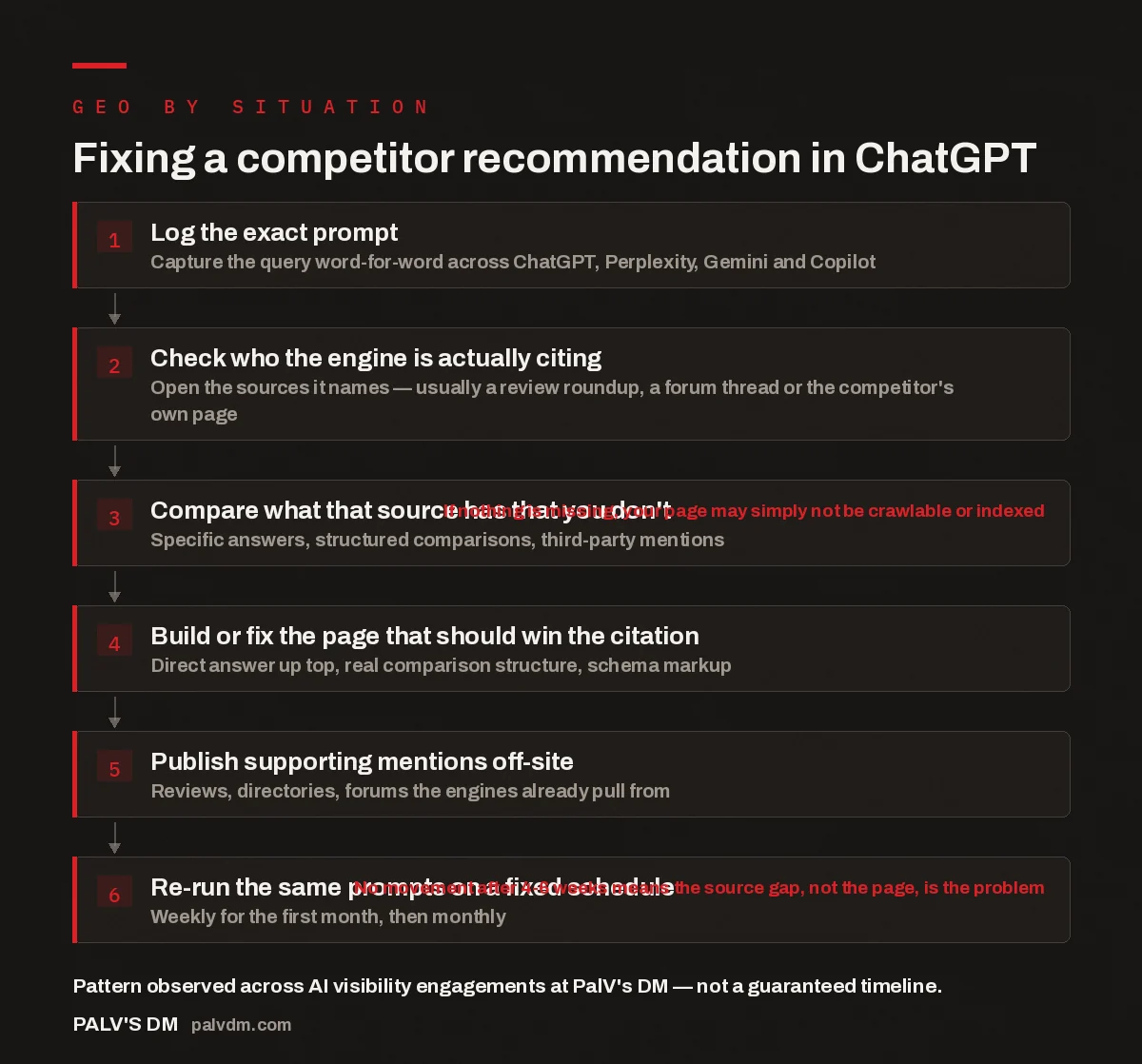
Fixing a competitor recommendation in ChatGPT
- Log the exact prompt. Capture the query word-for-word across ChatGPT, Perplexity, Gemini and Copilot.
- Check who the engine is actually citing. Open the sources it names — usually a review roundup, a forum thread or the competitor’s own page.
- Compare what that source has that you don’t. Specific answers, structured comparisons, third-party mentions. If nothing is missing, your page may simply not be crawlable or indexed
- Build or fix the page that should win the citation. Direct answer up top, real comparison structure, schema markup.
- Publish supporting mentions off-site. Reviews, directories, forums the engines already pull from.
- Re-run the same prompts on a fixed schedule. Weekly for the first month, then monthly. No movement after 4-6 weeks means the source gap, not the page, is the problem
Why does an AI engine recommend your competitor instead of you?
Generative engines don’t rank pages the way Google does. They generate an answer from whatever sources they trust for that topic, then cite the ones they pulled from. If your competitor shows up for “competitor recommended by ChatGPT” style queries, the engine found something from them, or about them, that answered the question more directly than anything it found from you. That “something” is usually one of three things: your competitor has a page that directly answers the exact question, your competitor is mentioned favourably on a third-party source the engine trusts (a review site, a subreddit, a “best X for Y” roundup), or your own equivalent page exists but is buried behind vague headings and content the engine can’t easily lift into an answer.
In the accounts we work on, it’s rarely a single cause. A client will have a decent comparison page, but the review sites the engine trusts only mention the competitor. Or the reverse: strong third-party mentions, but no page on their own site that answers the buyer’s question in the engine’s preferred format. Diagnosing which combination you’re facing is step one, and it’s the step most people skip in favour of publishing more blog posts.
How do you fix a competitor recommendation, step by step?
This is the process we run when a client comes to us saying ChatGPT keeps recommending a competitor. Diagnostic first, page-building second — deliberately in that order.
Step 1: Log the exact prompt, not a rough version of it
Screenshot or copy the precise wording that triggered the competitor recommendation, and run that same wording — not a paraphrase — across ChatGPT, Perplexity, Gemini, and Copilot. Rephrasing the query even slightly can change which sources the engine reaches for, so the exact prompt is your baseline. Run it two or three times per engine too, since generative answers aren’t always identical run to run.
Step 2: Open every source the engine actually cites
Most AI engines now show their sources, or you can ask directly (“what did you base that on?”). Open each one. You’re looking for a pattern: is it your competitor’s own site, or a third party talking about them? These need completely different fixes. If the engine is citing the competitor’s own page, the fix lives on your site. If it’s citing a review roundup, a forum thread, or a “best tools for X” article that doesn’t mention you, the fix lives off your site — no amount of on-page rewriting will move that.
Step 3: Compare what the cited source has that yours doesn’t
Read the cited page the way an engine “reads” it: does it answer the question in the first few sentences, does it name specific criteria or steps rather than speaking generally, and is it structured with clear headings, lists, or a comparison table the engine can extract cleanly? Run the same audit on your own equivalent page. If yours genuinely covers the same ground with the same specificity and still isn’t cited, the more likely culprit is crawlability — check the page isn’t blocked, is reachable from your internal links, and renders fast enough for crawlers that don’t wait around.
Step 4: Build or rebuild the page that should win the citation
If the gap is on-page, the fix is a page engineered for extraction: a direct answer to the exact question in the opening lines, a real comparison structure if the query is comparative, named specifics instead of vague claims, and schema markup that makes the structure machine-readable. This isn’t the same exercise as writing a blog post aimed at ranking on page one of Google — it’s writing for a system that lifts a self-contained chunk of your page into a generated answer. If that chunk doesn’t stand on its own, it doesn’t get used.
Step 5: Fix the off-site gap if that’s where the citation actually lives
If Step 2 showed the engine is pulling from third-party sources — review sites, community threads, comparison directories — no page on your own domain will out-rank that in its source selection. The fix here is slower and less within your direct control: genuine mentions on the same class of sources the engine already trusts. That usually means outreach to the specific sites it cited, encouraging real customer reviews on the platforms that showed up, and being listed accurately in the directories those engines pull from. There’s no shortcut for actually being present on the sources the engine trusts.
Step 6: Re-run the same prompts on a fixed schedule
AI engines don’t re-crawl and regenerate answers on a schedule you control. Check the same exact prompts weekly for the first month after publishing a fix, then move to monthly. If nothing has shifted after four to six weeks, go back to Step 2 — the gap may not have been the whole picture, or the source dependency runs deeper than a single page fix.
Most teams try to out-write the competitor’s page. The pattern we see repeatedly is that the fix is almost never “more words” — it’s answering the exact question the engine is being asked, in a format it can lift, from a source it’s willing to trust.
Palash, Founder, PalV’s DM
What actually moves the needle versus what doesn’t?
Not every AI-visibility problem is a content problem. Some of what teams try first burns time without changing the citation at all.
| Common first move | Why it usually fails | Do instead |
|---|---|---|
| Publish another blog post | Not necessarily structured for extraction or trusted enough to be cited | Audit the existing page against the cited source (Step 3), rebuild if thin |
| Add more keywords | Engines generate from meaning and structure, not keyword density | Restructure the answer — direct response, named specifics, clear headings |
| Buy more backlinks | Doesn’t change what third parties say about you | Pursue genuine mentions on the sources the engine actually cited |
| Wait it out | Nothing changes if the source gap goes unaddressed | Diagnose (Steps 1–3), fix the specific gap, re-check (Step 6) |
How long does it take to see a competitor recommendation change?
There’s no fixed number we can honestly give you, and any agency that quotes an exact week count is guessing. Directionally: on-page fixes tend to show up faster than off-site gaps, because publishing a better-structured page and getting it crawled is within your control, while getting mentioned on a third-party review site or forum thread depends on other people. In the accounts we track, on-page fixes tend to show movement in re-checks within a few weeks of the page being indexed; off-site gaps take longer, since they depend on new reviews or listings actually going live elsewhere. Track it with the fixed-schedule re-checks from Step 6 rather than guessing.
Do you need to fix this on every AI engine at once?
Not necessarily in one pass, but you need to know where the problem shows up before deciding priority. Some engines lean more on their own crawled index, others lean more on third-party review and community content, and one engine recommending a competitor doesn’t automatically mean all of them do. Run the Step 1 diagnostic across the major ones — ChatGPT, Perplexity, Gemini, and Copilot at minimum — before deciding whether this is a single-engine quirk or a genuine source gap.
Key takeaway
- Diagnose before you rebuild — logging the exact prompt and checking every cited source tells you whether the gap is on your site or off it.
- On-page fixes (direct answers, structured comparisons, schema) address extraction problems; off-site fixes (reviews, mentions, listings) address trust problems — they need different work.
- Re-check the same prompts on a fixed schedule rather than guessing whether a fix worked.
FAQ
Why does ChatGPT recommend my competitor by name?
ChatGPT generates its answer from sources it trusts for that question — either your competitor’s own page, or a third-party source such as a review site or forum that mentions them favourably. It names them because that’s where it found the clearest, citable answer, not because of any ranking against you directly.
Can I get my competitor removed from AI answers?
No, and that’s not really the goal. You can’t edit what an AI engine says about a competitor. The realistic path is making your own page and mentions strong enough that the engine has a genuinely better source to cite for that query.
Is this the same fix as ranking higher on Google?
Related but not identical. Traditional SEO ranking factors help, but AI engines specifically reward pages that answer a question directly and can be lifted as a self-contained chunk, and they weigh third-party mentions and reviews heavily. A page can rank fine on Google and still never get cited by ChatGPT if it isn’t structured for extraction.
How do I know if this is an on-page problem or an off-site problem?
Open the sources the AI engine actually cites for the query. If it’s linking to your competitor’s own website, the gap is on-page and the fix is a better-structured page on your site. If it’s linking to a third-party review, forum, or roundup, the gap is in your off-site presence, and the fix is genuine mentions and reviews on those same sources.
How often should I re-check whether the fix worked?
Weekly for the first month after you publish a fix, then monthly after that. AI engines re-crawl and regenerate answers on their own schedules, so a single check a few days after publishing won’t tell you much either way.
The short version
A competitor showing up in AI answers instead of you is diagnosable, but only if you diagnose it first. Log the exact prompt, check every source the engine cites, work out whether the gap is on your page or in your off-site mentions, then fix the specific thing that’s missing. Our AI visibility audit process covers this diagnostic in more depth, our page engineering process explains how we structure pages so engines can lift them, and our citation tracking approach shows what the Step 6 re-checks look like. If you’re not just losing to one competitor but not showing up anywhere, our piece on fixing zero AI visibility is the more relevant starting point.