Trends & Industry Developments
What We Think Search Looks Like in 2028
Our honest, no-hype read on the future of SEO: what search looks like by 2028, why citations beat rankings, and how to prepare your site and data now.

Search in 2028 will not be a search engine you type a query into and scroll ten blue links from. It will be a set of assistants and agents that read the open web on your behalf, assemble an answer, and only occasionally send anyone to a website at all. That is our honest read on the future of SEO: less about ranking a page, more about being the source those systems trust enough to cite, quote, or act on. Nobody has a verified roadmap for exactly how this plays out — including us — but the direction is already visible in how AI Overviews, AI Mode, and agentic shopping tools behave today. This piece lays out where we think things are heading and what we’d actually do about it now, not in three years.
Key takeaway
- By 2028, being cited inside an AI-generated answer will matter more for most brands than holding a top-three organic position, because a growing share of research happens without a click.
- Agentic search — bots that compare, shortlist, and sometimes buy on a person’s behalf — moves from novelty to a real, if still minority, channel that reads structured data instead of a homepage.
- The practical response isn’t panic or a total strategy rewrite — it’s making your content citable, your data machine-readable, and your measurement wider than a rank tracker, starting this quarter.
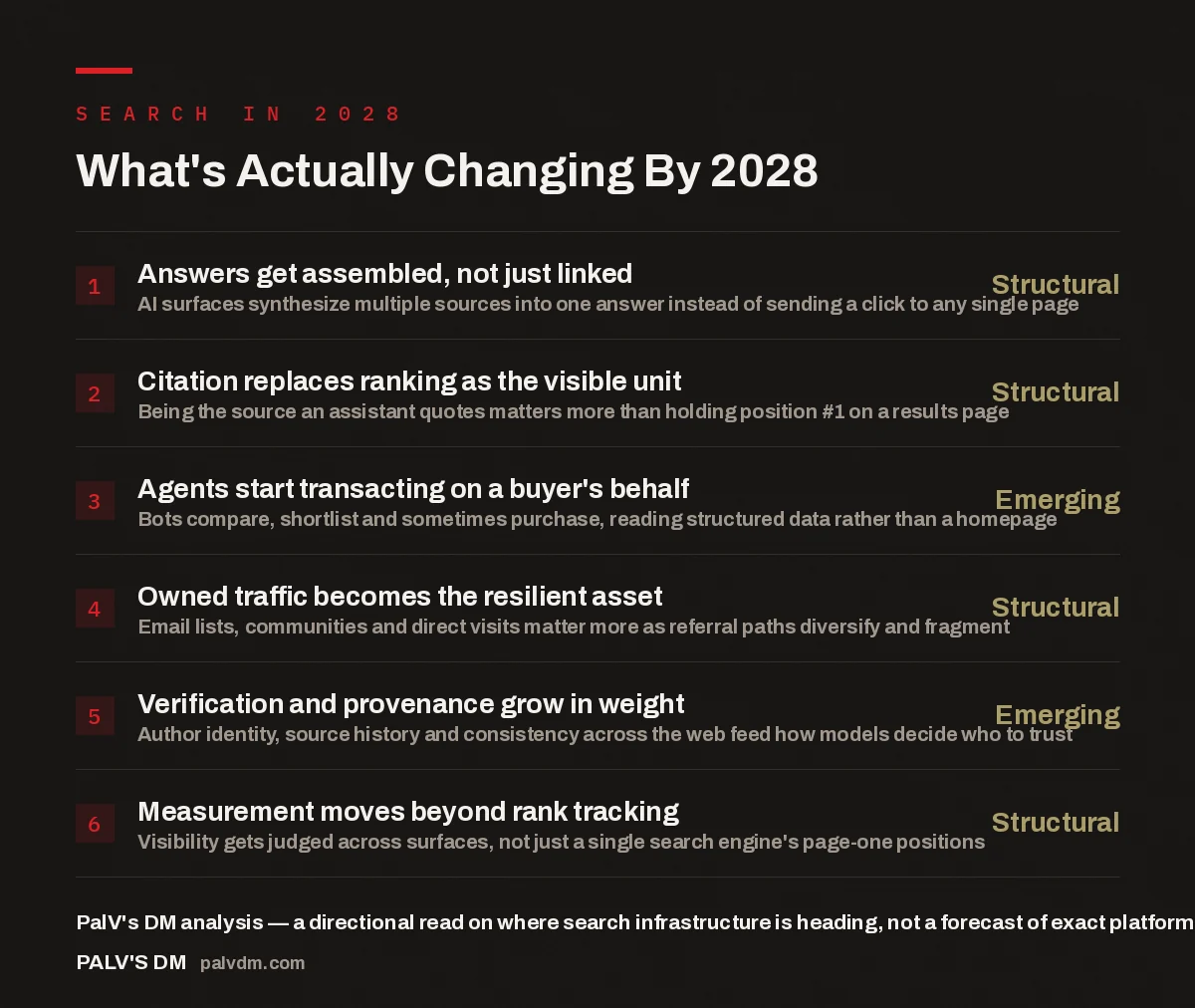
What’s Actually Changing By 2028
- Answers get assembled, not just linked — Structural. AI surfaces synthesize multiple sources into one answer instead of sending a click to any single page.
- Citation replaces ranking as the visible unit — Structural. Being the source an assistant quotes matters more than holding position #1 on a results page.
- Agents start transacting on a buyer’s behalf — Emerging. Bots compare, shortlist and sometimes purchase, reading structured data rather than a homepage.
- Owned traffic becomes the resilient asset — Structural. Email lists, communities and direct visits matter more as referral paths diversify and fragment.
- Verification and provenance grow in weight — Emerging. Author identity, source history and consistency across the web feed how models decide who to trust.
- Measurement moves beyond rank tracking — Structural. Visibility gets judged across surfaces, not just a single search engine’s page-one positions.
What does search actually look like right now, before we forecast forward?
Any forecast about 2028 has to start from where search sits today, because the 2028 version is an extension of current mechanics, not a break from them. Google already answers a large share of informational queries directly on the results page through AI Overviews and AI Mode, without requiring a click. Assistants like ChatGPT, Perplexity, and Gemini are increasingly used as a first stop for research and comparison queries that used to open with a Google search. None of this is speculative — it’s the baseline. The open question isn’t whether answers get generated instead of linked to; that’s already happening. The open question is how much further it goes, how fast, and which categories of query stay click-dependent versus which ones fully migrate to zero-click answers.
We’d draw a distinction between queries that resolve with a fact and queries that resolve with a decision. “What’s the GST rate on services” resolves with a fact — an AI answer satisfies it completely, and by 2028 we’d expect almost none of that traffic to reach a website. “Which CRM should a 20-person sales team in India use” resolves with a decision — it involves trade-offs, pricing nuance, and a buyer who wants to poke at the actual product. We think decision-stage queries stay more resistant to full zero-click resolution, which is exactly why the sites that survive well are the ones that own the decision-stage content, not just the fact-stage definitions.
How will answers replace links, and what does that mean for the future of SEO?
The future of SEO, as we see it, is a shift from optimising for a ranking position to optimising for inclusion in an answer. Those aren’t the same skill, even though they overlap. Ranking well has historically rewarded a page that is comprehensive, authoritative on its topic, and technically sound. Being cited by an AI system rewards a page that is easy to extract a clean, attributable claim from — a specific stat, a clear definition, a named recommendation — sitting inside content that’s still comprehensive enough to earn the model’s trust in the first place. The two goals aren’t in conflict, but the second one punishes vague, padded writing much more harshly, because there’s nothing extractable in a paragraph that hedges every sentence.
By 2028, we expect the sites that do best to be the ones that write like they expect to be quoted, not just read. That means direct claims stated plainly, a clear point of view instead of “it depends” as a final answer, and structural cues — headings, tables, defined terms — that make a page easy for a model to parse and easy for a human to skim. It also means accepting that some of that visibility never shows up as a session in analytics. A citation with no click is still a business outcome if the reader remembers the brand, but it’s an outcome you have to track differently than a pageview.
What happens when agents do the searching instead of people?
The part of 2028 that gets less attention than AI Overviews is agentic search — software that doesn’t just answer a question but acts on it, comparing options, filling a cart, or booking a service on a person’s behalf. We’ve written about agentic search and what it means when the buyer is a bot in more depth, but the short version is this: an agent doesn’t browse a homepage or read a hero banner. It reads structured data — product feeds, pricing tables, availability, reviews, specifications — and makes a comparison decision from that, often in seconds, often without a human checking every option it considered.
We don’t think agentic buying replaces human research and browsing by 2028 — that’s a longer, messier transition than three years, and plenty of purchase categories (anything with real complexity, trust requirements, or emotional weight) will keep a human in the loop well past then. But for straightforward, spec-comparable categories — commodity software plans, standard hardware, repeat-purchase consumables — we expect agentic comparison to be a meaningful and growing slice of transactions by 2028, not a fringe case. A brand invisible to that kind of comparison isn’t losing rankings; it’s not even being considered.
How should a site prepare its data for an AI-first search environment?
If both AI answers and AI agents are reading structured signals rather than a rendered page, the practical work between now and 2028 is making sure those signals actually exist and are accurate. We’ve laid out the specifics in preparing product and service data for AI agents, but the core of it is unglamorous and mostly overlaps with good technical hygiene that’s been undervalued for years: clean schema markup that matches what’s actually on the page, product and service data that’s consistent across your site and every marketplace or directory listing it, pricing and availability that update in near real time rather than going stale, and clear entity definitions — who you are, what you sell, what you don’t — stated plainly instead of implied through marketing copy.
None of that is exotic. Most of it is the same discipline that’s always separated well-run sites from neglected ones. What’s changed is the cost of skipping it. A stale price or an inconsistent product name used to just annoy a human visitor who’d usually forgive it and buy anyway. In an agent-mediated comparison, that same inconsistency can quietly remove you from consideration before a human ever sees the option.
The teams that struggle most with AI search aren’t the ones who did nothing — they’re the ones who did everything right for the old game and assumed it would carry over automatically. It mostly does, but not entirely, and the gap between “mostly” and “entirely” is where visibility gets lost.
Palash, Founder, PalV’s DM
How do you measure visibility when there’s no single results page left?
A rank tracker built for one search engine’s page-one positions was already showing its age before AI Overviews existed, and by 2028 we think it will be a genuinely minor part of a visibility dashboard rather than the center of it. The question a brand needs answered isn’t just “where do we rank on Google” — it’s “do we show up when someone asks ChatGPT, Perplexity, Gemini, or an AI Mode query about our category, and are we the source being cited when they do.” That’s a different measurement problem, and it needs a different scorecard. We’ve written about how we approach that in building a multi-surface visibility scorecard, which tracks presence and citation across engines rather than position on one.
Worth saying plainly: we don’t get every call right on this, and neither does anyone else confidently forecasting three years out in a space that’s moved this fast. We’ve gone back through our own predictions about AI search that didn’t hold up, and the honest lesson from that exercise is that timelines are the easiest thing to get wrong even when the direction is right. Treat everything in this piece as a directional bet worth preparing for, not a certainty worth betting the whole strategy on.
What should you actually do about this before 2028 arrives?
None of this calls for tearing up an existing SEO program. It calls for widening it. The technical foundations — crawlability, clean structured data, fast and reliable sites — matter more, not less, because both traditional crawlers and AI systems depend on them. Content needs to get more direct and more citable, with clear claims a model can lift cleanly rather than paragraphs that dance around a point. Data feeds and schema need the same accuracy discipline as your homepage copy, because agents read them as the primary source, not a backup. And measurement needs to expand past one search engine’s rank positions into whether you’re actually showing up — and being credited — across the assistants your buyers are starting to use first. For a longer view of how the last two years already reshaped these mechanics, our piece on the state of search in 2026 covers the ground this forecast builds on.
Where to start
If you want a clear read on where your own brand currently stands across AI answers — not just Google rankings — that’s the starting point before any 2028 planning makes sense.
Will traditional SEO still matter in 2028?
Yes, but as one input rather than the whole strategy. Technical health, crawlability, and structured data remain the foundation both traditional search engines and AI systems rely on. What changes is the goal layered on top of that foundation — visibility across AI answers and agents, not just organic rankings on one results page.
What is agentic search and should small businesses worry about it by 2028?
Agentic search refers to AI agents that compare options and complete tasks — including purchases — on a person’s behalf, reading structured product and service data rather than browsing a page visually. It matters most for spec-comparable, low-complexity categories first. Businesses selling considered, high-trust services have more runway, but clean data is worth preparing regardless.
How is measuring the future of SEO different from measuring traditional rankings?
Traditional SEO measurement centres on rank position and organic sessions from one search engine. Measuring visibility for the future of SEO means tracking whether your brand is cited across multiple AI assistants and answer surfaces, including cases where you’re referenced but no click occurs — an outcome a standard analytics dashboard won’t capture on its own.
Should a business change its content strategy today because of what search might look like in 2028?
Directionally, yes — writing more direct, citable content and fixing structured data pays off now under current AI Overviews and AI Mode behaviour, not just in some future state. It doesn’t require abandoning existing SEO work; it requires making content more extractable and your product data more accurate, both of which help today’s rankings too.
What’s the biggest risk in planning around a 2028 search forecast?
Treating any specific timeline as certain. Directionally, answers replacing links and agents entering the buying process are well underway. The pace, and which categories are affected first, is genuinely uncertain — which is why the useful response is preparing the fundamentals now rather than waiting for a precise date to act on.
Short version: the future of SEO by 2028 looks like fewer clicks for fact-based queries, more weight on being cited inside AI-generated answers, a growing slice of agent-mediated comparisons for simple purchase categories, and measurement that spans multiple AI surfaces instead of one rank tracker. The technical and content fundamentals don’t disappear — they just have to serve a wider set of readers, some of which aren’t human.